Armored Vehicle Costs in Plain English, What You Pay For and When It Makes Sense
Thinking about an armored car? Here is a realistic US cost breakdown, from basic handgun-resistant retrofits to factory-built luxury models, plus legal, safety, maintenance, and insurance considerations.

For most Americans, a so-called bulletproof car is not a practical purchase. But if you are researching one, the biggest mistake is focusing on a single price tag. The real cost depends on the threat level, the vehicle platform, the quality of the armoring work, and the upgrades needed to keep the vehicle safe to drive after hundreds or even thousands of pounds are added.
As of the mid-2020s, professional armoring in the US often starts in the tens of thousands of dollars. A modest handgun-resistant retrofit may begin around $30,000 to $60,000. A rifle-resistant SUV can easily land in the $80,000 to $150,000 range for the armoring work alone. Factory-armored luxury vehicles can climb far beyond that once the base vehicle is included.
This guide explains where the money goes, what protection ratings mean, what legal and insurance issues to check, and why most people are better served by layered security measures instead of full vehicle armoring. This is general information only, not a DIY guide. If you believe you face a real threat, consult a reputable armoring company, your insurer, and a qualified local attorney or DMV contact before spending money.
What “bulletproofing” a car really means
The term bulletproof is common, but bullet-resistant is more accurate. No civilian vehicle can promise perfect protection against every caliber, angle, repeated hit, or explosive threat. What buyers are really purchasing is a tested level of resistance against specific threats.
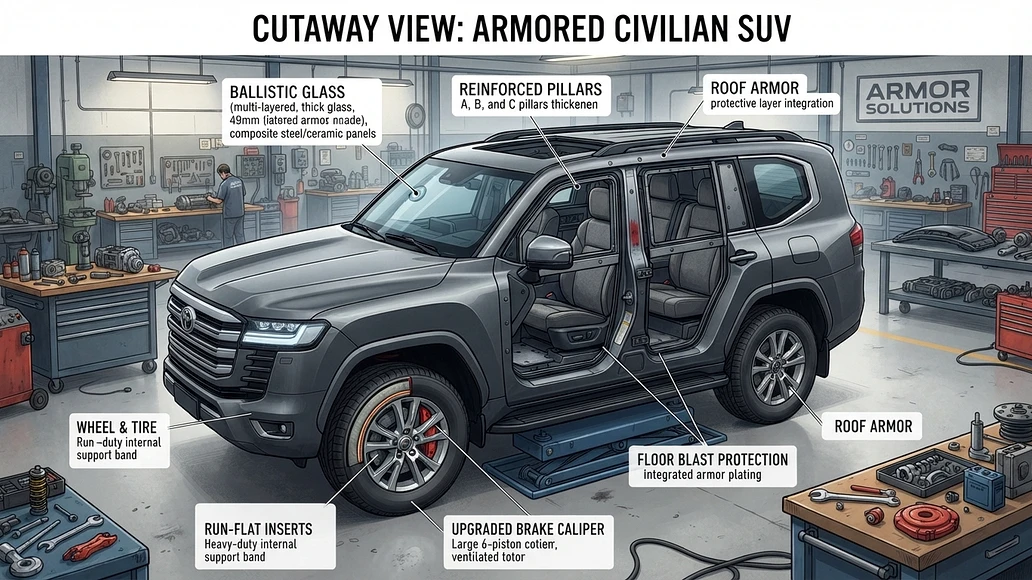
A professionally armored vehicle may include ballistic glass, opaque armor panels in the doors and body, reinforced pillars, overlap protection around seams, run-flat tire systems, upgraded suspension, stronger brakes, and sometimes protection for the floor, roof, battery, or fuel tank. Better builds also account for weak points such as door frames, hinges, and gaps around windows.
That is why price varies so much. You are not just buying thicker windows. You are paying for materials, engineering, labor, testing, and the mechanical changes needed so the vehicle still handles safely.
Core parts that drive the price
| Component | What it does | Typical cost impact | Why it matters |
|---|---|---|---|
| Ballistic glass | Protects windshield and side windows from specified rounds | Often $10,000 to $50,000+ per vehicle | Usually one of the most expensive parts, and one of the heaviest |
| Body armor panels | Protects doors, pillars, quarter panels, firewall, and other opaque areas | Often tens of thousands of dollars | Coverage area and protection level strongly affect cost |
| Run-flat systems | Allows limited driving after tire damage | Usually several thousand dollars | Critical if escape mobility matters |
| Suspension and brake upgrades | Helps the vehicle handle added weight safely | Several thousand to well over $10,000 | Without these, an armored vehicle can become less safe in normal driving |
| Optional systems | May include fire suppression, siren, intercom, tracking, or emergency lighting | Varies widely | Useful for some users, unnecessary for many |
How much armored car protection costs in the US
The simplest way to think about pricing is to separate retrofit cost from total ownership cost. Retrofit cost is what you pay to armor a vehicle you already own or one you buy separately. Total cost includes the base vehicle, taxes, shipping, downtime, insurance changes, and future maintenance.
Typical retrofit ranges by protection level
| Protection level | Typical threat focus | Added weight estimate | Approx retrofit range for sedan | Approx retrofit range for SUV |
|---|---|---|---|---|
| Lower handgun-resistant level, often compared to B4 | Common handgun threats | Roughly 800 to 1,300 lb | About $30,000 to $60,000 | About $40,000 to $70,000 |
| Mid to higher rifle-resistant level, often compared to B6 | Many rifle threats in professional risk environments | Roughly 1,200 to 1,800 lb | About $60,000 to $100,000+ | About $80,000 to $140,000+ |
| Higher rifle-resistant level, often compared to B7 | More severe rifle threats | Roughly 1,500 to 2,200 lb or more | About $90,000 to $150,000+ | About $120,000 to $200,000+ |
These are broad market ranges, not quotes. Vehicle size, glass area, desired discretion, overlap design, and brand reputation can move the number sharply.
Total cost when the base vehicle is included
| Scenario | Base vehicle cost | Armoring cost | Approx total |
|---|---|---|---|
| Mid-size sedan with basic handgun-resistant package | $25,000 to $45,000 | $30,000 to $60,000 | $55,000 to $105,000 |
| Full-size SUV with rifle-resistant package | $50,000 to $90,000 | $80,000 to $150,000+ | $130,000 to $240,000+ |
| Factory-armored luxury sedan or SUV | Included in package pricing | Integrated into final build | Often $150,000 to $300,000+, with some flagship models much higher |
At the very top end, factory-armored executive vehicles can cost several hundred thousand dollars, and some flagship models can approach or exceed the price of a house in many parts of the US.
Protection ratings, simplified
Different companies use different standards, including NIJ, UL 752, EN 1063, VPAM, and common European B-ratings such as B4, B6, and B7. The exact test methods differ, so buyers should not assume every label means the same thing across every standard. Still, the broad idea is straightforward: higher ratings are designed for more severe threats, and they cost more because they require thicker glass, stronger armor, and more engineering.
| Common label | General threat category | What it usually means for the buyer | Cost effect |
|---|---|---|---|
| B4 style protection | Handgun-focused protection | Often chosen for lower-profile civilian use where rifle threats are not the main concern | Lower entry cost, lower weight than rifle-rated builds |
| B6 style protection | Rifle-resistant protection | Common benchmark for higher-risk environments because it addresses more serious threats | Noticeably higher cost and weight |
| B7 style protection | Higher rifle-resistant protection | Used when the threat profile justifies heavier protection | Highest cost, highest weight, biggest effect on drivability |
The key point is simple. Do not buy a rating because it sounds impressive. Buy only the level that matches a credible threat assessment. Under-armoring can leave dangerous gaps. Over-armoring can waste money and create unnecessary weight, maintenance, and legal complications.
Where your money actually goes
Most first-time buyers underestimate how much of the bill comes from glass, labor, and supporting upgrades rather than just armor plate.
Cost breakdown by component
| Component | Typical price range | Performance impact | Notes |
|---|---|---|---|
| Ballistic windshield and side glass | $10,000 to $50,000+ | Major weight increase, slower window operation if movable | Large glass areas and higher ratings push cost up quickly |
| Opaque armor panels and overlap protection | $15,000 to $60,000+ | Raises curb weight and can affect door feel and body balance | Composite materials may cost more but save weight |
| Run-flat tires or inserts | $3,000 to $10,000+ | Can affect ride quality and replacement cost | Important for mobility after tire damage |
| Suspension, brake, and chassis upgrades | $5,000 to $20,000+ | Improves control and stopping with added mass | Should be treated as a safety requirement, not an optional luxury |
| Fuel tank, battery, floor, roof, or firewall protection | $5,000 to $25,000+ | Adds more weight and complexity | Often selected based on threat profile and route conditions |
| Optional electronics and emergency systems | $2,000 to $20,000+ | Minimal driving effect, but more maintenance complexity | May include tracking, intercom, siren, or fire suppression |
If a quote looks dramatically cheaper than the market, ask what is missing. It may exclude mechanical upgrades, overlap coverage, certification, or even some glass areas.
Retrofit versus factory-armored vehicles
Both approaches can make sense, but they serve different buyers.
| Factor | Retrofit armoring | Factory-armored vehicle |
|---|---|---|
| Upfront cost | Often cheaper if you already own a suitable vehicle | Usually higher total price |
| Engineering integration | Depends heavily on the shop’s skill and the donor vehicle | Typically better integrated from the start |
| Warranty | May split between vehicle maker and armoring company | Can be cleaner, though still model-specific |
| Lead time | Can be faster or slower depending on shop backlog | May involve long ordering windows |
| Resale | Can be harder to value, especially if documentation is weak | Often easier to market if from a recognized manufacturer |
| Discretion | Can be very discreet if based on a common civilian model | May attract more attention if based on a luxury flagship |
A retrofit can be cost-effective if the base vehicle is mechanically strong, common enough to service, and supported by a reputable armoring shop. A factory-armored vehicle often makes more sense for buyers who want integrated engineering, brand support, and a cleaner ownership story.
Who actually needs an armored vehicle, and who probably does not
This is where the conversation should get honest. Most people do not need a bullet-resistant vehicle. Armoring makes sense only when there is a specific, credible risk that justifies the cost, weight, and complexity.
People who may have a legitimate case include high-profile executives, public figures, security contractors, people traveling regularly in high-risk regions, or anyone with documented threats. Even then, the vehicle should be part of a broader security plan, not the whole plan.
For everyone else, better habits often provide more value per dollar. Secure parking, route planning, travel timing, driver training, communication plans, and situational awareness usually reduce risk more efficiently than adding armor to a daily driver.
How armoring changes the way a vehicle drives and wears out
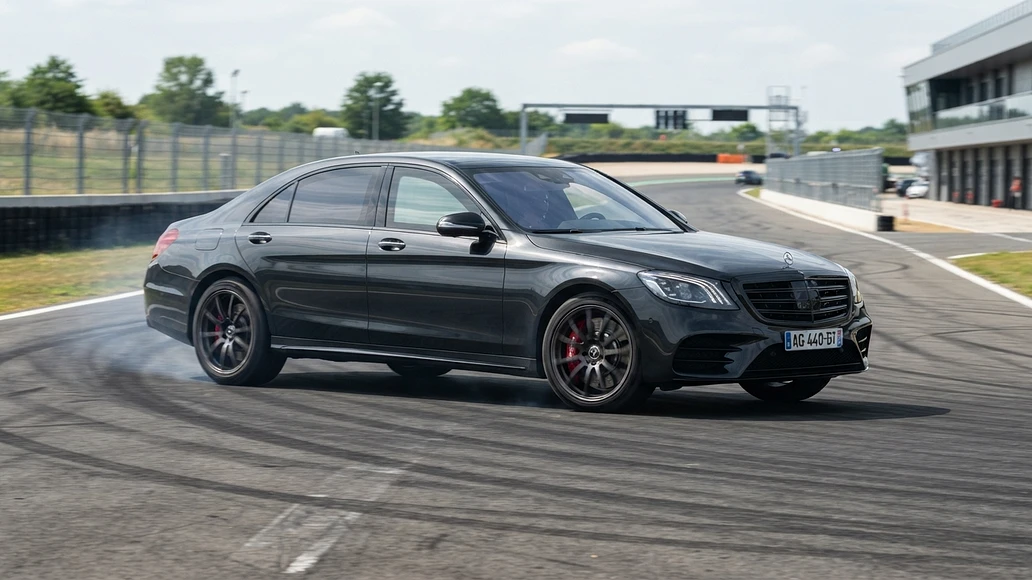
Armor is heavy. Depending on the package, a vehicle may gain roughly 800 to 2,200 pounds or more. That extra mass changes acceleration, braking distance, cornering, suspension wear, tire life, and fuel economy.
A poorly engineered build can become less safe in routine driving, especially in emergency maneuvers. That is why reputable shops upgrade springs, dampers, brakes, and sometimes cooling systems. They also account for how the added weight is distributed across the vehicle.
| Area affected | What usually changes | What to budget for |
|---|---|---|
| Fuel economy | Usually gets worse because of added weight | Higher monthly fuel cost |
| Tires | Wear faster under heavier loads | More frequent replacement, possible premium tire pricing |
| Brakes | Work harder and may wear faster | Shorter service intervals and higher parts cost |
| Suspension | Carries constant extra mass | Higher maintenance and occasional component upgrades |
| Glass replacement | Far more expensive than standard auto glass | Potentially very high replacement bill if damaged |
| Resale | Buyer pool is smaller | Possible slower sale or lower-than-expected resale value |
Is it legal to armor a car in the United States?
In general, there is no blanket federal ban on civilians owning an armored vehicle or ballistic glass. But that does not mean every build is automatically compliant everywhere. State and local rules can affect tint, inspections, registration, weight limits, and modification disclosures.
Before commissioning work, verify the following with your state DMV, insurer, and if needed a local attorney familiar with vehicle law:
| Issue | Why it matters | What to check |
|---|---|---|
| Window tint and visibility rules | Ballistic glass may interact with tint laws and visibility requirements | State tint limits, windshield rules, inspection standards |
| Vehicle weight and class | Heavy builds may affect compliance or inspection expectations | GVWR, axle load concerns, registration details |
| Insurance disclosure | Undisclosed modifications can create claim problems | Whether the insurer will cover the armoring and how it must be documented |
| Title and registration records | Major modifications may need to be recorded | State-specific paperwork requirements |
| Use restrictions for special equipment | Some optional systems may not be street-legal for civilian use | Rules on lights, sirens, communications gear, or other add-ons |
Do not rely on a sales rep alone for legal guidance. Get the answer from the agency or professional who would actually enforce or interpret the rule.
How to choose a reputable armoring company
Because this is a safety-critical purchase, documentation matters as much as the materials. A polished website is not enough. Ask for proof of testing, clear specifications, and a realistic explanation of tradeoffs.
| Question to ask | Why it matters | What a good answer looks like |
|---|---|---|
| What ballistic standard and level is this build certified to? | Prevents vague “bulletproof” claims | Specific standard names, level numbers, and test documentation |
| Which areas are protected, and where are the exclusions? | Coverage gaps can be dangerous | Written scope with glass, doors, pillars, seams, and optional roof or floor protection clearly listed |
| What suspension and brake upgrades are included? | Added weight must be managed safely | Detailed parts list and explanation of why they were chosen |
| How does the warranty work? | Armored vehicles often involve multiple vendors | Clear terms for armor, glass, mechanical upgrades, and service support |
| Can you provide references or prior builds on this platform? | Experience with the exact vehicle matters | Examples of similar completed projects and service history |
| What is the final curb weight and payload impact? | Helps assess drivability and legality | Specific estimated numbers, not vague assurances |
Red flags include prices far below market, refusal to discuss standards, no test data, no written scope of work, and grand promises such as “lifetime bulletproof protection” without meaningful documentation.
Alternatives if full armoring is too expensive or unnecessary
There is a wide middle ground between doing nothing and buying a fully armored SUV. In many cases, these options make more sense financially and practically.
| Alternative | Best for | Cost profile | Main tradeoff |
|---|---|---|---|
| Partial armoring, such as glass only or passenger cell only | Buyers with narrower threat concerns | Lower than full build, but still significant | Protection gaps remain |
| Armored vehicle rental | Occasional high-risk travel | Pay only when needed | Not practical for daily use |
| Professional driver or security support | People whose main risk is movement and route exposure | Can be cheaper than ownership depending on frequency | Ongoing service cost |
| Route planning, secure parking, and travel timing | Most civilians | Low cost | Requires discipline, not hardware |
| Communication and emergency planning | Preparedness-minded households | Low to moderate cost | Does not provide ballistic protection |
If your risk is occasional rather than constant, renting an armored vehicle for specific trips can be far more rational than owning one year-round.
Why DIY bulletproofing is a bad idea
DIY armoring is not just ineffective, it can be dangerous. Randomly adding heavy steel, homemade panels, or thick glass can overload doors, stress hinges, upset crash performance, and make the vehicle harder to control. It can also create legal and insurance problems if the modifications are undocumented or unsafe.
This article does not provide instructions for home armoring. If you are serious enough to consider ballistic protection, you are already in territory where professional engineering, testing, and legal review are the minimum standard.
What to budget beyond the upfront quote
The purchase price is only the beginning. Buyers should plan for higher operating costs and a smaller resale market.
| Budget item | Why it increases | Practical takeaway |
|---|---|---|
| Fuel | Extra weight reduces efficiency | Expect a permanent increase in running cost |
| Maintenance | Brakes, suspension, and tires work harder | Service intervals may shorten |
| Insurance | Modified value and repair cost may change coverage needs | Notify insurer before and after the build |
| Repairs | Ballistic glass and specialty parts are expensive | Minor damage can become a major bill |
| Downtime | Specialized service is less common than normal auto repair | Plan for longer repair timelines |
| Resale friction | Fewer buyers understand or want armored vehicles | Keep all documentation to protect value |
Recent trends in civilian armoring
Two trends stand out in the current market. First, prices are generally higher than older online articles suggest, due to material costs, labor, and demand. Second, newer builds often use lighter composites and more discreet designs, which help preserve appearance and drivability, though usually at a premium.
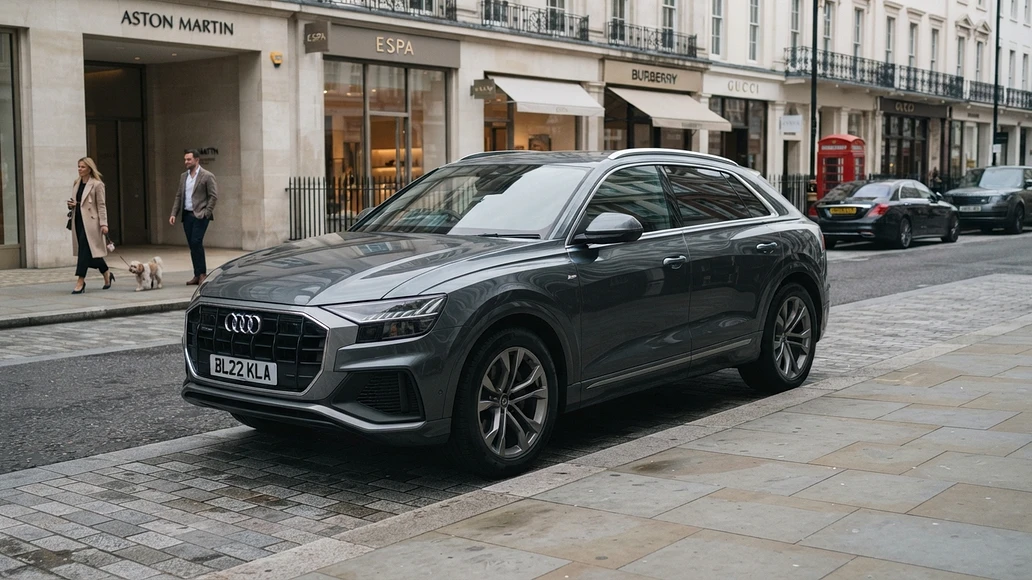
There is also more interest in low-profile protection, where the vehicle looks ordinary from the outside. That can be useful for some buyers, but it should not distract from the basics. Certification, mechanical safety, and honest threat matching matter more than stealth styling.
Bottom line
If you are asking what it costs to bulletproof a car, the honest answer is that meaningful protection usually starts around the price of a used car and can quickly rise to the price of a luxury vehicle. For many US buyers, realistic retrofit costs fall between about $30,000 and $100,000+, with larger rifle-resistant builds and factory-armored models going much higher.
The smarter question is whether armoring is the right answer at all. If you do not have a specific, credible threat, the better investment is usually layered personal security, better planning, and a reliable vehicle with strong maintenance and communication readiness. If you do have a real threat, work only with a reputable armoring company, verify standards and legal compliance, and budget for the long-term costs, not just the initial quote.
References
- How Much Does it Cost to Bulletproof a Car in 2026?
- How Much Does It Cost to Bulletproof a Car? Full Breakdown
- How to choose car bullet proof,How much does it cost to bulletproof ...
- Cost Of Bulletproof Car: Complete Guide To Armored Vehicle Pricing
- कार को बुलेटप्रूफ बनाने के लिए कितना खर्च आता है? जानिए किन पार्ट्स को ...