The Moisture-Control Tool Most Preppers Overlook
Desiccants do one job that matters a lot in preparedness. They pull moisture out of sealed spaces, helping protect food, ammo, electronics, documents, and medical supplies from mold, rust, and clumping. Here is how they work, which type to choose, and how to use them safely.

Most prepper mistakes with storage come down to one quiet enemy, moisture. A little humidity inside a bucket, ammo can, tote, or document box can lead to mold, corrosion, clumping, ruined labels, dead electronics, and spoiled confidence in your backup supplies. Desiccants are one of the simplest ways to fight that problem, but only if you understand what they do, what they do not do, and how to use the right type in the right place.
In plain terms, a desiccant is a material that removes moisture from the air inside a closed space. For preparedness, that matters because many stored items fail long before they are ever needed, not from dramatic disaster, but from slow exposure to humidity over time.
What a desiccant actually is
A desiccant is a drying agent. Its job is to lower humidity in a container or enclosed area by pulling water vapor out of the air. Some desiccants do this mainly by adsorption, which means water molecules cling to the surface of a porous material. Others work more by absorption, which means the moisture is taken into the material itself.
That difference sounds technical, but it helps explain why products behave differently. Silica gel has a huge internal surface area and holds moisture on that surface. Clay desiccants also trap moisture in a porous structure. Salt-based products such as calcium chloride can pull in a lot of water, but they may turn slushy or liquid as they work, which makes them useful in some spaces and a bad choice in others.
For preppers, the big takeaway is simple. Desiccants are not magic packets. They are moisture-control tools, and the material inside the packet determines where they belong.
How desiccants protect stored supplies
Humidity causes damage in several ways. It encourages mold growth, speeds rust and corrosion, softens paper, degrades labels and adhesives, and can make dry foods cake together. It also creates condensation when temperatures swing, especially in garages, sheds, basements, and vehicles.
Put a desiccant inside a properly sealed container and it changes the moisture balance in that enclosed space. Lower humidity means less chance for mold, less corrosion on metal, and less moisture migration into dry goods and sensitive gear.
What desiccants cannot do is fix a bad container. If your bucket lid leaks, your ammo can gasket is damaged, or your tote is opened constantly in a damp room, the packet is only fighting symptoms. Good moisture control starts with the container, then the desiccant supports it.
Common desiccant types and when to use each
| Desiccant type | Typical prepper uses | Strengths | Weak points | Safety notes | Reusable |
|---|---|---|---|---|---|
| Silica gel, non-indicating | Food storage containers, ammo cans, electronics cases, document boxes, tool storage | Clean, stable, widely available, good all-purpose choice | Limited capacity compared with some salt-based products in very wet spaces | Plain packets are generally low toxicity, but still a choking hazard and should not be opened into food | Often yes |
| Silica gel, indicating | Storage where visual saturation check matters | Easy to monitor by color change | Some indicating products contain cobalt compounds and are not ideal around food or children | Avoid food use unless clearly appropriate and avoid dust exposure | Often yes |
| Clay desiccant | General storage, tools, documents, some pantry uses | Affordable, simple, works well in moderate conditions | Usually less efficient than silica gel in some applications | Low hazard when intact, avoid dust | Sometimes |
| Calcium chloride and other salt-based absorbers | Closets, rooms, damp basements, RVs, larger enclosed spaces | High moisture capacity | Can liquefy or leak, not ideal near firearms, ammo, paper, or electronics | Keep upright and away from children and pets | Usually no |
| Molecular sieve | Specialty storage, very sensitive gear, advanced long-term applications | Very effective at low humidity levels | More expensive, often overkill for everyday home use | Use according to product instructions | Often yes |
| DIY options, rice, salt, baking soda, charcoal | Short-term stopgaps only | Cheap and easy to find | Less predictable and usually less effective than commercial desiccants | Do not treat as equal to purpose-made packets | Varies |
Silica gel
For most households, plain silica gel is the best starting point. It is versatile, relatively clean to handle, and commonly sold in packets, canisters, and rechargeable units. It works well in sealed bins, Mylar-packed dry goods, ammo cans, camera bags, radio cases, and emergency document storage.
Clay desiccants
Clay products are a practical middle-ground option. They are often inexpensive and useful for moderate humidity control. They may not be the top performer in every scenario, but they are dependable for many storage jobs.
Calcium chloride and similar products
These are better thought of as area moisture absorbers than packet desiccants for gear. They can pull a lot of water from damp air, which is why they are common in closets and basements. But that same strength creates risk. If the product leaks or spills, it can damage metal, paper, and electronics.
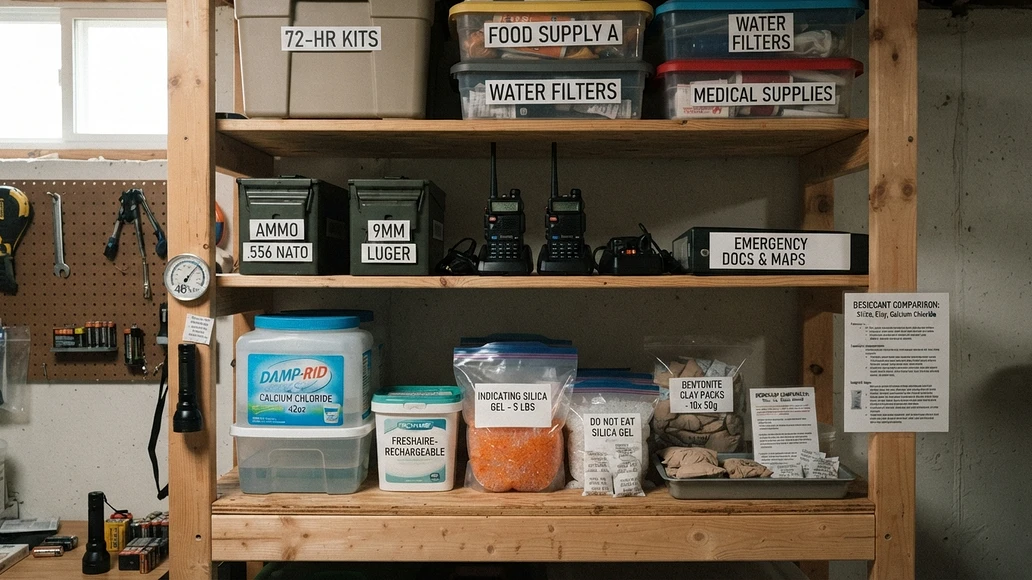
Homemade moisture absorbers
Rice, salt, baking soda, and charcoal are often suggested online. They may help a little in a pinch, but they are not a substitute for engineered desiccants when you are protecting expensive gear or long-term food stores. Use them as temporary backups, not as your main plan.
Desiccants and oxygen absorbers are not the same thing
This is one of the most common points of confusion in home storage. Desiccants control moisture. Oxygen absorbers control oxygen. Those are different problems, and they affect stored goods in different ways.
| Tool | Main job | Best for | Not meant for | Common cautions |
|---|---|---|---|---|
| Desiccant | Reduces humidity | Preventing mold, rust, clumping, and moisture damage | Removing oxygen or stopping all insect activity by itself | Use the right type for the container and contents |
| Oxygen absorber | Removes oxygen in a sealed package | Dry foods where oxidation and insect survival are concerns | Wet foods or moisture control | Needs a well-sealed environment to work properly |
| Both together | Controls both humidity and oxygen | Some dry long-term storage setups | Items that are already damp or poorly sealed | Choose products appropriate for food storage and the item being packed |
Think of it this way. If you are storing dry beans or rice in a sealed long-term setup, oxygen control may matter for shelf life and pests, while moisture control helps prevent humidity-related spoilage. If you are storing salt or sugar, oxygen is usually not the main issue, but moisture definitely is because clumping is the real enemy.
Using desiccants safely in food storage
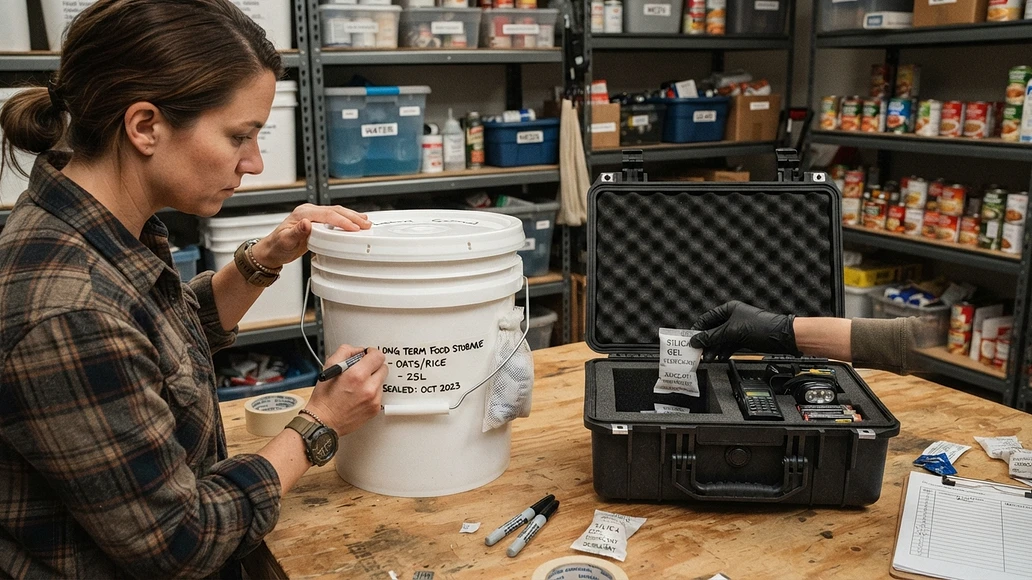
Desiccants can be useful in food storage, but they need to be used carefully. The packet belongs in the container as a moisture-control component, not mixed into the food itself. Use products intended for food-related storage, keep them intact, and reserve them for dry goods only.
| Food storage item | Main storage concern | Desiccant useful? | Oxygen absorber useful? | Notes |
|---|---|---|---|---|
| Rice and dry beans | Moisture, insects, oxidation over time | Sometimes | Often | Use only in fully dry products and sealed packaging |
| Flour | Moisture and pests | Sometimes | Often | Keep product dry before sealing |
| Sugar | Clumping from humidity | Yes | Usually no | Moisture control matters more than oxygen control |
| Salt | Clumping from humidity | Yes | No | Keep packet separate from the product |
| Spices | Humidity and flavor loss | Yes | Sometimes | Useful in sealed spice storage |
| Freeze-dried foods | Moisture intrusion after packaging is opened or repacked | Yes | Sometimes | Follow package and manufacturer guidance |
Good rules for home use are straightforward. Start with food that is already dry. Use a clean, sealed container. Keep the packet intact and out of direct contact with loose edible product. Label the container with the packing date and check it on a schedule. If the product is for food storage, avoid mystery packets from random packaging and avoid colored indicating gels unless you are certain they are appropriate for that use.
Where desiccants shine outside the pantry
Ammo, firearms, and metal tools
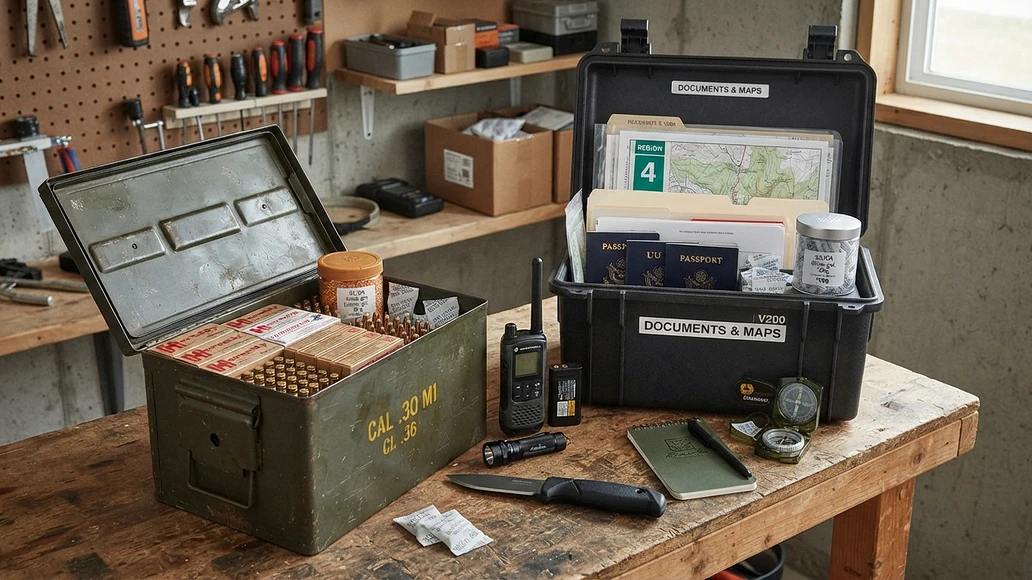
Humidity is hard on steel. A desiccant in a gun safe, ammo can, or toolbox can help reduce rust risk, especially in humid climates. Plain silica gel or rechargeable canisters are usually better choices than salt-based absorbers because they are less likely to leak and create corrosion problems of their own.
Electronics and backup media
Radios, flashlights, optics, cameras, battery accessories, hard drives, and charging gear all benefit from dry storage. Use desiccants in sealed cases, not loose in open shelves. If a device gets wet, do not assume a desiccant packet alone can rescue it. Drying electronics after water exposure is a separate issue and may require proper disassembly and professional service.
Documents, photos, and emergency records
Birth certificates, passports, insurance copies, maps, and family photos can all suffer from damp storage. A document box with a small desiccant pack can help preserve paper and reduce musty odors. Replace or recharge the desiccant on a schedule, especially if the box lives in a basement or garage.
Seeds and medicines
Seeds often store better in cool, dry conditions, so moisture control can help. Medicines are more complicated. Some medications are packaged with desiccants for a reason, but you should follow the manufacturer instructions and keep any packet separate and intact. Do not add random desiccants directly to pills or supplements unless the product packaging supports that use.
Are desiccant packets dangerous?
Usually, plain silica gel packets are more of a choking hazard than a poisoning hazard. That is why many packets say do not eat. For a healthy adult, accidentally swallowing the contents of a small plain silica gel packet is generally not considered chemically toxic. The bigger concern is choking, especially for children, older adults, and anyone with swallowing difficulty.
That said, not all desiccants are equal. Colored or indicating silica gels may contain added chemicals such as cobalt compounds. Industrial desiccants may also have different hazard profiles. Those products deserve more caution and are not the best choice for casual household food storage.
Dust is another issue. Intact packets are low risk, but torn packets or bulk material can irritate eyes, skin, and airways. People with asthma, COPD, or other chronic breathing issues should avoid handling dusty desiccants without ventilation and basic protection.
What to do if someone swallows a desiccant packet
If a person swallows a packet, the first question is not panic, it is identification. Was it a plain silica gel packet, a colored indicating product, or an unknown industrial absorber?
| Type swallowed | Likely risk | Immediate steps | When to call poison control or a doctor | When to seek emergency care |
|---|---|---|---|---|
| Plain silica gel packet or beads | Usually low chemical toxicity, choking risk remains | Remove any remaining material from the mouth, offer water if the person is alert, observe | Call if symptoms develop, if a large amount was swallowed, or if you are unsure what it was | Any choking signs, breathing trouble, persistent vomiting, severe distress |
| Colored or indicating silica gel | Higher concern because of possible indicator chemicals | Do not induce vomiting, rinse mouth, keep packaging for identification | Yes, contact poison control or a clinician promptly | Any breathing trouble, choking, severe symptoms, altered responsiveness |
| Unknown industrial desiccant or salt-based absorber | Variable, may be irritating or more hazardous | Stop exposure, rinse mouth if appropriate, keep label or packet | Yes, contact poison control or a clinician promptly | Any airway symptoms, eye exposure with severe irritation, worsening symptoms |
In the United States, Poison Control is available at 1-800-222-1222. If someone has trouble breathing, cannot speak, turns blue, collapses, or appears to be choking, call 911 right away.
General information only: this article is not a substitute for professional medical advice. When in doubt, contact Poison Control or your doctor.
How to tell when a desiccant is spent
Desiccants do not last forever. In a well-sealed container they may work for a long time, but eventually they become saturated. Some signs are obvious, while others depend on the product type.
| Sign | What it may mean | What to do |
|---|---|---|
| Indicator color change | The desiccant has absorbed moisture and needs recharging or replacement | Follow the product instructions |
| Clumping or heavier feel | Moisture uptake has increased | Inspect and replace or regenerate if designed for it |
| Musty smell or condensation in container | Humidity control is no longer adequate | Check the seal first, then replace desiccant |
| Rust, damp labels, or caked food | Moisture problem is active | Review the whole storage setup, not just the packet |
Many silica gel and some clay products can be reactivated by gentle heating, but only if the manufacturer says they are rechargeable. Follow the product instructions exactly. Do not guess with unknown packets, and do not heat products that may contain additives or plastic components not meant for that process.
Common prepper mistakes with desiccants
| Mistake | Why it causes problems | Better approach |
|---|---|---|
| Using desiccants in leaky containers | The packet keeps fighting incoming moisture | Fix the seal first |
| Confusing desiccants with oxygen absorbers | You solve the wrong storage problem | Match the tool to moisture or oxygen as needed |
| Using colored indicating gel around food without checking suitability | Some indicators carry added hazards | Use plain food-appropriate products for pantry storage |
| Dropping packets directly into loose food | Creates contamination and choking risk | Keep packets intact and separate |
| Sealing damp items with a packet and hoping for the best | Too much moisture may already be trapped inside | Dry the item first, then store it |
| Leaving packets where kids or pets can reach them | Creates avoidable choking and exposure risk | Store containers securely and keep spare packets locked away |
How to read labels and choose a safer product
When buying desiccants, read beyond the front label. Look for the material type, whether the product is intended for food-related storage, whether it is rechargeable, and whether it contains an indicator chemical. Safety Data Sheets are useful when you are buying in bulk or using anything beyond simple household packets.
If your main use is pantry storage, emergency bins, ammo cans, radios, and documents, plain non-indicating silica gel is usually the easiest and safest starting point. If you need a visual indicator, choose carefully and avoid products with hazardous indicator chemistry in areas where children, pets, or food are involved.
Adjusting your plan for humid and dry climates
A prepper in coastal Alabama has a different moisture problem than a prepper in high desert Nevada. In humid climates, desiccants saturate faster and containers need more frequent checks. Basements, garages, sheds, and vehicles are especially tough environments because temperatures swing and condensation forms easily.
In dry climates, moisture control is still useful, but your maintenance interval may be longer. The main lesson is to match your desiccant plan to your environment, not to a generic internet rule. A sealed tote in an air-conditioned closet is a very different storage environment than an ammo can in an uninsulated outbuilding.
Build a simple moisture-control plan
The best use of desiccants is systematic, not random. Walk through your storage areas and identify where humidity can do real damage. Then match the desiccant type to the container and contents.
| Storage area | Main moisture threat | Good desiccant approach | Maintenance focus |
|---|---|---|---|
| Pantry dry goods | Clumping, spoilage from humidity | Plain food-appropriate packet in sealed dry storage | Check seals and rotate stock |
| Ammo cans and safes | Rust and corrosion | Rechargeable silica gel canister or packets | Inspect after seasonal humidity changes |
| Electronics totes | Condensation and corrosion | Silica gel in sealed hard cases | Replace after opening or wet-weather use |
| Document boxes | Paper warping and mildew | Small silica or clay pack | Check every few months |
| Basements and closets | General dampness | Area moisture absorber if appropriate, away from valuables | Watch for leaks and spills |
If you do only one thing after reading this, do this. Pick your five most important storage containers and add the right moisture-control method to each one. That small step will protect more value than buying another gadget.
Responsible reuse and disposal
Reusable desiccants save money and reduce waste, but only when they are designed for regeneration. Follow the product instructions for recharging. If a packet is torn, contaminated, or of unknown composition, replace it instead of trying to salvage it.
For colored indicating gels or industrial products, be more cautious with disposal and handling. Keep them away from children and pets, avoid creating dust, and follow local guidance if the product contains hazardous additives.
FAQ
Can you safely use desiccant packets in home food storage, and which foods actually need them?
Yes, if the product is appropriate for food-related storage and the food is dry. Desiccants are most useful for items affected by humidity, such as sugar, salt, spices, and some dry long-term storage setups. Keep the packet intact and separate from the edible product.
What is the difference between silica gel and other desiccants like clay or calcium chloride?
Silica gel is a versatile all-purpose option for sealed containers. Clay is a practical lower-cost alternative for many uses. Calcium chloride can absorb a lot of moisture, but it may liquefy, which makes it better for room or closet dampness than for ammo, electronics, or paper storage.
Is it dangerous if my child or pet eats a desiccant packet, and what should I do right away?
Plain silica gel is usually low in chemical toxicity, but the packet can be a choking hazard. Remove any remaining material from the mouth, keep the packaging, and watch for coughing, trouble breathing, drooling, or distress. Contact Poison Control or your veterinarian when in doubt, and seek emergency help immediately for choking or breathing trouble.
How many desiccant packets should I use in a bucket or storage container, and can I reuse them?
The right amount depends on the container size, how often it is opened, the local humidity, and the sensitivity of the contents. Follow the manufacturer guidance instead of guessing. Many silica gel products can be reused if they are specifically sold as rechargeable.
Are the blue or pink color-changing desiccant packets safe to keep around the house?
They can be useful, but some indicating products contain cobalt compounds or other additives that deserve more caution. They are not my first choice around food, children, or pets. For general home preparedness, plain non-indicating silica gel is often the safer default.