The Prepper's Guide to Potassium Permanganate, Useful, Risky, and Often Misunderstood
Potassium permanganate can disinfect, dry weeping skin, and even help start a fire, but it is also a strong oxidizer that can burn skin, damage eyes, and poison children. Here is a practical, safety-first guide to when it belongs in a preparedness kit and when better options make more sense.

Potassium permanganate, often written as KMnO₄, has a reputation in preparedness circles as a tiny container of purple crystals that can do a surprising number of jobs. That reputation is partly deserved. In very specific situations, it can help with emergency water treatment, certain external skin soaks, and chemical fire starting. But the other half of the story matters just as much. It is a powerful oxidizer, it can cause burns, it can permanently stain gear and skin, and swallowing even a small amount can be a medical emergency.
This article is for general preparedness education, not medical advice. Any health-related use should follow professional instructions. If potassium permanganate is swallowed, gets in the eyes, or causes a painful skin reaction, seek urgent medical help or contact Poison Control right away.
What potassium permanganate is, and why people keep it in survival kits
Potassium permanganate is a dark purple crystalline chemical used in industry, water treatment, and some medical settings. Its usefulness comes from oxidation. In simple terms, it reacts aggressively with many organic materials and microbes. That is why it can act as a disinfecting agent in very dilute solutions, and why it can also ignite certain fuels under the right conditions.
Preparedness-minded users like it because a small amount stores compactly and can serve several roles. The problem is that multi-use does not automatically mean beginner-friendly. KMnO₄ is less forgiving than many modern alternatives. A water filter, household bleach, iodine tablets, or a ferro rod usually asks less of the user and carries fewer severe handling risks.
Is it really indispensable for preparedness?
No single chemical is indispensable. Potassium permanganate is better thought of as a niche tool for trained, careful adults who understand its limits. It shines when weight and versatility matter, but it is not the first item most households should reach for.
| Preparedness question | Where potassium permanganate helps | Where it falls short | Better default option for most people |
|---|---|---|---|
| Emergency water treatment | May reduce microbial risk in a true emergency when used very dilute | Does not remove chemicals, sediment, or many modern contaminants, easy to overdose | Certified water filter plus backup disinfectant tablets |
| Minor external skin care | Can be used in pale-pink soaks under medical-style guidance | Only external use, concentration errors can burn skin | Clinically packaged wound and skin products |
| Fire starting | Can ignite with glycerin under controlled conditions | Hazardous oxidizer, easy to misuse, poor choice around children | Ferro rod, stormproof matches, lighter |
| Long-term home storage | Long shelf life if kept dry and sealed | Needs careful segregation from fuels and household chemicals | Simpler, purpose-built supplies |
Evidence for common survival uses
Some uses are well supported, some are traditional but limited, and some are better left to professionals.
| Use or claim | Evidence strength | Practical value | Main caution |
|---|---|---|---|
| Topical soaks for weeping skin conditions and some minor infected skin problems | Well supported | Useful when correctly diluted to pale pink | External use only, stronger solutions can injure skin |
| General skin cleansing agent | Well supported | Real medical use exists | Not for deep wounds, not for casual improvisation |
| Emergency water disinfection | General guidance only | May reduce microbial risk in a pinch | Not equivalent to regulated drinking water treatment |
| Fire starting with glycerin | Well supported | Works chemically | High accidental fire risk |
| Foot soaks for athlete's foot and damp skin problems | General guidance to well supported | Can help dry and calm affected skin | Too-strong solutions can burn or irritate |
| Seed treatment and pond or agricultural uses | General guidance only | Real specialized use exists | Requires accurate dosing to avoid toxicity |
| Odor removal | Mixed | Chemically plausible | Safer products are usually better |
| Internal use for poisoning treatment | Highly specialized and inappropriate for lay use | Not a home remedy | Potentially dangerous, do not self-treat |
Emergency water treatment, what it can do and what it cannot
Potassium permanganate is sometimes described as a field-expedient water disinfectant. That description needs context. It may reduce microbial load in an emergency, but it is not a complete water purification system. It does not remove pesticides, heavy metals, fuel contamination, or sediment. It also does not replace the consistency of modern filters or regulated treatment chemicals.
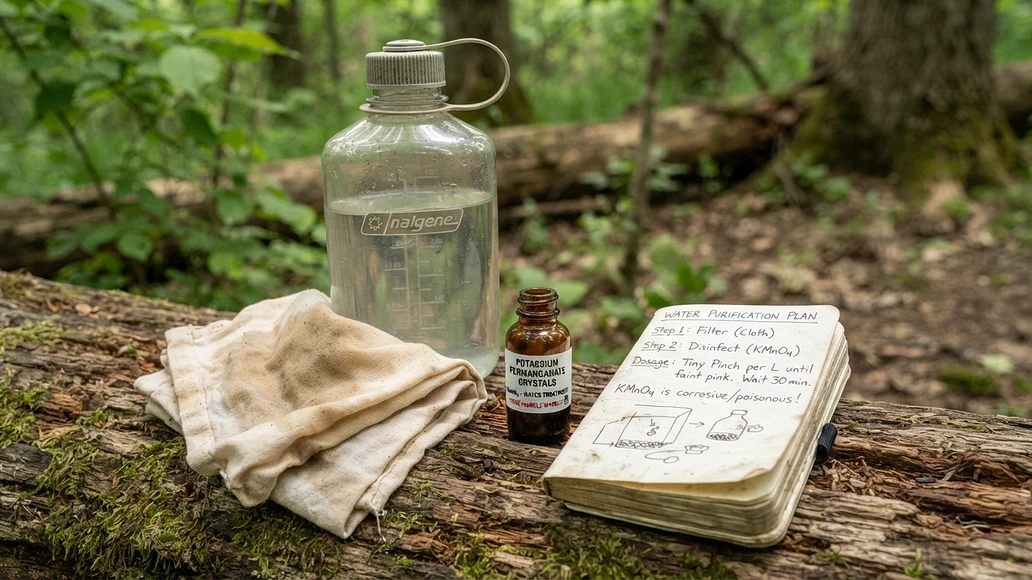
If you ever consider using it for water in a true emergency, the goal is a very faint pink color only. Dark pink or purple means too much. Water should be pre-filtered through cloth or another filter first if it is cloudy, because suspended material reduces effectiveness and makes dosing less reliable.
Emergency-only process
- Start with the clearest water source available.
- Pre-filter cloudy water through clean cloth, coffee filter, or a proper field filter.
- Add only enough potassium permanganate to create a very light pink tint.
- Allow contact time, commonly 30 to 60 minutes.
- If the water becomes strong pink or purple, do not treat that as normal. Overdosing increases risk.
- Use this only when better options are unavailable.
The safest preparedness plan is still layered water treatment, a filter for particles and protozoa, plus a tested disinfectant method for microbes. KMnO₄ belongs in the backup category, not the primary plan.
| Water treatment method | Main strength | Main weakness | Best use case |
|---|---|---|---|
| Potassium permanganate | Compact, multi-use backup | Dosing is imprecise, not comprehensive | Last-resort emergency use by informed adults |
| Household bleach | Common and effective when fresh and correctly dosed | Shelf life declines, not for dirty water alone | Home emergency storage |
| Iodine tablets | Portable and simple | Taste, some health limitations, less ideal for long-term use | Short trips and backup kits |
| Hollow-fiber water filter | Easy and reliable for many biological hazards | Does not remove all viruses or chemicals unless paired with other methods | Primary field water treatment |
| Boiling | Highly effective for microbes | Needs fuel and time, no chemical removal | Home or camp when fuel is available |
Topical skin use, one of the few areas with real mainstream support
Unlike many survival claims, topical potassium permanganate does have legitimate medical use. In dermatology, very dilute solutions are sometimes used as soaks or compresses for weeping eczema, some minor infected skin conditions, and damp fungal foot problems. The key phrase is very dilute. The solution should be pale pink, not magenta, not purple.
It is for external use only. It should not be used in deep wounds, large burns, body cavities, or as a homemade all-purpose antiseptic. If a wound is significant, spreading, very painful, or associated with fever, seek medical care instead of experimenting.
| Use | Visual target | Typical practical guidance | Who should avoid home use |
|---|---|---|---|
| Weeping skin soak | Pale pink | Short external soak or compress only, then stop if irritation develops | Children, people with fragile skin, anyone unable to dilute accurately |
| Foot bath for damp fungal skin problems | Pale pink | External soak only, avoid prolonged exposure | People with diabetes, poor circulation, open ulcers, severe skin disease |
| Minor skin cleansing under guidance | Pale pink | Use exactly as directed, rinse and stop if burning occurs | Pregnant or breastfeeding people without clinician guidance, those with severe eczema flare or allergy concerns |
| Dark pink or purple solution | Too concentrated | Do not apply to skin | Everyone |
If you choose to store potassium permanganate for this purpose, include written instructions in the container. In an emergency, people make mistakes when they rely on memory.
Fire starting with potassium permanganate, effective but not beginner-safe
The classic demonstration is potassium permanganate plus glycerin. After a short delay, the mixture can smoke and ignite. This works because KMnO₄ is a strong oxidizer and glycerin is a fuel. Some people also discuss sugar-based methods, but the same warning applies. You are intentionally creating a reactive chemical ignition source.
That makes it a chemistry trick with real preparedness value, but not a casual campfire method. It is less predictable than a lighter and more dangerous if your storage is sloppy or your work area contains spilled fuel, dry leaf litter, or synthetic fabrics.
Rules for emergency use
- Use only outdoors on a prepared fire base with tinder already arranged.
- Wear eye protection and avoid breathing dust.
- Keep the crystals dry until use.
- Do not experiment near fuel containers, alcohol stoves, solvents, or vehicle interiors.
- Do not let children handle or watch from close range.
- Treat it as an emergency backup, not your primary ignition method.

| Fire starter | Reliability | Skill needed | Injury risk | Best role |
|---|---|---|---|---|
| Potassium permanganate plus glycerin | Moderate when conditions are right | High | High | Specialized backup |
| Ferro rod | High | Moderate | Low | Primary field backup |
| Stormproof matches | High | Low | Low | Simple emergency ignition |
| Butane lighter | Very high | Low | Low to moderate | Everyday carry and camp use |
Other uses people talk about, and how seriously to take them
Potassium permanganate has a long history, so it collects a lot of folklore. Some of that folklore reflects real specialized uses. Some of it is just chemistry-adjacent improvisation.
| Claimed use | Reality check | Preparedness verdict |
|---|---|---|
| Foot care | Reasonable in very dilute external soaks | Plausible secondary use |
| Seed treatment | Real agricultural relevance with precise dosing | Specialized, not general-kit priority |
| Odor control | Possible through oxidation, but not standardized for home use | Usually skip it |
| Fruit handling and ripening-related uses | Mixed and not mainstream for household preparedness | Low priority |
| General household disinfectant replacement | Not a good substitute for safer, purpose-made products | Do not treat it as a routine cleaner |
How dangerous is potassium permanganate?
This is the part many prepper summaries rush past. KMnO₄ is not just a handy purple powder. It is corrosive enough to injure tissue, reactive enough to start fires with the wrong companion chemical, and toxic enough that ingestion can become life-threatening.
Possible harms include eye injury, skin burns, mouth and throat burns if swallowed, severe stomach irritation, vomiting, diarrhea, and in serious cases shock or breathing problems. Dust can irritate the respiratory tract. Long-term industrial exposure to manganese compounds has also been associated with lung and neurologic problems.
Human fatal dose estimates reported in safety literature are around 10 grams by mouth, and much smaller amounts can be dangerous for children. That is one reason tiny unlabeled baggies are a terrible storage choice.
What to do after accidental exposure
| Exposure type | Immediate action | What not to do | Next step |
|---|---|---|---|
| Swallowed crystals or solution | Rinse mouth, give a small amount of water or milk if the person is conscious and able to swallow | Do not induce vomiting, do not wait for symptoms | Call Poison Control and seek emergency care immediately |
| Eye splash | Flush with clean water for at least 15 minutes | Do not rub eyes | Get urgent medical evaluation |
| Skin burn or painful staining | Remove contaminated clothing and rinse skin thoroughly | Do not keep reapplying solution | Seek medical advice if pain, blistering, or large-area exposure occurs |
| Dust inhalation | Move to fresh air | Do not continue handling the product | Get medical help if cough, wheeze, or breathing trouble develops |
Safe storage and handling at home or in a kit
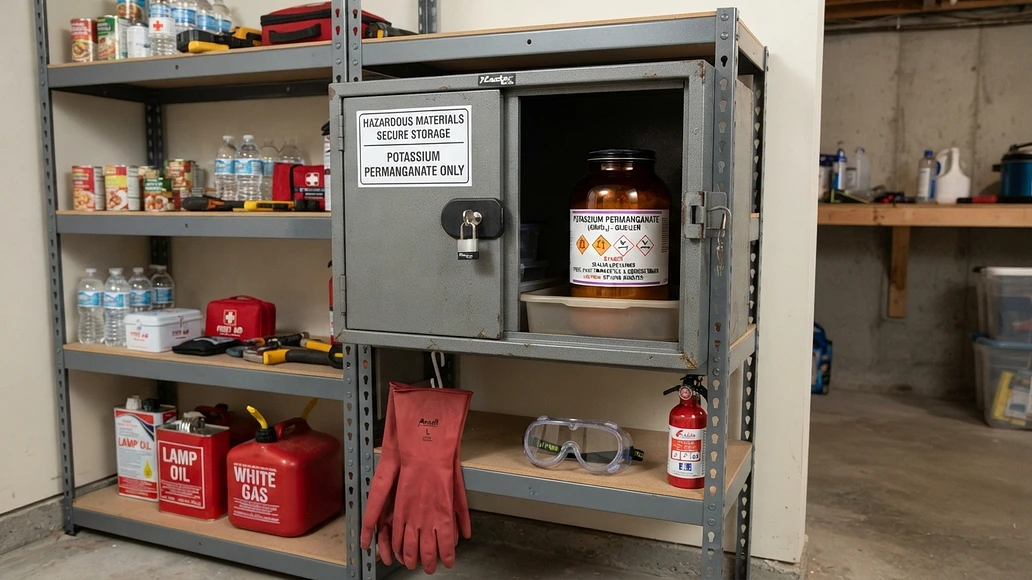
If you store potassium permanganate, store it like a hazardous oxidizer, not like a vitamin supplement or spice jar. Keep it dry, tightly sealed, clearly labeled, and physically separated from fuels, glycerin, sugar, alcohol, oils, solvents, and random household chemicals.
| Storage factor | Best practice | Why it matters |
|---|---|---|
| Container | Original container or chemical-resistant sealed bottle with clear label | Prevents moisture entry and confusion |
| Location | Cool, dry, locked area away from sunlight and heat | Reduces degradation and unauthorized access |
| Segregation | Keep away from fuels, glycerin, sugar, paper dust, solvents, and reducing agents | Prevents accidental ignition or violent reaction |
| Labeling | Mark as OXIDIZER, EXTERNAL USE ONLY, DO NOT SWALLOW | Critical for family and emergency responders |
| PPE | Use gloves, eye protection, and avoid dust | Reduces burn and eye injury risk |
| Child and pet safety | Use locked storage, never decant into food containers | Prevents accidental poisoning |
What kind should you buy?
For preparedness, the most important issue is not chasing the cheapest crystals. It is knowing what you are buying. Potassium permanganate may be sold as technical, laboratory, aquarium, water-treatment, or medical-related product. Purity, intended use, and documentation vary.
Look for a reputable seller, intact packaging, lot information, and safety documentation. Avoid mystery powders, repackaged unlabeled bags, and products with no clear source. For most households, a very small quantity is more than enough. Buying a large container increases storage risk without adding much practical value.
Who should avoid using it at home?
Some people should skip home use entirely. That includes children, anyone who cannot measure and label carefully, people with significant skin disease, those with diabetes or poor circulation when considering foot soaks, people with asthma or respiratory sensitivity if dust exposure is possible, and households where chemicals cannot be securely locked away.
Pregnant or breastfeeding people should not improvise with it without professional guidance. The same goes for anyone considering it for wounds, infections, or repeated skin treatment.
Potassium permanganate versus simpler preparedness tools
The strongest argument against calling KMnO₄ indispensable is that modern preparedness has easier options.
| Tool | Primary role | Shelf life | Ease of use | Risk level | Best for |
|---|---|---|---|---|---|
| Potassium permanganate | Specialized oxidizer, backup disinfection, chemical ignition | Long if dry | Low | High | Experienced users with written procedures |
| Bleach | Water disinfection and sanitation | Moderate | Moderate | Moderate | Home emergency sanitation |
| Iodine | Portable water disinfection | Good | High | Moderate | Compact backup treatment |
| Alcohol-based antiseptic products | Skin and surface sanitation | Good | High | Moderate | Routine first aid kits |
| Ferro rod | Fire starting | Excellent | Moderate | Low | Reliable field ignition |
| Certified water filter | Water purification | Long if maintained | High | Low | Primary field water safety |
Common mistakes and dangerous myths
The biggest mistakes are all predictable. People use too much. They trust color memory instead of written instructions. They treat it like a cure-all. They mix it with other chemicals because a forum post made it sound clever. They store it in unmarked containers. Or they assume that because something has medical uses, it must be safe in amateur hands.
Three myths deserve a direct answer. First, darker solution is not better. Second, internal use is not a home remedy. Third, if a safer modern tool can do the job, use the safer tool.
A responsible checklist if you still want to carry it
- Decide whether you truly need it, or whether a filter, bleach, iodine, and better fire tools cover your needs more safely.
- Buy only a small amount from a reputable source.
- Keep it in a sealed, labeled oxidizer-safe container.
- Store written instructions with it, including external-use-only warnings.
- Pack gloves and eye protection with the kit.
- Do not store it next to glycerin, fuels, sugar, solvents, or food items.
- Include Poison Control contact information in the kit.
- Do not let untrained family members improvise with it.
When to skip potassium permanganate and use something else
Skip it for routine wound care, everyday water treatment, general household cleaning, and ordinary campfire lighting. Skip it if children may access your supplies. Skip it if you do not want to maintain written handling instructions. Skip it if you are building a beginner-friendly kit for family use.
Use a filter and tested disinfectants for water. Use purpose-made first aid supplies for skin and wounds. Use lighters, matches, and ferro rods for fire. In most preparedness plans, those choices are safer and more reliable.
FAQ
Can you drink water treated with potassium permanganate every day?
No. It is best viewed as an emergency-only measure when better options are unavailable. It is not a preferred daily drinking-water method, and it does not address many contaminants that matter in real-world water safety.
How much is too much in a skin soak or foot bath?
Anything darker than a pale pink solution is too much for home use. Dark pink or purple solutions should not be applied to skin. If you do not have clear instructions and a reliable way to dilute it, do not improvise.
Is potassium permanganate safe around children and pets?
Not as a casually stored household item. It should be treated as a locked hazardous chemical. Small amounts can still cause serious poisoning or burns, especially in children.
What should I do if someone swallows potassium permanganate?
Rinse the mouth, give a small amount of water or milk if the person is conscious and can swallow, and contact Poison Control or emergency services immediately. Do not induce vomiting.
Can I mix it with other household chemicals to make a stronger disinfectant?
No. Do not mix potassium permanganate with random household chemicals. As a strong oxidizer, it can react dangerously with fuels, organics, and reducing agents. Mixing experiments are one of the fastest ways to turn a prep item into an injury.