Using Medical Manuka Honey on Minor Wounds, What It Can Help and When to Skip It
Medical-grade Manuka honey can support healing in some minor wounds and partial-thickness burns, but it is not the same as pantry honey and it is not right for every injury. Learn where the evidence is strongest, how to apply it safely, and when to get medical care.

Manuka honey has earned a place in modern wound care, but the useful version is not the jar in your pantry. For skin injuries, the safest option is a sterile, medical-grade honey product made for wound dressings. Used correctly, it may help maintain a moist healing environment, reduce odor, manage some drainage, and support healing in selected wounds, especially some partial-thickness burns and certain chronic wounds. Used incorrectly, it can delay proper treatment.
This guide is for general education only. It does not replace medical care. If a wound is deep, heavily bleeding, infected, caused by a bite, near the eye, or not improving, skip home treatment and get professional help.
What Manuka honey is, and how it differs from regular honey
Manuka honey comes from nectar gathered from the Manuka shrub, native to New Zealand and parts of Australia. It is often discussed because it contains compounds associated with antibacterial activity, including methylglyoxal, often shortened to MGO. Like other honeys, it also has a naturally low pH and high sugar concentration, which can help create an environment that is less friendly to many microbes.
That does not mean every Manuka honey product belongs on a wound. Regular table honey, raw honey, and grocery-store Manuka honey are food products. They are not packaged or sterilized for wound use. Medical-grade honey is processed and packaged specifically for clinical or first-aid use on skin injuries.
| Product type | Sterile for wound use | Intended use | Best use case | Main caution |
|---|---|---|---|---|
| Medical-grade honey dressing or gel | Yes | Topical wound care | Minor wounds, selected burns, clinician-guided chronic wounds | Still not appropriate for deep, infected, or high-risk wounds without medical input |
| Food-grade Manuka honey | No | Eating | Food use only | Not sterile, not a substitute for wound products |
| Regular honey | No | Eating | Food use only | Variable composition, not sterile, not designed for wound care |
| Standard non-honey dressing | Varies by product | Protection and moisture balance | Many routine minor wounds | May still need additional care such as cleansing, debridement, or clinician review |
What medical-grade honey means for wound care
Medical-grade honey is honey prepared for wound management, usually in sterile dressings, gels, or impregnated pads. Sterility matters because an open wound is not the place to experiment with food products. A medical product is also easier to apply in a controlled amount and cover with the right dressing.
Some honey wound products are regulated as medical devices in specific settings. That is different from a food label that says UMF or MGO. Those labels may describe chemical characteristics or grading, but they do not automatically mean the product is sterile or intended for wound care.
How Manuka honey may help wounds heal
Medical honey is thought to work through several mechanisms at once. It helps keep the wound bed moist, which can support tissue repair. Its high sugar content draws fluid, which may help with autolytic debridement, meaning the body can loosen dead tissue more effectively in some wounds. Its acidity and antimicrobial properties may also help reduce bacterial growth in selected cases.
Some people also notice less odor and less irritation as the wound improves. That said, symptom relief is not the same as complete healing. A wound can smell better and still need better offloading, compression, debridement, or infection treatment.
Where the evidence is strongest, and where it is mixed
The best support is for some partial-thickness burns, where honey dressings have been associated with faster healing compared with some conventional dressings in certain studies. Evidence for chronic wounds is more mixed. Some venous leg ulcers and other long-lasting wounds may benefit as part of a broader wound-care plan, but results are not uniform across every wound type.
Diabetic foot ulcers deserve extra caution. There are studies suggesting possible benefit in some settings, but these wounds can worsen quickly and often require pressure relief, circulation assessment, infection management, and regular professional follow-up. Home treatment without guidance is not a good plan.
| Wound type | Evidence for medical honey | Possible role | Home use or clinician-led |
|---|---|---|---|
| Small minor abrasions and scrapes | Reasonable but less studied than burns | May support moist healing if a sterile product is used | Home use may be reasonable if the wound is truly minor |
| Partial-thickness burns, small and minor | Strongest support | May shorten healing time in selected cases | Home use only for very small minor burns, otherwise get medical advice |
| Venous leg ulcers | Moderate, mixed | Adjunct to standard care | Clinician-led, because compression and wound assessment matter |
| Pressure injuries | Mixed | Possible adjunct in selected cases | Clinician-led |
| Diabetic foot ulcers | Mixed to cautionary | Possible adjunct in some settings | Clinician-led, not routine self-care |
| Surgical wounds | Case-dependent | Sometimes used under professional guidance | Clinician-led |
| Deep punctures, bites, heavily contaminated wounds | Not appropriate for self-treatment | Needs proper medical assessment first | Clinician care |
When not to use it, or when to get guidance first
Medical honey is not a cure-all. It should not be your first move for every wound. Some injuries need cleaning, closure, imaging, antibiotics, tetanus review, or urgent wound care instead.
| Red flag | Why it matters | What to do |
|---|---|---|
| Heavy bleeding or a gaping wound | May need pressure control, stitches, or urgent care | Seek immediate medical attention |
| Deep puncture wound, animal bite, or embedded debris | High infection risk, may need irrigation and further treatment | Get professional care |
| Burn larger than a small minor area, or suspected third-degree burn | Burn depth and fluid loss can be serious | Get medical care promptly |
| Spreading redness, warmth, pus, foul odor, fever, worsening pain | Possible infection | Stop self-care and seek medical evaluation |
| Diabetes, poor circulation, neuropathy, foot ulcer | Higher risk of delayed healing and hidden infection | Use clinician-guided care |
| Immunocompromise, chemotherapy, radiation injury, active cancer wound | Higher complication risk | Do not self-manage major wounds |
| Wound near the eye or on mucosal tissue | Sensitive area, risk of injury and contamination | Get professional advice |
| Bee-product or honey allergy | Risk of local or systemic reaction | Avoid use unless a clinician advises otherwise |
| No improvement after a short period, or worsening appearance | May need a different treatment plan | Seek medical care |
Manuka honey for small burns
For very small, superficial or partial-thickness burns, medical-grade honey may be helpful after the burn has been cooled under cool running water. It may support a moist wound environment and, in some studies, shorten healing time compared with some standard dressings.
Do not put honey on major burns, electrical burns, chemical burns, or burns with charred, white, leathery, or numb skin. Those need immediate medical care.
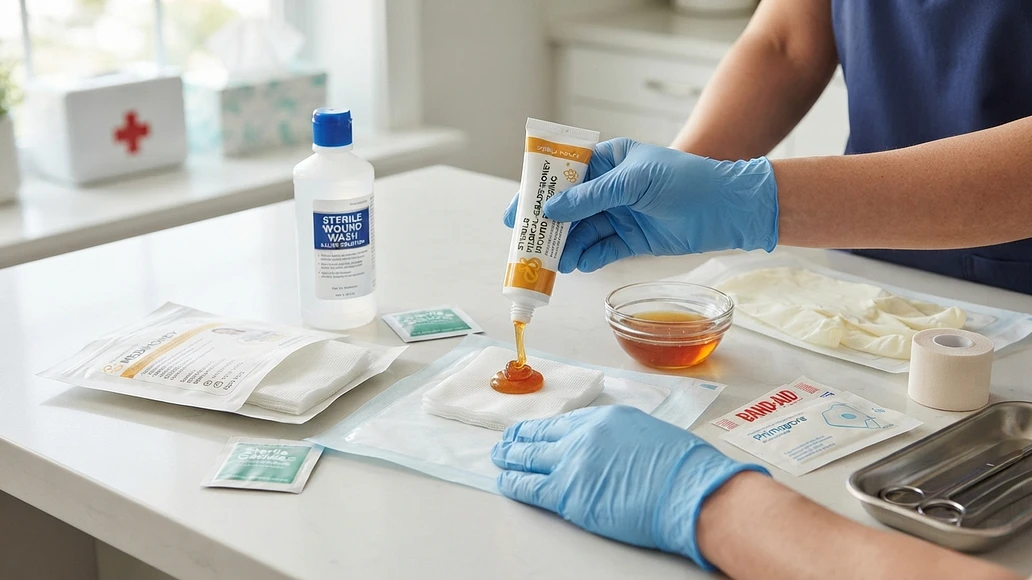
Manuka honey for cuts, scrapes, and minor abrasions
For a small scrape or shallow cut that has stopped bleeding, a medical-grade honey gel or dressing may be used as an alternative to a plain non-adherent dressing. The key steps are still the basics, rinse away dirt, protect the wound, and watch for infection.
If the cut is deep, the edges are far apart, or dirt cannot be removed easily, honey is not the answer. Proper cleaning and closure come first.
What chronic wounds need beyond honey
Chronic wounds often fail to heal because of pressure, poor circulation, swelling, dead tissue, infection, or repeated trauma. In those cases, honey may be only one small part of the plan. Venous ulcers often need compression. Diabetic foot ulcers often need offloading and blood sugar management. Some wounds need debridement, which is the removal of dead tissue. Others need cultures, imaging, or antibiotics.
That is why it is more accurate to think of medical honey as an adjunct, not a replacement for standard wound care.
How to apply medical Manuka honey safely
If you are using a sterile honey dressing or gel on a truly minor wound, keep the process simple and clean.
- Wash your hands well. If available, use clean disposable gloves.
- Stop any active bleeding with direct pressure before doing anything else.
- Rinse the wound gently with clean water or sterile saline to remove loose dirt.
- Pat the surrounding skin dry. Do not scrub the wound bed.
- Apply the medical-grade honey product as directed on the package, either directly as a gel or by placing the honey dressing over the wound.
- Cover it with an appropriate secondary dressing if needed, often a non-adherent pad and wrap or tape.
- Keep the area protected and monitor for increasing pain, redness, drainage, or odor.
Do not pack deep wounds on your own. Do not use pantry honey. Do not keep reusing a soiled dressing.
| Wound drainage level | Suggested dressing approach | Typical change frequency | What to watch for |
|---|---|---|---|
| Dry or minimal drainage | Thin layer of medical honey gel with non-adherent cover | Usually every 24 to 48 hours, or sooner if soiled | Sticking, dryness, increasing pain |
| Moderate drainage | Honey dressing plus absorbent secondary dressing | Usually daily, sometimes more often if saturated | Leakage, odor, skin irritation around the wound |
| Heavy drainage | Absorbent dressing system, often needs professional guidance | Often daily or more often | Maceration, worsening wound size, infection signs |
How often to change the dressing
There is no single schedule that fits every wound. A lightly draining scrape may only need a daily or every-other-day change if the dressing stays clean and intact. A wetter wound may need more frequent changes. In general, change the dressing sooner if it becomes saturated, dirty, loose, or painful.
Some people feel a brief stinging sensation when honey is first applied. Mild temporary discomfort can happen, but persistent burning, rash, swelling, or worsening pain is a reason to stop and reassess.
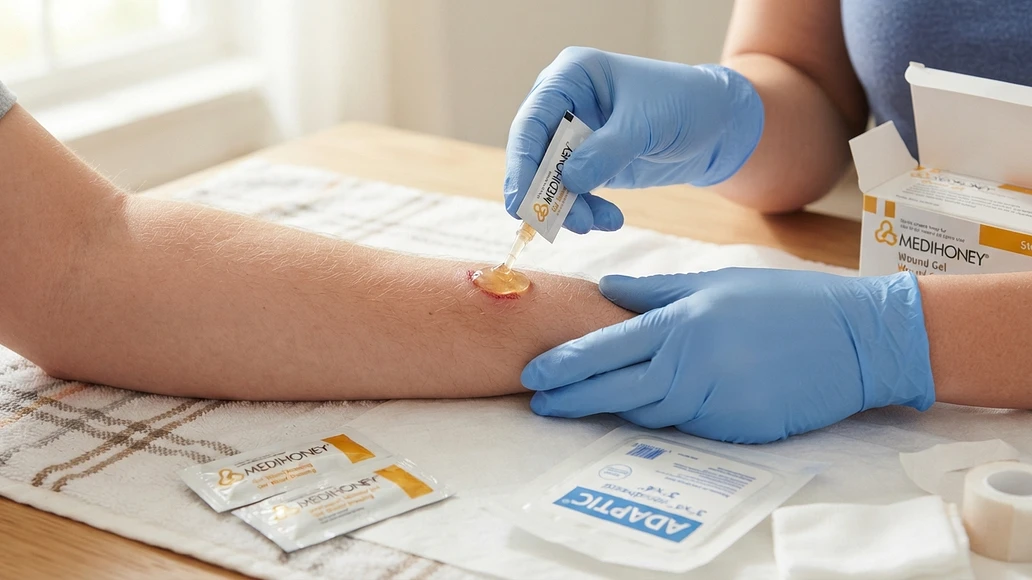
What normal healing looks like, and what is not normal
Normal healing usually means the wound gradually looks smaller, cleaner, and less tender over days to weeks, depending on the type of injury. Drainage should generally lessen over time. The surrounding skin should not become increasingly red or swollen.
Not normal includes spreading redness, increasing warmth, thick yellow or green drainage, bad odor, fever, worsening pain, black tissue, or a wound that keeps getting larger. Those are signs to stop self-treatment and get medical care.
Possible side effects and allergy concerns
Topical honey can cause stinging, irritation, or a sticky mess if too much is used or if the dressing is not appropriate for the amount of drainage. Some people can react to bee products or honey itself. If you have a known bee-product allergy, be cautious and avoid self-experimenting on a wound.
Skin around the wound can also become over-moisturized if drainage is not managed well. That soggy white skin, called maceration, can slow healing and means the dressing setup may need to change.
Common mistakes to avoid
The biggest mistake is using food honey instead of a sterile wound product. Other common problems include applying it to wounds that are too serious for home care, skipping proper rinsing, leaving a saturated dressing in place too long, and assuming less odor means the wound is healed.
Another mistake is treating chronic wounds as if they were simple cuts. If the cause is pressure, swelling, poor blood flow, or diabetes, the wound will not improve reliably unless those issues are addressed too.
How to choose a product, and what UMF and MGO do and do not mean
When shopping for a wound product, look first for wording that clearly indicates sterile, medical-grade, and intended for wound care. That matters more than a high number on the front label.
UMF and MGO are quality and activity markers often used for Manuka honey products. They can help describe the honey, but they do not by themselves prove the product is sterile, regulated for wound use, or the best choice for your specific injury. For wound care, packaging and intended use matter more than marketing terms.
| Label term | What it generally means | What it does not guarantee | What to look for instead |
|---|---|---|---|
| UMF | A grading system used for some Manuka honey products | Does not guarantee sterility or wound-device status | Clear statement that the product is sterile and for wound care |
| MGO | Indicates methylglyoxal content | Does not guarantee clinical suitability for wounds | Medical-grade packaging and wound-use instructions |
| Raw or unfiltered | Food-style processing description | Not appropriate proof of safety for open wounds | A sterile wound gel or dressing |
How medical honey fits with standard wound care
Even when honey is appropriate, it works best inside a basic wound-care framework. That means cleaning the wound, choosing a dressing that matches the amount of drainage, protecting the surrounding skin, and addressing the reason the wound happened. In chronic wounds, that may also mean debridement, compression, pressure relief, or infection treatment.
If you are building a home first-aid kit, think of medical honey as one optional tool, not the whole plan. Saline, non-adherent dressings, absorbent pads, tape, gloves, and a clear threshold for when to seek care are just as important.
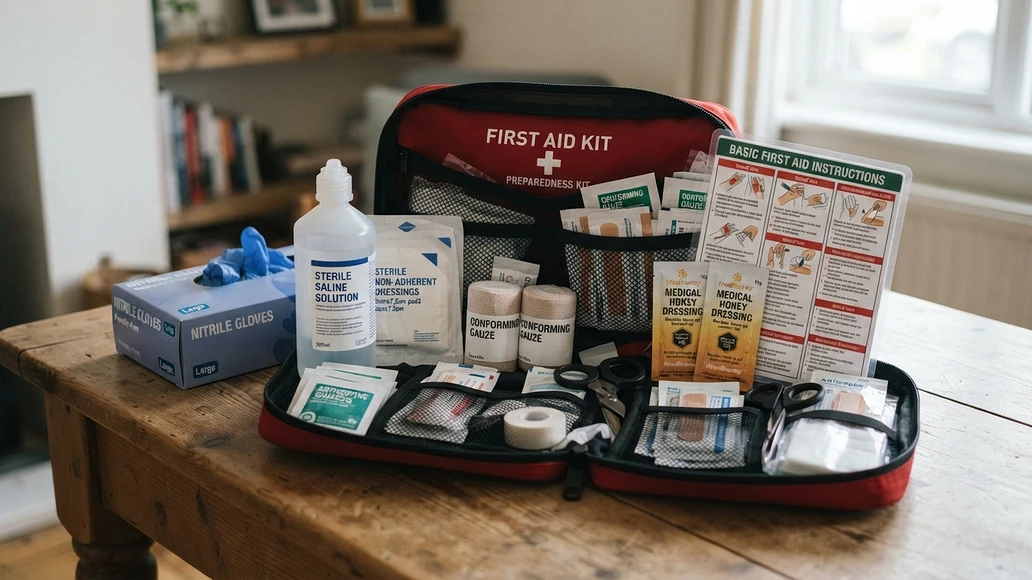
When to stop home care and seek medical help
Get medical attention if the wound is worsening, not improving after a short period, or showing any signs of infection. Also get help if pain is increasing instead of decreasing, if the wound opens wider, or if you have a health condition that raises the risk of poor healing.
For people with diabetes, poor circulation, numb feet, immune suppression, or cancer treatment, the threshold for professional care should be low. A wound that looks small can still become serious.
Bottom line
Medical-grade Manuka honey can be a useful wound-care option for selected minor wounds and some small partial-thickness burns. Its benefits are most believable when it is used as a sterile product, on the right kind of wound, with proper dressing technique and realistic expectations. It is not a substitute for standard wound care, and it is not a safe shortcut for deep, infected, or high-risk wounds.
If you want to keep it in your preparedness supplies, choose a sterile wound product, learn how to use it on truly minor injuries, and know the red flags that mean it is time to get medical care.
References
- Clinical and Postoperative Applications of Manuka Honey
- Honey in Wound Healing, An Updated Review
- Medicinal Honeys from Oceania, An Updated Review
- Manuka Honey, Medicinal Uses, Benefits, and Side Effects
- Manuka Honey as a Natural Remedy for Diabetic Foot Ulcers
- Understanding Medical Grade Honey, How Doctors Use Manuka