Using Medical Manuka Honey on Wounds, What It Can Help and When to Skip It
Manuka honey can support healing in some wounds, especially certain minor burns and selected chronic wounds, but only when used correctly. Learn the difference between medical-grade and food-grade honey, how to apply it safely, and when a wound needs professional care instead.

Manuka honey has a real place in wound care, but the useful version is not the jar in your pantry. For skin injuries, the key distinction is medical-grade, sterile honey versus food honey sold for eating. Research suggests honey dressings can help some wounds heal, especially certain partial-thickness burns and selected chronic wounds, while also supporting a moist healing environment and reducing odor or drainage in some cases. Still, it is not a cure-all, and it should not replace proper cleaning, dressing selection, debridement, pressure relief, compression, or antibiotics when those are needed.
This guide is for general education only. If a wound is deep, heavily bleeding, infected, getting worse, or involves diabetes, poor circulation, immunocompromise, or a foot ulcer, get medical care rather than trying to manage it with honey at home.
What Manuka honey is, and how it differs from regular honey
Manuka honey is made by bees that gather nectar from the Manuka shrub, native to New Zealand and parts of Australia. It is often discussed separately from regular table honey because it contains compounds associated with stronger antimicrobial activity, including methylglyoxal, often shortened to MGO. That does not mean every Manuka product is suitable for wounds.
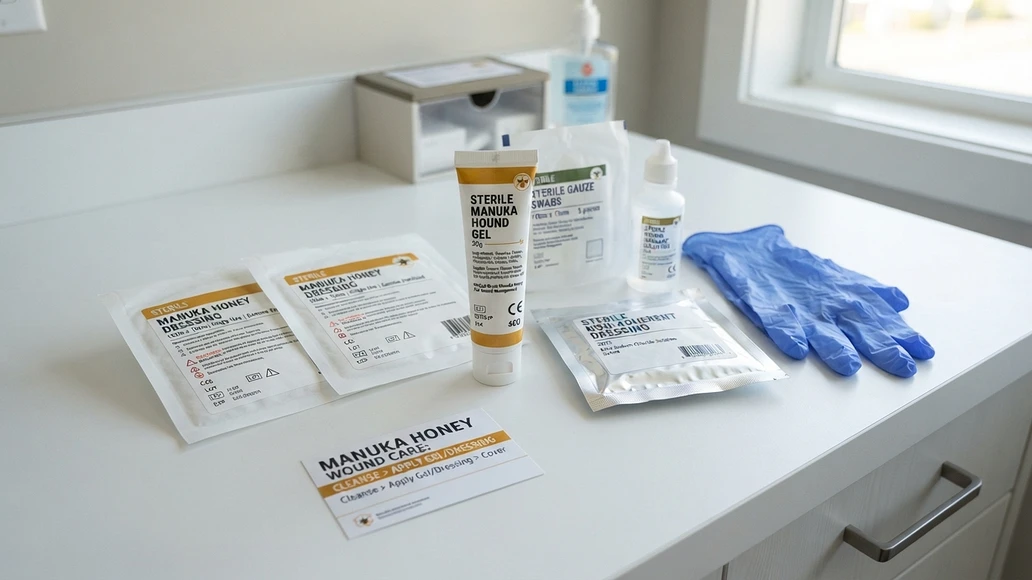
Regular honey and food-grade Manuka honey are made for eating. Wound products are made for contact with damaged skin. That difference matters because an open wound needs a product that is prepared, packaged, and sterilized for medical use.
| Product type | Sterile | Intended use | Best use case | Main caution |
|---|---|---|---|---|
| Medical-grade honey dressing | Yes | Wound care | Minor appropriate wounds, clinician-guided chronic wound care | Still not right for every wound, and not a substitute for medical assessment |
| Food-grade Manuka honey | No | Eating | Dietary use only | Not recommended as a wound dressing |
| Regular grocery honey | No | Eating | Dietary use only | Not equivalent to medical honey, not sterile |
| Standard non-adherent dressing without honey | Usually sterile if packaged that way | Routine wound coverage | Many minor cuts and scrapes after cleaning | May be enough on its own for simple wounds, depending on the injury |
What medical-grade honey means for wound care
Medical-grade honey is processed and sterilized for use on wounds. It is sold as gels, impregnated pads, alginate-style dressings, or other wound products. Sterility matters because open skin is vulnerable to contamination, and wound products should be designed to manage moisture, contact the wound bed appropriately, and work with a secondary dressing when needed.
Labels such as UMF and MGO can tell you something about the honey source or chemical profile, but they do not by themselves prove that a product is medical-grade. For wound care, look for packaging that clearly states it is intended for wound use and is sterile.
What UMF and MGO mean, and what they do not mean
UMF, or Unique Manuka Factor, is a grading system used in the retail Manuka market. MGO refers to methylglyoxal content. Both can be useful for identifying genuine Manuka honey, but neither replaces the need for a sterile medical product. A high UMF or high MGO jar from a grocery or supplement store is still not the same thing as a wound dressing cleared and packaged for skin injuries.
How Manuka honey may help wounds heal
Honey supports wound care through several mechanisms that are described consistently in clinical reviews. It helps maintain a moist wound environment, which can support tissue repair. Its high sugar content creates an osmotic effect that can draw fluid. It is naturally acidic, and that lower pH may help create conditions less favorable to some microbes. Medical honey is also discussed for antimicrobial and anti-inflammatory effects, and some patients report less odor, less drainage, or less discomfort with appropriate use.
Those benefits are real, but they are not universal. The strength of evidence depends on the wound type, the dressing method, and whether standard wound-care steps are also being used.
| Claim | Evidence strength | Practical takeaway |
|---|---|---|
| Can help some partial-thickness burns heal faster | Strongest support | One of the better-supported uses, especially with proper dressing technique |
| May help some chronic wounds | Moderate, mixed | Can be useful in selected cases, usually as part of a clinician-led plan |
| Supports moist healing and antimicrobial action | Well supported | Reasonable mechanism for use in appropriate wounds |
| Replaces standard wound care | Not supported | Use as an adjunct, not a substitute |
| Works for every wound type | Not supported | Wound selection matters |
Which wounds may benefit most
The best-supported home-use discussion is for small, minor wounds that have been cleaned properly and for minor partial-thickness burns that are limited in size. In clinical settings, honey dressings are also used for some chronic wounds, including selected venous leg ulcers and pressure injuries, but those cases usually need professional oversight because healing depends on more than the dressing alone.
For example, a venous leg ulcer may need compression. A diabetic foot ulcer may need offloading and vascular assessment. A wound with dead tissue may need debridement. In those situations, honey can be part of the plan, but not the whole plan.
| Wound type | Possible role for medical honey | Home care or clinician care | Notes |
|---|---|---|---|
| Small superficial scrape or abrasion | Possible | Home care may be reasonable if clean and improving | Only use sterile medical-grade product |
| Minor shallow cut | Possible in selected cases | Home care if edges are not gaping and bleeding is controlled | If deep or gaping, seek care |
| Small partial-thickness burn | Often the best-supported use | Home care may be reasonable if truly minor | Large burns or facial burns need medical evaluation |
| Venous leg ulcer | Possible adjunct | Clinician care preferred | Compression and wound assessment are central |
| Pressure injury | Possible adjunct | Clinician care preferred | Pressure relief and staging matter |
| Diabetic foot ulcer | Mixed evidence, caution | Clinician care | Do not self-treat at home |
| Surgical wound | Sometimes used in practice | Clinician guidance | Follow surgeon instructions first |
| Deep puncture, bite, embedded debris | Not appropriate for home honey use | Clinician care | High infection risk |
Which wounds need clinician guidance or different treatment
Do not rely on home honey treatment for wounds that are deep, heavily bleeding, contaminated, or clearly infected. The same goes for animal bites, puncture wounds, wounds with foreign material, large burns, suspected third-degree burns, wounds near the eye, and wounds on sensitive mucosal surfaces.
People with diabetes, neuropathy, poor circulation, chronic leg swelling, immune suppression, active cancer treatment, or recurrent wounds should be much more cautious. In these groups, even a small wound can become serious quickly.
Manuka honey for burns, can it shorten healing time?
Among the common wound categories, the evidence is strongest for some partial-thickness burns. Reviews have reported faster healing in certain burn wounds compared with some conventional dressings. That does not mean every burn should be treated at home with honey. Burn depth, size, location, and infection risk all matter.
A small minor burn on an arm may be one thing. A burn on the face, hands, feet, genitals, or over a large area is different and deserves medical assessment. If the skin looks white, charred, leathery, numb, or deeply damaged, that is not a home-care situation.
Manuka honey for cuts, scrapes, and minor abrasions
For simple cuts and scrapes, the first priorities are basic wound care. Rinse the area well, remove visible dirt if you can do so gently, stop bleeding with direct pressure, and protect the wound. In some minor cases, a sterile medical honey product may be used under a dressing to help maintain a moist environment. But many small cuts and abrasions heal well with standard non-adherent dressings alone.
If the wound edges are separated, the cut is deep, bleeding does not stop, or dirt remains embedded, skip home treatment and get care.
What the evidence says about chronic wounds
Chronic wounds are where people often become interested in Manuka honey, but they are also where caution matters most. Evidence is mixed. Some studies and reviews suggest benefit for selected chronic wounds, including improvements in odor, drainage, or healing progress in some cases. Other results are less consistent, especially when the underlying cause of the wound is not addressed.
That is why chronic wound care is usually condition-specific. Venous ulcers often need compression. Diabetic foot ulcers often need pressure offloading, blood sugar management, infection monitoring, and sometimes vascular care. Pressure injuries need pressure relief and careful staging. Honey may help in some of these settings, but it should be framed as an adjunct.
How to apply Manuka honey safely to a wound
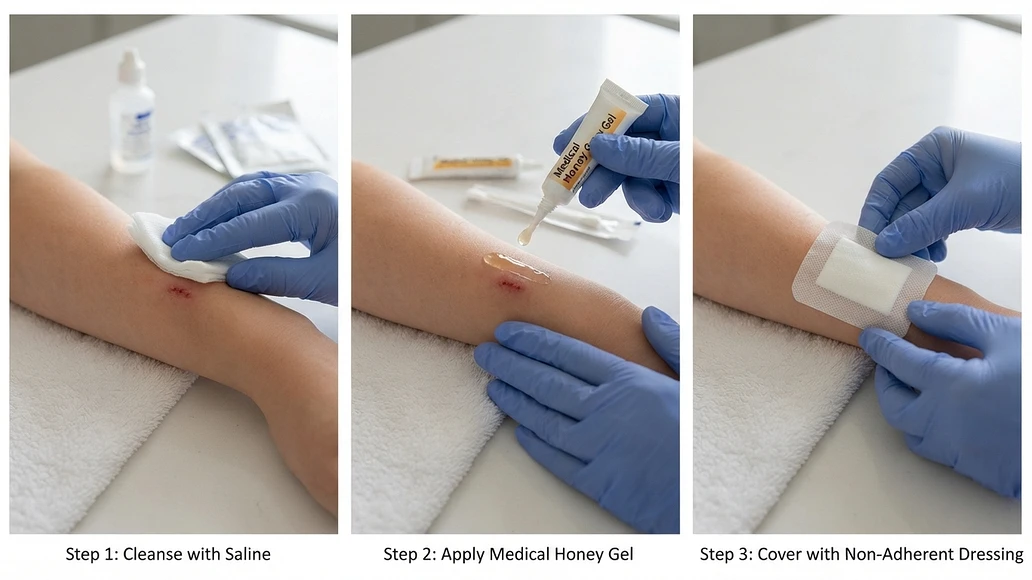
If you are using a sterile medical-grade Manuka honey product on a minor wound that is appropriate for home care, keep the process simple and clean.
- Wash your hands well. If available, use clean disposable gloves.
- Rinse the wound gently with clean water or sterile saline. Do not scrub aggressively.
- Pat the surrounding skin dry. Do not rub the wound bed.
- Apply the medical honey product as directed on the package. Some products go directly on the wound, while others are built into a dressing pad.
- Cover with a suitable secondary dressing if needed, often a non-adherent pad and wrap or tape.
- Keep the wound protected and monitor it daily for increased redness, swelling, drainage, odor, or pain.
Do not pack deep wounds yourself unless a clinician has instructed you to do so. Do not use food honey from a jar. Do not apply honey to wounds that clearly need stitches, urgent cleaning, or professional burn care.
| Wound drainage level | Application approach | Typical dressing change rhythm | What to watch for |
|---|---|---|---|
| Low drainage | Thin layer or honey dressing pad, covered with non-adherent dressing | Often every 24 to 48 hours, or per product instructions | Drying out, sticking, increasing redness |
| Moderate drainage | Honey dressing with absorbent secondary layer | Usually daily, sometimes more often early on | Leakage, odor, maceration of surrounding skin |
| Heavy drainage | Needs more absorbent dressing strategy | Often daily or more often | This may be too complex for home care, consider clinician review |
How often to change the dressing
Dressing changes depend on how much fluid the wound produces, what type of honey dressing you are using, and whether the dressing stays clean and intact. A lightly draining minor wound may only need a change every day or two. A wetter wound may need daily changes, sometimes more often if the dressing becomes saturated.
Follow the product instructions first. If the dressing leaks, smells worse, becomes painful, or sticks in a way that damages skin, reassess the approach. Chronic or heavily draining wounds should not be managed casually at home.
What normal healing looks like, and what is not normal
A normally healing minor wound should gradually look cleaner, less tender, and less inflamed over several days. Drainage should not steadily increase. The wound edges should not spread apart. Pain should slowly improve, not intensify.
Some people notice a brief stinging sensation with honey products. Mild temporary discomfort can happen, but worsening pain, spreading redness, pus, fever, foul odor, or a wound that enlarges instead of shrinking are not normal signs.
| Finding | More reassuring | Concerning |
|---|---|---|
| Redness | Limited and fading | Spreading outward |
| Pain | Stable or improving | Worsening or throbbing |
| Drainage | Light and decreasing | Pus, foul odor, or increasing volume |
| Wound size | Gradually smaller | Same size or larger after several days |
| General symptoms | Feeling well | Fever, chills, feeling ill |
Possible side effects and allergy concerns
Medical honey is generally well tolerated, but it is not risk-free. Possible problems include stinging, irritation, increased moisture that softens surrounding skin, and allergic reactions. Anyone with a known bee-product or honey allergy should avoid topical use unless a clinician specifically advises otherwise.
If you develop rash, swelling, hives, worsening redness, or any sign of an allergic reaction, stop using the product and seek medical advice. If there is trouble breathing or facial swelling, seek emergency care.
Common mistakes to avoid
| Mistake | Why it is a problem | Better approach |
|---|---|---|
| Using pantry honey | Not sterile, not intended for wounds | Use only sterile medical-grade honey products |
| Putting honey on a deep or infected wound | Delays proper care | Get medical evaluation first |
| Ignoring the cause of a chronic wound | Dressing alone may not solve the problem | Address compression, offloading, circulation, or pressure relief as needed |
| Leaving a saturated dressing in place | Can worsen skin breakdown and contamination | Change dressings based on drainage and instructions |
| Using it near the eye | Sensitive area, higher risk | Seek professional guidance |
| Continuing despite worsening symptoms | May allow infection or deeper injury to progress | Stop home care and get help |
How to choose a product for wound care
Choose a product that clearly states it is sterile and intended for wound management. Many medical honey products are sold as gels, tulle-style dressings, pads, or alginate combinations. The best format depends on the wound and how much it drains.
UMF and MGO can help identify Manuka-related characteristics, but the most important buying criteria for wound care are sterility, wound-use labeling, intact packaging, and instructions that match your situation. If you are unsure, ask a pharmacist, wound clinic, or clinician which type fits the wound.
How Manuka honey fits with standard wound care
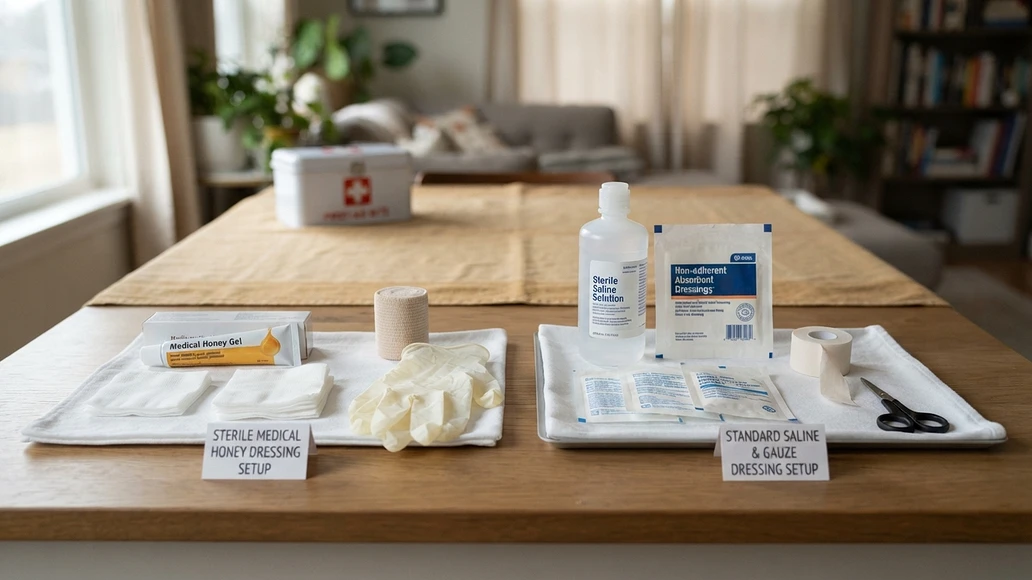
Honey works best when it is integrated into standard wound-care basics, not used instead of them. Standard care may include cleansing with water or saline, protecting the wound with a non-adherent dressing, changing dressings when wet or dirty, and reducing pressure or friction. For more complex wounds, standard care may also include debridement, compression therapy, offloading, topical antimicrobials, or systemic antibiotics.
That is why the most accurate way to think about Manuka honey is as a tool, not a replacement system.
When to stop home care and seek medical help
Stop self-care and get medical attention if the wound is not clearly improving, or if any red flags appear.
| Red flag | Why it matters | What to do |
|---|---|---|
| Heavy bleeding or gaping wound | May need closure or urgent treatment | Seek urgent care |
| Deep puncture, bite, or embedded debris | High infection and tissue injury risk | Get medical evaluation |
| Spreading redness, warmth, pus, foul odor | Possible infection | Seek prompt care |
| Fever or worsening pain | Possible systemic involvement or deeper problem | Seek prompt care |
| Large burn or suspected third-degree burn | Needs professional burn assessment | Do not treat at home with honey |
| Diabetes, poor circulation, neuropathy, foot ulcer | Higher complication risk | Use clinician-led care |
| Immunocompromise or cancer treatment | Healing may be impaired, infection risk higher | Get professional guidance |
| No improvement after a short period | May be the wrong treatment or wrong diagnosis | Arrange medical review |
Bottom line
Medical-grade Manuka honey can be a practical adjunct for certain wounds, especially some minor partial-thickness burns and selected simple wounds, and it may also have a role in clinician-managed chronic wound care. The safest approach is to use only sterile wound products, keep expectations realistic, and treat honey as one part of proper wound care rather than a replacement for it.
If there is any doubt about the depth, cause, cleanliness, or healing progress of a wound, it is better to get it checked than to keep experimenting at home.
References
- Clinical and Postoperative Applications of Manuka Honey
- Honey in Wound Healing, An Updated Review
- Manuka Honey, Medicinal Uses, Benefits, and Side Effects
- Manuka Honey as a Natural Remedy for Diabetic Foot Ulcers
- Medicinal Honeys from Oceania, Updated Review
- Understanding Medical Grade Honey, How Doctors Use Manuka