Can Your Kitchen Microwave Really Shield Electronics? What It Does, What It Doesn't
A microwave oven uses Faraday cage principles to contain cooking energy, but that does not automatically make it reliable EMP protection. Here is the practical, safety-first answer, plus better options for home preparedness.

Many people have heard that a microwave oven is basically a Faraday cage. That idea is partly true, but only in a narrow, technical sense. A microwave is designed to keep cooking energy inside the oven cavity, mainly around one specific frequency, not to serve as a universal shield for every electromagnetic threat.
If your real question is whether a microwave can protect a phone, radio, key fob, or backup electronics from EMP, solar storms, tracking, or hacking, the honest answer is more limited. It may block some everyday wireless signals in some situations, but it is not a purpose-built, standards-tested Faraday enclosure for critical preparedness use.
This guide explains the physics in plain English, covers normal household safety, and shows when a microwave might be a temporary signal blocker and when you should choose a better solution.
What a Faraday cage actually is
A Faraday cage is a conductive enclosure that reduces the electric fields and radio frequency energy reaching the space inside it. In simple terms, the metal shell redirects or attenuates electromagnetic energy so less of it gets through to the contents.
Whether a cage works well depends on several details, not just the fact that it is metal. The enclosure needs good electrical continuity, minimal gaps, controlled seams, and openings that are small relative to the wavelength of the energy you are trying to block. That last point matters a lot. A shield that performs well at one frequency may perform poorly at another.
Grounding is often misunderstood. Some Faraday enclosures work without a dedicated ground for many radio frequency uses, but grounding can matter in certain high-energy or specialized applications. For household preparedness, continuity, seam quality, and insulation of stored electronics are usually more important than the simplistic idea that any metal box becomes perfect once grounded.
Why openings matter
Every hole, seam, latch, hinge, and cable path can weaken shielding. A true high-performance enclosure is not just a box made of metal. It is a carefully designed conductive shell with controlled entry points and tight contact surfaces.
How a microwave oven uses Faraday cage principles
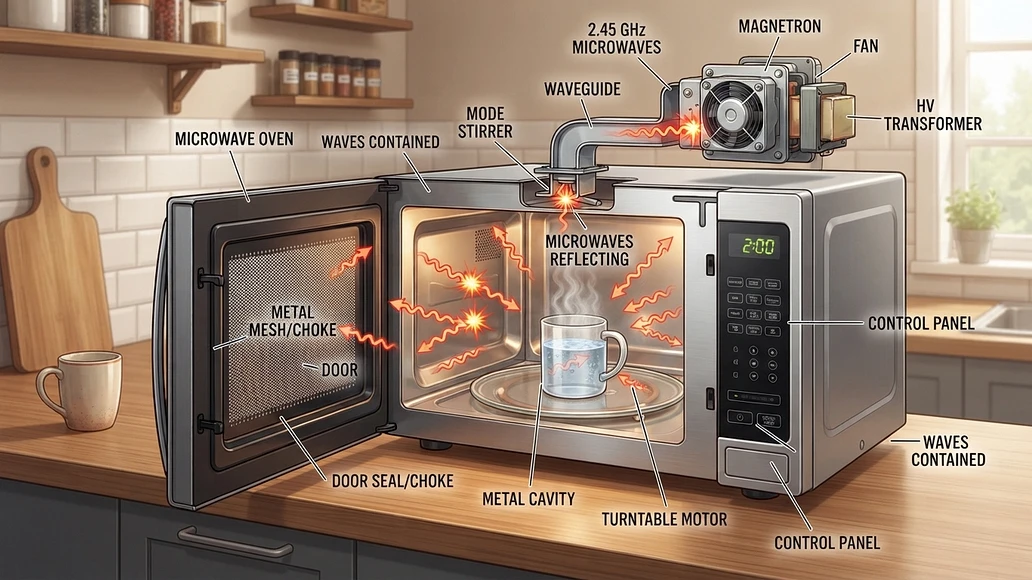
A microwave oven cooks food by generating radio frequency energy, usually around 2.45 GHz, and bouncing that energy around a metal cavity. The metal body helps keep that energy inside, where it can heat water-rich food. The window in the door looks transparent, but it contains a metal mesh. Those holes are small enough relative to the microwave wavelength that the cooking energy is largely reflected or contained, while visible light can still pass through so you can see your food.
That is why people casually call a microwave a Faraday cage. The oven cavity does use the same broad shielding concept. It is a conductive enclosure designed to contain electromagnetic energy.
Why the door mesh works
The wavelength of 2.45 GHz microwave energy is much larger than the tiny holes in the door screen. Because the openings are small compared with that wavelength, the mesh can block or strongly attenuate the cooking energy. Visible light has a much shorter wavelength, so light passes through and your eyes can still see inside.
This is the key nuance many articles skip. The mesh is not magic. It works because it was engineered for a specific frequency range.
So, is a microwave technically a Faraday cage?
Yes, in the loose sense that it is a conductive enclosure designed to contain electromagnetic energy.
No, if you mean a broad-spectrum, high-confidence protective enclosure for any radio signal or electromagnetic event.
The most accurate answer is this: a microwave oven is Faraday-like for its intended job. It is engineered to contain the oven's cooking frequency and keep leakage below strict safety limits during normal use. That does not mean it is a dependable shield against broadband pulses, severe electromagnetic events, or every wireless frequency you care about.
| Option | Main purpose | Designed frequency behavior | Weak points | Good choice for EMP storage? | Best everyday use |
|---|---|---|---|---|---|
| Microwave oven | Contain cooking energy | Optimized around 2.45 GHz | Door seams, latch area, power cord, wear and damage | No, not as a sole solution | Cooking, occasional short-term signal blocking test |
| Purpose-built Faraday bag | Shield portable electronics | Broad RF attenuation, varies by brand and design | Seal quality, wear, punctures, poor closure | Better than a microwave, especially for small devices | Phones, key fobs, radios, backup drives |
| Well-built metal can or box with insulated contents | Preparedness storage | Can provide broad shielding if seams and lid contact are good | Poor lid contact, paint, rust, interior contact with metal | Often a better DIY option | Backup electronics and spare gear |
| Engineered shielded enclosure | High-confidence protection | Designed and tested for known performance | Cost, size, complexity | Best option when failure is unacceptable | Critical equipment protection |
Why frequency matters more than most people realize
Electromagnetic shielding is not one-size-fits-all. A microwave oven is built to handle the energy it creates itself. That is very different from blocking a wide range of outside signals. Wi-Fi, Bluetooth, cellular bands, GPS, keyless entry systems, and possible high-energy pulse events all occupy different parts of the spectrum or behave differently in the real world.
That means a microwave might block one signal well, partially block another, and leak enough of a third to make the result unreliable. The fact that your phone loses signal inside one microwave does not prove that the same oven would protect a radio from a severe electromagnetic event.
Microwave shielding versus EMP and solar storms
This is where the prepper myth usually goes too far. An EMP is a fast, broadband electromagnetic pulse. A geomagnetic disturbance from a solar storm is a different phenomenon again, often discussed because of its effects on long conductors and grid infrastructure. Neither threat is equivalent to the steady 2.45 GHz energy inside a kitchen appliance.
A microwave oven has several limitations as emergency shielding. The door is a moving part with seams. The latch area is not a perfect continuous bond. The power cord is an entry path. The enclosure was not designed, marketed, or tested as a hardened protective container for survival electronics.
Could some ovens provide some attenuation against some signals? Possibly. Is that enough to trust with your only emergency radio, spare vehicle module, or backup medical electronics? No.
For preparedness, the safer conclusion is simple. Do not rely on a microwave as your only EMP or CME protection.
Can a microwave block phone, Wi-Fi, or car key signals?
Sometimes, yes. Reliably, not always.
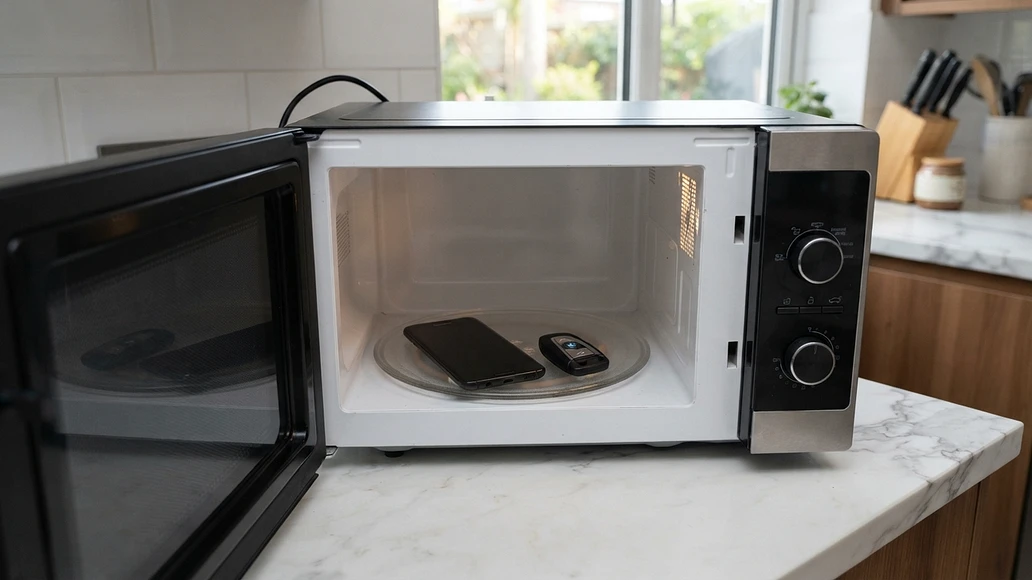
People often test this by putting a phone in an unplugged microwave and calling it, or by placing a key fob inside and checking whether the car still detects it. Results vary by oven design, age, seal condition, local signal strength, and the frequencies involved. Some microwaves block signals very well. Others only reduce them.
This can make a microwave a temporary, improvised RF barrier in a pinch, but not a guaranteed one. It is also important to separate signal blocking from true equipment protection. Preventing a phone from receiving a call is not the same as proving the device would survive a high-energy electromagnetic event.
Important safety limit
Never turn the microwave on with electronics, foil, or random metal objects inside unless the manufacturer specifically says the item is microwave-safe and intended for that use. Running a microwave empty or with unsuitable contents can cause arcing, damage the magnetron, and create a fire risk.
How safe microwave ovens are in normal household use
For everyday cooking, properly functioning microwave ovens are considered safe when used as directed. Regulatory agencies set strict leakage limits, and modern ovens are designed to stay well below those limits when the door, hinges, and seals are in good condition.
Microwaves use non-ionizing radiation. That means they do not have the energy needed to alter atomic nuclei or make food radioactive. They heat by exciting water molecules and other polar molecules in food. Current mainstream health guidance does not support the claim that normal microwave use causes cancer.
Distance also helps. Exposure drops quickly as you move away from the appliance, so standing a few feet back while it runs further reduces already low exposure.
| Scenario | What it means in practice | Exposure takeaway | Practical guidance |
|---|---|---|---|
| Leaning against the door while it runs | Closer than needed, poor habit | Still expected to be below legal leakage limits if the oven is in good condition | Avoid pressing against the oven |
| Standing about 2 feet away | Typical kitchen use | Lower exposure than direct contact distance | Reasonable everyday distance |
| Standing 3 feet or more away | Common while waiting | Exposure falls further with distance | Good choice if you want extra margin |
| Using a damaged or poorly closing oven | Door, latch, or seal problem | Potentially increased leakage and safety concerns | Stop using it until repaired or replaced |
Common myths that confuse this topic
| Myth | Reality |
|---|---|
| A microwave is a perfect Faraday cage for everything | It uses shielding principles, but it is optimized for cooking energy, not every frequency or threat |
| If it blocks my phone, it will protect against EMP | Signal blocking in a casual test does not prove high-energy event protection |
| Microwaved food becomes radioactive | False. Microwave ovens use non-ionizing radiation and do not make food radioactive |
| Normal microwave use causes cancer | Mainstream evidence does not support that claim when the appliance is used properly |
| Any metal box is automatically EMP-proof | Seams, openings, insulation, and construction quality all matter |
Better preparedness options than using your microwave
If your goal is to protect small electronics, there are better choices than repurposing a kitchen appliance. A purpose-built Faraday bag is convenient for phones, key fobs, handheld radios, and backup drives. A metal trash can with a tight-fitting lid can work as a larger DIY enclosure if you pay attention to electrical continuity and keep the contents insulated from the metal walls. Ammo cans are also popular, though paint, gasket details, and lid contact can affect performance.
The key design principles are straightforward. Use a continuous conductive shell, minimize gaps, avoid unnecessary penetrations, and insulate the devices inside so they do not directly touch the conductive exterior.
| DIY or commercial option | Strengths | Main limitations | Best use case |
|---|---|---|---|
| Faraday bag | Portable, easy to use, made for electronics | Quality varies, can wear out over time | Phones, key fobs, tablets, handheld radios |
| Metal trash can with lid | Affordable, roomy, popular for preparedness storage | Lid contact and seams may need improvement, contents must be insulated | Backup radios, solar charge controllers, spare electronics |
| Ammo can | Durable, compact, stackable | Paint and gasket design can interfere with shielding performance | Small critical spares and accessories |
| Foil-wrapped insulated box | Low cost, simple concept | Easy to tear, inconsistent results, not ideal for repeated access | Temporary backup storage |
| Microwave oven | Already in the house, may block some signals | Not designed for EMP storage, awkward, variable shielding | Short-term improvised signal blocking only |
How to check whether your microwave is still shielding properly
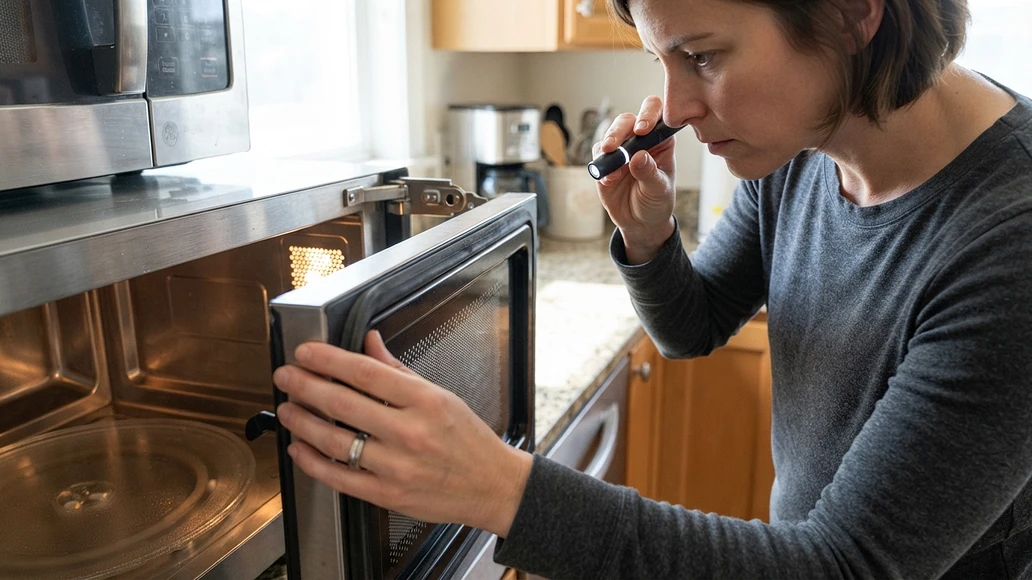
Start with a visual inspection. Look at the door seal, hinges, latch area, and the mesh in the window. If the door is bent, does not close squarely, or the latch feels loose, stop using the oven until it is checked or replaced. If the oven sparks, smells like burning, or shows physical damage, unplug it and do not keep testing it at home.
Professional leakage testing is more meaningful than internet tricks. Consumer phone tests can tell you only that some signals may or may not be getting through. They do not measure microwave leakage at the oven's operating frequency and should not be treated as a safety certification.
Microwave safety basics for the home
Most microwave injuries are not about radiation. They are about burns, steam, superheated liquids, and uneven heating. Use microwave-safe containers, be careful with sealed foods, and allow hot items to rest before handling. Keep children from crowding the appliance while it runs, mainly to prevent burns and spills.
If you are pregnant or simply cautious about EMF exposure, current evidence does not show harm from normal microwave use when the appliance is functioning properly. Still, if standing farther back gives you peace of mind, that is an easy and reasonable personal choice.
When using a microwave as a makeshift RF shield is reasonable
There are a few limited cases where using an unplugged microwave as a temporary RF barrier can make sense. For example, you might use it briefly to reduce signals to a phone or key fob while troubleshooting a privacy or interference issue. It can also serve as a simple classroom demonstration of shielding principles.
What it is not good for is long-term storage of mission-critical electronics, sole EMP protection, or any test that requires certainty. If failure would matter, use a purpose-built or carefully built shielding solution instead.
Preparedness without risky shortcuts
Balanced preparedness works better than gadget myths. If you are concerned about grid disruptions or electromagnetic threats, focus first on practical resilience. Keep printed contacts and maps, maintain backup lighting, store water, have alternative cooking methods, and protect a small set of truly important electronics in a better enclosure than a kitchen microwave.
For many households, a layered approach makes the most sense. Use surge protection where appropriate, keep spare batteries, store a backup radio, and place your most important small electronics in a tested Faraday bag or a well-constructed insulated metal container.
FAQ
Can I store my emergency electronics in a microwave to protect them from EMP?
You can place them there, but you should not trust a microwave as your only EMP protection. It was not designed or tested for that role, and seams, latches, and the power cord make performance uncertain. A purpose-built Faraday bag or a carefully built insulated metal container is a better choice.
Is it safe to put my phone in a microwave if I do not turn it on?
Placing a phone in an unplugged microwave for a brief signal-blocking test is generally different from operating the oven. The critical rule is never to turn the microwave on with the phone inside. For regular use, a Faraday pouch is safer and more practical.
How can I tell if my microwave is leaking radiation?
Check for obvious problems first, including a bent door, damaged seal, loose hinges, broken latch, or visible mesh damage. If anything looks wrong, stop using it. Informal phone tests are not reliable safety tests. If you need certainty, have the oven professionally evaluated or replace it.
Do microwaves make food or containers radioactive?
No. Microwave ovens use non-ionizing radiation, which heats food but does not make it radioactive. The bigger concern is whether the container is microwave-safe and whether the food heats unevenly.
Are there simple ways to build a better Faraday cage at home than using a microwave?
Yes. A metal trash can with a tight-fitting lid or a properly prepared ammo can is often a better preparedness option, especially if the contents are insulated from the metal interior and the seams make good contact. Commercial Faraday bags are also a practical option for small devices.