Faraday Cages and Modern Wireless, What Actually Stops 5G
5G is not one single signal, and not every metal box blocks it. Learn how Faraday cages, bags, mesh size, seams, and real-world testing determine whether modern phones and networks are truly isolated.

If you want the short answer, a properly built Faraday cage can block 5G. The catch is that many homemade cages, cheap pouches, and ordinary metal containers are not built well enough to do it consistently. With 5G, details matter. Low-band cellular signals behave differently from mid-band and mmWave, and small leaks at seams, lids, zippers, and cable openings can ruin an otherwise good shield.
For preparedness, privacy, and device security, it helps to think in terms of attenuation instead of a simple yes or no. A cage does not have to create perfect silence to be useful. It only has to reduce signals enough that the device inside cannot reliably send or receive. That is often achievable with a well-designed box or bag, but it should be tested, not assumed.
What a Faraday cage really does
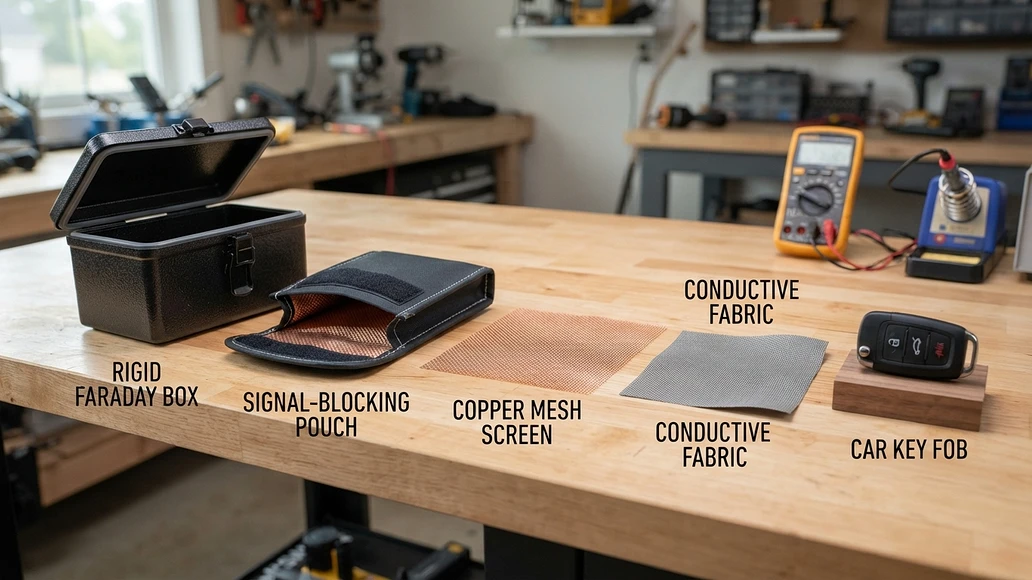
A Faraday cage is an enclosure made from conductive material, such as copper, aluminum, steel, or conductive fabric. When radio frequency energy hits that enclosure, part of the signal reflects away and part is absorbed or dissipated in the material. If the enclosure is continuous enough, the signal inside drops sharply.
This is why elevators, metal rooms, and some steel-heavy buildings can become phone dead zones. They are not perfect Faraday cages, but they can attenuate wireless signals enough to interrupt service.
The important distinction is this: a true RF shield is not just metal. It is metal with continuity. That means the walls, seams, lid, door, and closure all need to maintain conductive contact. A cookie tin with a loose lid may reduce signal strength, but it may not isolate a phone from strong nearby towers or Wi-Fi access points.
Why 5G is not one thing
People often talk about 5G as if it were a single frequency. It is not. In the United States, 5G commonly uses low-band, mid-band, and in some areas mmWave spectrum. Those bands have very different wavelengths, and that changes how easy they are to block and how sensitive they are to gaps.
| 5G band type | Typical frequency range | Approximate wavelength | What it means for shielding |
|---|---|---|---|
| Low-band | About 600 MHz to 1 GHz | About 30 to 50 cm | Longer wavelengths travel farther and can exploit larger leaks. A cage can still block them, but lid fit and seam continuity matter. |
| Mid-band | About 2.5 GHz to 4 GHz | About 7.5 to 12 cm | Common for practical 5G service. Good bags and boxes often block this well if closures are solid. |
| mmWave | About 24 GHz to 40 GHz | About 7.5 to 12.5 mm | Usually easier to stop with solid metal, but tiny gaps and poor seams become much more important. |
This is why one person can say, “My pouch blocks 5G,” and another can say, “Mine leaked.” They may be testing different bands, different signal strengths, or different failure points.
So, can 5G penetrate a Faraday cage?
In theory, a well-designed Faraday cage should block 5G signals. In real life, 5G gets through when the cage is incomplete, poorly sealed, worn out, or not designed for the frequencies involved.
A better way to phrase the answer is this: 5G does not magically defeat Faraday shielding, but sloppy shielding often fails against modern wireless signals.
That is especially true for consumer products marketed with vague phrases like “RFID blocking” or “signal safe” without published attenuation data. RFID blocking is not the same as broad-spectrum shielding for cellular, Wi-Fi, Bluetooth, GPS, and higher-frequency 5G bands.
What determines whether your cage blocks 5G
1. Seam quality
Seams are often the biggest weakness. A solid metal box with a poor lid can perform worse than a carefully made pouch with a well-designed double-fold closure. Any gap can act like a leak path.
2. Mesh opening size
Mesh can work, but the holes must be small relative to the wavelength of the signal. A common rule of thumb is that openings should be smaller than half the wavelength, and in practice smaller is better. For higher frequencies, even tiny openings matter more.
3. Material conductivity
Copper and aluminum are common shielding materials. Steel can also work, especially in rigid enclosures. Conductive fabrics are widely used in Faraday bags and can be effective when layered and properly sewn.
4. Closure design
Roll-top closures, overlapping flaps, conductive hook-and-loop systems, and double-layer designs usually outperform ordinary zippers. A standard zipper by itself is often a weak point.
5. Device contact with the enclosure
If the device touches the conductive shell directly, performance can become less predictable in some setups. It is usually better to place the device inside a nonconductive inner sleeve or wrap so it is isolated from the metal surface.
6. Cable penetrations
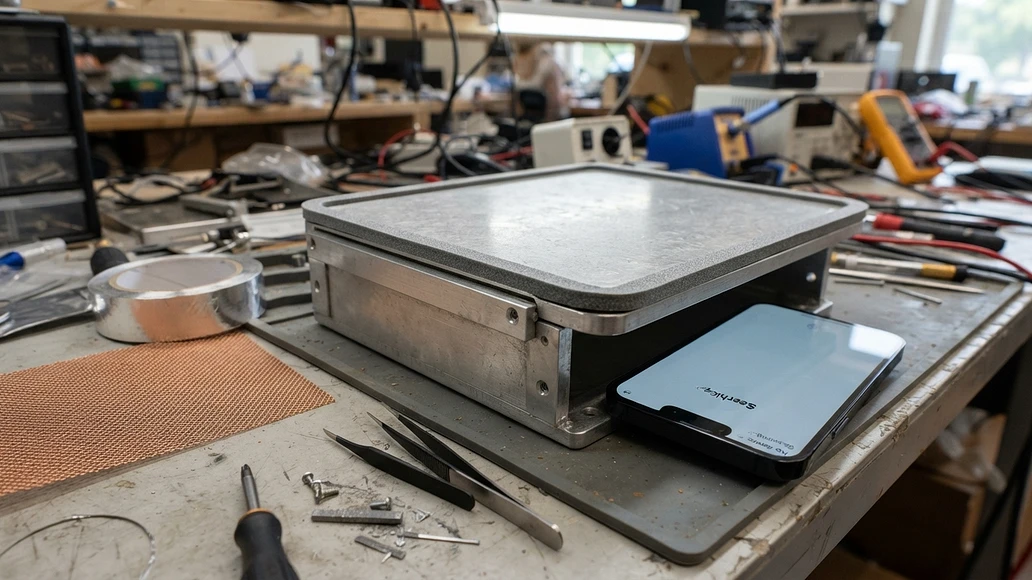
If a cable enters the enclosure, it can act like an antenna and carry energy past the shield. This is one reason professional RF shield boxes use filtered feedthroughs and carefully engineered ports.
How much attenuation is enough?
Shielding effectiveness is usually described in decibels, or dB. Higher numbers mean more signal reduction. For practical preparedness use, the goal is not laboratory perfection. The goal is enough attenuation that the device inside cannot maintain communication.
| Attenuation level | What it usually means in practice | Typical use case |
|---|---|---|
| 20 to 40 dB | Noticeable reduction, but leaks may remain in strong signal areas | Basic reduction, some canopy fabrics, weak-signal environments |
| 40 to 60 dB | Often enough to stop many everyday connections if the closure is good | Decent consumer bags, improved DIY boxes |
| 60 to 85 dB and above | Strong practical isolation across many common wireless bands | Quality Faraday bags, shield boxes, better enclosures |
These are broad ranges, not guarantees. A product can perform well at one frequency and poorly at another. That is why published test curves across a frequency range are more useful than a single marketing claim.
Faraday bags and pouches, are they enough for 5G?
Often, yes. A good Faraday bag can block sub-6 GHz 5G, 4G LTE, Wi-Fi, Bluetooth, GPS, and other common signals. Some premium products also publish performance into the 24 to 40 GHz range. But quality varies a lot.
What separates a serious Faraday pouch from a gimmick is not the label. It is the test data and the closure design. A bag that only claims RFID blocking may do little for a smartphone. A bag with independent attenuation testing over a wide frequency range is much more credible.
| Option | Typical strengths | Typical weaknesses | Best fit |
|---|---|---|---|
| Rigid metal box | Can provide strong shielding if lid and seams are tight | Bulky, easy to ruin with a poor lid seal | Home storage of backup electronics |
| Faraday bag or pouch | Portable, convenient, often effective for phones and key fobs | Wear over time, closure quality varies widely | Travel, daily privacy, vehicle key storage |
| Mesh cage | Can work well when opening size and continuity are correct | Harder to build correctly, leaks at joints are common | DIY projects and larger enclosures |
| Shielding paint | Useful for room-scale attenuation when properly installed | Permanent work, electrical safety concerns, not a simple DIY shortcut | Home projects with professional guidance |
| Conductive canopy or fabric enclosure | Portable room-scale reduction is possible | Often lower attenuation than rigid enclosures, closure gaps matter | Niche privacy or specialty setups |
Why everyday metal spaces kill signal
If you have ever lost service in an elevator or inside a heavily reinforced building, you have seen partial Faraday shielding in action. Metal walls, structural steel, foil-backed insulation, and coated glass can all reduce signal strength. Higher-frequency 5G, especially mmWave, tends to struggle more indoors because it is more easily blocked by walls and metal surfaces.
That does not mean every metal room is a proper Faraday cage. It means wireless coverage is highly sensitive to materials, openings, and geometry.
How to test whether your setup really blocks 5G
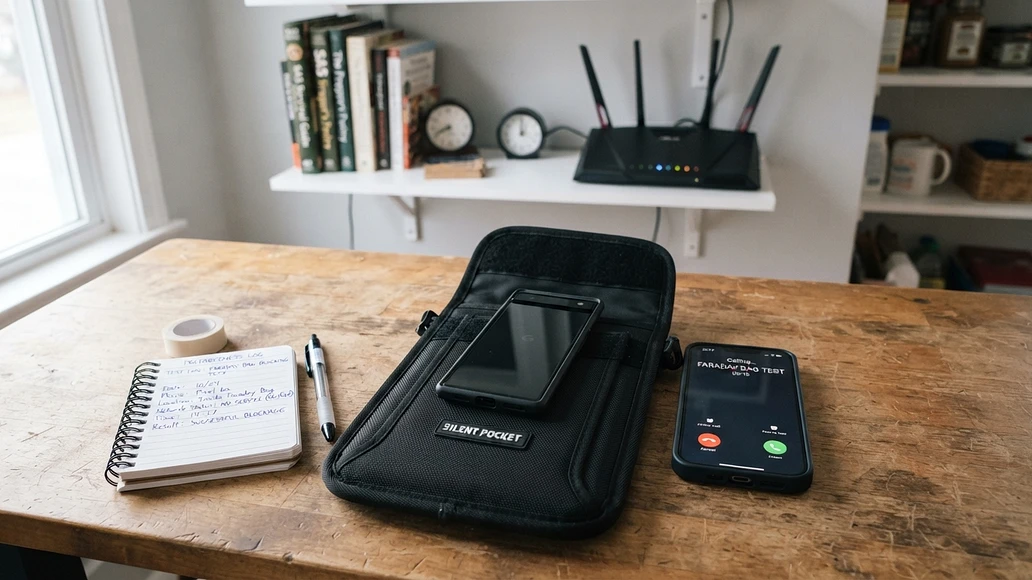
A quick phone-call test is a starting point, not proof. Modern phones use multiple radios and may switch between cellular, Wi-Fi, Bluetooth, GPS, and cached services. To test a cage or bag realistically, use several methods.
| Test method | What it checks | Limitations | Best use |
|---|---|---|---|
| Phone call or text | Basic cellular connectivity | Can miss intermittent leaks, call routing delays, and weak-signal effects | First pass screening |
| Wi-Fi test at 2.4 and 5 GHz | Common local wireless bands | Does not directly prove cellular or mmWave blocking | Checking bag and seam quality |
| Bluetooth accessory test | Short-range radio leakage | Range is short, results depend on device power | Extra leak check |
| Find My or device locator | Whether the phone can still report location or network presence | Can be delayed or cached | Privacy-focused testing |
| GPS map update test | Satellite and assisted location behavior | GPS behavior varies by device and cached data | Supplemental check |
| RF meter or lab test | Measured attenuation across frequencies | Requires equipment or professional service | High-confidence verification |
A practical home test routine
- Turn off Wi-Fi and Bluetooth on the phone so you can isolate cellular behavior first.
- Place the phone in the bag or cage and fully close it.
- Call the phone and send a text. Wait long enough to account for network delay.
- Repeat the test near a strong signal area, such as near a window or where your phone normally has excellent service.
- Turn Wi-Fi and Bluetooth back on, then test whether the phone can reconnect to a nearby router or accessory while enclosed.
- If privacy is your concern, test location features such as Find My or similar device-locator tools.
- Repeat after moving the device inside the enclosure, because some leak paths are directional.
If the phone sometimes connects and sometimes does not, assume the shield is unreliable. For key security or true signal isolation, unreliable is not good enough.
Common DIY mistakes that let signals leak through
| Failure point | What you notice | Likely cause | Practical fix |
|---|---|---|---|
| Loose lid | Phone still rings or reconnects intermittently | Poor conductive contact around the opening | Improve overlap, add conductive gasket material, retest |
| Large mesh openings | Weak reduction, especially at some bands | Openings too large for the target frequencies | Use finer mesh or a solid conductive layer |
| Ordinary zipper closure | Bag works inconsistently | Leak path along the zipper line | Use a bag with a tested roll-top or double-fold closure |
| Single thin layer | Some signals blocked, others still get through | Insufficient attenuation | Use multi-layer shielding or a better enclosure |
| Corrosion or wear | Older bag stops working as well | Damaged conductive fabric or seam degradation | Inspect regularly and replace when performance drops |
| Cable entering the enclosure | Unexpected connectivity remains | Cable acts as an antenna path | Avoid penetrations or use properly filtered feedthroughs |
Do you need grounding?
For blocking ordinary RF signals like 4G, 5G, Wi-Fi, and Bluetooth, grounding is usually not required for a small Faraday cage or bag to work. The enclosure blocks by conductivity and continuity, not because it is tied to earth ground.
Grounding can matter in other contexts, such as lightning protection, static discharge control, or specialized installations. It is not a magic fix for a leaky bag or poorly sealed box. If you are considering permanent shielding tied into household electrical systems, consult a qualified electrician or RF professional. Poor grounding work can create shock and fire hazards.
What the evidence supports, and what it does not
| Claim | Evidence status | Plain-English takeaway |
|---|---|---|
| A properly designed Faraday cage can block 5G | Well supported | Yes, if the enclosure is continuous and tested across relevant bands. |
| Mesh size and seam quality matter | Well supported | Small gaps often determine success or failure. |
| Most quality Faraday bags block sub-6 GHz 5G | Mixed to well supported | Many do, but performance varies and published test data matters. |
| A simple phone-call test proves full protection | Weak | No. It is only a rough screening method. |
| Faraday shielding is proven medical protection from 5G | Weak or mixed | Use shielding mainly for signal control, privacy, and security, not as a substitute for medical advice. |
| Any metal box is a Faraday cage | Inaccurate | Metal helps, but seams, lid fit, and continuity decide real performance. |
Preparedness and privacy uses that make sense
Faraday protection has practical uses that do not depend on fear-based claims. It can help isolate a backup phone, reduce tracking risk, protect a key fob from relay attacks, or keep a device offline until you choose to use it. For emergency planning, it can also be part of a broader communications strategy that includes offline maps, paper contacts, spare power, and non-networked backups.
What it cannot do is replace a full plan. If your phone is isolated, you also lose incoming alerts, calls, and navigation updates. That tradeoff may be useful in some situations, but it should be intentional.
Health claims need caution
Some readers look into Faraday cages because of concerns about EMF or 5G exposure. It is reasonable to want accurate information and peace of mind, but shielding should be framed carefully. Mainstream public-health guidance does not recommend consumer Faraday cages as necessary medical protection for routine daily life.
If you are dealing with headaches, sleep problems, pregnancy concerns, or chronic symptoms that you think may be related to EMF exposure, talk with a licensed healthcare professional. A shielding product may provide comfort or reduce some RF exposure, but it is not a substitute for medical care, prenatal care, or evidence-based treatment.
When to upgrade or replace your setup
Faraday bags and conductive fabrics wear out. Repeated folding, abrasion, moisture, dirty closures, and seam fatigue can reduce performance over time. Re-test any bag or pouch that you rely on, especially if it is used daily in a pocket, glove box, or travel kit.
Also remember that wireless technology keeps evolving. A product that was marketed years ago for basic cell blocking may not have published performance data for newer 5G bands or higher-frequency testing. Updated attenuation charts are worth checking before you buy.
FAQ
Does a microwave oven work as a Faraday cage for 5G phones?
Sometimes it reduces signal a lot, but it is not a reliable or recommended substitute for a proper Faraday cage. Microwave ovens are designed to contain energy at their operating frequency, not to serve as general-purpose RF shield boxes across all wireless bands. Never run a microwave with a phone inside.
Do Faraday cages need to be grounded to block 5G?
No, not usually for small enclosures and bags used to block radio signals. Good conductive coverage and tight seams matter more than grounding for this purpose.
Can 5G still track my phone if it is inside a Faraday bag?
If the bag is working properly and fully isolates the phone, the device should not be able to communicate with the cellular network. But a weak or worn bag may leak enough signal for intermittent contact. Test the bag regularly if privacy matters.
What attenuation level should I look for if I want to stop phone communication?
As a practical target, many users look for products with published performance in roughly the 60 dB to 85 dB range across the bands they care about. More is generally better, but closure quality and real-world testing still matter.
Bottom line
5G can get through a bad Faraday cage, not because 5G is unstoppable, but because many cages and bags are poorly designed or never tested. If you want dependable isolation, focus on continuous conductive coverage, tight seams, small openings, strong closures, and published attenuation data across the right frequency range. Then verify it with more than one home test.
For preparedness and privacy, that practical approach works far better than myths about any random metal box doing the job.
References
- Metal Enclosure Improvement
- Cage de Faraday : guide complet pour comprendre, fabriquer ...
- RF Attenuation Charts Explained: What Faraday Bag Ratings ...
- How To Choose The Best Faraday Bag: A Complete Buying Guide
- Faraday Pouches: How Signal-Blocking Bags Work and When...
- Faraday Cage Buying Guide: How to Choose Effective RF ...
- What Is a Faraday Bag? · The Definitive 2026 Guide | REVIS-1 Learn