Wild Lettuce and Other “Morphine-Like” Plants, What They Are and the Safety Facts That Matter
Many people searching for a plant that works like morphine are really hearing about wild lettuce. Here is what wild lettuce is, how it differs from opium poppy and kratom, what the evidence actually shows, and when self-treatment is not a safe choice.

When people search for a plant that is “like morphine,” they are usually being pointed toward wild lettuce, sometimes called opium lettuce. That nickname can be misleading. Wild lettuce is not opium poppy, it does not contain morphine in meaningful amounts, and it should not be treated as a proven substitute for medical pain care. What it does have is a long history in folk use, a milky latex called lactucarium, and limited early research suggesting some sedative or pain-modulating effects from compounds such as lactucin and lactucopicrin.
That distinction matters, because “resembles morphine” can mean several very different things. It can mean the plant has a milky sap that looks a bit like poppy latex. It can mean people historically used it for discomfort or sleep. Or it can mean a product has opioid-like effects, which is a much more serious safety issue. Those are not the same thing.
This guide explains what wild lettuce is, how to identify it more carefully, how it differs from opium poppy and kratom, why homemade dosing is unreliable, and when pain should be evaluated by a clinician instead of self-treated with an herb.
What people usually mean by a “morphine-like” backyard plant
In prepper and herbal circles, the plant most often described this way is wild lettuce, usually Lactuca virosa or related wild lettuce species. The comparison comes mostly from its bitter white latex, traditional use, and reports of mild sedative effects. It does not mean the plant is chemically the same as morphine.
By contrast, opium poppy, Papaver somniferum, is the true plant source of opium alkaloids such as morphine and codeine. That is a very different botanical and chemical category. Kratom is different again. It is not a poppy or a lettuce, but it can produce opioid-like effects and has much more significant safety concerns, especially with concentrated 7-hydroxymitragynine products.
What “resembling morphine” actually means
The phrase is often used loosely online, so it helps to separate the meanings.
| Meaning of the claim | What it may refer to | Why readers should be cautious |
|---|---|---|
| Visual resemblance | Milky plant latex that looks somewhat like poppy sap | Appearance does not prove the same chemistry or the same effects |
| Traditional use resemblance | Historical use for discomfort, cough, or sleep | Traditional use is not the same as strong human clinical evidence |
| Pharmacologic resemblance | Some sedative or pain-modulating activity in early studies | That still does not mean a plant contains morphine or works like prescription opioids |
| Opioid-like effect | Seen more often in kratom discussions than wild lettuce | This carries higher risk of dependence, overdose, interactions, and delayed medical care |
Wild lettuce vs opium poppy vs kratom
These plants are often lumped together in casual conversation, but they are not interchangeable.
| Plant | Main compounds discussed | Does it contain morphine? | Typical claim | Main safety concerns | U.S. context |
|---|---|---|---|---|---|
| Wild lettuce | Lactucin, lactucopicrin, lactucarium | No meaningful morphine content | Mild natural pain relief or calming effect | Sedation, allergy, misidentification, variable potency, delayed care | Not FDA-approved for pain treatment |
| Opium poppy | Opium alkaloids including morphine and codeine | Yes | Source plant for true opiates | Toxicity, legal issues, misuse risk, dangerous extraction practices | Heavily regulated, not appropriate for home remedy use |
| Kratom | Mitragynine, 7-hydroxymitragynine | No, but can act opioid-like | Natural painkiller or energy booster | Dependence, liver injury, seizures, contamination, overdose risk, stronger concern with 7-OH products | Not FDA-approved, regulatory warnings and varying state rules |
Is wild lettuce the same as opium poppy?
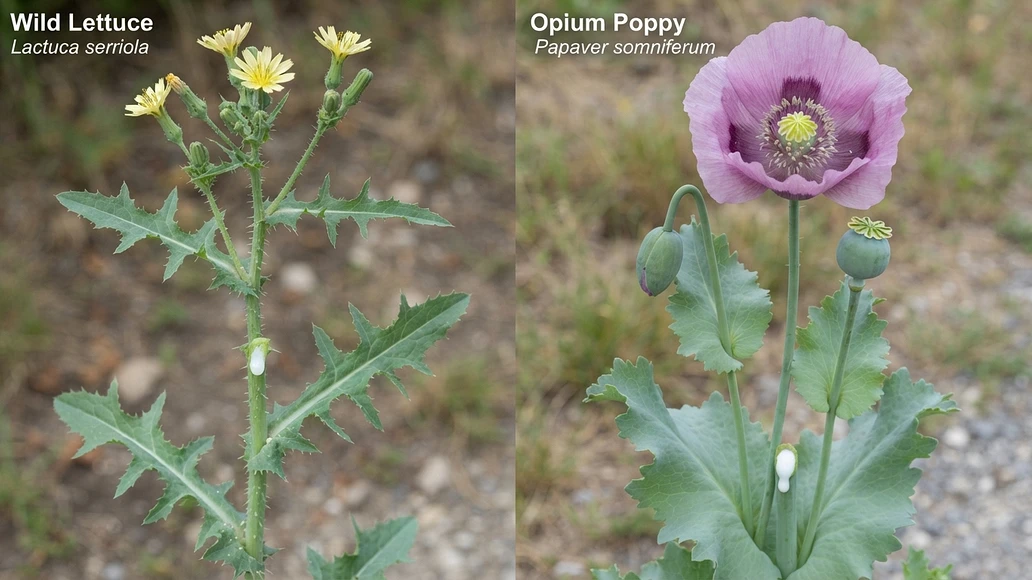
No. This is the most important correction to make. Wild lettuce is not opium poppy. The fact that both can produce a latex does not make them chemically or medically equivalent. Opium poppy is the source of well-known opioid alkaloids. Wild lettuce is not.
That means you should be skeptical of any article, video, or product page that blurs the line and implies wild lettuce contains morphine, codeine, or “natural opiates.” It does not. At most, the evidence supports a more modest claim, that certain compounds in wild lettuce may have mild sedative or analgesic activity in limited research settings.
What is lactucarium, and why do people compare it to opium latex?
Lactucarium is the dried milky latex from certain lettuce species. Historically, it was used in folk medicine for calming, cough, and discomfort. The comparison to opium usually comes from the look of the sap and the old nickname “opium lettuce,” not from the presence of morphine.
That visual similarity is one reason the internet keeps repeating the comparison. But milky latex is found in many plants, and similar appearance does not tell you much about safety, potency, or usefulness. It also does not solve the practical problem that homemade plant material varies widely by species, growing conditions, plant age, and preparation method.
What the evidence says about pain relief
The evidence for wild lettuce as a pain reliever is limited. There is traditional use and some preclinical work, including animal and laboratory research, suggesting compounds in wild lettuce may have analgesic or sedative effects. What is missing is strong, consistent human evidence showing that homemade or over-the-counter wild lettuce products reliably treat pain.
That does not mean the plant has no activity. It means the confidence level is low, and the gap between folk use and dependable treatment is large. For a person with serious pain, that gap matters.
| Claim | Evidence level | Practical takeaway |
|---|---|---|
| Wild lettuce contains morphine or codeine | Very weak, misleading | Do not treat wild lettuce as a true opiate source |
| Wild lettuce may reduce pain perception | Limited, mixed | Possible mild effect, but not proven as a reliable human pain treatment |
| Wild lettuce may be sedating | Limited, plausible | Sedation can be a risk, especially with alcohol or sleep medicines |
| Homemade extracts can be dosed accurately | Poor support | Potency varies too much to assume consistency or safety |
| Kratom has opioid-like effects | Well supported for risk, mixed for benefit | Higher concern than wild lettuce, especially with concentrated products |
| Natural means safe | False | Plant products can still cause toxicity, interactions, and delayed treatment |
Which compounds are studied in wild lettuce
The compounds most often discussed in wild lettuce are lactucin and lactucopicrin. These are not opioid alkaloids. They are different plant chemicals that have been studied for possible sedative or analgesic effects. That is why careful wording matters. A plant can have some pain-related activity without being chemically similar to morphine in the way many readers assume.
For a general reader, the simplest summary is this. Wild lettuce may contain compounds worth scientific interest, but current evidence does not justify treating it as a dependable stand-in for standard pain care.
How wild lettuce is identified
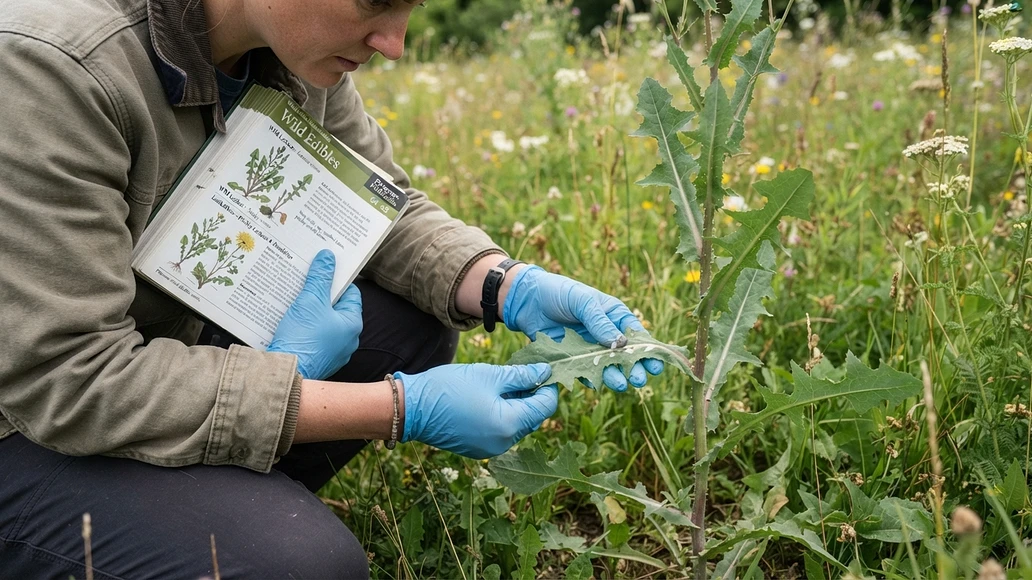
Wild lettuce identification should be approached conservatively. Different species can be confused with one another, and internet plant advice often skips the hard part, which is ruling out lookalikes. Common features people note include taller growth, lobed leaves, yellow dandelion-like flowers in mature plants, and a bitter white latex when cut. But those clues alone are not enough for safe use.
If you are foraging, the safest approach is to identify the plant across multiple features, at multiple growth stages, with a reliable regional field guide or a trained local expert. Never rely on one trait, one photo, or one social media clip.
Why milky latex is not the same as morphine
Milky sap is a plant trait, not a proof of medicinal identity. Many plants produce latex. Some are irritating, some are toxic, and some are simply unrelated to the compounds people think they are getting. This is one reason online “natural morphine” claims can be so misleading. They often jump from appearance to effect without showing the chemistry or the human evidence.
Common lookalikes and misidentification risks
Misidentification is one of the biggest practical dangers in backyard or roadside foraging. A wrong plant can mean no benefit, unexpected side effects, or outright poisoning. Even a correct plant can be contaminated by roadside runoff, herbicides, pesticides, pet waste, or industrial pollutants.
| Risk area | Why it matters | Safer approach |
|---|---|---|
| Wrong species | Lookalikes may not have the same compounds and may be unsafe | Confirm with several field marks and a trusted regional source |
| Immature plants | Young plants can be harder to identify accurately | Wait for more complete growth features before making an identification |
| Contaminated growing site | Roadsides and treated lawns can carry chemicals and pollutants | Avoid harvesting from questionable locations |
| Single-source internet advice | Short videos often oversimplify identification | Cross-check with a field guide, extension resource, or expert |
| Assuming all wild lettuce is equal | Species and growing conditions affect chemistry | Do not assume one plant or patch matches another in effect or safety |
Forms people use, tea, tincture, latex, and extract
Wild lettuce is commonly discussed in forms such as tea, tincture, dried herb, latex, or concentrated extract. The problem is not just whether a form exists. The problem is that these forms are rarely standardized in a way that gives a predictable amount of active compounds.
Tea made from one patch of plants may differ substantially from tea made from another. A homemade tincture may vary by alcohol strength, plant freshness, and extraction time. Latex or resin preparations can be even less predictable. That unpredictability is a major reason not to treat home preparation as equivalent to a tested medication.
Why homemade dosing is unreliable
Homemade extraction and dosing are unreliable for several reasons. Plant chemistry changes with species, soil, weather, maturity, and storage. Preparation methods also change what ends up in the final product. Even if two people follow the same online recipe, the result may not be remotely similar in strength.
For a sedating plant, that matters. Too little may do nothing. Too much may cause dizziness, grogginess, nausea, or unsafe impairment. More importantly, self-treating escalating pain with an unstandardized extract can delay care for appendicitis, gallbladder disease, kidney stones, fractures, infection, nerve compression, or other conditions that need diagnosis.
Side effects and interaction risks
Wild lettuce is often marketed as gentle, but “gentle” is not the same as risk-free. The most relevant concerns are sedation, dizziness, stomach upset, allergic reaction, contamination, and interactions with other substances that depress the central nervous system.
| Concern | Why it matters | Who is at higher risk |
|---|---|---|
| Sedation or drowsiness | Can impair driving, tool use, and judgment | Older adults, people using sleep aids, alcohol, opioids, or benzodiazepines |
| Dizziness or lightheadedness | Raises fall risk and may worsen dehydration | Older adults, people with low blood pressure, people working outdoors in heat |
| Allergic reaction | Plant families can trigger sensitivity in some people | People with known plant allergies or asthma |
| Contamination | Wild-harvested plants may carry chemicals, mold, or pollutants | Anyone harvesting from roadsides, vacant lots, or treated land |
| Drug interactions | Combining sedating substances can amplify impairment | People taking antidepressants, seizure medicines, opioids, sleep medicines, or alcohol |
| Delayed diagnosis | Masking symptoms can postpone needed treatment | Anyone with new, severe, persistent, or unexplained pain |
Who should avoid wild lettuce
Some groups should be especially cautious or avoid it entirely unless a qualified clinician says otherwise. This includes people who are pregnant or breastfeeding, children, older adults, people with liver disease, seizure history, significant mental health conditions, or a history of substance use disorder. It also includes anyone taking medications that can cause sedation or interact unpredictably with herbal products.
| Group or situation | Why avoidance is wise | Better next step |
|---|---|---|
| Pregnancy or breastfeeding | Insufficient safety data and possible exposure to active compounds | Ask an obstetric or primary care clinician before using any sedating herb |
| Children and teens | Limited safety evidence and harder-to-predict effects | Use pediatric guidance for pain instead of herbal experimentation |
| Older adults | Higher risk of falls, confusion, and medication interactions | Review pain options with a clinician or pharmacist |
| Liver disease | Herbal products may add metabolic stress or interact with medicines | Seek medical advice before using supplements |
| Seizure history | Some botanicals and contaminants may lower seizure threshold | Use clinician-guided treatment only |
| Substance use disorder history | Self-treatment with psychoactive products can complicate recovery | Use supervised pain management strategies |
| Use of alcohol, opioids, benzodiazepines, or sleep medicines | Combined sedation can be dangerous | Avoid mixing and ask a clinician about safer options |
Wild lettuce compared with kratom and 7-OH
Wild lettuce and kratom are often mentioned in the same conversations, but they should not be treated as similar-risk products. Wild lettuce is generally discussed as a mild folk remedy with limited evidence. Kratom has much stronger opioid-like concerns, especially at higher doses and especially in concentrated or semi-synthetic 7-hydroxymitragynine products. Those products have drawn increased warnings because of potency, dependence potential, and overdose risk.
If a website jumps from wild lettuce to kratom as if they are just stronger and weaker versions of the same idea, that is a red flag. The safety profile is not the same, and neither product is FDA-approved for pain treatment.
When a plant remedy is not the right choice
Herbal self-care is not appropriate for every kind of pain. Severe pain, worsening pain, pain after trauma, or pain with systemic symptoms needs a different level of attention. Plants may blunt symptoms without addressing the cause.
| Situation | Why self-treatment is a poor fit | Recommended action |
|---|---|---|
| Chest pain or pressure | Could reflect a heart or lung emergency | Seek urgent medical care |
| Shortness of breath | May signal respiratory or cardiac danger | Seek urgent medical care |
| Severe abdominal pain | Could be appendicitis, gallbladder disease, obstruction, or bleeding | Get prompt medical evaluation |
| Pain after a fall or injury | Fracture, internal injury, or concussion may be present | Get examined before masking symptoms |
| One-sided weakness, numbness, or confusion | Possible neurologic emergency | Call emergency services |
| Black stool, bloody stool, or vomiting blood | Possible gastrointestinal bleeding | Seek urgent medical care |
| Fever with worsening pain | Could indicate infection | Contact a clinician promptly |
| Pain lasting more than a few days without improvement | Persistent symptoms need diagnosis | Schedule medical evaluation |
What to try instead for short-term pain relief
For minor, short-term aches, the safest first steps are usually the least dramatic ones. Rest, hydration, gentle movement when appropriate, ice or heat depending on the problem, and evidence-based over-the-counter options may be more predictable than an unstandardized herb. If you use any medicine, follow the label and consider your own health conditions, especially stomach ulcers, kidney disease, liver disease, blood thinners, or other regular medications.
For chronic pain, the answer is rarely one plant or one pill. Better long-term approaches often include diagnosis, physical therapy, sleep improvement, activity changes, and a plan tailored to the cause of pain.

How to interpret online claims about “natural morphine”
A useful rule is to slow down whenever a product or article uses dramatic language. Ask three questions. Is the claim about appearance, tradition, or actual chemistry? Is there human evidence, or only anecdotes and animal studies? Does the source clearly explain who should not use it and when to seek care?
If those answers are vague, the claim is probably overstated. In health topics, especially pain, overstated claims can lead to delayed diagnosis, risky mixing with alcohol or sedatives, and false confidence in homemade preparations.
Legal and regulatory context in the U.S.
In the United States, a plant being sold online does not mean it is approved to treat pain. Wild lettuce products are not FDA-approved analgesics. Kratom products are also not FDA-approved, and federal agencies have repeatedly warned about safety concerns, contamination, and misleading health claims. State rules on kratom vary, and concentrated 7-OH products have drawn especially serious concern.
That legal context matters because marketing language can make a product sound more established than it is. “Natural,” “traditional,” and “herbal” are not proof of effectiveness or safety.
Bottom line
If you came here wondering which plant is usually described as a natural painkiller that resembles morphine, the answer is usually wild lettuce. But the better takeaway is that the comparison is easy to overstate. Wild lettuce is not opium poppy, does not meaningfully contain morphine, and has limited evidence for pain relief in humans. Kratom is a separate category with more serious opioid-like risks, especially in concentrated 7-OH products.
For mild discomfort, some people may still be interested in traditional botanicals. If so, the safest approach is to keep expectations modest, avoid mixing sedating substances, avoid homemade high-potency extracts, and get medical advice when pain is severe, persistent, unexplained, or tied to injury or neurologic symptoms.
References
- FDA, FDA and Kratom
- Yale Medicine, Kratom, What Is It and Is It Safe?
- University of Utah Health, Kratom, What You Need to Know About This Natural Opioid
- Encyclopaedia Britannica, Kratom
- PubMed, Research overview relevant to kratom analgesic potential and safety caveats
- ScienceDaily, Natural product shows pain-killing properties
- Chulalongkorn University, Analgesic and anti-inflammatory discussion related to kratom research