Faraday Cages and Modern 5G, What Actually Gets Blocked
5G is not one single signal, and not every metal box is a real shield. Here is how Faraday cages, bags, and DIY setups perform against low-band, mid-band, and mmWave 5G, plus how to test them without false confidence.

If you want the short answer, a properly built Faraday cage can block 5G signals. The catch is that 5G is not one single frequency, and many so-called cages are really just metal containers with leaks. In practice, whether 5G gets through depends on the band in use, the size of openings, the quality of seams and closures, and how much signal reduction the enclosure actually provides.
For preparedness, privacy, and device security, that distinction matters. A cage or pouch does not need to create a perfect zero-signal environment to be useful. It usually only needs enough attenuation to stop a phone, key fob, or tracker from communicating. But if you need high confidence, especially for modern phones that use several radios at once, you should think in terms of shielding effectiveness, not just a yes or no phone-call test.
Bottom line first
An ideal Faraday cage blocks 5G. A real-world cage may only attenuate it. Low-band 5G can be stubborn because of its longer wavelength and stronger building penetration. Mid-band 5G is common and usually easier to stop with a well-made enclosure. mmWave 5G is heavily blocked by metal and walls, but it is also more sensitive to tiny gaps, poor seams, and weak closures.
| Claim or topic | Evidence status | Practical takeaway |
|---|---|---|
| A properly designed Faraday cage can block 5G signals | Well supported | Good enclosures and tested pouches can reduce signal enough to stop normal communication. |
| Mesh opening size matters | Well supported | Openings must be small relative to wavelength, and seams often matter more than the mesh itself. |
| Higher 5G bands are easier to block but more sensitive to leaks | Well supported | mmWave is strongly attenuated by metal, but tiny gaps can become the weak point. |
| A simple phone-call test proves a cage is fully effective | Weak | Useful as a quick screen, but not enough for serious confidence. |
| Faraday shielding is a proven medical necessity for routine wellness | Weak or mixed | Use shielding mainly for signal control, privacy, and security. For health concerns, rely on medical and public-health guidance. |
What a Faraday cage really does
A Faraday cage is a conductive enclosure that reduces electric fields and radio-frequency energy inside the enclosure. It works mainly through reflection and absorption. When RF energy hits the conductive surface, currents form in the material and most of the energy is redirected or dissipated before it reaches the protected space.
That does not mean any random metal object is automatically a high-performance shield. A cookie tin with a loose lid may block some signals. A purpose-built RF enclosure with continuous conductive contact around every edge will usually block much more. The difference is often measured in decibels of attenuation.
Attenuation is simply signal reduction. Roughly speaking, 20 dB is a noticeable reduction, 40 dB is strong, and 60 to 80 dB is serious shielding that often stops practical communication for consumer devices. The exact amount needed depends on how strong the outside signal is and how sensitive the device radio is.
Why 5G is not one thing
People often ask whether a Faraday cage blocks 5G as if 5G were a single frequency. It is not. In the United States, 5G can operate in low-band, mid-band, and high-band ranges. Those bands behave differently in buildings, vehicles, and enclosures.
| 5G band type | Typical frequency range | Approximate wavelength | Real-world behavior | Shielding note |
|---|---|---|---|---|
| Low-band 5G | About 600 MHz to 1 GHz | About 50 cm to 30 cm | Travels farther and penetrates buildings better | Needs solid coverage and good seam contact. Larger wavelengths can still exploit poor enclosure design. |
| Mid-band 5G | About 2.5 GHz to 4 GHz | About 12 cm to 7.5 cm | Common balance of speed and coverage | Usually blocked well by quality bags, boxes, and mesh with tight seams. |
| mmWave 5G | About 24 GHz to 40 GHz | About 12.5 mm to 7.5 mm | Very fast, short range, poor wall penetration | Metal blocks it readily, but tiny gaps and closure leaks become much more important. |
This is why one bag might block ordinary cellular service but still leak Wi-Fi or higher-frequency signals. It is also why published test curves across a wide frequency range are more useful than a vague claim like “blocks RFID” or “military grade.”
Can 5G penetrate a Faraday cage in theory?
In theory, a continuous conductive enclosure with no meaningful openings can block 5G very effectively. In practice, 5G only “penetrates” when the cage is incomplete, poorly sealed, or not designed for the frequencies involved. Most failures are not because 5G is magical. They happen because the enclosure has a path for energy to leak through.
Common leak paths include lid gaps, zipper edges, mesh openings, hinge areas, cable pass-throughs, and places where conductive layers do not make firm contact. A device touching the conductive wall can also create odd results in some setups, especially improvised ones.
Mesh size, seams, and materials, the details that decide the outcome
A common rule of thumb is that openings should be smaller than about half the wavelength of the signal you want to block, and smaller is generally better. But that is only a starting point. Real shielding performance also depends on material conductivity, thickness, layer count, and whether every seam maintains continuous electrical contact.
For sub-6 GHz 5G, fine metal mesh or solid conductive walls can work well if the enclosure is tightly closed. For mmWave, the shorter wavelength means tiny imperfections matter more. A bag with a weak fold-over closure or a box with a hairline lid gap may still leak enough to matter.
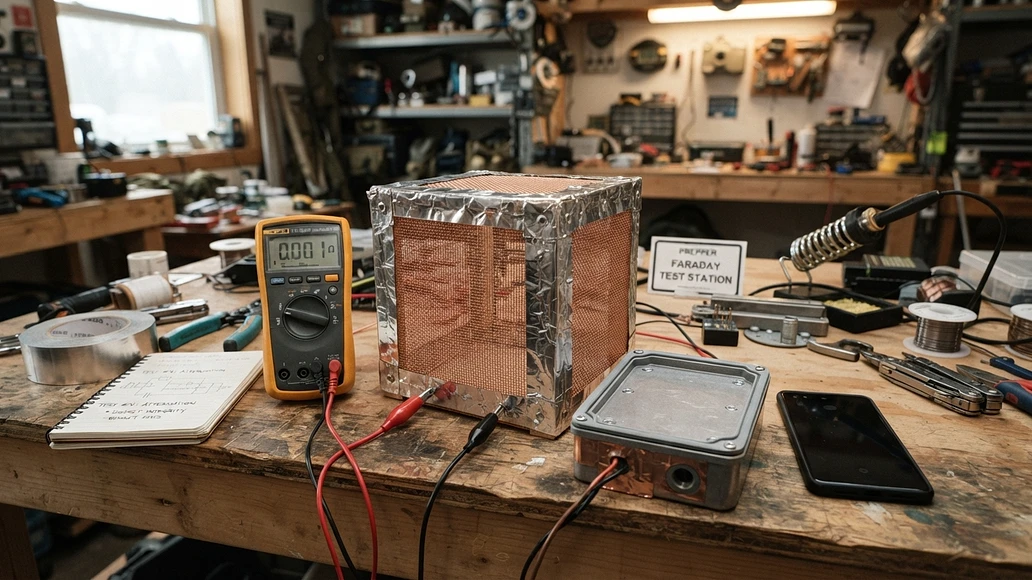
| Design feature | Why it matters | What good looks like | Common failure |
|---|---|---|---|
| Wall material | Conductive surfaces reflect and absorb RF | Copper, aluminum, steel, or tested conductive fabric | Painted or coated surfaces that interrupt conductivity |
| Mesh opening size | Large holes can pass higher-frequency energy | Fine mesh sized for target frequencies | Decorative screen or hardware cloth used without frequency planning |
| Seams and joints | Leaks often occur where panels meet | Overlapping conductive contact, conductive tape, RF gasket | Loose lids, poor overlap, corrosion |
| Closure design | Bags and boxes fail at the opening first | Double fold, conductive layers, tested zipper or gasket | Single zipper, weak Velcro, partial contact |
| Cable entry | Wires can act like antennas | Filtered feedthroughs or no cables at all | Charging cable run through the door gap |
Why everyday metal spaces sometimes kill phone service
Elevators, steel rooms, shipping containers, and some modern buildings can act like partial Faraday enclosures. That is why phones often lose signal in elevators or deep inside metal-heavy structures. Those spaces are not perfect cages, but they show the same principle. The more continuous the conductive shell, the more likely signals are to drop.
That also explains why 5G, especially mmWave, struggles indoors. Carriers often need dense small cells, indoor systems, or carefully placed antennas because higher frequencies do not travel through walls and metal nearly as well as lower bands.
Do Faraday bags and pouches block 5G?
Many do, some do not. A good Faraday bag is basically a flexible conductive enclosure. The best ones publish attenuation data across a wide range, often from low MHz into the GHz range. Better products also explain closure design, because the opening is usually the weakest point.
For practical use, many quality bags can block 4G, sub-6 GHz 5G, Wi-Fi, Bluetooth, GPS, and key fob signals. The weak products are often the ones marketed only as RFID blockers. RFID blocking is a much narrower claim and does not prove strong performance against modern cellular or Wi-Fi bands.
| Option | Typical strength | Pros | Cons | Best use case |
|---|---|---|---|---|
| Metal box with tight conductive lid | Can be very strong if well sealed | Durable, inexpensive, good for home storage | Lid gaps are common, not portable | Home preparedness storage for spare devices |
| Mesh cage | Good when mesh and seams are designed correctly | Scalable, visible construction | Performance depends heavily on opening size and joints | DIY projects and larger enclosures |
| Faraday bag or pouch | Ranges from poor to excellent | Portable, convenient, useful for travel and key fobs | Closures wear out, cheap bags may leak at higher frequencies | Phones, tablets, key fobs, small electronics |
| Shielding paint | Can be strong when properly installed | Covers walls and rooms | Permanent, requires careful installation, electrical safety concerns | Room-level signal reduction with professional help |
| Conductive canopy or fabric enclosure | Moderate to strong depending on fabric and setup | Flexible, removable | Seams, openings, and grounding questions complicate performance | Specialized privacy or testing setups |
How to test whether your cage really blocks modern signals
A quick phone-call test is better than nothing, but it is not enough by itself. Modern phones use cellular, Wi-Fi, Bluetooth, GPS, NFC, and location services. A setup that blocks one radio may still leak another.
Use a layered test process:
Cellular test. Place the phone in the enclosure and try a call and text from another phone. Wait a minute or two, because some devices show stale signal bars briefly.
Wi-Fi test. Connect the phone to a nearby 2.4 GHz or 5 GHz network, then place it in the enclosure and see whether it disconnects.
Bluetooth test. Pair the phone with earbuds, a speaker, or a watch, then check whether the connection drops inside the enclosure.
Location test. Use a device locator feature or mapping app before and after enclosure. GPS and assisted location can behave differently from cellular.
Strong-signal test. Repeat the test near a strong router or in an area with strong cellular service. Weak-signal environments can create false confidence.
If you need serious assurance, use products with published attenuation data or have the setup tested with RF instruments. Lab methods such as ASTM D4935 and IEEE 299 are designed to measure shielding effectiveness across frequency ranges, which is far more informative than one yes or no test.
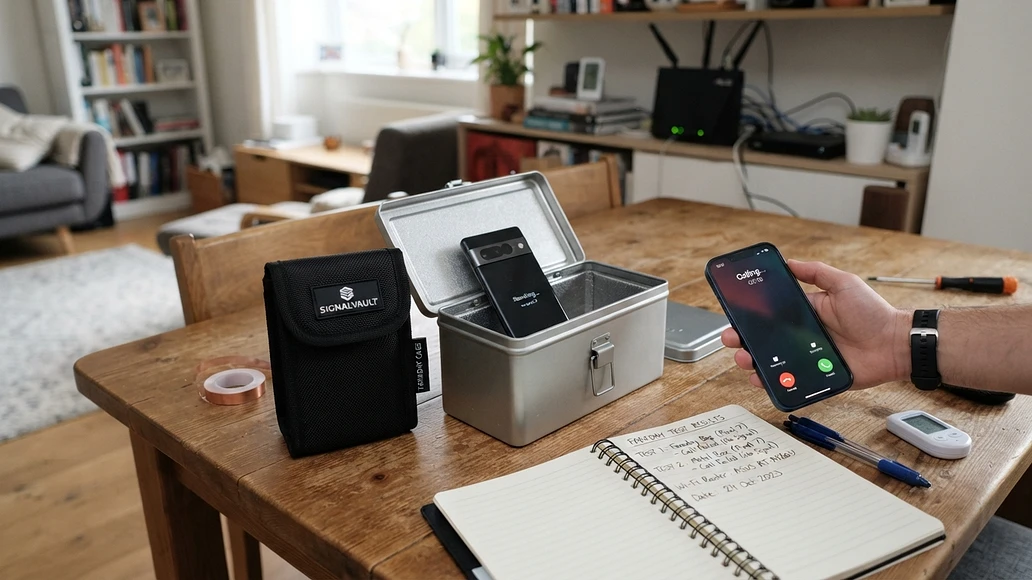
| Test method | What it checks | Difficulty | Main limitation | Best use |
|---|---|---|---|---|
| Phone call or text | Basic cellular blocking | Easy | Does not measure attenuation or other radios | Fast screening test |
| Wi-Fi disconnect test | 2.4 GHz and 5 GHz leakage | Easy | Depends on router power and distance | Useful for finding closure leaks |
| Bluetooth test | Short-range radio leakage | Easy | Very short range can mask weak leaks | Good secondary check |
| GPS or locator test | Satellite and assisted location behavior | Moderate | Results can lag or cache | Broader real-world verification |
| RF instrument test | Measured attenuation across bands | Advanced | Requires equipment or lab access | Best for high-confidence validation |
Common DIY mistakes that let 5G slip through
The most common mistake is assuming metal alone is enough. A metal trash can, ammo can, or tin may work well, but only if the lid makes continuous conductive contact. Paint, rubber seals, oxidation, and poor fit can all reduce performance.
Another mistake is using regular mesh without thinking about frequency. A coarse screen may look substantial but still perform poorly at higher frequencies, especially if the seams are loose. Cheap pouches also fail because of weak closures, worn conductive fabric, or marketing claims that only cover RFID.
One more issue is running cables into the enclosure. A charging cable through a crack can act like an antenna path and defeat the whole point. If you need powered operation inside a shielded enclosure, that moves into professional RF enclosure territory.
Preparedness and security uses that make practical sense
Faraday protection is most useful when you want signal control. That includes storing a spare phone offline, isolating a device from tracking or remote commands, and protecting key fobs from relay theft. For preppers, it can also be part of a communications plan where some devices stay disconnected until needed.
It is not a complete strategy by itself. A phone in a bag cannot receive emergency alerts, calls, or navigation updates. If you isolate a device, you also need offline maps, backup power, printed contacts, and a clear routine for when the device comes back online.
| Use case | How shielding helps | Main caution | Best tool |
|---|---|---|---|
| Car key fob protection | Reduces relay-attack risk | Retest pouch regularly because wear is common | Small tested Faraday pouch |
| Phone privacy during travel | Stops routine radio communication while enclosed | You also lose legitimate connectivity and alerts | Quality phone-sized Faraday bag |
| Emergency spare device storage | Keeps device offline until needed | Battery maintenance and periodic retesting still matter | Sealed metal box or tested bag inside a box |
| Home RF reduction project | Can reduce signal entry into a room | Permanent installations raise electrical and code issues | Professional-grade materials and expert help |
Health claims, what shielding can and cannot promise
This topic often drifts into health claims. It is reasonable to say that a Faraday cage or bag can reduce RF exposure by reducing signal inside the enclosure. It is not reasonable to present consumer shielding as a proven medical treatment or a necessary health measure for pregnancy, chronic illness, or general wellness.
If you are worried about symptoms you believe are related to EMF or 5G, use balanced public-health information and talk with a licensed healthcare professional. If anxiety about exposure is becoming intrusive, that is also a good reason to seek professional support. For most readers, the strongest case for Faraday products is privacy, security, and signal management, not medical treatment.
Do you need grounding?
For blocking radio signals, grounding is often not required. Many Faraday bags, pouches, and shield boxes work ungrounded. Grounding can matter in some specialized situations involving static discharge, safety, or certain low-frequency electrical concerns, but it is not the magic ingredient that turns a leaky container into a good RF shield.
If you are considering permanent room shielding, conductive paint, or anything near household wiring, treat that as an electrical project. Follow local code and consult a qualified electrician or RF professional.
Maintenance matters more than most people think
Shielding materials wear out. Conductive fabrics can crack or delaminate. Closures lose tension. Metal surfaces corrode. Adhesive conductive tape can lift at the edges. A bag that worked last year may not work now, especially if it is folded, carried, or opened daily.
Retest after heavy use, after any modification, and whenever you change devices. New phones and networks may use different bands, and product makers increasingly advertise performance into higher GHz ranges for that reason.
FAQ
Does a microwave oven work as a Faraday cage for 5G phones?
Sometimes, but it is not a dependable storage solution. Microwave ovens are designed to contain energy around the oven's operating frequency, not to serve as certified multi-band shield boxes for phones. Some will block many signals well, others may leak enough to allow partial connectivity. Never run the microwave with a phone inside, and do not rely on it for critical security needs.
Do Faraday cages need to be grounded to block 5G?
No, not usually. For RF blocking, the enclosure quality, continuity, and closure design matter more than grounding. Grounding may be relevant for safety or specialized installations, but it is not required for most bags, pouches, or small enclosures.
Can 5G still track my phone if it is in a Faraday bag?
If the bag is working properly and fully blocks the phone's radios, the phone should not be able to communicate over cellular, Wi-Fi, Bluetooth, or GPS while sealed inside. The risk is not hidden tracking through perfect shielding. The risk is a weak or worn bag that leaks enough signal for intermittent communication.
What attenuation level is enough to stop 5G communication?
There is no single number that guarantees success in every environment, because outside signal strength varies. As a practical rule, higher attenuation is better, and many serious products aim for roughly 60 dB or more across relevant bands. For demanding use, look for published test data across the frequencies you care about, not just a single headline number.
Final takeaway
5G does not magically defeat a Faraday cage. What defeats a Faraday cage is poor design. If the enclosure has continuous conductive coverage, tight seams, and a closure that actually seals, it can block modern wireless signals very effectively. If it is just a metal container with gaps, 5G may still get through, especially as frequencies rise and imperfections matter more.
For most people, the smart approach is simple. Buy or build for the bands you actually need to block, favor tested products over vague claims, and verify performance with more than one kind of test.
References
- Metal Enclosure Improvement
- Cage de Faraday : guide complet pour comprendre, fabriquer ...
- How To Choose The Best Faraday Bag: A Complete Buying Guide
- RF Attenuation Charts Explained: What Faraday Bag Ratings ...
- Faraday Pouches: How Signal-Blocking Bags Work and When...
- What Is a Faraday Bag? · The Definitive 2026 Guide | REVIS-1 Learn