The Prepper's Guide to Potassium Permanganate, Useful, Risky, and Often Misunderstood
Potassium permanganate can disinfect, dry, oxidize, and even help start a fire, but it is not a casual survival chemical. Here is what it can realistically do, where the risks begin, and when safer tools make more sense.

Potassium permanganate, often sold as dark purple crystals, has a reputation in preparedness circles as a compact chemical that can handle several jobs at once. That reputation is partly deserved. In very specific situations, it can help with emergency water treatment, certain external skin soaks, and fire starting. But it is also a strong oxidizer that can burn skin, damage eyes, stain gear, and become dangerous when mixed or measured carelessly.
This article is practical by design, but it is also conservative. It is not medical advice. Any health-related use of potassium permanganate should follow professional instructions, and any accidental swallowing, eye exposure, or significant skin reaction should be treated as a medical issue, not a DIY problem.
What potassium permanganate is, and why people keep it in survival kits
Potassium permanganate, abbreviated KMnO₄, is an oxidizing chemical. In plain language, it reacts aggressively with many organic materials and contaminants. That oxidizing action is why it shows up in water treatment, dermatology soaks, laboratory work, and some industrial processes.
For preparedness, the appeal is simple. A small amount stores for a long time if kept dry, and the same container may serve several niche purposes. The problem is that many survival articles treat those uses as easy, routine, or universally safe. They are not. The same chemistry that makes KMnO₄ useful also makes it hazardous.
Is it really indispensable for preparedness?
No single chemical is indispensable. Potassium permanganate is best understood as a specialized backup item, not a magic solution. It earns a place in some kits because it is compact, versatile, and effective in a few narrow roles. It does not replace a proper water filter, standard first aid supplies, or reliable fire tools.
| Preparedness question | Where potassium permanganate helps | Where it falls short |
|---|---|---|
| Can it do more than one job? | Yes, it can support emergency water treatment, external soaks, and chemical fire starting | Each use requires different handling and carries different risks |
| Is it safer than common alternatives? | Sometimes useful as a backup when standard supplies are unavailable | Usually no, modern filters, bleach, iodine products, and normal fire starters are easier and safer |
| Is it beginner friendly? | Only if the user studies it in advance and labels it clearly | Poor measuring, over-concentration, and accidental mixing can cause harm fast |
| Should every household store it? | Only if adults in the home can handle oxidizers responsibly | Homes with children, pets, or casual storage habits may be better off skipping it |
Evidence for common survival uses
Some uses are grounded in mainstream practice, especially very dilute external skin applications. Others are mostly emergency guidance or chemistry demonstrations. That difference matters.
| Use or claim | Evidence strength | Typical role | Key caution |
|---|---|---|---|
| External skin soaks for weeping eczema, minor infected skin, or drying irritated areas | Well supported | Topical antiseptic and drying agent in very dilute solutions | External use only, dark purple solutions are too strong |
| General skin cleansing in limited situations | Well supported | Short-term external disinfecting support | Not for deep wounds, large burns, or routine casual use |
| Emergency water disinfection | General guidance only | May reduce microbial risk when used carefully | Does not remove chemicals, metals, or sediment, and is not ideal for daily use |
| Fire starting with glycerin | Well supported | Strong oxidizer can trigger ignition | High accidental fire risk, use only in controlled outdoor conditions |
| Foot soaks for athlete's foot or damp skin problems | General guidance to well supported | Drying and antifungal support in dilute form | Too-strong solutions can burn skin |
| Seed treatment | General guidance only | Used in some agriculture and aquaculture settings | Accurate dosing matters, overuse can damage seeds or living systems |
| Odor control or fruit handling tricks | Mixed | Chemistry-based or anecdotal uses | Not standardized for household preparedness |
| Internal treatment for poisoning | Highly specialized and inappropriate for lay use | Historical medical use only | Do not self-treat by swallowing or administering internally |
Emergency water treatment, what it can do and what it cannot
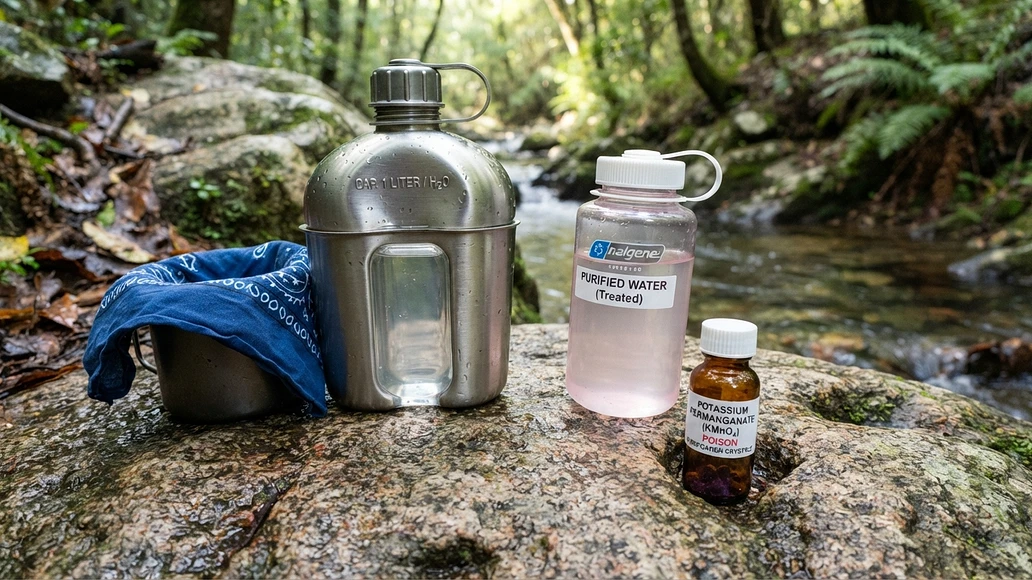
Potassium permanganate is sometimes used in emergencies to reduce microbial contamination in water. The traditional field rule is to add only enough to create a very light pink color, then wait roughly 30 to 60 minutes. That advice reflects practical emergency use, not a modern regulated drinking-water standard.
Before anything else, understand the limits. KMnO₄ does not remove pesticides, fuel, heavy metals, salt, or many industrial contaminants. It also does not physically remove dirt. If the water is cloudy, muddy, or full of debris, pre-filter it through clean cloth or, better yet, use a proper filter before any chemical treatment.
Conservative field process for emergency use only
- Choose the clearest source available.
- Pre-filter visible sediment through clean cloth, coffee filter material, or a proper field prefilter.
- Add a very small amount of potassium permanganate and stir until the water is only faintly pink.
- If the water turns medium pink, purple, or brownish from overuse or contamination reactions, do not assume it is safe. Start over with a fresh batch if possible.
- Allow contact time of at least 30 minutes, and longer if the water is very cold.
- If you have a safer treatment method available, such as boiling, a certified filter, or properly dosed emergency water disinfectant, use that instead.
| Water treatment factor | Best practice | Why it matters |
|---|---|---|
| Water clarity | Use the clearest source and pre-filter first | Sediment shields microbes and consumes oxidizer |
| Solution color | Only faint pink | Darker color suggests excessive concentration |
| Contact time | At least 30 minutes, longer in cold conditions | Oxidation needs time to work |
| Use frequency | Emergency only | Not a preferred daily drinking-water method |
| Contaminants removed | Partial microbial reduction only | Does not solve chemical contamination or salinity |
Topical use for skin problems, where the evidence is strongest
The most defensible household use of potassium permanganate is external skin care in very dilute solutions, especially for wet, irritated, or weeping skin conditions when a clinician has advised it. In dermatology settings, it is used as a drying and antiseptic soak. The key phrase is very dilute. Pale pink is the visual target. Dark pink or purple is too strong for skin.
It should never be swallowed. It should not be used in eyes, on deep wounds, inside body cavities, or as a substitute for proper care of serious infections. People with diabetes, poor circulation, severe eczema, large open areas, or fragile skin should not improvise with it without medical guidance.
| Topical situation | Visual strength guide | How it is generally used | Who should avoid DIY use |
|---|---|---|---|
| Weeping eczema or irritated wet skin | Pale pink only | Short soak or compress, then stop if stinging increases | Children, pregnant people without guidance, those with extensive skin damage |
| Minor superficial skin cleansing | Pale pink only | Brief external rinse or compress | Anyone treating deep cuts, punctures, or burns |
| Foot soak for athlete's foot or damp skin breakdown | Pale pink only | Short soak, then dry feet well | People with neuropathy, diabetes, or broken skin unless advised by a clinician |
| Dark pink or purple solution on skin | Too strong | Do not use | Unsafe for everyone |
If a soak causes pain, blistering, or worsening irritation, stop immediately and rinse with plenty of water. Brown staining on skin or fabric is common, but pain and tissue damage are not normal and should not be ignored.
Fire starting with potassium permanganate
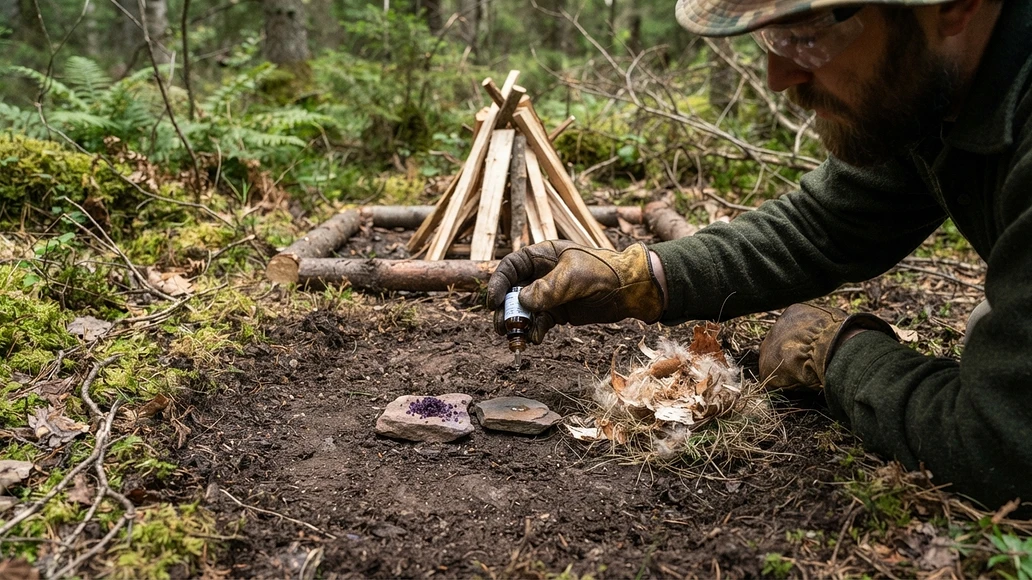
This is the use that gives KMnO₄ its dramatic reputation. As a strong oxidizer, it can react with glycerin and generate enough heat to ignite tinder. The chemistry is real. The danger is real too. This is not a camp trick for casual practice around dry grass, spilled fuel, children, or enclosed spaces.
When it makes sense
It is best viewed as a last-ditch backup ignition method when normal fire tools fail or are unavailable. A ferro rod, stormproof matches, and a lighter are all simpler and safer for routine preparedness.
Safety rules that matter
- Use only outdoors on a prepared fire base with cleared ground.
- Keep the crystals dry and separate from fuels, oils, sugar, glycerin, and random chemicals until the moment of intentional use.
- Wear eye protection if available, and keep your face back from the reaction area.
- Prepare tinder before starting the reaction, because ignition may be delayed and then sudden.
- Never experiment indoors, on countertops, in vehicles, or near stored gear.
Other survival uses, useful, possible, and mostly niche
Potassium permanganate also appears in discussions about hygiene, foot care, seed treatment, deodorizing, and even food handling. Some of these have a basis in real practice. Others are more experimental or anecdotal. For most households, these are secondary reasons to own it, not primary ones.
| Secondary use | Practical value | Reality check |
|---|---|---|
| Foot care | Reasonable in dilute external soaks | Can help dry damp skin and support treatment, but not a cure-all |
| Seed treatment | Possible for experienced growers | Requires precise dosing and is easy to overdo |
| Odor oxidation | Chemically plausible | Safer consumer products usually make more sense |
| Improvised cleaning | Limited | Staining and oxidation can damage materials |
| Fruit handling claims | Low preparedness value | Not a mainstream household use worth prioritizing |
How dangerous potassium permanganate really is
Preparedness content often understates this part. Potassium permanganate is not just a stain-maker. It is corrosive in stronger solutions, damaging to eyes, harmful if inhaled as dust, and dangerous if swallowed. Small crystal quantities can be serious, especially for children. Reported toxicology references place oral LD50 in rats around 1090 mg/kg, and human fatal oral doses have been estimated around 10 grams. You do not need anywhere near those amounts to cause severe burns to the mouth, throat, and stomach.
Long-term exposure to manganese-containing dusts is also a concern in occupational settings. That does not mean a sealed prep bottle creates chronic poisoning by itself, but it does mean you should avoid handling loose crystals carelessly or creating dust in enclosed spaces.
If exposure happens
| Exposure type | Immediate action | Next step |
|---|---|---|
| Swallowed, crystals or solution | Rinse mouth, give a small amount of water or milk if the person is conscious and able to swallow | Call Poison Control and seek emergency care immediately |
| Eye splash | Flush with clean water for at least 15 minutes | Get urgent medical help |
| Skin burn or painful reaction | Remove contaminated clothing and rinse skin thoroughly | Seek medical advice if pain, blistering, or large-area exposure occurs |
| Dust inhalation | Move to fresh air | Get medical help if coughing, wheezing, or breathing trouble develops |
In the United States, Poison Control can be reached at 1-800-222-1222.
Storage and handling at home
If you decide to keep potassium permanganate, storage discipline matters more than quantity. The goal is to keep it dry, clearly labeled, and physically separated from anything it could react with.
| Storage factor | Recommended approach | Reason |
|---|---|---|
| Container | Original container or a compatible, tightly sealed, clearly labeled bottle | Prevents moisture entry and accidental misidentification |
| Location | Cool, dry shelf away from sunlight and heat | Protects stability and reduces accidental reaction risk |
| Separation | Store away from fuels, oils, glycerin, sugar, solvents, and reducing agents | It is a strong oxidizer and can intensify fire |
| Child and pet safety | Locked cabinet, not a loose pouch in a shared bathroom or kitchen | Crystals are dangerous if swallowed |
| Field kit packaging | Secondary sealed bag plus written warning label | Contains leaks and alerts anyone opening the kit |
| Handling | Use gloves, avoid dust, and never dip wet tools into the container | Reduces contamination and skin exposure |
What type should you buy for preparedness?
Buy only from reputable sellers that identify the product clearly and provide safety information. For preparedness, the exact grade matters less than traceability and purity documentation. Avoid mystery packets, unmarked crystals, or products sold with vague claims.
Look for a supplier that provides a safety data sheet and clear labeling. If your intended use includes emergency water treatment planning, remember that municipal and industrial water applications do not automatically translate into safe household dosing. Professional systems use controlled processes, testing, and trained operators.
Who should skip it entirely
Some households are better off not storing potassium permanganate at all. If children or cognitively impaired adults might access it, if you cannot guarantee careful labeling, or if you are likely to forget the dilution rules under stress, safer alternatives are the better preparedness choice.
People with asthma, chronic lung disease, fragile skin, diabetes, vascular disease, or poor wound healing should be especially cautious. Pregnant or breastfeeding people should not improvise topical use without clinician guidance. It should not be used on children unless a medical professional has given explicit instructions.
Potassium permanganate compared with safer modern options
| Item | Main job | Ease of use | Risk level | Best role in preparedness |
|---|---|---|---|---|
| Potassium permanganate | Specialized oxidizer, backup water treatment, external soaks, chemical ignition | Low to moderate, requires knowledge | High if misused | Niche backup for trained adults |
| Unscented household bleach | Water disinfection and sanitation | Moderate, still requires correct dosing | Moderate | Common emergency disinfectant |
| Iodine tablets or drops | Emergency water treatment | Easy to moderate | Moderate, not ideal for everyone | Portable backup water treatment |
| Water filter, certified | Physical removal of many pathogens | Easy | Low | Primary field water tool |
| Alcohol-based antiseptic products | Skin and surface sanitation | Easy | Moderate, flammable | Routine hygiene and first aid support |
| Ferro rod or stormproof matches | Fire starting | Easy to moderate | Lower than chemical ignition | Primary fire kit |
A responsible carry checklist
If you still want to keep potassium permanganate in a survival kit, treat it like a controlled specialty item.
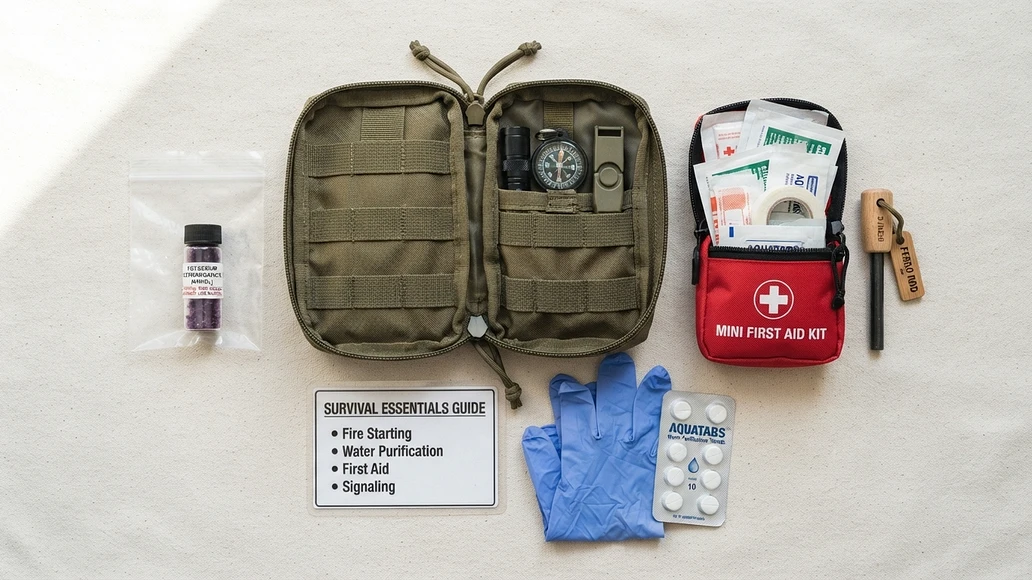
- Store only a small amount in a sealed, labeled container.
- Add a second waterproof bag around the container.
- Include printed instructions that say external use only for skin, emergency water use only, and call Poison Control immediately if swallowed.
- Keep it physically separated from glycerin, fuels, sugar, and other reactive materials unless you intentionally train with that setup.
- Pack safer first-line alternatives first, such as a filter, bleach guidance card, standard wound supplies, and normal fire starters.
- Review the color rule before every trip, pale pink only for any skin or emergency water application.
Common myths that cause trouble
Myth, if a little is good, darker purple is better
False. For skin and emergency water use, darker color usually means too much. Pale pink is the safety cue commonly emphasized in medical and practical guidance.
Myth, it is fine to drink regularly if the water looks treated
False. This is an emergency method, not a preferred daily drinking-water approach.
Myth, it is a good all-purpose wound disinfectant
False. It has a narrow role in certain superficial external skin situations. It is not for deep wounds, punctures, major burns, or serious infections.
Myth, mixing it with household chemicals makes a stronger cleaner
False and dangerous. Random mixing can create heat, fire, toxic conditions, or corrosive injury.
When to skip potassium permanganate and use something else
Use a proper water filter when you have one. Use bleach or approved water treatment tablets when you have clear dosing instructions. Use standard first aid supplies for wounds. Use a ferro rod, lighter, or matches for fire. In most realistic preparedness situations, those tools are safer, simpler, and more reliable.
Potassium permanganate makes the most sense as a backup for informed adults who understand oxidizers and who want one compact item with a few specialized uses. That is a narrower role than many survival articles suggest.
FAQ
Can you drink water purified with potassium permanganate every day, or is it only for emergencies?
It is best treated as an emergency-only option. It may reduce some microbial risk when used correctly, but it is not a preferred daily drinking-water method and does not remove chemical contaminants or sediment.
How much potassium permanganate is too much in a skin soak or foot bath?
If the solution is more than pale pink, it is too strong for routine topical use. Dark pink or purple solutions should not touch skin. When in doubt, do not use it, because over-concentrated solutions can irritate or burn tissue.
Is potassium permanganate safe to use around children and pets?
Not casually. It should be considered a poisoning and burn hazard. If stored at home, it belongs in a locked location with clear labeling, out of reach of children and pets.
What should I do immediately if someone accidentally swallows potassium permanganate crystals or solution?
Rinse the mouth, give a small amount of water or milk if the person is fully conscious and able to swallow, then call Poison Control right away at 1-800-222-1222 and seek emergency care. Do not wait for symptoms.
Can I mix potassium permanganate with other household chemicals to make stronger disinfectants?
No. Do not mix it with household chemicals, fuels, solvents, glycerin, sugar, or cleaners unless you are intentionally using a known fire-starting reaction in a controlled outdoor emergency setting. Random mixing is unsafe.