When the Orange Box Runs Out, How to Keep Your Baking Rising
Out of baking soda during a storm, supply hiccup, or everyday pantry miss? This practical guide explains which substitutes actually work, how to match them to cookies, cakes, pancakes, and quick breads, and how to store leaveners for a more resilient baking pantry.

Running out of baking soda is annoying on a normal day and a real problem when stores are closed, roads are blocked, or you are trying to cook from a deep pantry. The good news is that some substitutes work well. The less good news is that they do not all work the same way, and a bad swap can waste flour, fat, eggs, and fuel.
This guide is written for home bakers who also think in preparedness terms. It covers what baking soda actually does, which replacements are reliable, which ones only help a little, how to match the substitute to the recipe, and how to build a backup plan before you need it.
Important safety note: This is general cooking guidance, not medical advice. If you have kidney disease, heart failure, uncontrolled high blood pressure, are pregnant, or take medicines that affect potassium or sodium balance, check with a clinician before routinely using potassium-based or low-sodium leavening substitutes.
Why baking soda matters, especially in a resilient kitchen
Baking soda is sodium bicarbonate. In baking, it does more than make batter puff up. It helps with rise, browning, spread, crumb texture, and flavor balance. In many recipes, especially those with acidic ingredients like buttermilk, yogurt, brown sugar, molasses, lemon juice, or vinegar, it reacts quickly to release carbon dioxide gas. That gas creates bubbles, and those bubbles help lift the batter or dough.
For preparedness-minded households, that matters because baking soda is a small, cheap ingredient that can determine whether a batch of muffins turns out light or dense, whether pancakes stay tender, and whether a quick bread becomes edible or brick-like. In a disruption, you want substitutions that are tested, predictable, and not wasteful.
Leavening science in plain language
There are three main ways baked goods rise.
- Chemical leavening, such as baking soda, baking powder, and potassium bicarbonate. These create gas through a chemical reaction.
- Mechanical leavening, such as whipped egg whites or creaming butter and sugar. These trap air that expands during baking.
- Steam leavening, where water in the batter turns to steam and pushes the structure upward.
Baking soda needs acid to work well. Baking powder already contains both an alkaline component and an acid component, so it is more self-contained. Some baking powders are double-acting, which means they react a little when mixed and more when heated. That makes them more forgiving than baking soda in many emergency substitutions.
Mechanical options like whipped egg whites and bubbly liquids like club soda can help, but they are not full replacements in every recipe. They are best thought of as partial backups.
The fastest decision guide
| What you have | How to substitute for 1 teaspoon baking soda | Best use cases | What to watch for |
|---|---|---|---|
| Baking powder | Use 3 teaspoons baking powder | Cakes, muffins, pancakes, quick breads | May add extra sodium, can taste flat if recipe depended on soda for browning |
| Potassium bicarbonate | Use 1 teaspoon potassium bicarbonate | Most recipes that call for baking soda | Add a little salt if needed for flavor, avoid if high potassium is a concern |
| Self-rising flour | Replace regular flour with self-rising flour and reduce or remove added salt | Biscuits, pancakes, muffins, simple quick breads | Not ideal for every recipe, wheat-based unless using a gluten-free version |
| Whipped egg whites | Use as a structure and lift helper, not a direct ratio swap | Sponge cakes, light batters | Weak substitute for dense batters, requires gentle folding |
| Club soda | Replace part of the liquid in the recipe | Pancakes, waffles, light batters | Only modest lift, use immediately |
| Homemade baking powder | Mix 1 part baking soda with 2 parts cream of tartar, use 3 teaspoons per 1 teaspoon soda called for | Emergency pantry baking | Best mixed fresh and used promptly |
Baking powder, the most dependable backup for most people
If you are out of baking soda, baking powder is usually the safest first choice. A common rule is 3 teaspoons baking powder for every 1 teaspoon baking soda. This works because baking powder is less concentrated and already includes the acid needed for reaction.
That said, the result will not always be identical. Recipes that use baking soda often rely on it to neutralize acidic ingredients and improve browning. If you swap in baking powder, the flavor can be slightly tangier and the color may be paler.
When baking powder works well
It performs best in pancakes, muffins, snack cakes, and many quick breads. It is also a practical fix for emergency baking because it is easy to measure and forgiving in uneven conditions.
When baking powder is less ideal
It can be less satisfying in cookies where spread, chew, and browning matter a lot. It may also underperform in recipes built around strong acidic ingredients unless you test and adjust.
Using self-rising flour without wrecking the recipe
Self-rising flour already contains baking powder and salt. That makes it useful when a recipe calls for regular flour plus baking soda or baking powder. It is not a direct teaspoon-for-teaspoon substitute for baking soda alone. Instead, you use it to replace some or all of the regular flour in the recipe and then reduce the extra salt and leavening.
A common benchmark is that self-rising flour contains about 1 1/2 teaspoons baking powder and 1/4 teaspoon salt per cup of flour. That means it is most useful in recipes where the flour amount is easy to swap cleanly.
Best uses for self-rising flour
Biscuits, pancakes, muffins, and simple quick breads are the easiest wins. It is less predictable in cookies, specialty cakes, and recipes where flour protein level matters a lot.
Prepper caution
Self-rising flour has a shorter quality window than plain flour because the mixed-in leavening can lose strength over time. Rotate it more often than all-purpose flour, and store it cool and dry in a sealed container.
Potassium bicarbonate, the closest functional match
Potassium bicarbonate is one of the best true replacements for baking soda because it behaves similarly in recipes. In many cases, you can use it 1 to 1 in place of baking soda.
Because it does not bring sodium, some people use it for lower-sodium baking. However, that does not make it universally safer. It increases potassium intake, which can be a serious issue for people with kidney disease, certain heart conditions, or those taking medications that affect potassium levels.
How to use it
Substitute equal amounts for baking soda. If the finished product tastes a little flat, add a small amount of salt elsewhere in the recipe if your diet allows it.
Who should be careful
Anyone on ACE inhibitors, ARBs, potassium-sparing diuretics, or anyone told to limit potassium should not make potassium bicarbonate a routine pantry solution without professional guidance.
Whipped egg whites and club soda, helpful but limited
These are not full chemical replacements, but they can save certain recipes.
Whipped egg whites
Whipped egg whites add trapped air. They work best in sponge-style cakes, soufflé-like batters, and recipes that are already light. They do not replace the pH effects of baking soda, and they are usually not enough for dense muffins or hearty quick breads on their own.
Club soda
Club soda contributes bubbles and liquid. It can improve tenderness and add a little lift to pancakes, waffles, and thin batters. It is not strong enough to stand in for baking soda in most cookies or loaf-style quick breads.
In a grid-down setting, both options come with practical limits. Eggs need safe handling, and club soda loses carbonation once opened and stored warm.
Homemade baking powder from pantry ingredients
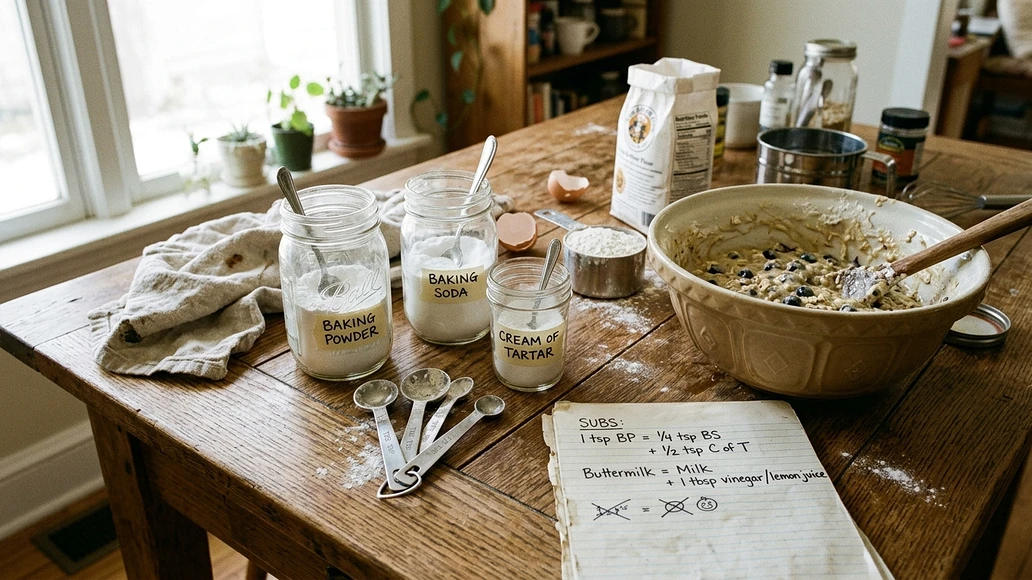
If you still have baking soda but no baking powder, you can make a simple homemade baking powder by mixing 1 part baking soda with 2 parts cream of tartar. Some people add a little cornstarch for storage stability, but for emergency use it is best to mix only what you need and use it right away.
To replace 1 teaspoon baking soda in a recipe, use about 3 teaspoons of this homemade baking powder blend. Since this mix is time-sensitive once combined, do not count on it for long-term pre-mixing unless you have tested your storage conditions.
Why this matters for preparedness
Cream of tartar is a compact pantry item that expands your options. If you stock both baking soda and cream of tartar, you can cover more baking situations with less guesswork.
Best substitute by recipe type
| Recipe type | Best substitute | Backup option | Adjustment notes | Failure risk |
|---|---|---|---|---|
| Cookies | Potassium bicarbonate or baking powder | Self-rising flour in simple drop cookies | Expect some change in spread and browning | Moderate |
| Cakes | Baking powder | Whipped egg whites for sponge-style cakes | Fold gently if using egg whites, avoid overmixing | Low to moderate |
| Muffins | Baking powder | Self-rising flour | Reduce added salt if using self-rising flour | Low |
| Quick breads | Baking powder | Potassium bicarbonate | Dense batters need reliable chemical lift | Moderate |
| Pancakes and waffles | Baking powder | Club soda plus baking powder, or self-rising flour | Use batter promptly for best lift | Low |
| Dense loaves and emergency skillet breads | Potassium bicarbonate or baking powder | Self-rising flour | Do a small test batch first | Moderate to high |
Storage, shelf life, and simple potency tests
Leaveners are lightweight and cheap, but they are not immortal. Heat, humidity, and repeated opening reduce reliability.
| Item | Typical pantry value | Storage advice | Quick potency test |
|---|---|---|---|
| Baking soda | Long shelf life when sealed | Keep dry, tightly closed, away from odors | Stir a little into vinegar. Strong fizz means active |
| Baking powder | Shorter useful life than baking soda | Seal tightly, protect from humidity | Stir a little into hot water. Active powder should bubble |
| Cream of tartar | Good long-term helper ingredient | Store dry and sealed | No simple stand-alone kitchen test, rely on rotation and recipe trials |
| Self-rising flour | Useful but less stable than plain flour | Cool, dry, sealed, rotate regularly | Best tested by small-batch baking rather than a quick fizz test |
| Potassium bicarbonate | Stable when stored dry | Keep tightly sealed and labeled | Small test bake is the most practical check |
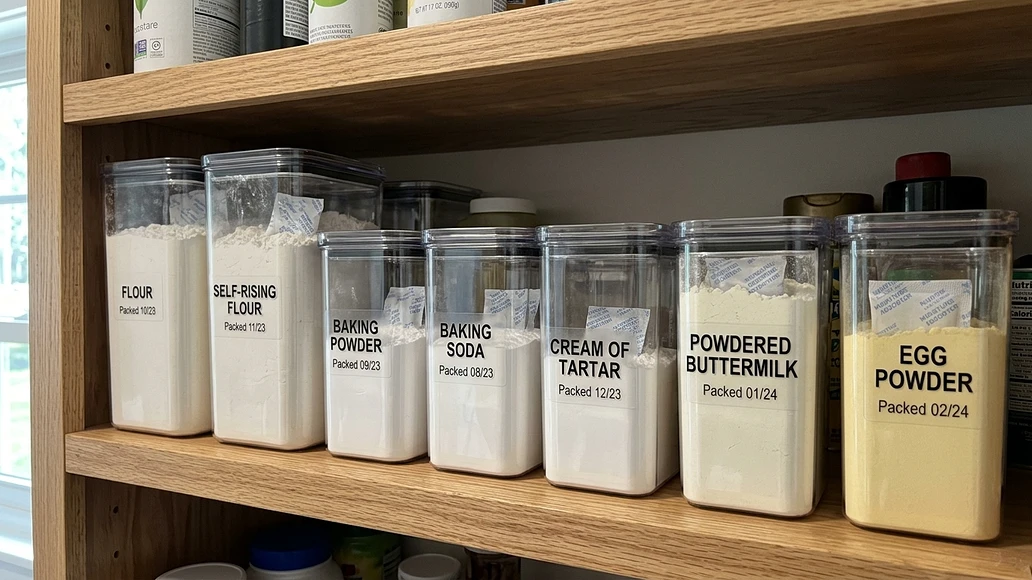
If you bake only occasionally, date each container when opened. In a humid climate, consider smaller containers so you expose less product to air each time.
Low-tech baking when power is out
Substitutions behave differently when heat is uneven. In a conventional oven, the batter gets a predictable rise window. In a Dutch oven, camp oven, solar oven, or stovetop setup, the top and bottom may heat at different rates. That can make weak substitutes fail faster.
What works best off-grid
Baking powder and potassium bicarbonate are usually the most dependable in low-tech setups because they provide more predictable chemical lift. Mechanical methods like whipped egg whites are more fragile if you cannot control heat well.
Practical grid-down tips
- Choose forgiving recipes such as muffins, skillet biscuits, pancakes, or simple quick breads.
- Mix only when your heat source is ready. Chemical leaveners start working early.
- Use smaller pans or smaller portions so the center cooks before the structure collapses.
- Expect less dramatic rise than in a modern oven.
- Test one small batch before committing scarce ingredients.
Common substitution mistakes that waste food
Most failures come from a few repeat errors.
Using baking powder 1 to 1 for baking soda
This is one of the most common mistakes. Baking powder is weaker, so a 1 to 1 swap often gives poor rise.
Ignoring the recipe's acid
If the original recipe used baking soda to balance buttermilk, yogurt, molasses, or vinegar, changing the leavener can also change flavor and browning.
Over-leavening
More is not better. Too much leavener can make batter rise fast, then collapse. It can also leave a bitter, metallic, or soapy taste.
Using partial substitutes as if they were full replacements
Egg whites and club soda can help, but they cannot rescue every recipe. Use them where they fit, not as universal fixes.
Skipping a test batch
If ingredients are scarce, a half batch is cheap insurance. Keep notes on what worked, especially for family recipes.
Health and diet considerations
| Leavener | Main nutrition concern | Who should pay attention | Practical note |
|---|---|---|---|
| Baking soda | Sodium | People limiting sodium, including some with hypertension or heart failure | Used in small amounts, but repeated baking adds up |
| Baking powder | Sodium | People on low-sodium diets | Often used in larger amounts than baking soda in substitutions |
| Potassium bicarbonate | Potassium | People with kidney disease, some heart conditions, or potassium-sensitive medications | Do not assume sodium-free means risk-free |
| Self-rising flour | Wheat and added salt | Gluten-free households and sodium-conscious bakers | Check label and do not assume it fits special diets |
| Buttermilk powder and some baking powders | Possible dairy or corn ingredients | People with allergies or intolerances | Read labels before stocking deep pantry backups |
If your household has medical or dietary restrictions, build your emergency baking plan around ingredients you already know are safe for you.
How to stock a more resilient baking pantry
A good preparedness pantry does not rely on one orange box. It uses layers of backup.
| Item | Why stock it | Priority | Storage note |
|---|---|---|---|
| Baking soda | Cheap, versatile, useful beyond baking | Highest | Keep sealed and dry |
| Baking powder | Most practical direct backup for many recipes | Highest | Rotate more often than baking soda |
| Cream of tartar | Lets you make homemade baking powder and stabilize egg whites | High | Store dry and labeled |
| Self-rising flour | Fast solution for biscuits, pancakes, muffins | Medium | Rotate regularly |
| Potassium bicarbonate | Closest functional substitute, lower sodium option for some | Medium | Label clearly with health cautions |
| Powdered buttermilk | Adds acid and flavor when fresh dairy is unavailable | Medium | Useful for long-term pantry baking |
| Egg powder | Backup for recipes that may use whipped whites or whole eggs | Medium | Follow package storage guidance |
If you want one simple rule, stock both baking soda and baking powder, then add cream of tartar as your next layer of resilience.
Practice before the emergency
The best time to test substitutions is when dinner does not depend on them. Pick two or three family favorites and run small trials. Try the standard version, then a baking powder version, then a self-rising flour or potassium bicarbonate version if appropriate. Write down the ratio, texture, browning, and whether the result was worth repeating.
This turns vague internet advice into a household-specific playbook. That is exactly the kind of low-cost preparation that pays off later.

FAQ
Can I always swap baking powder for baking soda in a 1 to 1 ratio?
No. A more reliable starting point is 3 teaspoons of baking powder for 1 teaspoon of baking soda. Even then, flavor, browning, and texture may change.
What is the best baking soda substitute if I also need to limit sodium?
Potassium bicarbonate is often the closest functional substitute, but it is not appropriate for everyone. People with kidney disease, certain heart conditions, pregnancy concerns, or medications that affect potassium should ask a clinician before using it routinely.
How can I tell if my baking soda or baking powder has gone bad in storage?
Test baking soda in vinegar for strong fizz. Test baking powder in hot water for bubbling. If the reaction is weak, replace it or reserve it for non-baking household uses.
Will my cakes still rise if I only use whipped egg whites instead of baking soda?
Some light cakes can rise with whipped egg whites, especially sponge-style recipes. Dense cakes and quick breads usually need chemical leavening for dependable results.
Is potassium bicarbonate safe for people with kidney or heart problems?
Not always. It can raise potassium intake, which may be unsafe for some people with kidney disease, heart conditions, or certain medications. This is a case where personalized medical guidance matters.
References
- 6 baking soda substitutes every home baker should know
- 9 Best Substitutes for Baking Soda in Sweet Baking Recipes
- 2. Self-Rising Flour
- What can I substitute for baking soda?
- Substitution in Disaster Relief Cooking: Key Strategies for Limited Resources
- If You're Out of Baking Powder or Baking Soda Try These