The Purple Oxidizer in Your Kit, Useful, Risky, and Often Misunderstood
Potassium permanganate has a reputation as a do-everything prepper chemical, but its real value depends on careful handling, very dilute use, and knowing when safer tools are better. Here is a practical guide to what it can do, what it cannot do, and how to store it responsibly.

Potassium permanganate, often sold as dark purple crystals, has long been treated like a miracle item in preparedness circles. The appeal is easy to understand. A tiny amount can color water, oxidize organic material, help start a fire under controlled conditions, and serve as a very dilute external skin soak. But the same chemistry that makes it useful also makes it hazardous. It is a strong oxidizer, it can burn skin and eyes, and swallowing even a small amount can be dangerous.
This article is for general education only and is not medical advice. Any health-related use should follow professional instructions. If potassium permanganate is swallowed, gets in the eyes, or causes significant skin pain or blistering, seek urgent medical help or contact Poison Control right away.
What potassium permanganate is, and why people keep it in survival gear
Potassium permanganate, abbreviated KMnO₄, is an oxidizing chemical. In plain language, it reacts aggressively with many organic materials and reducing agents. That is why it has several very different uses. In industry and water treatment, it is used to oxidize contaminants. In dermatology, very dilute solutions may be used externally as a drying and cleansing soak for certain skin conditions. In survival settings, it is often discussed for emergency water treatment, fire starting, and hygiene.
Its color is part of its practical appeal. Very weak solutions appear pale pink. Stronger solutions become bright pink, then purple. That visible color change gives users a rough warning sign. If a skin soak looks dark pink or purple, it is too strong for casual topical use.
The problem is that many survival articles stop at the clever uses and skip the limits. Potassium permanganate is not a harmless all-purpose camp chemical. It is a niche item that rewards precision and punishes guesswork.
Is it really essential for preparedness?
For most households, no single chemical is indispensable. Potassium permanganate can be useful, but it is best understood as a specialized backup item rather than a first-choice solution for everything.
| Preparedness question | Where potassium permanganate helps | Where it falls short |
|---|---|---|
| Can one small container do several jobs? | Yes, it can support emergency water treatment, controlled fire starting, and some external hygiene uses. | Each use requires different handling, and mistakes can cause burns, poisoning, or accidental fire. |
| Is it the best option for routine water safety? | Only as an emergency measure when better methods are unavailable. | Filters, boiling, and approved disinfectants are usually safer and easier to dose correctly. |
| Is it a good first aid staple? | Only for specific external uses in very dilute solutions. | It is not for deep wounds, not for internal use, and not a substitute for proper wound care. |
| Is it a reliable fire starter? | Yes, the chemistry is real when paired with the right reactants. | It is more hazardous and less forgiving than matches, lighters, or a ferro rod. |
If you already have strong water filters, a dependable fire kit, and a basic first aid setup, potassium permanganate becomes less important. If you choose to carry it anyway, do so because you understand its narrow strengths, not because it is magic.
Emergency water treatment, what it can do and what it cannot
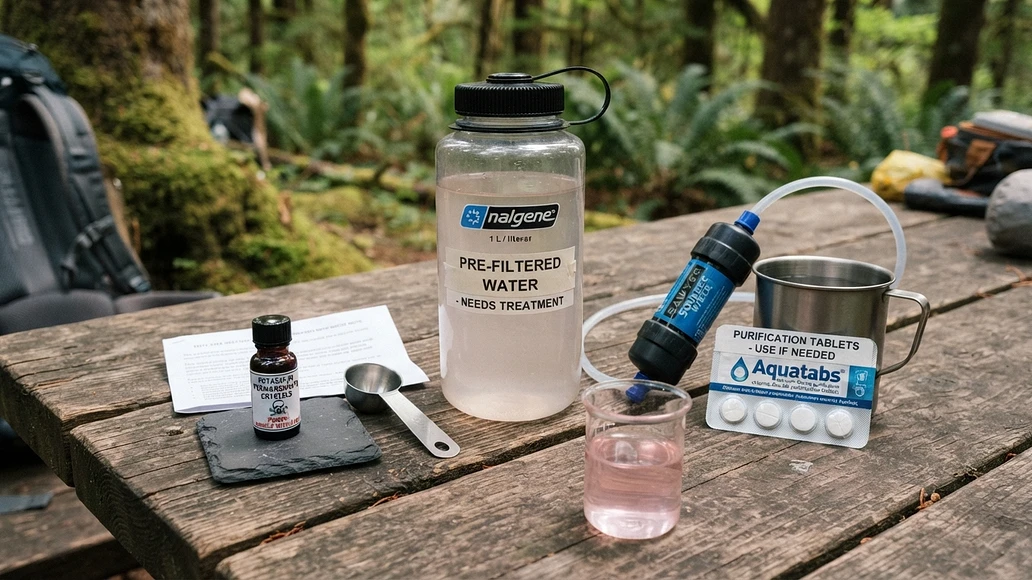
Potassium permanganate is sometimes used in emergencies to reduce microbial risk in water. The traditional field guidance is to add only enough to create a very light pink color, then allow contact time before use. That said, this is not equivalent to regulated drinking water treatment, and it does not remove chemical pollutants, heavy metals, fuel contamination, or sediment on its own.
Before any chemical treatment, cloudy water should be pre-filtered through clean cloth, coffee filters, or a proper field filter to remove visible debris. Cleaner water gives any disinfecting step a better chance to work.
Practical emergency approach
- Pre-filter the water to remove dirt and suspended material.
- Add only a tiny amount of potassium permanganate, aiming for a faint, pale pink color.
- If the water turns medium pink or purple, it is too concentrated for casual emergency use.
- Let the water stand for at least 30 minutes, and longer if the water is cold.
- If a safer modern option is available, such as boiling, an approved backpacking purifier, or labeled water disinfection tablets, use that instead.
This method is best viewed as risk reduction, not a guarantee of potability. It may lower microbial load, but it is not a complete treatment system. It also requires judgment that many people will not have under stress.
| Water treatment method | Best use case | Ease of use | Main risk | Notes |
|---|---|---|---|---|
| Potassium permanganate | Last-resort emergency use | Low to moderate | Overdosing and incomplete treatment | Does not remove chemicals or sediment. Color-based dosing is imprecise. |
| Boiling | Biological contamination | Moderate | Fuel use and time | Reliable for microbes when done correctly. |
| Backpacking filter | Routine field water | High | Filter clogging or misuse | Often easier and safer for most users. |
| Chlorine dioxide tablets | Planned emergency kits | High | Wait time | Standardized dosing is a major advantage. |
| Unscented household bleach | Home emergency treatment | Moderate | Incorrect concentration or expired product | Works best when the label strength is known. |
Topical skin use, where the evidence is strongest
The best-supported household use of potassium permanganate is external skin care in very dilute solutions, usually as a soak or compress for selected skin problems under medical guidance. It has been used as a cleansing and drying agent for weeping eczema, some minor infected skin conditions, and certain foot problems. The key phrase is very dilute. Dermatology guidance commonly describes the correct appearance as pale pink.
Dark pink or purple solutions are too strong for casual skin contact. Concentrated solution can irritate or burn skin and can seriously injure eyes. It also stains skin, fabric, tubs, and countertops.
Important limits for first aid use
Potassium permanganate is for external use only. It should not be swallowed. It should not be used in deep wounds, punctures, large burns, or serious infections as a do-it-yourself treatment. People with diabetes, poor circulation, fragile skin, or significant skin disease should not improvise with it outside professional care.
| Use | Evidence strength | Typical visual target | Main caution |
|---|---|---|---|
| External soak for weeping skin conditions | Well supported | Pale pink | Too-strong solution can burn or irritate skin. |
| General skin cleansing in selected cases | Well supported | Pale pink | External use only. Avoid eyes and mucous membranes. |
| Foot soak for athlete's foot or damp skin problems | General guidance to well supported | Pale pink | May help symptoms, but not always a complete cure. |
| Deep wound treatment | Poor choice for home use | Not recommended | Seek proper medical care instead. |
| Internal use for poisoning or infection | Highly specialized and unsafe for lay use | Not applicable | Do not attempt. |
If you cannot measure carefully, cannot identify a pale pink dilution confidently, or are treating a child, skip it and use a safer, simpler option recommended by a clinician.
Fire starting, real chemistry with real hazards
One reason survivalists like potassium permanganate is that it can ignite when combined with certain materials, especially glycerin. This is not a myth. It is a genuine oxidation reaction that can produce enough heat to start combustion. Some people also discuss sugar-based methods, but these are less straightforward and still hazardous.
The fact that it works does not mean it belongs in every fire kit. A ferro rod, stormproof matches, or a quality lighter is easier to use, easier to teach, and far less likely to create a chemical accident.
Safety rules if you study the reaction
- Treat it as a controlled demonstration or emergency-only skill, not a casual camp trick.
- Keep the crystals dry and separate from fuels, oils, and random chemicals.
- Use eye protection and keep your face back from the reaction area.
- Prepare tinder first, because the reaction can be delayed and then flare quickly.
- Never experiment indoors, in dry grass, or near stored gear.
Accidental mixing is the hidden risk. A bottle of crystals leaking into a kit that also contains glycerin, sugary residue, or other reactive materials is not a harmless mess. It can become a fire hazard.

Other survival uses, from practical to questionable
Potassium permanganate gets credited with a long list of extra uses, including foot care, deodorizing, seed treatment, pond treatment, and even fruit handling. Some of these have a real basis in chemistry or agriculture. Others are more niche, outdated, or poorly standardized for household use.
| Claimed use | Evidence quality | Practical value for most households | Bottom line |
|---|---|---|---|
| Foot soaks for fungal or damp skin issues | Moderate to strong | Moderate | Can be useful when properly diluted, but not for everyone. |
| Seed treatment | General guidance | Low to moderate | Requires accurate dosing. Better suited to informed growers. |
| Pond or water system oxidation | General guidance in professional contexts | Low | Not a casual home treatment method. |
| Odor control | Mixed | Low | Safer products usually make more sense. |
| Fruit handling or ripening-related use | Mixed | Low | Not a mainstream preparedness use. |
For the average prepper, the most realistic non-fire uses are emergency water treatment as a backup and limited external skin applications under clear instructions. Everything else is more specialized.
How dangerous is it, really?
The short answer is that potassium permanganate deserves respect. It is corrosive to tissues in stronger concentrations, can cause severe eye injury, and is toxic if swallowed. Safety data sources report an oral LD50 in rats around 1090 mg/kg, and human fatal doses have been estimated around 10 grams. Those figures are not a recipe or a threshold to test. They simply show that a small container can contain enough material to do serious harm, especially to a child.
Ingestion can burn the mouth, throat, esophagus, and stomach. Eye exposure can cause major irritation and possible lasting damage. Dust inhalation can irritate the respiratory tract. Long-term manganese exposure in occupational settings has also been associated with lung and neurologic problems.
What to do after accidental exposure
| Exposure type | Immediate action | What not to do | Next step |
|---|---|---|---|
| Swallowed crystals or solution | Rinse mouth. Give a small amount of water or milk if the person is awake and able to swallow. | Do not induce vomiting. Do not try home antidotes. | Call Poison Control or seek emergency care immediately. |
| Eye splash | Flush gently with clean water for at least 15 minutes. | Do not rub the eye. | Get urgent medical evaluation. |
| Skin irritation or burn | Remove contaminated clothing and rinse skin thoroughly. | Do not keep using the solution if pain increases. | Seek medical advice if pain, blistering, or large-area exposure occurs. |
| Dust inhalation | Move to fresh air. | Do not stay in the exposure area. | Get medical help if coughing, wheezing, or breathing trouble develops. |
Storage and handling at home
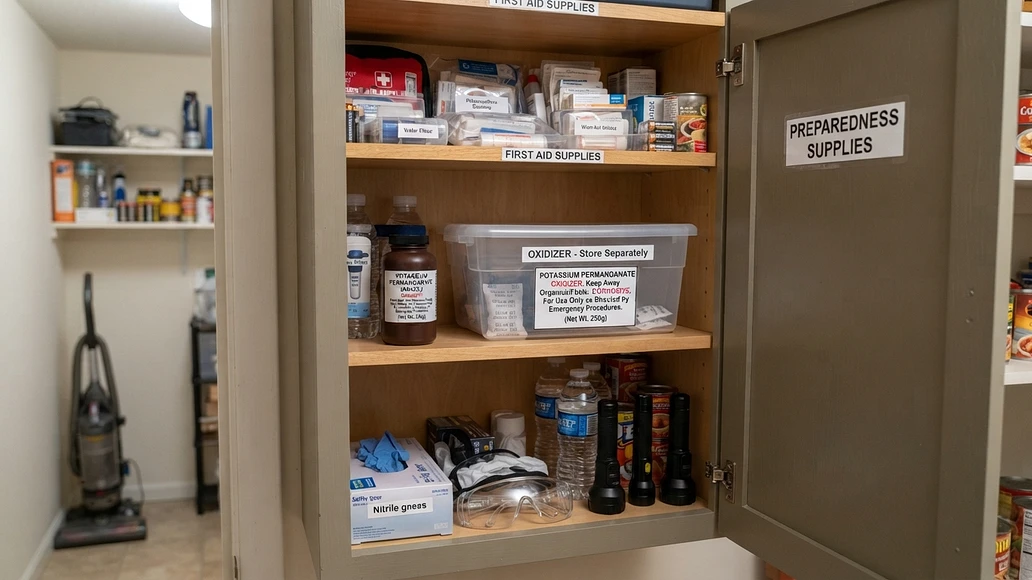
If you decide to keep potassium permanganate, storage discipline matters more than quantity. It should be kept dry, clearly labeled, and physically separated from fuels, glycerin, sugar, solvents, oils, and any unknown chemicals. Child-resistant storage is essential.
| Storage factor | Best practice | Why it matters |
|---|---|---|
| Container | Original labeled container or a chemically compatible, tightly sealed bottle | Prevents moisture entry and confusion. |
| Location | Cool, dry cabinet away from heat and sunlight | Reduces degradation and accidental reactions. |
| Separation | Store away from glycerin, fuels, sugar, oils, and reducing agents | Prevents unintended ignition or violent reaction. |
| Labeling | Add clear warnings such as OXIDIZER, EXTERNAL USE ONLY, DO NOT SWALLOW | Helps family members and future-you avoid mistakes. |
| Access control | Locked or high storage, away from children and pets | Small amounts can still be dangerous. |
| PPE | Use gloves and eye protection when handling crystals | Reduces risk of burns, staining, and eye injury. |
What type should you buy?
Preparedness buyers will see technical, laboratory, aquarium, and water-treatment related products. The main issue is not just purity. It is whether the product is properly labeled, sealed, and sold with enough documentation to identify what it is. Avoid mystery powders, repackaged unlabeled bags, or products with vague sourcing.
For a home kit, smaller quantities are usually smarter than bulk. A tiny amount goes a long way, and large quantities increase storage risk without adding much practical value for most families.
| Product type | What to look for | Concern |
|---|---|---|
| Lab or reagent grade | Clear labeling, supplier documentation, sealed packaging | May be more than most households need. |
| Water-treatment related product | Intended-use details and supplier credibility | Professional applications do not automatically translate to home drinking water use. |
| Aquarium or pond product | Exact chemical identity and concentration | Instructions may be aimed at non-potable systems, not human use. |
| Loose repackaged crystals | Best avoided | Unknown purity, weak labeling, and higher misuse risk. |
Who should avoid using it at home
Some people should not improvise with potassium permanganate at all. That includes children, anyone who cannot measure carefully, people with asthma or significant respiratory sensitivity, and those with fragile or compromised skin. Pregnant or breastfeeding people should not experiment with home-prepared solutions without medical guidance. People with diabetes, vascular disease, or poor wound healing should not use it casually on skin problems.
If you are the sort of person who wants one simple, low-error tool, potassium permanganate is probably not for you. Preparedness is often better served by boring, standardized products than by clever chemistry.
Potassium permanganate compared with simpler alternatives
| Tool or chemical | Primary role | Ease of use | Risk level | Best takeaway |
|---|---|---|---|---|
| Potassium permanganate | Niche oxidizer for emergency water treatment, external soaks, and fire starting | Low to moderate | High if misused | Versatile, but unforgiving. |
| Unscented bleach | Emergency water disinfection and sanitation | Moderate | Moderate | More standardized for home emergency planning. |
| Iodine tablets or tincture | Water treatment in some field settings | Moderate | Moderate | Simpler dosing, but not ideal for everyone. |
| Alcohol-based antiseptic products | Skin sanitation on intact skin | High | Moderate | Far simpler for routine first aid tasks. |
| Backpacking water filter | Field water treatment | High | Low to moderate | Usually the best first purchase for outdoor use. |
| Ferro rod or stormproof matches | Fire starting | High | Low | Better than chemical ignition for most people. |
A responsible checklist if you choose to carry it
- Store only a small amount in a sealed, clearly labeled container.
- Keep written instructions with it, including external-use-only warnings.
- Do not rely on memory for dilution. Include a note that skin solutions should be pale pink only.
- Pack it far away from glycerin, fuels, sugar, and food items.
- Carry safer primary tools first, such as a filter, matches, and standard first aid supplies.
- Add Poison Control contact information to your kit notes.
- Do not let untrained family members experiment with it.
Common myths that cause trouble
Myth, if a little works, more works better
False. With potassium permanganate, stronger often means more dangerous, not more effective.
Myth, it is fine to drink if the water is purple enough
False. Dark color signals over-concentration. Emergency water treatment guidance aims for only a faint pink tint, and even then it is a backup method, not a daily routine.
Myth, it is a good all-purpose wound medicine
False. It has limited external uses and is not appropriate for deep wounds, serious burns, or major infections.
Myth, mixing it with household chemicals makes a better disinfectant
False and dangerous. Random chemical mixing can create heat, toxic byproducts, or fire risk.
When to skip it and use something else
Skip potassium permanganate when you have access to a proper water filter, chlorine dioxide tablets, boiling, standard wound-cleaning supplies, or ordinary fire tools. Skip it if you are treating a child, dealing with a serious wound, trying to purify chemically contaminated water, or working in a cramped indoor setting. In most modern preparedness plans, safer and more standardized tools should do the heavy lifting.
FAQ
Can you drink water treated with potassium permanganate every day?
No. It is better treated as an emergency-only option when safer, standardized methods are unavailable. It is not a preferred routine drinking-water method for home use.
How much is too much in a skin soak or foot bath?
If the solution is more than pale pink, it is too strong for casual topical use. Dark pink or purple is a warning sign. When in doubt, do not use it.
Is it safe around children and pets?
Not casually. It should be stored securely, clearly labeled, and out of reach. Children are at higher risk from accidental swallowing and skin burns.
What should I do if someone swallows it?
Rinse the mouth, give a small amount of water or milk if the person is awake and can swallow, and contact Poison Control or emergency care immediately. Do not induce vomiting.
Can I mix it with other household chemicals to make a stronger disinfectant?
No. Do not mix potassium permanganate with random chemicals. It is a strong oxidizer and can react dangerously, including causing heat or fire.