Can Your Kitchen Microwave Really Shield Electronics? What It Does, What It Doesn't
A microwave oven uses Faraday cage principles to keep cooking energy inside, but that does not make it a dependable EMP shelter. Here is the practical, safety-first answer, plus better options for signal blocking and home preparedness.

Many people have heard that a microwave oven is basically a Faraday cage. That idea is partly true, but it needs an important qualifier. A microwave oven is designed to contain microwave energy at a specific frequency used for cooking. That does not automatically make it a reliable shield for every kind of radio signal, and it definitely does not make it a proven solution for EMP or solar storm protection.
If you want the short answer, here it is. A microwave oven uses Faraday cage principles, but only within the limits of its design. It is a good example of frequency-specific shielding, not a universal protective box.
What a Faraday cage actually is
A Faraday cage is a conductive enclosure that reduces the electric fields and radio frequency energy reaching the space inside it. In simple terms, the metal shell redirects or absorbs electromagnetic energy so less of it gets through to the contents.
For a Faraday cage to work well, several details matter. The enclosure needs good electrical continuity, minimal gaps, and openings that are small relative to the wavelength of the signal you are trying to block. In many real-world designs, seams, latches, vents, cords, and poorly fitted doors become the weak points.
That is why people often overstate the term. Not every metal box is a high-performance Faraday cage. Some metal containers provide partial shielding. Others work well only across a narrow range of frequencies.
| Feature | Basic metal container | Microwave oven | Purpose-built Faraday bag or cage |
|---|---|---|---|
| Main purpose | Storage or enclosure | Contain 2.45 GHz cooking energy | Broad RF shielding for electronics |
| Electrical continuity | Varies widely | Engineered around cavity and door system | Designed specifically for shielding |
| Openings and seams | Often large or poorly sealed | Controlled, but not optimized for all threats | Usually minimized and tested |
| Best use case | General storage | Cooking food safely | Protecting devices from RF exposure or storage risks |
| EMP suitability | Unknown | Unreliable | Better option, though quality still matters |
How a microwave oven keeps radiation inside
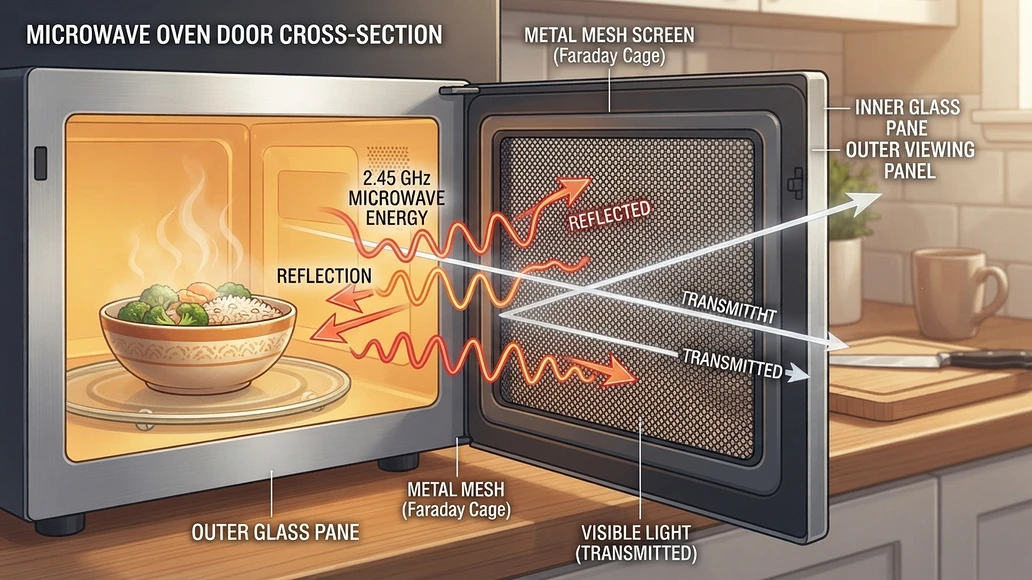
A microwave oven generates radio frequency energy, usually around 2.45 GHz, using a magnetron. That energy bounces around the metal cavity and is absorbed by water-rich food. The oven body is metal, and the door includes a metal mesh and sealing structure that help keep the microwave energy inside while still letting you see through the window.
This is why the oven can heat food without flooding the kitchen with the same level of energy. The cavity acts like a shielded chamber for the frequency it was built to contain.
The key phrase is the frequency it was built to contain. Microwave ovens are not designed as broad-spectrum protective enclosures for every electromagnetic threat.
Why the door screen blocks microwaves but not visible light
The holes in the door mesh are much smaller than the wavelength of the microwave energy used for cooking, but much larger than the wavelength of visible light. That is why light passes through so your eyes can see inside, while the cooking-frequency energy is largely reflected or blocked.
This is one of the easiest ways to understand why frequency matters. Shielding is not just about whether something is metal. It is also about hole size, seam quality, and the wavelength of the signal involved.
So, is a microwave oven technically a Faraday cage?
In casual conversation, yes, it is fair to say a microwave oven behaves like a Faraday cage. In technical terms, the more accurate answer is that it is a shielded metal cavity engineered to confine microwave energy at its operating frequency.
That distinction matters because readers often jump from that fact to a much bigger claim, such as using a microwave to protect radios, backup drives, or emergency electronics from EMP. The evidence for that leap is weak.
If your goal is understanding kitchen safety, the answer is reassuring. Properly functioning microwave ovens are designed to keep leakage very low and below regulatory limits. If your goal is preparedness, the answer is more cautious. A microwave is not a substitute for purpose-built shielding.
Microwave shielding is not the same thing as EMP protection
EMP and solar storm discussions often get mixed together with ordinary radio shielding, but they are not the same problem. A microwave oven is built to contain a known, narrow operating frequency. EMP concerns involve intense, fast, broadband electromagnetic effects. Solar storms can affect long conductors and grid infrastructure in ways that are very different from a kitchen appliance's design challenge.
Several practical limitations make a microwave a poor primary choice for EMP protection. The door seam is a weak point. The power cord is another path that can couple energy. The unit is not sold or tested as an EMP container. Age, damage, and manufacturing differences also matter.
| Question | Microwave oven | Purpose-built Faraday storage |
|---|---|---|
| Designed to contain 2.45 GHz cooking energy | Yes | Sometimes, depending on product |
| Designed for broadband shielding of stored electronics | No | Yes |
| Tested and marketed for EMP storage | No | Often, though quality varies |
| Has vulnerable seams, latch points, or cord paths | Yes | Usually reduced by design |
| Good choice as sole protection for mission-critical gear | No | Better, especially with layered storage |
Can a microwave block phone, Wi-Fi, or key fob signals?
Sometimes, yes. Many microwaves can reduce or block signals well enough that a phone may lose service, Wi-Fi may drop, or a key fob may stop communicating while inside. But results vary by oven design, fit of the door, signal strength, and the frequencies involved.
That means a microwave can sometimes work as a short-term signal isolation box in a pinch. It does not mean it is a dependable long-term storage solution for sensitive electronics.
There is also an important safety rule here. If you place a phone or other device inside a microwave for signal blocking, do not turn the microwave on. A microwave is not a charging locker, not a testing chamber, and not a safe place to run electronics while the oven operates.
Reasonable use versus risky use
| Use case | Reasonable? | Why |
|---|---|---|
| Temporarily isolating a phone from signals with the oven off | Sometimes | May block communication, but performance is inconsistent |
| Storing a spare key fob briefly to reduce relay risk | Sometimes | Can work, but a tested Faraday pouch is more practical |
| Long-term storage of emergency electronics for EMP protection | No | Not designed or verified for that purpose |
| Running the microwave with electronics or metal items inside | No | Can damage the oven, cause arcing, or create a fire hazard |
How safe microwave ovens are in normal household use
For everyday cooking, the safety picture is much clearer than the EMP question. Properly functioning microwave ovens leak very little energy, and regulators set strict limits on allowable leakage. Consumer and health guidance has remained consistent for years. Used as directed, microwave ovens are considered safe.
Microwaves use non-ionizing radiation. That means they do not have the kind of energy associated with altering DNA the way ionizing radiation can. They do not make food radioactive. They heat by causing polar molecules, especially water, to move and generate heat.
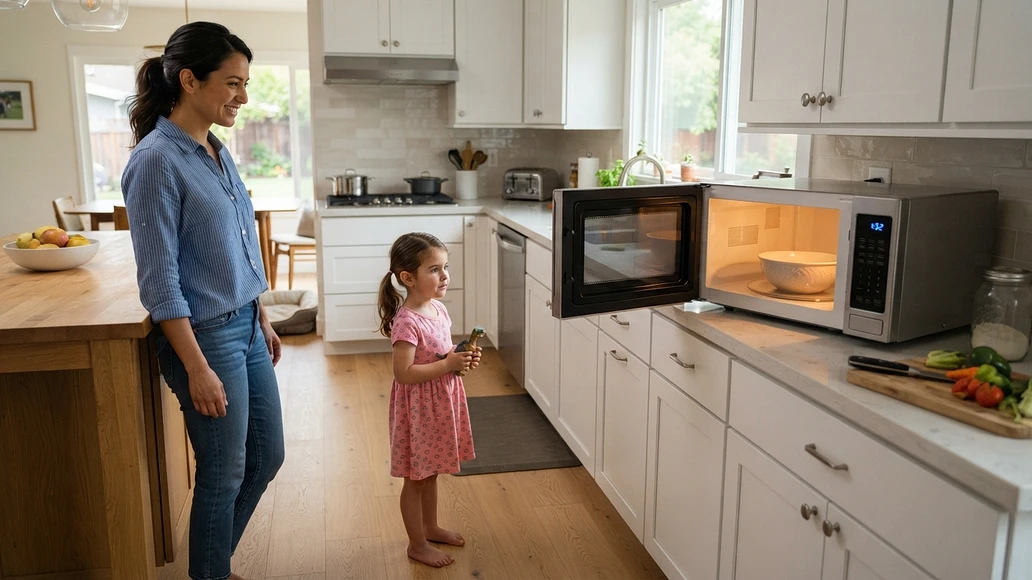
Distance still helps. Even though leakage from a working oven is already low, standing a few feet away reduces exposure further because field strength drops quickly with distance.
| Scenario | Practical exposure picture | What to do |
|---|---|---|
| Leaning against the door while it runs | Still expected to be below limits if the oven is in good condition, but unnecessary | Avoid pressing against the appliance |
| Standing about 2 feet away | Lower exposure than at the surface | Normal everyday use |
| Standing 3 or more feet away | Lower still | Good habit if you want extra margin |
| Using a damaged or poorly closing oven | Risk is less predictable | Stop using it until repaired or replaced |
Common myths that cause confusion
| Myth | Fact |
|---|---|
| Microwaved food becomes radioactive | No. Microwave ovens use non-ionizing radiation and do not change food into a radioactive material. |
| If a microwave blocks Wi-Fi, it will protect against EMP | No. Blocking one everyday signal does not prove broad protection against intense electromagnetic events. |
| Any metal box is a Faraday cage | No. Shielding depends on continuity, seams, openings, and the frequencies involved. |
| Microwave ovens cause cancer in normal use | Mainstream health guidance says properly functioning ovens are safe when used as directed. |
| Grounding is always required for a Faraday cage to work | Not always. Grounding can matter in some applications, but enclosure quality and continuity are often the bigger issues for RF shielding. |
Better preparedness options than using your microwave
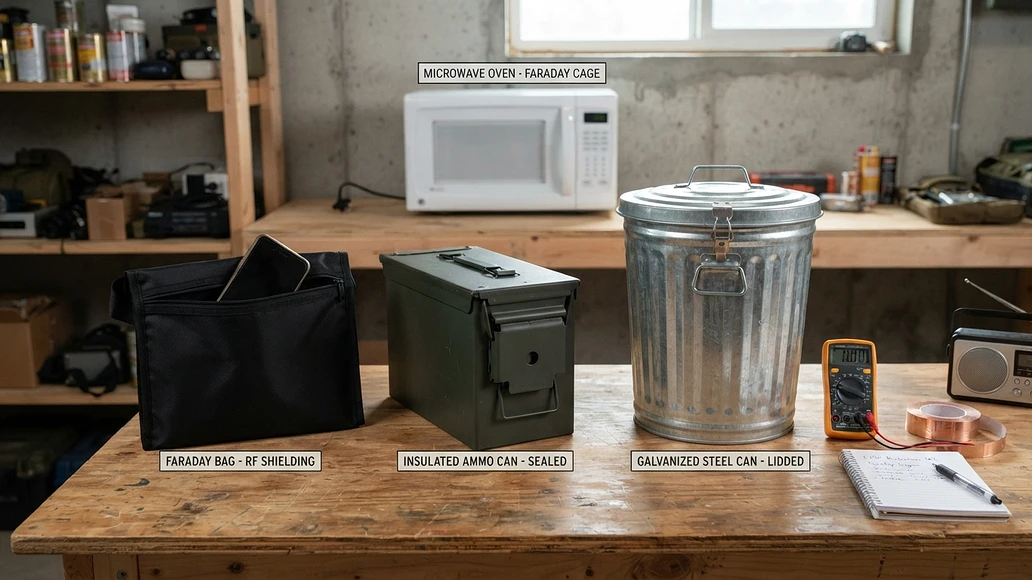
If your goal is protecting backup electronics, there are better choices than repurposing a kitchen appliance. A purpose-built Faraday bag, a properly prepared metal can with insulated contents, or a tested shielded container is usually more practical and more believable as a preparedness tool.
The basics are straightforward. You want a conductive enclosure with good continuity, minimal gaps, and insulation so the electronics do not directly touch the metal shell. For critical gear, layered protection is smarter than relying on one container.
| Option | Strengths | Weak points | Best use |
|---|---|---|---|
| Faraday bag | Portable, purpose-built, easy to use | Quality varies, can wear out | Phones, radios, key fobs, small electronics |
| Metal trash can with tight lid and insulated interior | Affordable, larger capacity | Needs careful setup and testing | Home storage of backup gear |
| Ammo can modified for insulation and seal management | Durable, compact | Conductive gasket issues may need attention | Small emergency electronics |
| Microwave oven | Already in the house, may block some signals | Not designed for EMP storage, awkward, unreliable | Short-term signal isolation only |
How to tell if your microwave may not be shielding properly
You do not need to become a technician to spot obvious warning signs. Check that the door closes squarely, the latch works smoothly, the hinges are not loose, and the seal area is clean and undamaged. If the door is bent, the mesh is damaged, or the unit sparks or smells hot, stop using it.
Professional leakage testing is the proper way to evaluate a suspect oven. Homemade signal tests can be interesting, but they are not a substitute for appliance safety testing. A phone call that still rings inside the oven does not automatically mean the oven is unsafe for cooking. It may simply mean the oven does not block that particular signal well.
Kitchen safety matters more than the Faraday debate
For most households, the bigger risks from microwave ovens are ordinary kitchen hazards, not radiation fear. Burns from superheated liquids, unevenly heated leftovers, steam injuries, and unsafe containers are more realistic concerns.
Use microwave-safe containers, follow food reheating guidance, stir and rest foods when needed, and keep children from crowding the appliance while it runs. If the oven is damaged, replace it rather than guessing.
When a microwave is a reasonable makeshift shield, and when it is not
Using a microwave with the power off as a temporary signal blocker can be reasonable for low-stakes situations, such as checking whether a key fob is still transmitting or isolating a phone briefly. It can also be a useful teaching example for understanding shielding and wavelength.
It is not reasonable as your only plan for EMP, CME, or long-term protection of critical emergency electronics. If you truly care about preserving radios, backup drives, chargers, or medical-support accessories, use a container designed for that role and keep duplicates where practical.
Balanced preparedness without risky shortcuts
Preparedness works best when it focuses on likely problems first and uses proven tools where the stakes are high. For most homes, that means backup power planning, water storage, communication redundancy, and safe storage of key electronics. A microwave can teach you something about shielding, but it should not be the backbone of your plan.
If you want a simple rule to remember, use your microwave for cooking, not as your primary electronics bunker.
Frequently asked questions
Can I store my emergency electronics in a microwave to protect them from EMP?
You can physically place them there, but it is not a dependable EMP strategy. A microwave oven was not designed or tested as an EMP storage container, and its seams, door, and power cord create uncertainty. Use a purpose-built Faraday bag or a properly prepared shielded container instead.
Is it safe to put my phone in a microwave if I do not turn it on?
With the microwave off, placing a phone inside briefly for signal isolation is generally low risk to the phone. The critical rule is never to run the microwave with the phone inside. Do not use the oven as a charging spot or experiment with active operation.
How can I tell if my microwave is leaking radiation?
Start with visible condition. Check the door, hinges, latch, and seal area. If the door is damaged, bent, or does not close properly, stop using the oven. For real evaluation, use professional service or proper leakage testing rather than relying only on informal phone or Wi-Fi tests.
Do microwaves make food or containers radioactive?
No. Microwave ovens use non-ionizing radiation to heat food. They do not make food radioactive. The bigger concern is whether the container itself is microwave-safe and whether the food heats evenly.
Are there simple ways to build a better Faraday cage at home than using a microwave?
Yes. A metal trash can with a tight-fitting lid and insulated interior, a properly set up ammo can, or a quality Faraday bag are all better starting points. The key is continuous conductive shielding and keeping devices insulated from direct metal contact.
References
- Are Microwave Ovens Dangerous? - Good Housekeeping
- Fours à micro-ondes et leurs dangers - CCHST
- Microwave Oven EMF: Safe Distance and Radiation Levels
- How does a Faraday cage work? - from 1836 to 2025
- Microwaves and Faraday Cages: Understanding the Science Behind Electromagnetic Shielding
- What's in Your Faraday Cage? Electronics to Protect!