Raising Capable Kids With Everyday Skills That Last
A practical, age-by-age guide to helping children build self-management, communication, money habits, safety awareness, and resilience through daily routines.

Helping children grow into capable adults is about more than grades, sports, or a packed activity schedule. Kids also need practical habits, emotional tools, and decision-making skills they can carry into school, work, relationships, and daily life. When parents teach these abilities steadily, in small age-appropriate steps, children gain confidence and real independence.
In this guide, life skills means a broad set of abilities, including self-management, home competence, communication, money habits, health and safety awareness, digital judgment, and resilience. The goal is not to make children miniature adults overnight. It is to give them repeated practice, support, and responsibility that grows with them.
Educational note: This article is for general education only. It is not medical, psychological, legal, or financial advice. For emergencies, call 911. For persistent emotional distress, developmental concerns, or safety questions, contact a pediatrician, licensed mental health professional, school counselor, or other qualified expert.
What counts as a life skill, and why does it matter?
Life skills are the abilities that help a child function well in the real world. Some are practical, like making a snack, sorting laundry, or packing a backpack. Some are cognitive, like planning ahead, following steps, and solving problems. Others are social-emotional, like calming down, listening, asking for help, and handling conflict respectfully.
These skills matter because long-term success depends on more than knowledge alone. A child who can manage time, recover from mistakes, communicate clearly, and make safer choices is better prepared for school demands, friendships, work expectations, and adult independence.
How life skills connect to child development and executive function
Many life skills rest on executive function, the brain-based set of abilities that helps children pay attention, remember steps, control impulses, and shift between tasks. You can think of executive function as the management system behind everyday behavior.
For example, getting ready for school requires remembering what comes next, resisting distractions, and finishing a task before moving on. Sharing with a sibling requires emotional control and flexible thinking. Saving money for a goal requires planning and delayed gratification.
These abilities develop over time. That is why repetition, routines, and guided practice work better than lectures. A child usually does not learn responsibility from being told to be responsible. They learn it by practicing one manageable responsibility again and again.
Recent context, why families are teaching more of the new basics
In recent years, many parents and educators have shifted from a narrow focus on academic performance toward whole-child readiness. Financial literacy, digital literacy, emotional regulation, and communication are increasingly seen as core basics, not optional extras.
Schools can support this work, but they cannot cover every daily habit a child needs. Families still play the biggest role in teaching routines, responsibility, judgment, and follow-through. The good news is that life skills do not require a separate class at home. Most can be taught through ordinary family life.
Which life skills fit each age?
Children develop at different rates, so use age ranges as a guide, not a rigid checklist. If your child is neurodivergent, has a chronic health condition, or learns differently, adjust the pace and break tasks into smaller steps. Progress matters more than comparison.
| Age range | Self-management | Home skills | Social-emotional | Money | Digital | Safety |
|---|---|---|---|---|---|---|
| 3 to 5 | Put shoes away, wash hands, follow a simple routine | Put toys in bins, help wipe spills, carry napkins to table | Name feelings, take turns, use simple polite words | Understand that money buys things, practice waiting | Use devices with an adult, learn basic screen rules | Know full name, identify trusted adults, basic body safety |
| 6 to 8 | Pack school items with help, brush teeth consistently, start simple time awareness | Make a basic snack, sort laundry, clear dishes | Apologize, ask for help, practice calm-down steps | Save for a small goal, compare simple choices | Learn not to share personal information, ask before clicking | Know address and phone number, understand when to call 911 with guidance |
| 9 to 11 | Use checklists, manage homework materials, begin planning ahead | Help prepare meals, fold laundry, clean a bathroom with supervision | Resolve minor conflicts, read social cues, show empathy | Track spending, divide money into save, spend, give | Recognize scams, rude behavior, and unsafe messages online | Basic first aid awareness, bike and pedestrian safety, emergency contacts |
| 12 to 14 | Manage a calendar, estimate time, build study routines | Cook simple meals with supervision, do laundry start to finish, manage room care | Use respectful disagreement, handle peer pressure, self-advocate | Create a simple budget, understand bank basics | Practice privacy settings, healthy posting habits, cyberbullying response | Emergency planning basics, safe use of kitchen tools with supervision |
| 15 to 18 | Manage deadlines, appointments, transportation planning, personal routines | Plan meals, shop with a budget, maintain living spaces | Professional communication, boundary setting, conflict repair | Use checking and savings accounts, compare costs, understand work pay basics | Build a healthy digital reputation, evaluate online information, protect accounts | Know emergency procedures, basic first aid course, safe driving or transit habits |
Core life skill domains every child needs
It helps to think in domains instead of random chores. That keeps your teaching balanced and prevents overemphasis on only one area, such as housework or academics.
| Domain | Example skills | Everyday activities that teach them |
|---|---|---|
| Self-management | Hygiene, organization, time awareness, follow-through | Morning checklists, bedtime reset, backpack packing, calendar review |
| Home and domestic skills | Cleaning, laundry, food prep, basic household care | Meal prep nights, laundry day, room reset, table setting |
| Social and communication | Listening, empathy, conflict resolution, asking for help | Family discussions, role-play, sibling problem-solving, thank-you notes |
| Financial literacy | Saving, spending choices, budgeting, earning | Allowance planning, grocery comparisons, savings jars, teen job planning |
| Health and safety | Hygiene, sleep habits, emergency awareness, first aid basics | Handwashing routines, sleep schedules, emergency drills, supervised wound care basics |
| Digital citizenship | Privacy, respectful communication, scam awareness, screen balance | Device agreements, co-viewing, password habits, discussing online scenarios |
| Community and civic skills | Responsibility, service, cooperation, respect for shared spaces | Library visits, volunteering, neighborhood cleanups, helping younger siblings safely |
How do you start without overwhelming your child?
Start with one area that would make daily life smoother right now. For one child, that may be getting ready on time. For another, it may be speaking respectfully when frustrated. For a teen, it may be learning to manage money or appointments.
Choose one skill, define what success looks like, and practice it for several weeks. Keep the first version small. Instead of saying, “You need to be more responsible,” say, “For the next two weeks, your job is to put your lunch container in the sink and plug in your school device every night.”
Children usually do better when expectations are visible and specific. A short checklist on the fridge often works better than repeated verbal reminders.
Teaching life skills through everyday routines
Routine-based learning is one of the most practical ways to teach life skills because it turns repeated family moments into practice. You do not need to create extra lessons if you use what already happens every day.
Morning routine
Morning routines can teach sequencing, time awareness, hygiene, and preparation. Younger kids can follow picture cues. Older kids can use a written checklist and estimate how long each step takes.
Meals and kitchen time
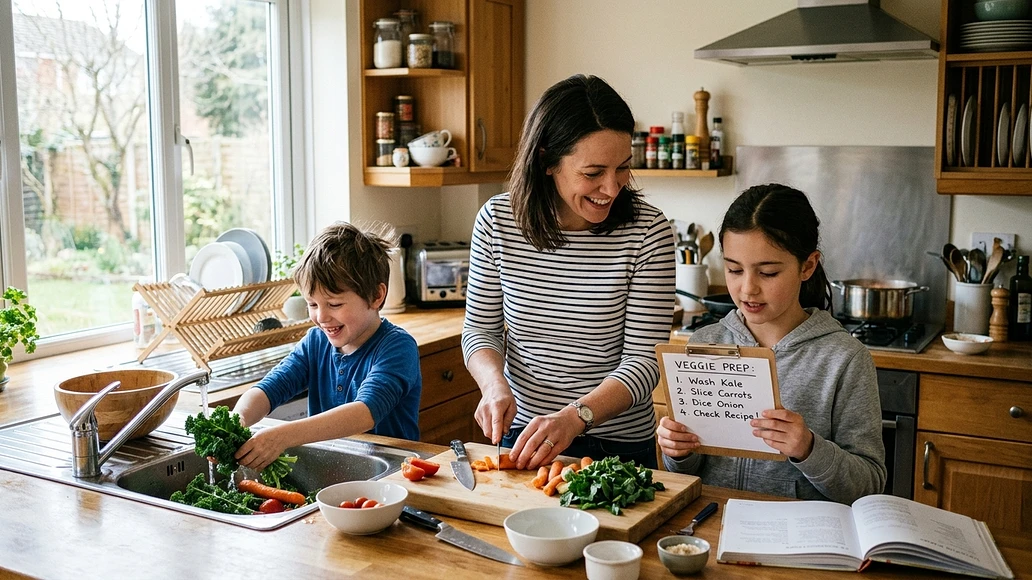
Meals teach planning, nutrition awareness, patience, measurement, cleanup, and teamwork. Young children can wash produce or set napkins on the table. Older children can help make simple foods. Teens can plan one budget-friendly family meal each week.
Errands and shopping
Errands are ideal for teaching comparison shopping, polite conversation, waiting, list-following, and money choices. Ask children to help find items, compare sizes, or calculate whether a purchase fits the plan.
Evening reset
Evening routines build responsibility and reduce next-day stress. A five- to ten-minute reset can include putting away shoes, charging devices in the family-approved location, laying out clothes, and checking the next day’s schedule.
Practical teaching strategies that work at home
Children learn life skills best when adults move from showing, to practicing together, to stepping back gradually. This process is slower than doing the task yourself, but it is what builds competence.
| Strategy | What it looks like at home | Why it works |
|---|---|---|
| Modeling | You demonstrate the task while naming the steps out loud | Children see exactly what success looks like and hear the thinking behind it |
| Guided practice | You do the task together and prompt the next step | Support lowers frustration and helps the child connect steps in sequence |
| Gradual release | You remove help one piece at a time as the child improves | Responsibility grows without overwhelming the child |
| Natural consequences | If a child forgets homework, they experience the inconvenience and then plan a fix | Real outcomes teach cause and effect more effectively than lectures |
| Routine-based repetition | The same skill is practiced at the same time each day or week | Repetition turns effortful tasks into habits |
Helpful scripts can keep the tone calm and supportive:
- “Let’s do the first step together, then you try the next one.”
- “What is your plan if that does not work?”
- “I can see this is frustrating. Take a breath, then tell me which part feels hard.”
- “You are still learning this. What helped last time?”
Building resilience, coping skills, and a growth mindset
Long-term success depends partly on how children respond when things do not go well. A child who can tolerate mistakes, recover from embarrassment, and try again is better prepared for school, work, and relationships.
Resilience is not built by shaming children or throwing them into tasks that are too hard. It grows when adults normalize effort, coach through setbacks, and let children experience manageable discomfort. If your child burns the toast while learning breakfast prep, that can become a calm lesson in retrying, not a reason to take over forever.
One useful family habit is a weekly reflection. Ask, “What was hard this week, what did you learn, and what will you try next time?” This teaches children to connect effort with growth.
How can kids learn safer problem-solving and decision-making?
Problem-solving is a life skill that supports nearly every other skill. Teach a simple framework and use it often. One easy version is:
- Name the problem.
- Break it into smaller parts.
- Think of two or three possible next steps.
- Choose the safest reasonable option.
- Try it, then review what happened.
For younger children, this may sound like, “Your water spilled. What do we need first?” For older children, it may be, “You forgot your project materials. What are your options before school starts?”
Safety matters here. Children should not be expected to solve high-risk situations alone. They need clear rules for when to stop and get an adult immediately, such as injuries, fire, unsafe online contact, medication issues, or anything involving tools, electricity, or strangers.
Money skills for kids and teens
Money habits start long before a first paycheck. Children benefit from learning that money involves choices, tradeoffs, and planning. The exact system matters less than consistency and conversation.
Young children can practice saving for a small goal. Elementary-age kids can divide money into categories such as save, spend, and give. Middle schoolers can track spending and compare prices. Teens can learn budgeting basics, banking terms, work pay concepts, and how to plan for larger expenses.
If you use allowance, be clear about its purpose. Is it for practice managing money, paying for extras, or connecting work and earnings? There is no single perfect system, but confusion creates conflict. State the rules simply and revisit them as your child matures.
For teen side jobs or small business ideas, keep it safe and legal. Parents should check local rules related to child labor, permits, platform policies, and taxes. Treat entrepreneurship as education, not pressure.
Digital life skills are now basic life skills
Children also need guidance for the online world. Digital life skills include protecting privacy, recognizing manipulative content, responding to cyberbullying, balancing screen use, and knowing when to ask an adult for help.
Rather than relying only on strict time limits, focus on habits and context. Where are devices used? What kinds of apps are allowed? What information is never shared? What should a child do if someone online makes them uncomfortable?
Useful family rules include keeping devices in shared spaces when appropriate, using parental controls, reviewing privacy settings, and having regular non-punitive conversations about what children see online. Kids are more likely to report problems when they believe they will be helped, not immediately shamed.

Supporting kids with different needs
Some children need more repetition, more visual supports, or more time to master a skill. Neurodivergent children, including those with ADHD, autism, learning differences, or sensory challenges, may do best with shorter steps, clear routines, and direct teaching instead of vague expectations.
Adapt the method before assuming the child is unwilling. A written checklist, timer, picture sequence, or practice at a quieter time may make a major difference. If a child has chronic health needs or disabilities, choose tasks that are safe and realistic, and coordinate with teachers, therapists, or medical professionals when needed.
Independence should be the goal, but independence can look different from child to child. The right question is not, “Can they do it exactly like other kids?” It is, “What support helps them do more for themselves safely and confidently?”
Common mistakes parents make, and better alternatives
| Pitfall | Why it backfires | Better alternative |
|---|---|---|
| Doing tasks faster for the child | It saves time now but delays competence later | Build extra time for practice and let the child own one step at a time |
| Expecting too much too soon | Children feel overwhelmed and resist | Match the task to developmental level and break it into smaller parts |
| Using shame or harsh criticism | It damages confidence and reduces willingness to try again | Use calm coaching, specific feedback, and repair after mistakes |
| Focusing only on grades | Important practical and social skills get neglected | Treat routines, communication, and responsibility as part of success |
| Teaching only through lectures | Children rarely internalize skills they do not practice | Use modeling, repetition, and real-life application |
| Giving risky tasks too early | It can lead to injury or fear | Use supervision, age-appropriate tools, and certified training where needed |
Create a simple family life skills roadmap
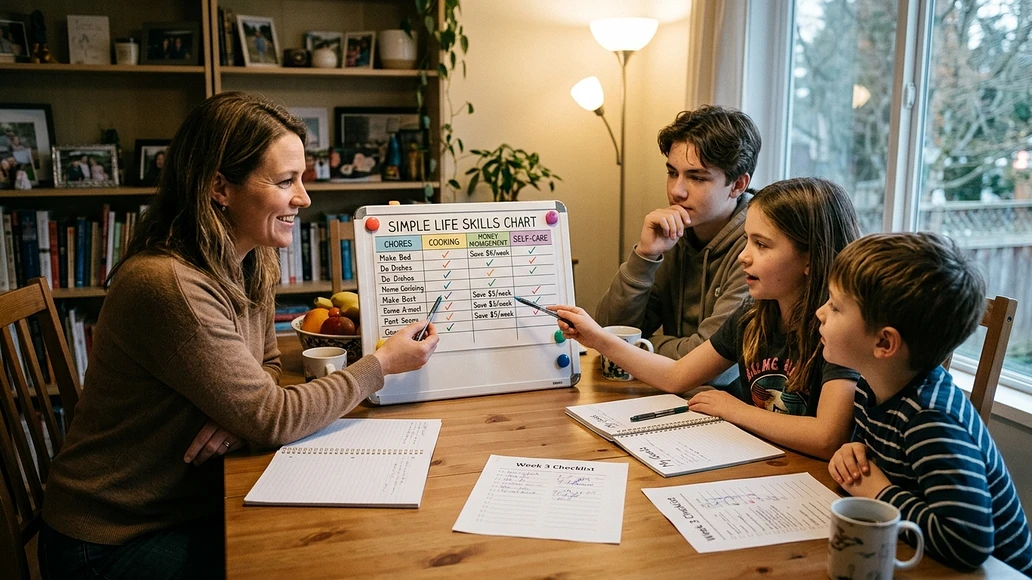
You do not need a perfect system. A simple roadmap is enough. Pick one focus area each month or each school term. Write down two or three target skills for each child, plus the routine where each skill will be practiced.
For example, one child may work on packing school items independently. Another may practice respectful disagreement. A teen may take over one weekly meal and track its cost. Review progress weekly in a short family check-in.
Keep the tracking simple.
| Roadmap step | What to decide | Example |
|---|---|---|
| Choose a focus | Pick one domain that matters right now | Morning independence |
| Define the skill | State the exact behavior | Pack backpack and water bottle before bed |
| Pick the routine | Attach it to a regular time | Every school night after dinner |
| Set support level | Decide how much help the child gets | Parent checks list, child completes steps |
| Review progress | Notice what worked and what needs adjusting | Friday check-in with praise and one improvement |
When should you seek professional help?
Sometimes a life skill struggle is not just about motivation or habit. Consider professional support if your child shows persistent severe anxiety, major mood changes, self-harm talk, frequent explosive behavior, significant school decline, or ongoing difficulty with everyday functioning that does not improve with consistent support.
A pediatrician, school counselor, occupational therapist, psychologist, or other qualified professional can help identify whether attention, learning, sensory, emotional, or developmental factors are getting in the way. Getting help early is a strength, not a failure.
FAQ
What are the most important life skills to teach first?
Start with the skills that improve daily functioning and reduce stress for your child and family. For many children, that means self-management first, such as hygiene, routines, putting belongings away, and asking for help appropriately. After that, add communication, simple home responsibilities, and basic safety awareness.
How do I know if my child is behind on life skills for their age?
Use age guides as loose benchmarks, not strict rules. Look for patterns instead of one missed skill. If your child is making progress with support, that is a good sign. If they are consistently unable to manage age-expected daily tasks across settings, or if distress is high, talk with a pediatrician, teacher, or specialist.
How can I teach life skills if I have very little time or energy?
Attach teaching to routines you already have. Ask your child to do one part of breakfast, one part of cleanup, or one part of bedtime prep every day. Small repeated practice beats occasional big lessons.
Should schools teach life skills, or is that mainly a family job?
It should be both. Schools can support communication, organization, health education, and social-emotional learning. Families are still essential because many life skills are built through daily routines, home responsibilities, and repeated real-world practice.
What if my child refuses to help or practice?
Check whether the task is too hard, too vague, or poorly timed. Reduce the size of the task, teach the steps more clearly, and connect it to a routine. Stay calm and consistent. If refusal is intense and persistent across many areas, consider whether stress, anxiety, attention issues, or another underlying challenge may be involved.
References
- Principle 2: The New Basics, Real Skills for Real Life
- Life Skills for Kids by Age: Complete Development Guide
- 13 Essential Life Skills for Kids to Achieve Future Success
- Life Skills Training Promotes Individual Effectiveness
- Life skills that promote school health in adolescents
- Life Skills to Teach Kids at Home: A Grade-by-Grade Guide
- A Month-by-Month Guide to Teaching Life Skills in High School
- Applying the Science of Child Development in Child Welfare Systems