Can a Root Cellar Save Your Meat Supply? What Actually Works
Root cellars are excellent for many vegetables, but they are not a safe stand-in for real meat preservation. Learn what root storage can do, what it cannot do, and which tested methods make meat safer for longer storage.

Preparedness advice often revives old claims about burying food, packing it near roots, or keeping it in a cellar for months. That can blur an important line. A root cellar is a storage environment, not a preservation treatment for raw meat. Cool, dark, humid conditions help many vegetables last longer, but they do not reliably control the pathogens that make meat dangerous.
If you are trying to protect a meat supply during harvest season, hunting season, or a power outage plan, the safest approach is to separate two ideas. First, root storage is for crops that tolerate cool, humid conditions. Second, meat preservation requires a validated method such as refrigeration, freezing, pressure canning, controlled curing, drying, fermentation, or properly managed smoking. A cellar may sometimes hold already preserved products if the recipe and storage conditions allow it, but it should not be treated as a magic fix for fresh meat.
What people mean by “root storage,” and why the phrase causes confusion
The phrase usually points to one of several very different practices. Some people mean a true root cellar. Others mean storing food in a buried cache, packing items in sand or sawdust, or placing meat near root vegetables because the area feels cool. Historically, families also used cellars after salting, smoking, or curing meat, which can make it sound as if the cellar itself did the preserving.
That distinction matters. A root cellar can slow spoilage in suitable produce because many roots and tubers prefer cool temperatures and high humidity. Raw meat is different. It is a high-risk food that supports dangerous bacterial growth unless it is kept under controlled refrigeration or preserved by a tested method.
Root-cellar storage versus actual meat preservation
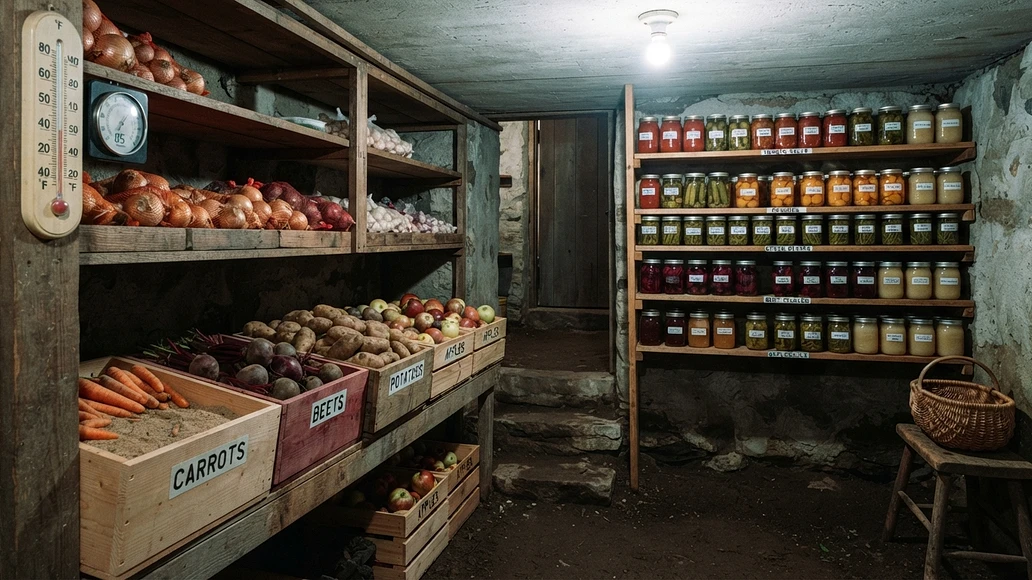
A root cellar helps manage temperature swings, humidity, darkness, and ventilation. Those conditions are useful for carrots, beets, turnips, parsnips, potatoes, apples, and similar crops. They are not enough, by themselves, to make raw meat safe for long-term storage.
Meat preservation works by reducing or controlling one or more hazards. That may mean destroying microbes with heat, lowering water activity through drying, changing pH through fermentation, using salt and curing agents in precise amounts, or keeping the product continuously cold enough to slow growth. Without one of those controls, time becomes the enemy.
| Question | Root cellar alone | Validated meat-preservation method |
|---|---|---|
| Controls dangerous bacteria in raw meat | No | Yes, when the tested method is followed correctly |
| Makes food shelf-stable | No | Sometimes, depending on the method and recipe |
| Useful for carrots, beets, potatoes, and similar crops | Yes | Not the main purpose |
| Suitable for long-term raw meat storage | No | No, unless the meat is first properly preserved or continuously frozen or refrigerated |
| Requires measured temperature and humidity | Yes | Yes |
The science that decides whether meat keeps or spoils
Safe preservation is not about folklore or a single ingredient. It depends on measurable conditions. Temperature is the first gate. If meat is too warm for too long, pathogens can multiply quickly. Water activity is another major factor. Drying meat enough can make it harder for microbes to grow, but partial drying is not enough. Acidity matters too. Fermented meats rely on a controlled pH drop, not guesswork. Salt concentration, oxygen exposure, packaging, and total storage time also affect safety.
Several pathogens are especially relevant in meat preservation, including Clostridium botulinum, Salmonella, Listeria monocytogenes, Staphylococcus aureus, and pathogenic E. coli. Some can be present without obvious odor or visible spoilage. That is why smell is not a reliable safety test, and why “it looks fine” is not enough.
Which foods belong in a root cellar
Root cellars shine when used for the foods they were built for. Many root crops and some fruits store well under cool, humid, dark conditions with good airflow and protection from freezing. Crop-specific needs vary, but the general idea is that produce storage and meat storage are not interchangeable.
| Food type | Typical root-cellar fit | Why it works or fails |
|---|---|---|
| Carrots, beets, turnips, parsnips | Good fit | Prefer cool temperatures and high humidity, can hold quality well when clean and undamaged |
| Potatoes | Good fit | Need cool, dark storage, but not conditions that encourage rot or freezing |
| Apples and some pears | Conditional fit | Can store well, but should be monitored because damaged fruit can spoil quickly |
| Onions and garlic | Conditional fit | Usually prefer drier conditions than roots |
| Raw beef, pork, venison, poultry | Not a fit | Requires refrigeration, freezing, or a tested preservation method |
| Home-canned meat | Conditional fit | Only after proper pressure canning, in sound jars, under suitable storage conditions |
Why raw meat should not be stored with root vegetables
Putting raw meat beside root crops creates multiple risks at once. Root vegetables often carry soil, moisture, and surface microbes. Cellars also tend to have higher humidity than a refrigerator, and that is the opposite of what you want for fresh meat. Add shared shelves, bins, or containers, and cross-contamination becomes likely.
There is also a false sense of security. Because a cellar feels cold and old-fashioned, it can seem like a traditional answer. In reality, a cellar that is safe for carrots may still be too warm for meat. Even if the air is cool, the environment is not designed to hold raw meat at the consistently low temperature needed for safety.
Historical methods, and why modern readers should be careful with them
Before widespread refrigeration, people preserved meat with combinations of salting, drying, smoking, cool weather slaughter, rendering, and later storage in cellars or pantries. The key point is that the preservation happened before storage. The cellar was often a holding place after the meat had been transformed by salt, drying, or heat.
Some historical methods also depended on climate, season, breed, cut size, and household experience that are hard to reproduce safely today. A story about meat hanging in a cold outbuilding or packed in fat is not the same as a tested modern method. It may explain what people did, but it does not validate the practice for a present-day kitchen.
Refrigeration and freezing are the baseline
For most households, the safest starting point is simple. Keep fresh meat refrigerated for short-term use or freeze it for longer storage. If you want shelf-stable options for emergencies, preserve the meat first with a tested process. Refrigeration and freezing are not glamorous, but they are predictable and measurable.
| Goal | Best baseline method | Main safety note |
|---|---|---|
| Use within a short period | Refrigeration | Keep temperature consistently cold and avoid cross-contamination |
| Store for months with good quality | Freezing | Package well to reduce freezer burn and keep temperature stable |
| Store without power after processing | Pressure canning or a validated shelf-stable method | Follow tested procedures exactly |
| Portable protein for field use | Properly made jerky | Heat treatment, thickness, drying, and storage all matter |
Pressure canning meat, the tested shelf-stable option for many homes
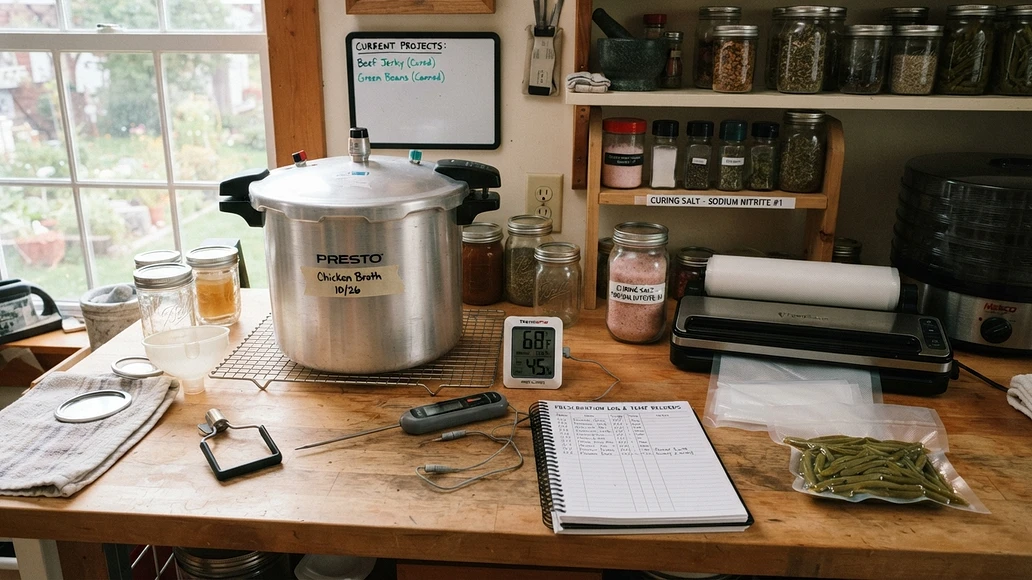
When people want a pantry-ready meat supply, pressure canning is one of the most practical home methods. Meat is a low-acid food, so it must be processed in a pressure canner using tested procedures. A boiling-water canner is not a safe substitute.
Pressure canning works because it reaches temperatures high enough, for the required time, to control dangerous microorganisms in low-acid foods. Jar size, headspace, pressure level, altitude adjustments, and processing time all matter. If a jar later becomes swollen, leaks, spurts, or shows damage, it should be discarded without tasting.
Jerky can work, but only when the process is controlled
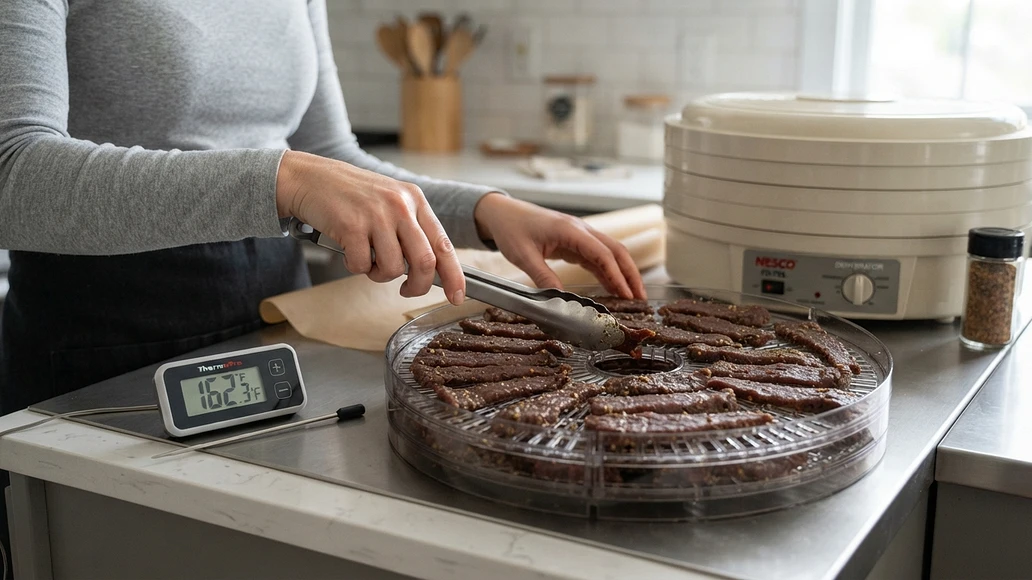
Jerky is often treated as a simple off-grid food, but it is more technical than it looks. Safe jerky depends on lean meat, uniform slicing, proper marination if used, a heat step where recommended, and drying until the product reaches the right texture and moisture level. Storage also matters. Even good jerky can mold or spoil if exposed to humidity or stored too warm.
Smoke flavor does not replace drying, and partial dryness is not enough. If you want jerky for preparedness, use a tested procedure from a trusted source and make small batches until you understand how your equipment performs.
Dry curing, nitrite, salt concentration, and humidity control
Dry curing is where many traditional meat stories begin, but it is not beginner-friendly improvisation. Safe curing depends on exact salt levels, sometimes nitrite or nitrate in approved curing products, the thickness and weight of the meat, and controlled temperature and humidity during the process. Too little curing agent may fail to control pathogens. Too much can be hazardous.
This is one of the clearest areas where a root cellar can be misunderstood. A cellar might resemble part of the environment used after curing, but it does not replace the formulation, measurements, and monitoring that make curing work. If you are not using a tested recipe and a precise scale, you are guessing with a high-risk food.
Smoking is not the same as preserving
Smoking adds flavor and can contribute to preservation in some systems, but smoke alone is not a complete safety treatment. Hot smoking can cook food, while cold smoking usually does not. Cold-smoked products often require curing, strict temperature control, and additional hurdles such as drying or refrigeration.
That is why “smoked” on its own tells you very little. Some smoked meats are fully cooked and ready to eat. Others are cured but still require refrigeration. Others are simply flavored. The process, not the label, determines safety.
Fermented meats require starter cultures and measurable targets
Fermented sausage and similar products can become stable only under controlled conditions. The process depends on a reliable starter culture, a predictable pH drop, controlled temperature and humidity, and often a final water activity target. This is not a category for casual experimentation in a basement corner.
If you are serving pregnant family members, older adults, very young children, or anyone with immune suppression or serious chronic illness, extra caution is warranted with home-cured, fermented, smoked, or cellar-stored meats.
How a root cellar can still help, after preservation is done
A root cellar is not useless in a meat plan. It can support preparedness in indirect ways. It can reduce pressure on freezer space by holding produce well. It can store some shelf-stable foods in a cooler environment. It may also be suitable for certain already preserved products if the recipe specifically allows that storage and the cellar stays within the required range.
What it cannot do is turn fresh meat into a safe pantry item by proximity to roots, damp sand, ash, wax, fat, or a sealed crock. Those ideas belong in historical discussion, not as general household advice.
Root-cellar design and monitoring checklist
If you maintain a cellar for produce and preserved foods, treat it like a system that needs measurement. “Cool” and “dry enough” are not precise enough for food safety planning.
| Feature | Why it matters | What to monitor |
|---|---|---|
| Thermometer | Confirms actual temperature, not just how the room feels | Daily or seasonal readings, especially during weather swings |
| Hygrometer | Helps manage humidity for produce and packaging integrity | Relative humidity trends and condensation problems |
| Ventilation | Reduces stale air, excess moisture, and some spoilage issues | Airflow, odors, and damp spots |
| Drainage and moisture control | Standing water and seepage increase contamination and mold risk | Leaks, puddles, wall dampness |
| Pest protection | Rodents and insects can ruin food and spread contamination | Droppings, gnaw marks, damaged packaging |
| Sanitation | Dirty bins, soil buildup, and spills raise contamination risk | Cleaning schedule and separation of produce from preserved foods |
Common mistakes that create unnecessary risk
Several errors show up again and again in preparedness content. One is relying on smell or appearance. Another is burying meat, packing it in sand or sawdust, or storing it in improvised containers because a story online made it sound traditional. Another is assuming that a layer of fat, wax, ash, or a sealed vessel automatically means safety. None of those are reliable stand-ins for tested preservation.
Another common mistake is mixing categories. People may read about root-cellaring carrots, then assume the same environment can hold fresh venison. Or they may see a cured ham hanging in a cool room and miss the fact that the curing formula and process did the real preservation work.
Choosing the right method for your goal
The best method depends on what you need most. If you want convenience and low complexity, freezing is hard to beat. If you want shelf-stable jars for outages, pressure canning is a strong option. If you want portable trail food, jerky may fit. If you want traditional charcuterie, be honest about the learning curve and the need for tested formulas and environmental control.
| Priority | Best-fit method | Why it fits | Main limitation |
|---|---|---|---|
| Low complexity | Freezing | Simple, familiar, reliable when power is stable | Depends on freezer space and electricity |
| Shelf-stable storage | Pressure canning | Practical pantry storage for many meats | Requires equipment and exact processing |
| Portable food | Jerky | Lightweight and convenient | Procedure-sensitive and not indefinite |
| Traditional cured products | Controlled curing | Can produce durable, flavorful foods | Higher skill and monitoring demands |
| Use a root cellar well | Store produce there, not raw meat | Matches the cellar's strengths | Does not solve fresh meat preservation |
Who should avoid experimenting
If you are brand new to food preservation, do not start with improvised cellar-stored meat, home-fermented sausage, or casual dry curing. Households without reliable temperature control should also avoid high-risk methods. Extra caution is important if the food may be served to pregnant people, older adults, immunocompromised individuals, or anyone with chronic conditions that raise infection risk.
General preparedness advice is not a substitute for a tested recipe. If you suspect foodborne illness, especially severe vomiting or diarrhea, dehydration, fever, bloody stool, or neurologic symptoms, contact a healthcare professional or poison-control service promptly.
Legal and sharing considerations
Home-preserved meat may face additional rules if you plan to sell it, gift it widely, transport it across state lines, or serve it at public events. Requirements can involve USDA, FDA, state, county, or local authorities. What is acceptable for your own household may not be acceptable for commercial or public distribution.
Bottom line
A root cellar is a valuable preparedness asset, but it is not a preservation method for raw meat. Use it for the crops and shelf-stable foods it suits best. For meat, rely on methods that actually change the safety equation, refrigeration, freezing, pressure canning, validated jerky procedures, or carefully controlled curing and fermentation. That approach may sound less romantic than old cellar lore, but it is far more dependable when your family's health is on the line.
References
- USDA Food Safety and Inspection Service, Jerky and Food Safety
- USDA Food Safety and Inspection Service, Beef From Farm to Table
- USDA Food Safety and Inspection Service, Food Safety at Home
- National Center for Home Food Preservation, How Do I Can
- National Center for Home Food Preservation, Jerky
- U.S. Food and Drug Administration, What You Need to Know About Foodborne Illnesses
- University of Minnesota Extension, Root Cellaring