Onion Socks at Bedtime, Folk Remedy Claims, Real Evidence, and Safe Alternatives
Curious whether sleeping with onion slices in your socks actually helps congestion, colds, or sleep? Here is a balanced look at what people claim, what science supports, what risks matter, and what to try instead.

Sleeping with onion slices tucked into socks is a long-running folk remedy that gets passed around whenever someone has a stuffy nose, a rough cold, or a bad night of sleep. The idea sounds simple, but the claims around it often go much further than the evidence does. If you are curious, the most useful question is not whether people swear by it, but what it could realistically do, what it cannot do, and what risks come with putting a moist plant material against skin for hours.
This article takes a practical, safety-first approach. In short, there is no strong clinical evidence that onions on the feet detoxify the body, shorten a cold, kill viruses, or improve sleep quality. At most, some people may notice a strong smell, a comforting ritual, or a temporary sense that breathing feels easier. That is very different from proven treatment. It is also important to know that prolonged contact under socks can irritate skin, especially in people with diabetes, eczema, broken skin, allergies, or reduced foot sensation.
General guidance only: This is not a diagnosis or a substitute for medical care. If you are pregnant, have a chronic condition, have foot problems, or are considering this for a child, it is best to be conservative and ask a clinician before trying unproven topical remedies.
What people mean by sleeping with onions in socks
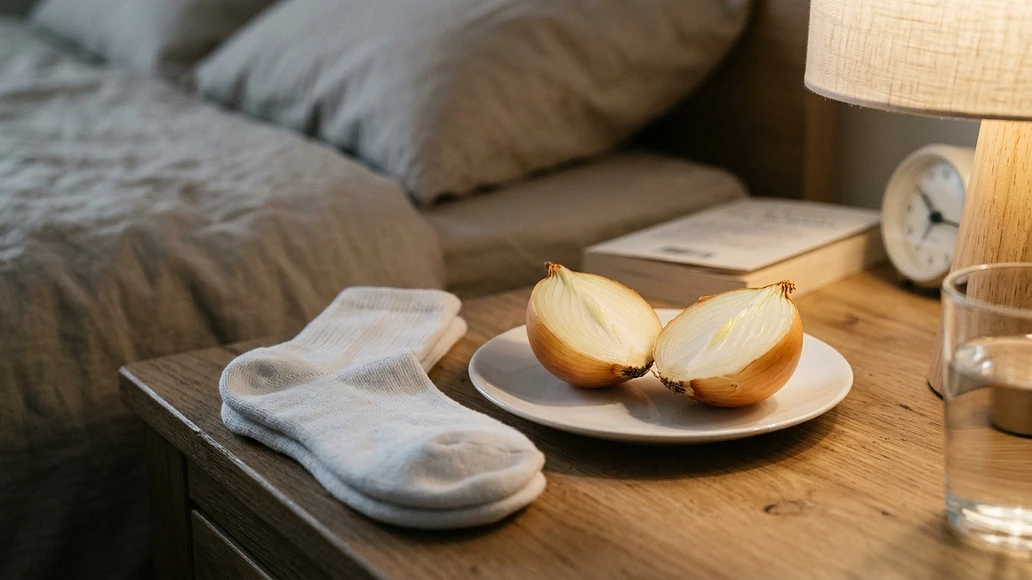
The method usually means placing a slice of raw onion, often white or red onion, against the sole of the foot and then holding it in place with a sock while sleeping. Some versions call for a thin slice over the arch, while others suggest the ball of the foot or heel. The practice is usually promoted for colds, congestion, fever, circulation, detox, or general immune support.
Those claims are not all equal. A claim that a strong odor might make someone feel temporarily more open is very different from a claim that onion compounds pass through intact skin in meaningful amounts and change the course of an illness. That second claim needs real evidence, and it is not supported.
What benefits are commonly claimed, and what evidence actually shows
| Claim | Evidence level | What a cautious reader should know |
|---|---|---|
| Onions in socks draw out toxins | Weak to unsupported | There is no credible clinical evidence that onions placed on the feet remove toxins through the skin. |
| Onions on feet help cure colds or flu | Weak to unsupported | Colds and flu are viral illnesses, and topical onion use is not an evidence-based treatment. |
| Onion socks improve sleep quality | Weak to unsupported | No strong evidence shows this practice improves sleep duration, sleep stages, or overall sleep quality. |
| The smell may make breathing feel easier | Mixed, symptom-level only | Some people may perceive temporary relief from odor or ritual, but that is not the same as treating congestion or infection. |
| Eating onions supports general nutrition | Well supported | Onions are nutritious foods, but that does not mean they work as a transdermal remedy on the feet. |
| Prolonged moist contact can irritate skin | Well supported | Occlusion, moisture, friction, and plant compounds can trigger redness, itching, rash, or dermatitis. |
Can onion socks shorten a cold or stop an illness?
No good evidence shows that this practice shortens a cold, lowers viral load, prevents flu, or changes the course of an upper respiratory infection. That matters because many folk-remedy articles blur the line between feeling soothed and actually treating disease.
If someone says they felt better after trying it, several explanations are more plausible than a medicinal effect through the feet. Symptoms may have been improving on their own. The smell may have changed how they perceived congestion. The bedtime routine itself may have felt calming. Those are all possible, but none of them prove that onion slices on skin are a treatment.
Can it help sleep or nighttime breathing?
There is no strong evidence that onion socks improve sleep architecture, reduce insomnia, or increase sleep duration. If a person sleeps better after trying it, the benefit is more likely related to comfort, expectation, or the fact that they also used other measures, such as a humidifier, hydration, or extra rest.
For nighttime breathing, a strong smell can sometimes create a subjective sense of airflow or freshness. That is not the same as reducing inflammation, clearing mucus, or treating the cause of congestion. If your nose feels blocked because of a cold, allergies, dry air, or sinus irritation, evidence-based measures are more reliable.
Why this remedy remains popular
Folk remedies often survive because they are inexpensive, memorable, and easy to try. Onion socks also come with a built-in sensory effect. Onions smell strong, can make eyes water, and can leave moisture and discoloration behind. Those visible and noticeable changes can make the remedy feel active, even when there is no proof it is doing what is claimed.
There is also a long tradition of linking the feet to whole-body health in popular wellness culture. That can make the story sound plausible. But plausibility is not proof. Intact skin is a protective barrier, and claims of meaningful therapeutic absorption from a raw onion slice on the foot are not backed by credible clinical evidence.
Why smell and discoloration can be mistaken for proof
Two things often get misread as signs that the onion is working. First is the smell. A strong onion odor can make people think active compounds are moving through the body or pulling illness out. In reality, smell alone does not show treatment is happening. It only shows that onion volatiles are present in the air around the person.
Second is the appearance of the onion after several hours in a sock. It may look darker, wetter, softer, or discolored. That is usually explained by oxidation, moisture, pressure, and contact with sweat, not by toxin extraction. The same kind of change can happen when cut produce sits out or is pressed against a damp surface.
How the method is usually performed
People who try this remedy usually cut a fresh onion into slices, place one or more slices against the bottom of the foot, and pull on a sock to hold them in place. Some leave it on overnight. That overnight part is where risk rises, because longer contact means more moisture, more friction, and more time for irritation to develop.
Because the benefit is unproven, it would be irresponsible to give aggressive how-to instructions as though this were established care. A safer framing is this: if an adult without risk factors still chooses to experiment, they should keep the trial brief, use intact skin only, check the skin before and after, and stop at the first sign of irritation. Overnight use, especially on sweaty or fragile skin, is not the cautious option.
Skin absorption basics, and why they matter here
Your skin is designed to keep many outside substances out. Some medications can be delivered through skin, but they are specially formulated for that purpose. A raw onion slice is not a controlled transdermal system. The idea that meaningful medicinal compounds pass through intact foot skin in amounts that would treat a cold or improve sleep is not supported.
What is much more believable is local irritation. Plant juices, moisture, pressure from the sock, and hours of occlusion can all stress the skin barrier. That is why the main practical concern here is not missing out on a miracle cure. It is ending up with a rash, soreness, or a skin problem that was avoidable.
Safety risks for adults, children, and sensitive skin
| Group or situation | Main concern | Why caution matters |
|---|---|---|
| Healthy adults with intact skin | Irritation, redness, itching | Even normal skin can react to prolonged damp contact and friction. |
| People with eczema, psoriasis, or sensitive skin | Dermatitis flare | A weakened skin barrier is more likely to sting, burn, or break down. |
| People with broken skin, cuts, blisters, or athlete's foot | Pain, worsening irritation, delayed healing | Plant juices and moisture can aggravate already damaged skin. |
| People with diabetes or reduced foot sensation | Unnoticed injury | Redness, pressure injury, or skin breakdown may go unnoticed and become more serious. |
| Infants and children | More vulnerable skin, scratching, accidental ingestion | Children are not good candidates for prolonged occlusive folk remedies. |
| Pregnancy | No proven benefit, possible irritation | There is no strong upside, so a conservative approach makes sense. |
Who should avoid this practice entirely
Some readers should skip this remedy rather than trying to make it safer. That includes anyone with diabetes, peripheral neuropathy, reduced foot sensation, eczema, psoriasis, open skin, foot ulcers, known onion allergy, or a history of contact dermatitis. It should also be avoided in infants and children, especially overnight.
If you cannot reliably feel irritation developing, or if your skin is already compromised, the risk-benefit balance is poor. There is no proven medical payoff to justify that risk.

Common mistakes that increase the chance of problems
| Mistake | Why it is a problem | Safer takeaway |
|---|---|---|
| Leaving onion slices on all night | Longer exposure increases moisture, friction, and irritation risk | If someone insists on trying it, shorter contact is less risky than overnight occlusion |
| Using it on broken or irritated skin | Damaged skin is more reactive and more likely to worsen | Do not apply to cuts, blisters, rashes, or peeling skin |
| Using tight socks | Pressure and rubbing can add discomfort and skin stress | Avoid anything that increases friction or compression |
| Trying it on children | Children have more delicate skin and may scratch or ingest material | Use child-appropriate, evidence-based comfort measures instead |
| Assuming odor or discoloration proves detox | These changes are not evidence of toxin removal | Interpret smell and color changes as normal onion and moisture effects |
What to do if the skin becomes red, itchy, blistered, or painful
Remove the onion and sock right away. Wash the area gently with lukewarm water and mild soap if needed, then pat dry. Do not keep reapplying the onion to see if the reaction passes. If the skin is mildly irritated, keeping it clean, dry, and uncovered for a while may help.
If there is significant burning, swelling, blistering, spreading rash, drainage, increasing pain, or symptoms that do not improve, seek medical care. People with diabetes, poor circulation, or reduced foot sensation should be especially cautious and should not wait on worsening foot symptoms.
Onion socks versus evidence-based options for congestion relief
| Approach | What it may help | Evidence and practical notes |
|---|---|---|
| Onion slices in socks | Possible subjective comfort only | Not proven to treat congestion, infection, or illness duration. Skin irritation is a real downside. |
| Saline nasal spray or rinse | Nasal dryness and mucus | Often more reliable for symptom relief when used correctly and hygienically. |
| Humidified air | Dry, irritated nasal passages | Can make breathing feel more comfortable, especially in dry indoor air. |
| Fluids and rest | General cold recovery support | Simple supportive care remains a mainstay for routine viral illnesses. |
| Honey for cough, for appropriate ages only | Nighttime cough | Can help some adults and older children, but should not be given to infants under 1 year. |
| Medical evaluation when symptoms are severe | Breathing trouble, high fever, chest pain, dehydration | Important when symptoms go beyond routine self-care. |
Better-supported options for sleep support
| Approach | Best use | Why it is a stronger choice |
|---|---|---|
| Consistent sleep schedule | Trouble falling asleep or staying asleep | Regular timing supports the body's sleep rhythm better than folk remedies. |
| Cool, dark, quiet room | General sleep quality | Environmental changes are low risk and often effective. |
| Limiting late caffeine and alcohol | Frequent nighttime waking | Addresses common sleep disruptors directly. |
| Managing congestion with saline or humidified air | Sleep disrupted by stuffy nose | Targets the symptom that is actually interfering with sleep. |
| Medical evaluation for chronic insomnia or loud snoring | Persistent sleep problems | Important when the issue may be insomnia, anxiety, or sleep apnea. |

Onions as food versus onions on skin
Onions do have value in the diet. They contain nutrients and plant compounds that fit into a healthy eating pattern. But a food being nutritious does not mean it becomes a medicine when pressed against the skin. That leap is where many folk-remedy claims go wrong.
It is reasonable to say onions are healthy to eat. It is not reasonable to say that placing raw onion on the foot detoxifies the body, boosts immunity through the skin, or reliably improves sleep.
Myth versus fact
| Myth | Fact |
|---|---|
| Onions in socks pull toxins out overnight | There is no credible clinical evidence supporting toxin removal through the feet with onion slices. |
| If the onion turns dark, it absorbed illness | Darkening is more likely from oxidation, moisture, and pressure. |
| Because onions are healthy to eat, they must work through skin too | Nutritional benefits from food do not automatically translate to transdermal treatment. |
| If breathing feels easier, the cold is being treated | A temporary sensory effect is not the same as treating infection or reducing inflammation. |
| It is harmless because it is natural | Natural substances can still irritate skin, especially under moist, prolonged contact. |
How to tell when symptoms need medical care instead of home remedies
| Situation | Self-care may be reasonable | Get medical advice promptly |
|---|---|---|
| Typical cold symptoms | Mild congestion, sore throat, mild cough, low energy for a few days | Symptoms lasting more than about 10 days, worsening after initial improvement, or becoming unusually severe |
| Breathing symptoms | Mild stuffiness without distress | Trouble breathing, wheezing, chest pain, or blue lips |
| Fever | Low fever with otherwise manageable symptoms | High fever, persistent fever, or fever with confusion or dehydration |
| Sleep trouble | Short-term sleep disruption during a cold | Frequent insomnia, severe daytime impairment, loud snoring, gasping, or suspected sleep apnea |
| Skin reaction from a remedy | Mild redness that fades after stopping | Blistering, swelling, drainage, spreading rash, severe pain, or any foot wound in a person with diabetes |
Bottom line for curious but cautious readers
If you were hoping onion socks had a proven bedtime benefit, the evidence does not support that. They are not a validated treatment for colds, flu, congestion, detox, circulation, or sleep quality. The most that can be said is that some people may experience a subjective sense of comfort or smell-based relief, but that is anecdotal and not the same as medical benefit.
The bigger practical issue is safety. Moist, prolonged contact under a sock can irritate skin, and some people should avoid the practice entirely. If your goal is better breathing at night or better sleep during a cold, you will usually do better with low-risk, evidence-based measures such as saline, humidified air, hydration, rest, and good sleep habits. And if symptoms are severe, prolonged, or unusual, skip the folk experiment and get proper medical advice.
References
- National Center for Complementary and Integrative Health, The Science of Herbs and Botanicals
- National Center for Complementary and Integrative Health, Onions and Garlic
- Centers for Disease Control and Prevention, Common Cold Basics
- Centers for Disease Control and Prevention, Flu Treatment
- MedlinePlus, Home Care for Colds
- MedlinePlus, Insomnia
- American Academy of Dermatology, Itchy Skin and Irritation Care
- American Diabetes Association, Foot Complications
- National Institute on Aging, Insomnia and Sleep
- U.S. Food and Drug Administration, What You Need to Know About Colds and Flu