Drone Distance in the Real World, What Homeowners and Pilots Should Know
Drone range is more complicated than a spec sheet number. Learn the difference between technical range, battery range, and legal range, plus what typical drones can actually do around homes, neighborhoods, and emergency situations.

Drone range sounds simple until you look closer. A manufacturer may advertise a long transmission distance, but that does not mean a small quadcopter can safely, legally, or practically fly that far in everyday use. For most people in the US, the important question is not the maximum number on a box. It is what a drone can realistically do over a neighborhood, a farm, or a storm-damaged property, and what that means for privacy, safety, and preparedness.
This article gives a balanced overview for homeowners and drone operators. It covers technical range, battery limits, legal limits, realistic distances by drone type, and what to do if a drone near your home seems intrusive or unsafe. This is general information, not legal advice. Laws can vary by state and situation.
What “range” means when people talk about drones
People often use one word, range, to describe several different limits. That causes confusion and a lot of exaggerated claims.
Control link range
This is how far the radio link between the pilot and the drone can work under ideal conditions. It is the number most often used in marketing. For modern consumer camera drones, that technical link can be surprisingly long in open areas with little interference.
Battery-limited flight distance
A drone also needs enough battery to fly out, do its job, and return with a safety margin. In practice, battery endurance often becomes the real limit before the radio link does.
Mission radius
Mission radius is the practical distance a pilot can use while still leaving room for wind, rerouting, return-to-home behavior, and unexpected delays. This is usually much shorter than the advertised maximum range.
Legal operating range
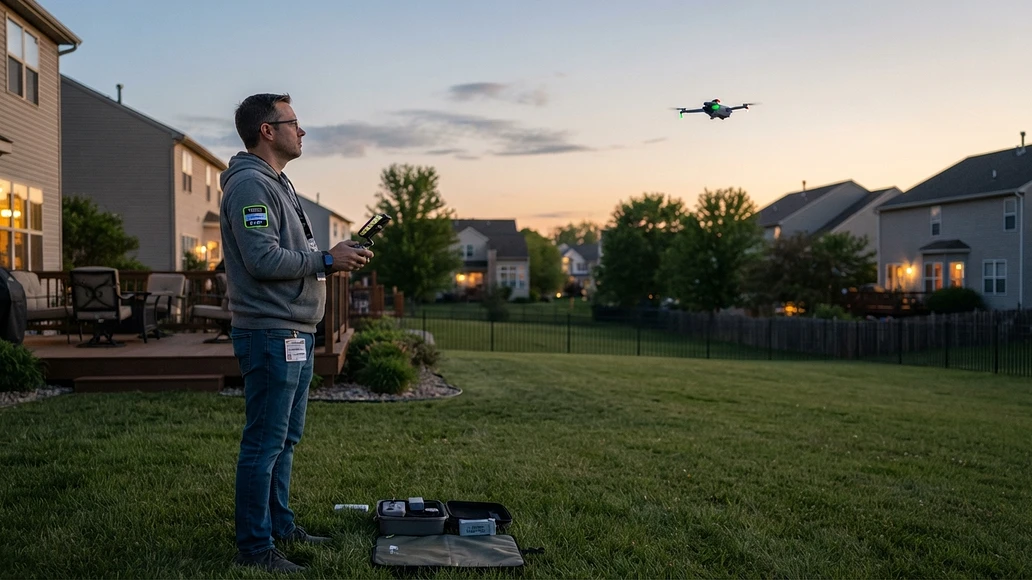
In the US, many flights are limited by visual line of sight rules. That means the pilot or visual observer must be able to keep the aircraft in sight. So even if a drone could technically fly much farther, the legal distance may be far shorter.
| Range term | What it means | Why it matters |
|---|---|---|
| Control link range | Maximum radio connection distance in ideal conditions | Useful for comparing systems, but often optimistic |
| Battery-limited distance | How far the drone can travel before power becomes the constraint | Usually the real practical limit |
| Mission radius | Conservative working distance with return margin | Best number for safe planning |
| Legal range | How far the drone may be flown under applicable rules | Can be much shorter than technical capability |
How far common drones fly in practice
Real-world drone distance depends heavily on type, environment, and purpose. A toy drone in a backyard is not in the same class as a mapping aircraft or a military platform.
| Drone type | Typical real-world range band | Typical flight time | Common use case |
|---|---|---|---|
| Toy or beginner drone | 20 to 100 meters | 5 to 15 minutes | Backyard practice, basic fun flying |
| Entry consumer camera drone | About 0.5 to 2 miles | 20 to 30 minutes | Family photos, casual aerial video |
| Mid-range consumer or prosumer drone | About 1 to 5 miles | 25 to 45 minutes | Photography, inspections, mapping |
| Commercial multirotor | Several miles, mission dependent | 20 to 50 minutes | Industrial inspection, public safety |
| Fixed-wing commercial drone | 10 to 15 plus miles, sometimes much more | 1 to several hours | Surveying, agriculture, long corridor mapping |
| Long-range FPV build | Highly variable, from short local flights to many miles | 10 to 30 plus minutes | Racing, cinematic flying, hobby experimentation |
| Military drone | Hundreds to 1,000 plus miles | Many hours | Reconnaissance, strike, long endurance missions |
For everyday neighborhoods, the most relevant category is the consumer or prosumer camera drone. These aircraft may have impressive published transmission specs, but the realistic working distance is often much shorter once battery reserve, interference, and legal visibility are factored in.
Why spec sheet numbers rarely match reality
Manufacturers usually test in ideal conditions, open terrain, low interference, and a clean radio environment. That is not how most people fly.
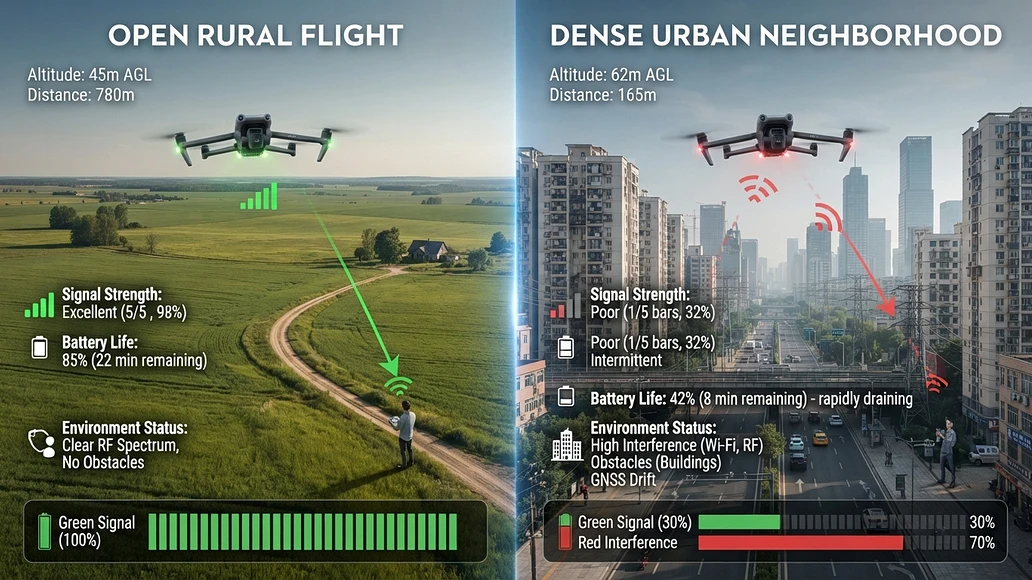
In a suburb or city, Wi-Fi congestion, buildings, trees, power lines, and reflective surfaces can reduce signal quality. Wind also matters more than many beginners expect. A drone that cruises comfortably on the way out may need much more power to fight a headwind on the way back.
Cold weather can cut battery performance. Added payload, such as strobes or accessories, can shorten endurance. Even camera settings and aggressive flying style can affect usable distance.
| Condition | Effect on usable range | Practical takeaway |
|---|---|---|
| Open rural field | Usually best-case signal and visibility | Closest to advertised performance |
| Suburban neighborhood | Moderate interference and obstacles | Expect shorter range than the box claims |
| Dense urban area | Heavy interference, blocked sight lines | Usable distance may drop sharply |
| Cold weather | Reduced battery efficiency | Plan a shorter mission radius |
| Strong wind | Higher power draw, slower return | Keep extra battery margin |
| Heavy payload | Less endurance and slower climb | Reduce distance expectations |
How far drones are usually allowed to fly in the US
For many civilian operators, the legal limit matters more than the technical limit. Recreational flyers and many commercial operators are generally expected to keep the drone within visual line of sight, unless operating under a specific approval or waiver framework.
That does not produce one exact number for every drone, because visibility depends on aircraft size, lighting, weather, background, and the pilot's ability to maintain sight. In practical terms, small consumer drones become hard to see at surprisingly short distances. Many discussions place reliable visual awareness for small drones somewhere around a few hundred meters, sometimes farther in ideal conditions, but not at the dramatic distances often implied online.
Altitude rules matter too. A common rule of thumb for small drone operations is to remain at or below 400 feet above ground level unless a specific exception applies. Operators also need to pay attention to airspace restrictions, temporary flight restrictions, and local conditions.
| Scenario | Technical potential | Typical legal operating limit | What that means in practice |
|---|---|---|---|
| Recreational flying | Often miles of transmission range on modern drones | Visual line of sight | Legal distance is usually much shorter than the radio spec |
| Part 107 commercial flying | Also may have long technical range | Usually visual line of sight unless otherwise authorized | Professional use still requires conservative planning |
| BVLOS operation | Can extend far beyond normal sight range | Requires specific approval, procedures, and oversight | Not the same as casual neighborhood flying |
| Delivery or industrial corridor missions | Designed for extended routes | Managed under structured operational controls | Very different from a hobby drone over a backyard |
State privacy and nuisance laws can also matter. Simple overflight is not automatically illegal, but low hovering near windows, repeated targeted observation, or recording that invades privacy may trigger state or local issues. If you have a specific dispute, consult a qualified attorney in your state.
Can a drone really watch you from miles away?
This is where fear often outruns reality. A small hobby drone does not need to be miles away to capture useful footage. In fact, if someone wanted clear close-up video of a person or home details, the drone would usually need to be much closer than dramatic headlines suggest.
Small consumer drones can record high-quality video, but image clarity depends on distance, lens characteristics, lighting, movement, and whether the operator is actually trying to frame a subject. A drone that is physically far away may still be in the area, but that does not mean it is getting detailed, usable footage of a specific person.
There is also a practical limit on persistence. A single small quadcopter cannot usually stay over an area all day. Battery swaps, charging, weather, and operator attention all limit continuous tracking. That does not mean misuse never happens. It means the common image of a tiny drone silently monitoring one home for endless hours is usually overstated for ordinary civilian aircraft.
| Claim | Reality check | Bottom line |
|---|---|---|
| A hobby drone can secretly watch you from miles away | It may be able to fly that far technically, but detailed observation usually requires closer proximity | Possible in limited cases, but often exaggerated |
| A small drone can follow someone all day | Battery life and operator workload make this difficult for one aircraft | Not a routine capability for most consumer drones |
| Any drone overhead is spying | Many flights are for photos, roof checks, practice, or transit | Context and behavior matter more than presence alone |
| Military drone capabilities reflect neighborhood drone risks | Military systems are in a completely different class | Do not confuse the two |
Why range matters for homeowners
Drone distance matters because it affects how often aircraft may appear nearby, how long they can remain in an area, and whether they are likely to be operating legally and safely. It also shapes realistic privacy concerns.
Noise and visibility
Most small drones are easier to notice by sound than by sight. If a drone is close enough to create a privacy concern, it is often also close enough to hear, especially in a quiet neighborhood.
Overflight versus hovering
A drone passing overhead on the way to another location is different from one that repeatedly hovers low near a home. Flight pattern matters. Repeated low passes, lingering near windows, or returning to the same spot can justify concern.
Crash risk
Longer range can tempt inexperienced operators to push battery limits. That raises the chance of a forced landing, flyaway, or impact with structures, trees, or vehicles.
| Flight pattern near a home | Likely explanation | Recommended response |
|---|---|---|
| Brief pass overhead in daylight | Transit, photography, or routine flying | Observe, no immediate action unless unsafe |
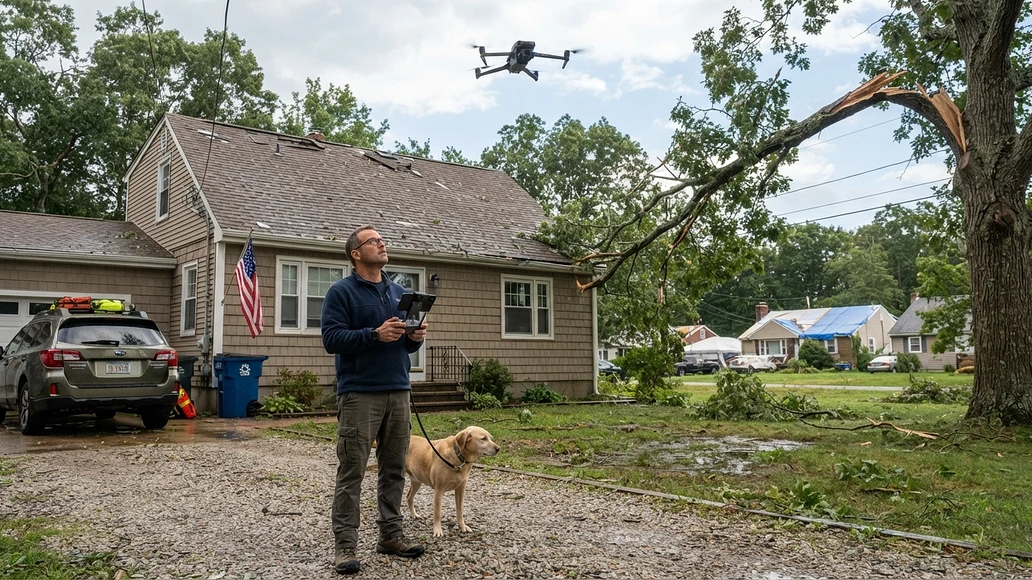
| Short hover over a roof after a storm | Inspection or insurance documentation | Monitor, ask politely if appropriate |
| Repeated low hovering near windows | Potentially intrusive or unsafe behavior | Document and consider reporting |
| Night flights close to homes without obvious purpose | Could be legitimate, but deserves closer attention | Document details and assess pattern |
| Erratic flight near people, cars, or power lines | Unsafe operation | Prioritize safety, document, report if needed |
What really limits drone distance
Three factors matter most, battery endurance, signal quality, and legal restrictions. Everything else tends to feed into one of those.
Battery endurance and return margin
Safe pilots do not fly until the battery is nearly empty. They leave a return reserve for wind, rerouting, and landing. A conservative mission radius is often far shorter than the maximum possible out-and-back distance.
Signal and interference
Urban environments are harder on range than open countryside. Buildings block and reflect signals. Wi-Fi and other radio traffic can add noise. Terrain can also break the link if the drone drops behind a hill or tree line.
Wind, temperature, and payload
Headwinds on the return leg are a classic trap. Cold batteries can sag under load. Extra gear reduces endurance. These are ordinary reasons why a drone that looked fine on paper may underperform in the field.
Preparedness uses where range is genuinely helpful
Longer drone range is not only about risk. It can be genuinely useful in emergencies and home preparedness when used responsibly.
Property inspection
After storms, a drone can check roofs, gutters, tree damage, fencing, and outbuildings without immediately climbing a ladder. Even a short-range flight can save time and reduce exposure to hazards.
Situational awareness after disasters
Flooded roads, blocked driveways, wildfire smoke, and downed trees are easier to assess from above. A drone can help a household decide whether to shelter in place, reroute, or call for help.
Search and community support
In rural areas, drones can assist with locating livestock, checking remote fence lines, or helping volunteer search efforts when coordinated lawfully and safely.
Mapping and delivery coverage
As range increases, the area a drone can cover grows quickly. That matters for agricultural mapping, utility inspection, and delivery trials. It is one reason BVLOS operations continue to attract interest from industry and regulators.
| Preparedness task | How much range is usually needed | Why it helps |
|---|---|---|
| Roof and yard inspection | Very short | Safer than climbing immediately after a storm |
| Checking a long driveway or access road | Short to moderate | Quick assessment of obstructions or washouts |
| Farm or large property overview | Moderate | Covers more ground in less time |
| Search support in open terrain | Moderate to long, mission dependent | Improves visibility over difficult ground |
| Delivery or corridor inspection | Long | Expands service area and route efficiency |
What to do if a drone near your home worries you
If a drone seems intrusive or unsafe, focus on documentation and lawful reporting. Do not try to jam it, hit it, or shoot it down. That can be dangerous and may be illegal.
- Note the time, location, and flight pattern.
- Record video from your property if it is safe to do so.
- Look for repeated behavior, such as low hovering near windows or recurring visits at the same hour.
- If you can identify the operator nearby, a calm conversation may resolve a misunderstanding.
- If the conduct appears unsafe, harassing, or voyeuristic, contact local law enforcement.
- If the issue involves aviation safety or repeated unlawful operation, use appropriate FAA reporting channels.
Situations that deserve more serious attention include persistent low hovering, repeated flights targeting one home, apparent stalking, or any crash causing injury or property damage.
Responsible ownership, range discipline is a real skill
For drone owners, good range management is part of basic preparedness. It lowers the chance of crashes, lost aircraft, and neighborhood conflict.
| Good practice | Why it matters | Simple rule of thumb |
|---|---|---|
| Plan a conservative mission radius | Prevents battery emergencies | Turn back earlier than you think you need to |
| Check wind before launch | Return leg may be harder than outbound leg | Assume conditions can worsen |
| Maintain visual awareness | Supports legal compliance and obstacle avoidance | Do not rely only on the screen |
| Respect neighbors | Reduces complaints and privacy concerns | Avoid unnecessary low hovering near homes |
| Label and register when required | Supports compliance and accountability | Know the current FAA requirements before flying |
Where drone range is heading next
Recent trends suggest transmission systems are improving faster than battery endurance. That means drones may keep getting better at maintaining a stable link over distance, while battery limits and legal limits remain the main practical constraints for many users.
Commercial interest in BVLOS operations and delivery trials is also continuing. No specific dated update is required here, but the broad direction is clear. Longer-range operations are expanding under structured oversight, not as a free-for-all over neighborhoods.
For households, that means you may see more legitimate commercial drone activity over time in some areas. For hobby pilots, it means the technology may outpace what is wise or lawful to do with it. Good judgment matters as much as hardware.
FAQ
Is it legal for someone to fly a drone over my backyard?
Not automatically illegal, but not automatically acceptable either. Overflight rules are complex. A brief pass overhead may be lawful, while repeated low hovering, peering into windows, or invasive recording may violate state or local laws. If the behavior seems targeted or harassing, document it and seek local legal guidance.
How far can a drone fly before it loses signal or battery?
That depends on the model and conditions. Toy drones may only manage tens of meters. Many consumer camera drones can technically link over miles in ideal conditions, but practical operation is often much shorter because of battery reserve, interference, and legal visibility limits.
Can small hobby drones really record clear video from far away?
They can record high-quality video, but useful detail usually requires being relatively close to the subject. A drone does not need to be directly overhead, but dramatic claims about detailed spying from miles away are often overstated.
What should I do if a drone keeps hovering outside my window?
Document the behavior from a safe place, note times and patterns, and contact local law enforcement if it appears intrusive, threatening, or repeated. Do not attempt to interfere physically with the aircraft.
How far should I keep my own drone from neighbors’ homes to be respectful and safe?
There is no universal courtesy number that fits every property, but the best practice is simple. Avoid unnecessary low hovering near homes, keep your flight path purposeful, maintain visual line of sight, and give people space. If you need to inspect your own property near a property line, keep the flight brief and transparent.