Money Readiness for Hard Times, Financial Habits That Make Preparedness Stronger
Preparedness is not only about supplies. Strong money habits can help you handle job loss, medical bills, repairs, and disasters with less panic. Learn how budgeting, emergency savings, debt control, insurance, and digital safety fit into a practical survival plan.

A practical survival plan is not only about food, water, flashlights, or backup power. It is also about whether your household can absorb a job loss, a medical bill, a car repair, a storm evacuation, or a week of missed work without falling apart financially. That is where financial literacy matters.
Financial literacy means understanding how to earn, spend, save, borrow, protect, and organize money so your choices support stability instead of creating avoidable risk. In preparedness terms, it helps you stay functional during common emergencies, not just dramatic worst case scenarios.
This article is educational only and is not personal financial, legal, tax, or insurance advice. If you are behind on minimum payments, in collections, considering bankruptcy or debt settlement, or facing a major life change such as serious illness, disability, divorce, or long-term caregiving, get individualized help from a qualified professional such as a nonprofit credit counselor, benefits counselor, attorney, or certified financial planner.
Why money skills belong in every survival plan
Most households are more likely to face inflation pressure, reduced work hours, a deductible after a storm, or a broken transmission than a total collapse scenario. Financial literacy helps with those real-world disruptions because it improves cash flow awareness, emergency savings, debt decisions, insurance choices, and access to reliable records.
Recent cost of living pressure has also pushed many people into what some surveys call survival spending, where immediate bills crowd out long-term planning. Short-term tools can sometimes buy time, but they can also deepen fragility if they become the default. A stronger approach is to move from reactive spending to a repeatable household system.
| Topic or claim | Evidence strength | What it means for preparedness |
|---|---|---|
| Basic financial literacy improves financial outcomes and resilience | Well supported | Learning core money skills can improve day to day decisions and reduce vulnerability to common shocks. |
| Budgeting and cash flow tracking help prevent crises | Well supported | Knowing where money goes is often the first step to finding room for savings, insurance, and debt reduction. |
| Emergency funds reduce vulnerability to shocks | Well supported | Accessible savings can shorten the duration and severity of many emergencies. |
| Using credit in emergencies can help | Mixed | Credit can bridge a gap, but high interest and high utilization can make the next month worse. |
| Home skills such as cooking, repair, and sewing reduce financial risk | General guidance | These skills can lower recurring costs and improve self-reliance, but they do not replace a budget or insurance. |
| Financial literacy alone guarantees survival in severe disasters | Weak | Money skills help, but they cannot remove all systemic or catastrophic risks. |
| Speculative investments or debt-funded prepping improve resilience | Often harmful | High-risk bets and overspending on gear can weaken your safety margin. |
What financial literacy actually includes
For preparedness, financial literacy is broader than clipping coupons or checking your bank balance. It includes several connected skills.
- Cash flow management, knowing what comes in, what goes out, and when.
- Budgeting, giving each dollar a job so essentials are covered first.
- Emergency savings, building liquid reserves for disruptions.
- Debt management, especially controlling high-interest balances.
- Credit awareness, understanding how borrowing affects future options.
- Insurance literacy, using policies to transfer risks you cannot absorb alone.
- Digital safety, protecting accounts, devices, and identity.
- Recordkeeping, keeping documents available when time matters.
Preparedness gets stronger when these skills work together. A pantry helps with grocery inflation. A budget helps you keep stocking it. Insurance helps if a tree hits the roof. An emergency fund helps with the deductible. Good records help you file the claim.
Start with cash flow, the foundation of financial resilience
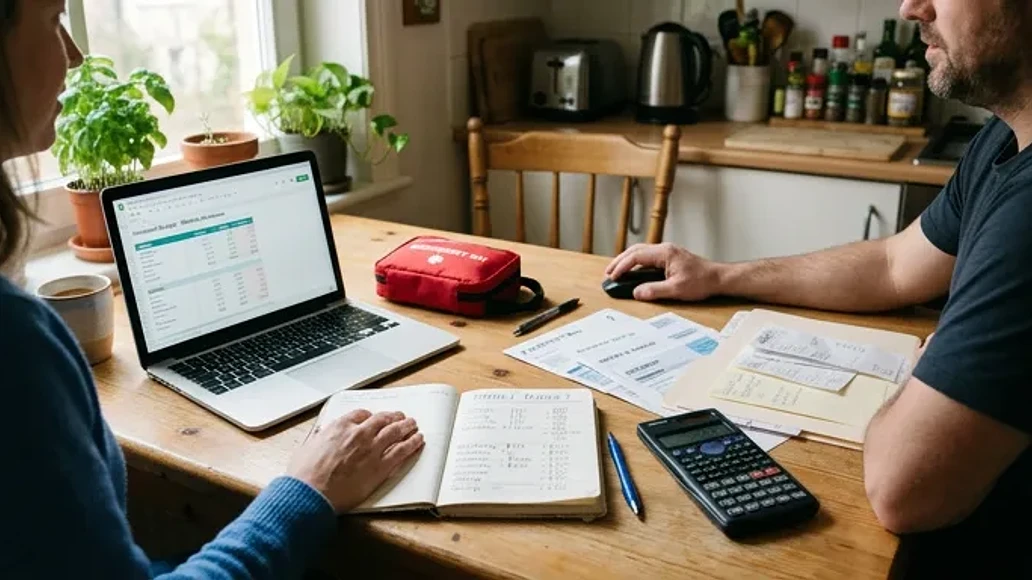
If you do not know your monthly cash flow, it is hard to build any reliable survival plan. Cash flow is simply the movement of money into and out of your household. The goal is not perfection. The goal is visibility.
A simple starting method is to review the last 60 to 90 days of transactions and sort them into categories such as housing, utilities, food, transportation, insurance, debt payments, medical, child care, subscriptions, and preparedness. Then separate each category into fixed, variable, and optional spending.
Many people do well with one of two systems.
| Budget style | How it works | Best for | Preparedness advantage |
|---|---|---|---|
| 50/30/20 style | A percentage framework for needs, wants, and savings or debt payoff | People who want a simple overview | Easy to add a preparedness line under savings goals |
| Zero-based budget | Every dollar is assigned a purpose before the month begins | Households with tight margins or irregular spending | Better control over seasonal costs, emergency savings, and supply rotation |
Whichever method you choose, create a dedicated preparedness category. It can include emergency savings, insurance deductibles, batteries, shelf-stable food, prescription backup costs, pet supplies, and document storage. This keeps preparedness from becoming random impulse spending.
How to build an emergency fund that actually helps in a crisis
An emergency fund is one of the clearest links between financial literacy and survival. It gives you options when income drops or expenses spike. Without it, even a manageable problem can turn into late fees, credit card debt, or missed insurance premiums.
There is no single perfect number for everyone, but a practical ladder works well.
| Savings milestone | What it can cover | Why it matters |
|---|---|---|
| First $500 | Small car repair, urgent prescription, copay, minor home fix | Creates immediate breathing room |
| First $1,000 | Many common surprise bills | Reduces reliance on high-interest borrowing |
| One month of essential expenses | Short disruption in income or temporary displacement | A strong early resilience target |
| Three to six months of essential expenses | Job loss, recovery after disaster, major interruption | A common long-term goal for broader stability |
If money is tight, start with a tiny automatic transfer. Even $10 to $25 per paycheck builds the habit. Windfalls such as tax refunds, overtime, rebates, or gift money can accelerate the fund if you assign part of them before they disappear into routine spending.
Where to keep emergency savings
Emergency money should be safe, liquid, and easy to access. Chasing high returns is usually the wrong goal for this part of your plan.
| Storage option | Pros | Cons | Best use |
|---|---|---|---|
| Checking account | Immediate access, easy bill payment | Too easy to spend accidentally, lower separation from daily money | Small buffer for very short-term surprises |
| High-yield savings account | Liquid, separate from spending, often insured | May take a day or two to transfer depending on setup | Main emergency fund for most households |
| Credit union savings | Insured, community-focused, often good customer service | Branch access varies by area | Good option for local banking relationships |
| Cash at home | Useful during power outages or payment network disruptions | Theft, fire, loss, no insurance if stored carelessly | Limited backup cash, not the whole fund |
| Prepaid card | Can separate funds from daily spending | Fees, limits, replacement hassles | Usually less ideal than insured bank or credit union accounts |
A balanced setup for many households is to keep most emergency savings in an insured savings account and a modest amount of cash at home for short outages or evacuation needs. Store home cash discreetly and securely. Do not advertise it.
Debt control, because high-interest balances can sabotage preparedness
Debt is not all the same. A fixed-rate mortgage is different from a payday loan. A manageable student loan is different from revolving credit card debt at a very high interest rate. For survival planning, the biggest danger is debt that compounds quickly and steals future cash flow.
Prioritize debts that are expensive, unstable, or tied to severe consequences. In many households that means credit cards, payday loans, title loans, and overdue accounts with fees. Two common payoff methods are useful.
| Method | How it works | Strength | Watchout |
|---|---|---|---|
| Avalanche | Pay extra toward the highest interest debt first | Usually saves the most money over time | Progress can feel slow if the balance is large |
| Snowball | Pay extra toward the smallest balance first | Quick wins can improve motivation | May cost more in interest overall |
If you cannot make minimum payments, are using one debt to pay another, or are considering payday or title loans for essentials, treat that as a warning sign. That is a good time to contact a nonprofit credit counseling agency or another qualified advisor. Avoid anyone promising guaranteed debt elimination, secret loopholes, or pressure to buy expensive coaching.
Credit can be a tool, but it is not a substitute for readiness
Good credit can help during emergencies by improving access to rentals, utilities, insurance pricing in some states, or lower-cost borrowing. But credit is a backup tool, not the foundation. A card used for a deductible and paid off quickly is very different from carrying a balance for months because the budget never recovered.
Basic credit-protection habits include paying on time, keeping balances modest relative to limits, checking statements for fraud, and reviewing your credit reports regularly. If you are rebuilding credit, one small account used carefully can be more effective than opening several accounts at once.
Buy Now Pay Later plans deserve caution. They may reduce immediate pressure, but they can also create overlapping obligations that are easy to lose track of. If a purchase is truly essential, compare the total cost, due dates, fees, and what happens if your income changes before you commit.
Insurance is one of the most overlooked survival tools
Preparedness-minded households sometimes focus so much on gear that they underweight insurance. Yet one major uninsured loss can wipe out years of careful stocking and saving. Insurance transfers risk that would be hard for most families to absorb alone.
| Insurance type | What it helps protect against | Preparedness question to ask |
|---|---|---|
| Health insurance | Medical bills, hospital care, prescriptions | What are my deductible, out-of-pocket maximum, network rules, and prescription backup options? |
| Renters insurance | Loss of belongings, liability, some temporary living costs | Would a fire, theft, or storm loss be financially survivable without it? |
| Homeowners insurance | Dwelling damage, belongings, liability, some displacement costs | Do I understand exclusions, deductibles, and whether flood coverage is separate? |
| Auto insurance | Vehicle damage, liability, medical costs depending on policy | Could I replace or repair my vehicle quickly enough without coverage? |
| Disability insurance | Income loss from illness or injury | If I could not work for months, what would pay the bills? |
| Life insurance | Income replacement for dependents after death | Would my household be financially stable if I died unexpectedly? |
Review policies at least once a year and after major life changes. Read the declarations page, confirm deductibles, and know what is excluded. For disaster planning, understand whether flood, earthquake, sewer backup, or business-use coverage requires separate policies or endorsements.

Life stage matters, because risks and priorities change
The right financial survival plan for a teenager is not the same as the right plan for a retiree or a military family. The core skills stay similar, but the pressure points change.
| Life stage | Key skills | Common risks | Helpful next step |
|---|---|---|---|
| Teen or young adult | Basic budgeting, saving, debit and credit basics, scam awareness | Impulse spending, fraud, lack of emergency savings habit | Open a savings account and practice tracking every dollar for one month |
| College student | Managing irregular income, avoiding high-interest debt, building credit carefully | Overuse of credit cards, subscription creep, emergency travel costs | Create a bare-bones monthly budget and keep a small emergency reserve |
| Working adult or family | Cash flow planning, insurance review, emergency fund growth, document organization | Child care costs, medical bills, vehicle repairs, job loss | Build one month of essential expenses and review deductibles |
| Service member or military family | Deployment planning, spouse access to accounts, emergency records, benefits awareness | Moves, family separation, scams targeting military households | Use official financial readiness resources and confirm powers of attorney if needed |
| Older adult or caregiver | Health cost planning, fraud prevention, estate basics, income continuity | Medical bills, caregiving strain, cognitive decline scams | Organize legal and medical documents and review trusted contacts |
Pregnancy, chronic illness, disability, and aging can sharply increase medical and caregiving costs. In those situations, health coverage, disability planning, and benefits screening become especially important.
Home skills can stretch your budget and improve resilience
Financial literacy is not only about spreadsheets. It also includes understanding which practical skills reduce recurring expenses and dependence on fragile systems. Cooking from basic ingredients, maintaining a pantry, sewing simple repairs, preserving food safely, basic home maintenance, and caregiving skills can all support a stronger financial plan.
These skills are not magic, and the evidence is more practical than clinical, but they often reduce waste and improve flexibility. A household that can cook from staples, patch clothing, and handle small repairs may need less emergency cash for minor disruptions.
Look for low-cost learning through extension programs, libraries, community colleges, local workshops, and reputable online tutorials. Avoid spending heavily on specialized gear before you have mastered the basics.
Digital financial survival skills matter now
Modern preparedness includes protecting your money online. If your phone, email, or bank login is compromised during a stressful event, the damage can spread quickly. Digital financial literacy means using tools conveniently without becoming easy to exploit.
- Use strong, unique passwords for banking and email.
- Turn on multi-factor authentication where available.
- Keep devices updated.
- Do not click urgent payment links from texts or emails you did not expect.
- Review transactions and alerts regularly.
- Know how to freeze cards quickly if your wallet or phone is lost.
- Store key account numbers and contact methods securely in a backup location.
Scammers often target people in crisis with fake charities, fake utility shutoff notices, bogus insurance help, and impersonation calls. Slow down, verify independently, and use official contact information from your statements or provider websites.
Plan for health shocks and caregiving before they happen
Many financial emergencies are health-related. A stronger survival plan includes prescriptions, transportation to care, deductibles, time off work, and the possibility that one person may need to care for another.
| Common emergency | Tools that can shorten the problem | Tools that may only ease symptoms |
|---|---|---|
| Job loss | Emergency fund, updated resume, lower fixed expenses, unemployment benefits if eligible | Credit card use without a repayment plan |
| Medical bill | Health insurance, HSA or FSA if available, emergency savings, payment plan negotiation | Ignoring bills until collections begin |
| Car repair | Dedicated sinking fund, emergency savings, preventive maintenance | Title loan or payday loan |
| Natural disaster displacement | Insurance review, emergency cash, document copies, evacuation budget | Last-minute expensive bookings with no plan for reimbursement |
| Caregiving crisis | Benefits screening, family role planning, document access, backup child or elder care contacts | Ad hoc borrowing every month with no support plan |
If health or caregiving needs are already straining your budget, ask about hospital financial assistance, prescription cost programs, public benefits, disability resources, and local social service agencies. A social worker or benefits counselor may help you find options you did not know existed.
Documents and records, the paperwork side of preparedness
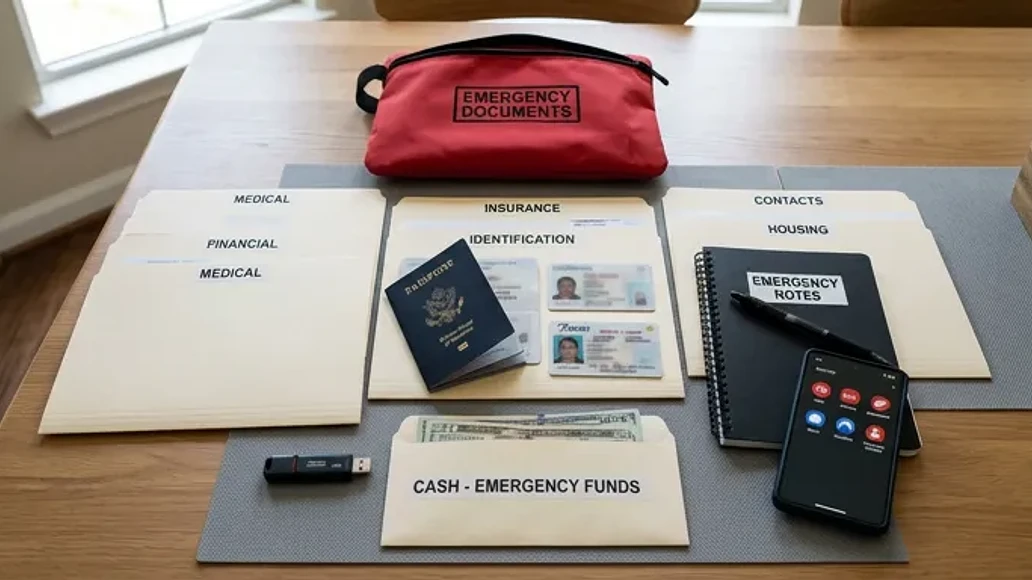
In a crisis, missing paperwork can delay claims, benefits, travel, medical decisions, and access to money. Every household should maintain an organized set of essential records in both physical and secure digital form.
Your packet may include identification, insurance cards and policies, bank and credit account contacts, mortgage or lease information, vehicle title and registration, medication list, emergency contacts, copies of key bills, and basic legal documents such as powers of attorney or guardianship paperwork if relevant.
Use a waterproof folder or pouch for physical copies and a secure encrypted digital backup for scans. Tell a trusted person how to access what they may need in a true emergency, but do not overshare sensitive information casually.
If you are living paycheck to paycheck, start smaller and more strategically
Financial preparedness can sound unrealistic when every dollar already has a job. But low-margin households still benefit from a survival framework. The scale changes, not the value of the skills.
Start by protecting the basics. Keep housing, utilities, food, transportation to work, medications, and insurance as the top tier. Then look for the smallest actions that create flexibility, such as one canceled subscription, one lower bill, one pantry meal plan, one extra shift, or one automatic transfer to savings.
A realistic early plan might be a $300 to $500 mini emergency fund, a written list of all due dates, a pantry buffer of low-cost staples, and a clear rule to avoid payday or title loans unless you have received qualified counseling and fully understand the consequences.
Use windfalls carefully. Tax refunds, back pay, gifts, and side-income bursts can disappear fast. Splitting them between urgent needs, debt reduction, and emergency savings often creates more lasting stability than spending them all on delayed wants or expensive preparedness gear.
A practical financial readiness map
| Skill area | Basic level | Intermediate level | Advanced level |
|---|---|---|---|
| Budgeting | Track income and essential bills | Use a monthly budget with sinking funds | Review trends quarterly and adjust for seasonal risks |
| Emergency savings | Save first $500 to $1,000 | Build one month of essential expenses | Build three to six months based on job and household risk |
| Debt | Stop adding high-interest debt where possible | Use snowball or avalanche payoff plan | Refinance or restructure appropriately with professional guidance if needed |
| Credit | Pay on time and monitor statements | Keep utilization modest and review reports | Optimize access while avoiding unnecessary accounts |
| Insurance | Carry essential coverage | Review deductibles and exclusions yearly | Coordinate policies with broader disaster and estate planning |
| Digital safety | Use strong passwords and alerts | Enable multi-factor authentication and secure backups | Maintain a full recovery plan for lost devices or compromised accounts |
| Home skills | Cook basic low-cost meals and store staples | Learn simple repair and maintenance skills | Integrate cost-saving skills into long-term resilience planning |
When to get professional help
General education can take you far, but some situations call for personalized advice. Seek qualified help if you cannot meet minimum payments, are in collections, are considering bankruptcy, have a complex tax or legal issue, need disability or elder planning, or are unsure how to compare major insurance or retirement decisions.
Look for nonprofit credit counseling for debt and budgeting support, fee-only planners for broader financial planning, licensed insurance professionals for coverage questions, and attorneys for estate or legal matters. Verify credentials and be cautious with anyone who promises guaranteed returns, pushes leverage, or pressures you into expensive seminars or proprietary products.
FAQ
How big should my emergency fund be if I am just starting and money is tight?
Start with a small but real target, often $500 to $1,000. That amount can handle many common surprises and reduce the need for high-interest borrowing. After that, aim for one month of essential expenses, then build toward a larger reserve over time.
Is it ever smart to use credit cards or Buy Now Pay Later as part of a survival plan?
Only as a limited backup, not as the core plan. Credit can help bridge a short gap if you already know how it will be repaid quickly. If it becomes the normal way you cover groceries, utilities, or medical costs, it is usually a sign the underlying budget needs attention.
What are the most important financial literacy skills for teenagers and college students who want to be prepared?
The essentials are tracking spending, building a savings habit, understanding how credit works, avoiding scams, and learning to separate needs from wants. Those habits matter more than trying to learn advanced investing too early.
How can I improve my financial literacy if I feel overwhelmed and do not know where to start?
Pick one small action for this week. Review your last month of spending, list your fixed bills, and set up a tiny automatic transfer to savings. Then add one more step next week, such as checking insurance deductibles or organizing your account logins and documents.
What are some free or low-cost resources that can help me build a stronger financial survival plan?
Good starting points include the Consumer Financial Protection Bureau, university extension programs, military financial readiness resources for eligible families, public libraries, and nonprofit credit counseling organizations. These sources are often more trustworthy than social media personalities selling urgency.
References
- An essential guide to building an emergency fund
- How to learn financial literacy skills and build foundational knowledge
- Financial literacy among young college students
- Empowering Youth by Building Early Financial Literacy Skills
- Almost 80% of Gen Z and Millennials Use 'Survival Spending'
- Financial Readiness report
- Money Management Tips for Parents of College Students