Can Your Kitchen Microwave Really Shield Electronics? The Science, Limits, and Safer Options
A microwave oven uses Faraday cage principles, but that does not make it a dependable EMP shelter. Here is what it can block, what it cannot, and how to protect devices more safely.

Many people have heard that a microwave oven is basically a Faraday cage. That idea is partly true, but it needs an important qualifier. A microwave oven is built to keep a very specific kind of electromagnetic energy inside the cooking cavity, mainly the 2.45 GHz radio waves produced by its magnetron. That does not automatically mean it is a dependable shield for every signal, every threat, or every preparedness scenario.
If your real question is whether a microwave can protect a phone, radio, key fob, or emergency electronics from outside electromagnetic energy, the honest answer is, sometimes for limited signal blocking, but not reliably enough to trust for EMP or long-term protection. Understanding why requires a quick look at how Faraday cages work, how microwave ovens are designed, and where the weak points are.
What a Faraday cage actually is
A Faraday cage is a conductive enclosure that reduces the electric field inside it by redistributing charge across its outer surface. In practical terms, it can block or weaken radio frequency energy and other electromagnetic fields, depending on the design. The key phrase is depending on the design.
A true shielding enclosure works best when it has continuous conductive material, tight seams, minimal openings, and good electrical continuity all the way around. The size of any holes or gaps matters because electromagnetic waves have wavelengths, and openings that are small relative to the wavelength are easier to block. Shielding also depends on frequency, field strength, and how the enclosure is built.
That is why not every metal box is automatically a high-performance Faraday cage. A lidded trash can, an ammo can, a purpose-built Faraday bag, and a microwave oven may all offer some shielding, but they do not offer the same shielding, across the same frequencies, with the same reliability.
How a microwave oven uses Faraday cage principles
A microwave oven is designed around a metal cavity. The magnetron generates radio waves at about 2.45 GHz, and the metal walls reflect that energy so it stays inside the cooking chamber instead of spreading through your kitchen. The door includes a metal mesh with holes small enough to let visible light through while helping contain the much longer microwave wavelength.
That is why you can watch food cook through the window without the oven spraying dangerous levels of microwave energy into the room. The body, door frame, mesh, and sealing geometry all work together to confine the intended frequency. Properly functioning ovens are also regulated for leakage, and normal household use is considered safe when the appliance is in good condition.
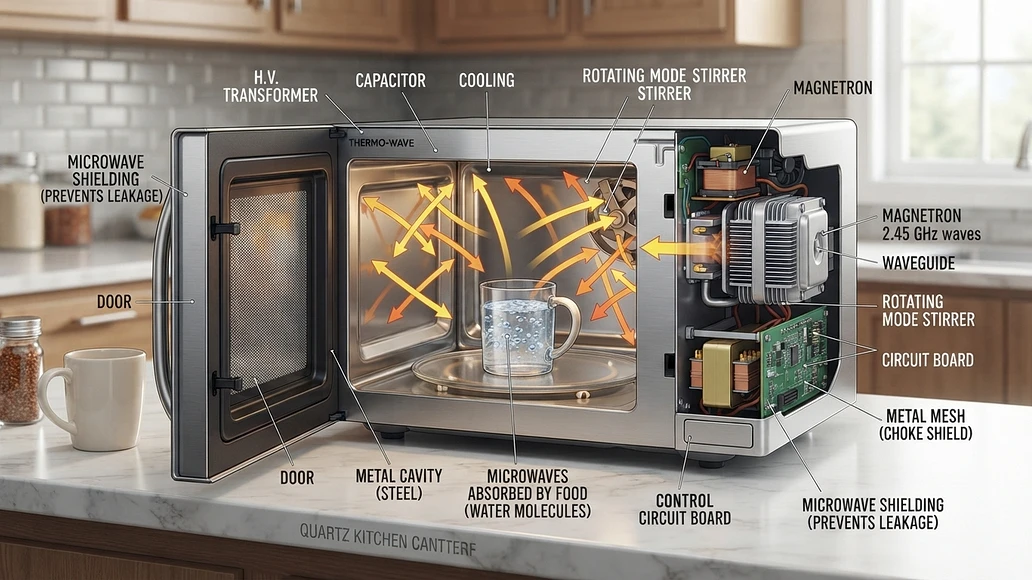
So, is a microwave oven technically a Faraday cage?
In a limited sense, yes. A microwave oven behaves like a Faraday-style shield for the frequency range it was designed to contain. In casual conversation, calling it a Faraday cage is understandable.
In a stricter engineering sense, the better answer is this: it is a frequency-specific shielding enclosure, not a general-purpose protective cage for all electromagnetic threats. It is optimized to keep cooking energy in, not to guarantee broadband protection from outside pulses, high-energy events, or every wireless signal.
That distinction matters because preparedness claims often skip over frequency range, seam quality, door leakage tolerance, and the fact that the power cord itself can act as a path for energy. Those details are exactly why a microwave should not be treated as a standards-based EMP solution.
Why the door screen blocks microwaves but still lets you see inside
The oven window is one of the easiest ways to understand the physics. Visible light has a much shorter wavelength than microwave energy, so the perforated metal screen can allow light to pass while still reflecting or attenuating 2.45 GHz radiation. The holes are tiny compared with the microwave wavelength, which is roughly 12 centimeters.
This does not mean every hole size blocks every signal equally. It means the screen was engineered for the oven's operating frequency. That is a very different goal from broad-spectrum shielding against unknown external sources.
Microwave oven versus purpose-built shielding
| Option | Main purpose | Best at blocking | Weak points | Good choice for EMP protection? | Best everyday use |
|---|---|---|---|---|---|
| Household microwave oven | Contain cooking energy | Its design frequency, around 2.45 GHz | Door seams, latch area, power cord, unknown continuity | No, not as a primary plan | Short-term signal blocking in a pinch, if the oven is off |
| Purpose-built Faraday bag | Portable RF shielding | Consumer wireless bands, depending on product quality | Wear, punctures, poor closure technique | Better than a microwave, but quality varies | Phones, key fobs, tablets, small radios |
| Metal trash can with insulated contents | DIY preparedness storage | Broad shielding if seams and lid fit well | Lid contact quality, interior insulation mistakes | Often a better DIY option | Backup electronics storage |
| Metal ammo can with gasket modified or continuity improved | Compact DIY shielded storage | Small-device protection if built carefully | Rubber gasket can interrupt conductivity, limited space | Potentially useful if properly prepared | Handheld radios, flash drives, spare chargers |
Why a microwave is not dependable EMP or CME protection
EMP and CME discussions often get lumped together, but they are not the same thing. A nuclear EMP involves a fast, intense electromagnetic pulse with broad frequency content. A coronal mass ejection affects the power grid differently, mainly through geomagnetic effects on long conductors. In both cases, the issue is not just whether a box is metal. The issue is whether the enclosure provides robust shielding across relevant frequencies and whether connected conductors create paths for damaging energy.
A microwave oven has several limitations for that job. The door is designed with allowable leakage limits for normal cooking safety, not zero leakage under extreme outside fields. The seams and latch area are not built as hardened shielding joints. The power cord is still attached unless you physically disconnect the appliance, and even then, the oven was never certified as an EMP storage container. Age, dents, corrosion, and door wear can further reduce confidence.
That is why most technically grounded preparedness advice treats a microwave as, at best, an improvised and unverified shield, not a serious primary defense for mission-critical electronics.
Can it block phone, Wi-Fi, Bluetooth, or car key signals?
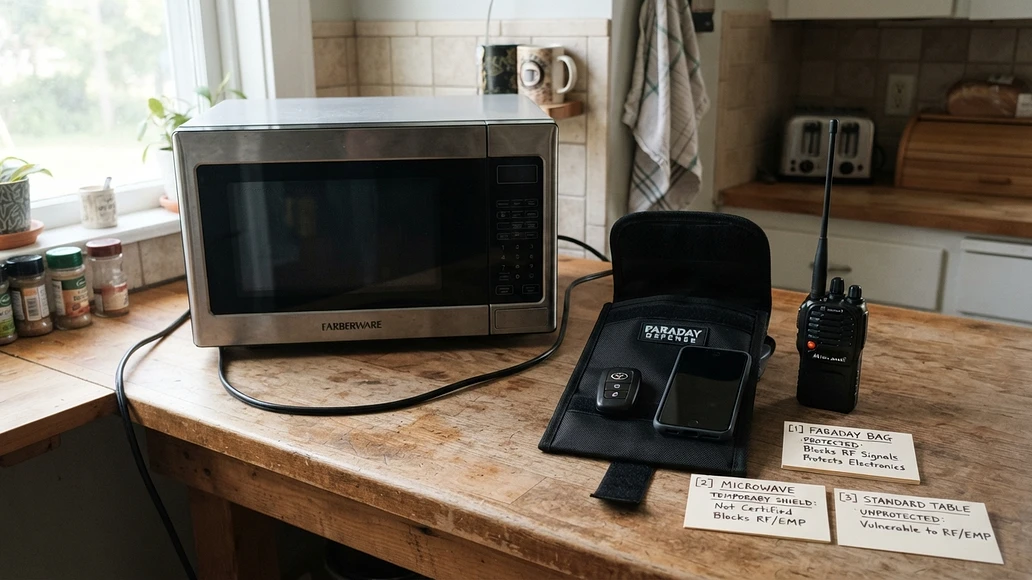
Sometimes, yes. Many people notice that a phone placed inside an unplugged microwave may lose cellular, Wi-Fi, or Bluetooth connectivity. Key fobs may also stop communicating when enclosed. But results vary by oven design, signal strength, carrier band, and how well the door closes.
This kind of informal signal blocking is not the same as verified high-level shielding. A device that loses one signal in your kitchen may still be vulnerable to other frequencies or stronger fields. It is also possible for one microwave to block a key fob well while another leaks enough signal for the test to fail.
For privacy or anti-relay concerns, a purpose-built Faraday pouch is usually more practical than using a kitchen appliance. It is portable, repeatable, and made for that use case.
Everyday microwave safety, what the evidence says
Modern microwave ovens are regulated for leakage, and properly functioning units leak very little radiation, typically well below official limits. The broader health consensus is also clear on two common fears. Microwave ovens do not make food radioactive, and normal use has not been shown to cause cancer when the appliance is used as directed.
Microwaves use non-ionizing radiation. That means they do not have enough energy to alter atomic nuclei or damage DNA in the way ionizing radiation can. Their main effect in cooking is heating water-rich food.
Distance still helps. Even though leakage limits are already low, exposure drops quickly as you move away from the appliance. Standing a few feet back while it runs is a simple, reasonable habit, especially if it reduces anxiety or keeps children away from hot food and steam.
| Situation | What matters most | Practical risk level | Best guidance |
|---|---|---|---|
| Using a modern microwave in good condition | Door seal integrity and normal operation | Low | Use as directed and avoid pressing against the door while it runs |
| Standing several feet away | Distance reduces already low exposure | Very low | A simple habit that adds margin and keeps kids clear of hot containers |
| Using an old oven with a bent door or damaged latch | Possible increase in leakage | Higher than normal | Stop using it until repaired or replaced |
| Running the oven empty or with unsuitable metal inside | Arcing and magnetron damage | Unsafe | Do not do it unless the manufacturer specifically allows the item or mode |
Common myths, sorted out
| Myth | Reality |
|---|---|
| A microwave is a perfect Faraday cage for anything electromagnetic | It is designed to contain its cooking frequency, not to guarantee broadband or EMP-grade shielding |
| If a phone loses signal inside, the oven will protect electronics from EMP | Signal loss in a casual test does not prove protection against intense or broad-spectrum events |
| Microwaved food becomes radioactive | No. Microwave energy is non-ionizing and heats food without making it radioactive |
| Microwave ovens cause cancer in normal use | Mainstream health guidance says properly functioning ovens are safe when used as directed |
| Any metal container is automatically a good Faraday cage | Seams, openings, insulation, and continuity determine performance |
Better preparedness options than using your microwave
If your goal is realistic device protection, there are better choices than repurposing a kitchen appliance. A purpose-built Faraday bag is convenient for phones, tablets, key fobs, and small radios. For home storage, a metal trash can with a tight-fitting lid and insulated contents is a common DIY approach. Ammo cans can also work for smaller gear, but many need attention to the gasket and electrical continuity before they perform well as shields.
The basic design rules are simple. The conductive shell should be as continuous as possible. The contents should be insulated from direct contact with the metal. The closure should fit tightly and consistently. The container should be reserved for storage, not mixed into daily kitchen use.
| Storage option | Cost level | Capacity | Main advantage | Main caution | Best use case |
|---|---|---|---|---|---|
| Faraday bag | Low to medium | Small | Portable and easy to use | Quality varies by brand and wear over time matters | Phone, key fob, GPS, small radio |
| Metal trash can with lid | Low to medium | Large | Good DIY storage potential | Needs interior insulation and a well-fitting lid | Backup electronics at home |
| Modified ammo can | Low to medium | Small to medium | Durable and compact | Rubber gasket may reduce electrical continuity | Spare handheld gear |
| Microwave oven | Already owned | Medium | May block some everyday signals | Not designed or verified for EMP storage | Temporary signal isolation only |
How to check whether your microwave is still shielding properly
The first step is visual inspection. Look for a door that closes squarely, a clean sealing surface, intact hinges, and a latch that engages firmly. If the door is bent, the mesh is damaged, or the unit has been dropped, do not assume it is still performing normally.
Also pay attention to warning signs during use. Sparking, burning smells, unusual buzzing, or visible damage are reasons to stop using the appliance. Professional leakage testing is more reliable than homemade methods. Informal phone tests can tell you something about signal blocking, but they do not measure microwave leakage or certify safety.
If you suspect a problem, the safest move is repair by a qualified technician or replacement of the oven.
Microwave safety basics for the kitchen
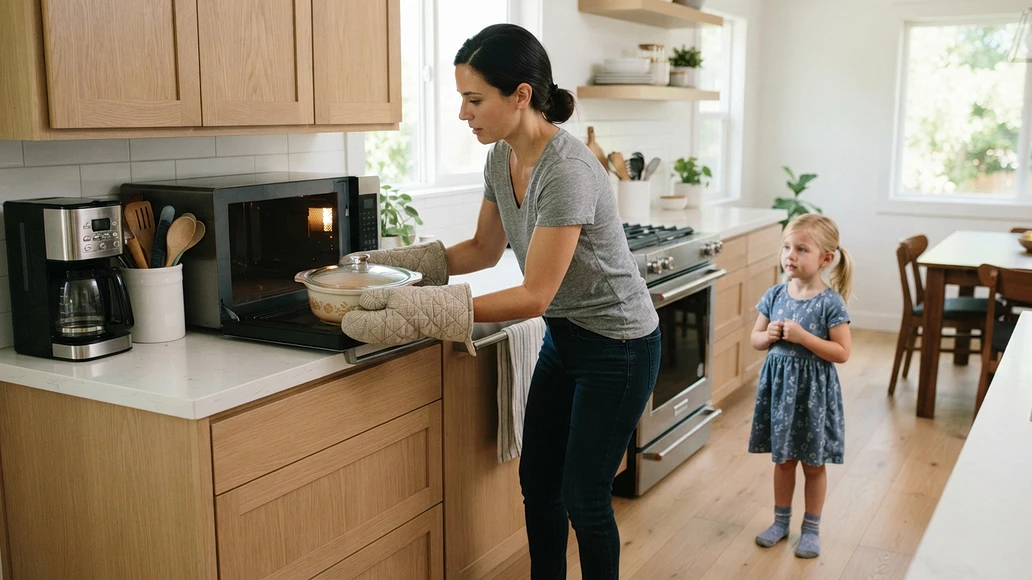
The biggest day-to-day risks from microwaves are usually not radiation. They are burns, superheated liquids, steam, and uneven heating. Use microwave-safe containers, stir food when appropriate, allow standing time, and be careful with sealed containers or tightly covered foods that can vent suddenly.
Children should be kept back while the oven is running, mostly to prevent spills, steam burns, and grabbing hot dishes. If you are pregnant or simply cautious about EMF exposure, current evidence does not show harm from normal microwave use, but standing a bit farther away is a reasonable personal comfort choice.
When using a microwave as a makeshift RF shield makes sense
There are a few narrow situations where an unplugged microwave can be a practical short-term enclosure. You might use it briefly to see whether a key fob stops transmitting, to demonstrate shielding concepts in a classroom, or to reduce ordinary wireless communication to a device for a moment.
Even then, there are limits. Do not turn the microwave on with electronics inside. Do not treat the oven as a secure long-term storage vault. Do not assume a successful phone test means your emergency radio is protected from a severe electromagnetic event.
In other words, a microwave can be a convenient improvised signal blocker, but it is not a preparedness-grade answer.
Preparing for grid threats without risky shortcuts
Balanced preparedness works better than gadget myths. If you are concerned about grid disruption, focus first on practical steps that help in many emergencies, not just rare electromagnetic scenarios. Keep backup lighting, stored water, shelf-stable food, battery banks, printed contact information, and a communications plan. For electronics you truly want to protect, use a purpose-built Faraday product or a carefully built storage container based on proven shielding principles.
That approach addresses the root problem directly. Repurposing a microwave may feel clever, but it is still an improvised workaround with too many unknowns to be your only plan.
FAQ
Can I store my emergency electronics in a microwave to protect them from EMP?
You can physically place them there, but it is not wise to rely on that as your main protection. A microwave was not designed, tested, or certified as an EMP storage enclosure. Use a purpose-built Faraday bag or a better DIY shielded container instead.
Is it safe to put my phone in a microwave if I do not turn it on?
Generally, placing a phone in an unplugged microwave for a brief signal-blocking test is not the same as operating the oven, but you should never run the microwave with the phone inside. Also, do not make the microwave your regular storage place for electronics because someone else could accidentally start it.
How can I tell if my microwave is leaking radiation?
Start with the basics. Inspect the door, hinges, latch, and sealing surfaces. If the door is damaged or does not close properly, stop using the oven. Professional leakage testing is more reliable than homemade tests. A phone signal test does not measure microwave leakage.
Do microwaves make food or containers radioactive?
No. Microwave ovens use non-ionizing radiation to heat food. That process does not make food radioactive. Container safety is a separate issue, so use microwave-safe containers to avoid melting, chemical leaching, or breakage.
Are there simple ways to build a better Faraday cage at home than using a microwave?
Yes. Common options include a metal trash can with a tight lid and insulated contents, or a properly prepared ammo can for smaller devices. Purpose-built Faraday bags are often the easiest and most repeatable option for everyday use.
References
- Are Microwave Ovens Dangerous? , Good Housekeeping
- Fours à micro-ondes et leurs dangers , CCHST
- Microwave Oven EMF: Safe Distance and Radiation Levels
- How does a Faraday cage work? , from 1836 to 2025
- Microwaves and Faraday Cages: Understanding the Science Behind Electromagnetic Shielding
- What's in Your Faraday Cage? Electronics to Protect!