Using Manuka Honey on Wounds, What Helps, What Hurts, and How to Do It Safely
Manuka honey can support healing in some wounds, especially certain minor burns and selected chronic wounds, but only when used correctly. Learn the difference between medical-grade and grocery-store honey, how to apply it safely, and when to get medical care instead of treating a wound at home.

Manuka honey has a real place in wound care, but it is not a magic fix and it is not the same thing as squeezing pantry honey onto a cut. Research and clinical use suggest that sterile, medical-grade honey can help some wounds by supporting a moist healing environment, lowering bacterial burden, and sometimes shortening healing time in selected cases, especially partial-thickness burns. At the same time, evidence is mixed for other wound types, and some injuries should never be managed at home with honey.
If you are considering Manuka honey for wound care, the safest approach is to think of it as an adjunct to standard wound care, not a replacement for cleaning, proper dressings, debridement, offloading, compression, or antibiotics when those are needed.
What Manuka honey is, and how it differs from regular honey
Manuka honey is made by bees that collect nectar from the Manuka plant, native to New Zealand and parts of Australia. It is often marketed for its naturally high levels of antibacterial activity. In wound care, that matters because honey can create a low-pH, high-osmolarity environment that may discourage microbial growth while helping keep the wound bed moist.
Regular table honey and raw local honey can share some broad honey properties, but they are not interchangeable with wound products. For wound use, the key distinction is not just the floral source. It is whether the product is sterile, intended for wound care, and packaged as a medical product.
What “medical-grade honey” means for wound care
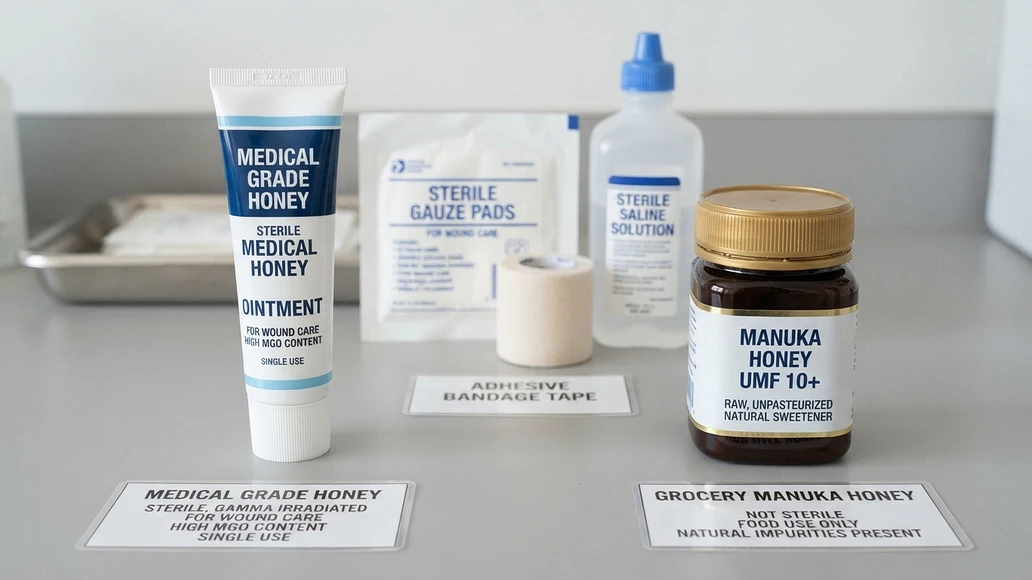
Medical-grade honey is processed and sterilized for use on wounds. It is designed to reduce contamination risk and is sold in forms such as gels, impregnated dressings, alginates, and wound pads. This is very different from food-grade honey, even if the jar says Manuka, UMF, or MGO.
For home wound care, sterile packaging matters because open or food-grade honey may contain contaminants and is not produced under the same standards as wound products. A label that highlights premium Manuka quality does not automatically mean the product is appropriate for an open wound.
| Product type | Sterile | Intended use | Best use case | Main caution |
|---|---|---|---|---|
| Medical-grade honey dressing or gel | Yes | Wound care | Minor wounds that are appropriate for home care, or clinician-directed use for selected chronic wounds | Still not suitable for deep, heavily bleeding, or infected wounds without medical guidance |
| Food-grade Manuka honey | No | Eating | Nutrition and flavor | Not recommended for open wounds because it is not sterile wound care material |
| Regular grocery honey | No | Eating | Kitchen use | Not a wound dressing and should not be treated as equivalent to medical honey |
| Standard non-adherent dressing without honey | Usually sterile if packaged as wound care | Wound protection | Many simple cuts, scrapes, and abrasions after proper cleaning | May be enough on its own for minor wounds, depending on the injury |
How Manuka honey may help wounds heal
Medical honey is thought to help through several mechanisms. It draws fluid because of its osmotic effect, helps maintain a moist wound bed, has a naturally acidic pH, and may reduce odor and inflammation in some wounds. Some studies also suggest it can help loosen dead tissue and support autolytic debridement, which is the body’s own process of softening and shedding nonviable material.
That does not mean every wound heals faster with honey. The strongest support is for some partial-thickness burns and selected wound settings. In other categories, the evidence is mixed, and the result often depends on wound type, circulation, infection status, pressure, and whether standard care is also being done correctly.
Which wounds may benefit most
For a general audience, the most reasonable takeaway is that medical-grade Manuka honey may be useful for small, uncomplicated wounds that are already appropriate for home care, and for certain clinician-managed wounds where honey is used as part of a broader treatment plan.
| Wound type | Evidence outlook | Possible role for medical-grade Manuka honey | Home use or clinician care |
|---|---|---|---|
| Small minor abrasions and scrapes | Reasonable but not dramatic | May help maintain moisture and protect the wound when used under a proper dressing | Home care may be appropriate if the wound is clean and shallow |
| Partial-thickness minor burns | Best supported | May shorten healing time in some cases and help with moisture balance | Home care only for small minor burns, larger or more serious burns need medical care |
| Venous leg ulcers | Mixed to moderate | May help selected wounds, especially with odor or exudate, but compression remains essential | Clinician-guided care is preferred |
| Pressure injuries | Mixed | May be used in some settings as part of a dressing plan | Usually clinician care |
| Diabetic foot ulcers | Mixed and cautionary | Possible benefit in some studies, but decisions should be clinician-led | Clinician care, not self-treatment |
| Post-surgical wounds | Case dependent | Sometimes used in clinical settings, but not a default home remedy | Follow surgeon or wound clinic instructions |
Which wounds should not be treated at home with honey
Some wounds need standard medical assessment first, regardless of whether honey might have useful properties. Do not rely on home honey treatment for deep punctures, animal bites, wounds with embedded debris, heavy bleeding, gaping cuts, large burns, suspected third-degree burns, wounds near the eye, or wounds on sensitive mucosal surfaces.
You should also avoid self-managing significant wounds if you have diabetes, poor circulation, neuropathy, immune suppression, active cancer treatment, radiation injury, or a history of delayed healing. In those situations, even a small wound can become serious quickly.
Manuka honey for burns, does it shorten healing time?
This is one of the stronger areas of support. Reviews commonly report that medical honey can help some partial-thickness burns heal faster than certain conventional dressings. That does not apply to every burn, and it definitely does not mean all burns should be treated at home.
For a small minor burn, cooling the area under cool running water is still the first step. Honey is not first aid for active heat injury. It may become part of the dressing plan after the burn has been cooled and assessed, if the burn is small, superficial to partial-thickness, and not on the face, hands, genitals, major joints, or a large body area.
Any burn with blistering over a large area, charred skin, white or leathery skin, severe pain, numbness, or signs of infection needs prompt medical care.
Manuka honey for cuts, scrapes, and minor abrasions
For simple cuts and scrapes, the biggest benefits usually come from basic wound care done well. That means rinsing out dirt, gently cleaning the area, controlling bleeding, and covering the wound. Medical-grade honey may be useful if you want a moist dressing environment and the wound is shallow and clean.
In many cases, however, a standard non-adherent dressing and routine wound hygiene are enough. Honey is optional, not mandatory, for routine minor skin injuries.
Manuka honey for chronic wounds, what the evidence says
Chronic wounds are more complicated than fresh cuts. Venous leg ulcers, pressure injuries, and diabetic foot ulcers often fail to heal because of pressure, swelling, poor blood flow, infection, dead tissue, or repeated trauma. Honey may help with moisture balance, odor, and bacterial control in selected cases, but it does not fix the root cause.
That is why chronic wound care usually depends on more than a topical product. Venous ulcers often need compression. Diabetic foot ulcers often need offloading and blood sugar management. Pressure injuries need pressure relief and repositioning. Some wounds need debridement. If those pieces are missing, honey alone is unlikely to solve the problem.
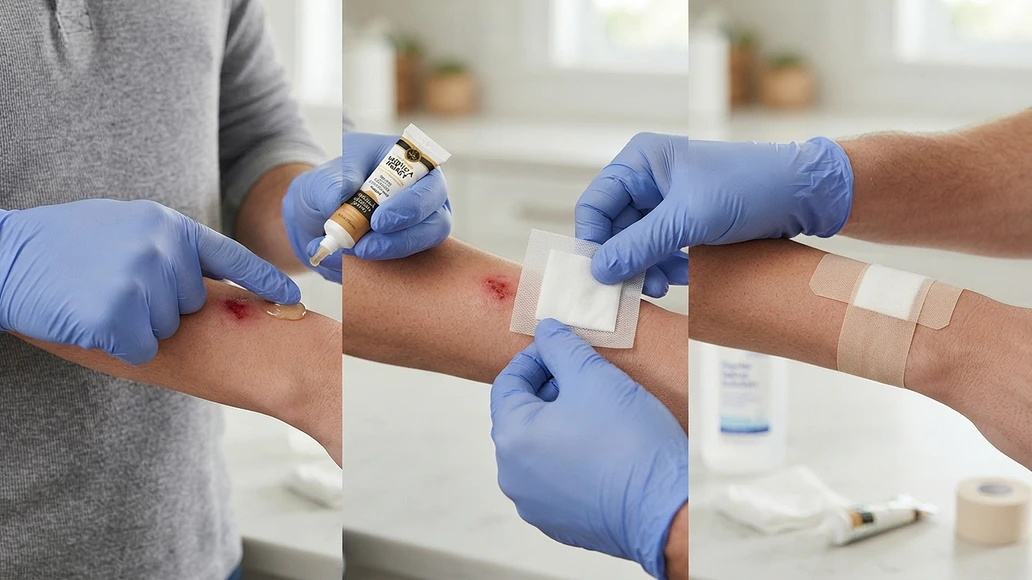
How to apply Manuka honey safely to a wound
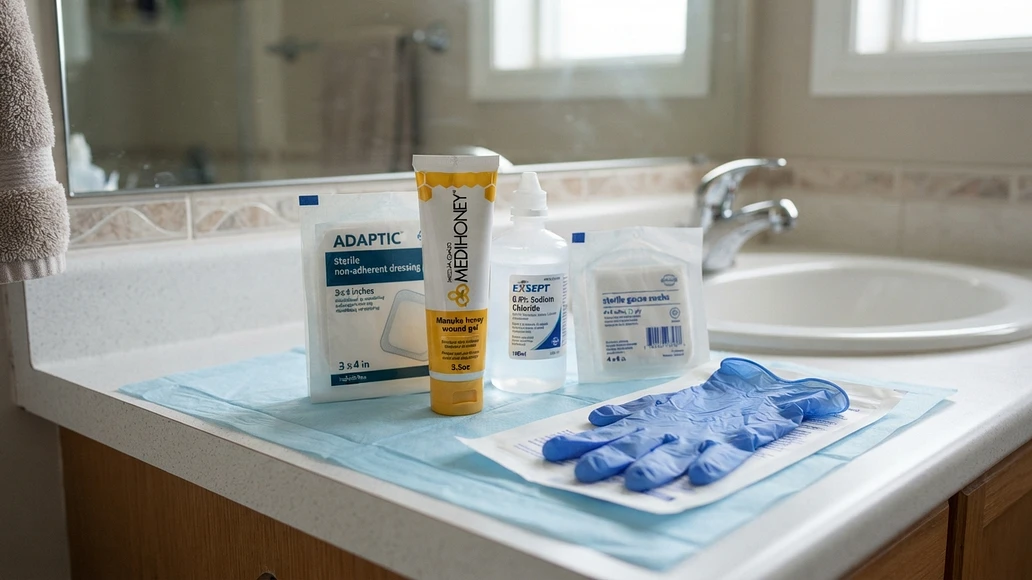
Use only a sterile medical-grade honey product labeled for wound care. If the wound is anything more than minor, ask a clinician before using it.
| Step | What to do | Why it matters |
|---|---|---|
| 1. Wash your hands | Use soap and water, or clean gloves if available | Reduces contamination |
| 2. Stop active bleeding first | Apply direct pressure with clean gauze | Honey is not for uncontrolled bleeding |
| 3. Rinse the wound | Use clean water or saline to flush out dirt | Cleaning comes before any dressing product |
| 4. Pat surrounding skin dry | Keep the wound bed moist, but dry the nearby skin gently | Helps the dressing stick and protects skin |
| 5. Apply the medical honey | Place a thin layer on the wound or use a honey-impregnated dressing per package directions | Provides contact with the wound bed |
| 6. Cover with a secondary dressing | Use a non-adherent pad, gauze, or other recommended cover | Keeps the honey in place and absorbs drainage |
| 7. Secure the dressing | Use tape or wrap without making it too tight | Protects the wound while preserving circulation |
| 8. Recheck daily | Look for drainage, odor, redness, pain, and dressing saturation | Helps catch problems early |
Do not pack deep wounds with honey unless a clinician has told you to do so. Do not use it inside the eye. Do not put it on a wound that clearly needs stitches, urgent cleaning, or professional debridement.
How often to change the dressing
Dressing frequency depends mostly on drainage. A wetter wound may need more frequent changes because excess exudate can dilute the honey and soak through the cover dressing. A drier wound may need less frequent changes.
| Drainage level | Typical dressing check schedule | Likely change frequency | What to watch for |
|---|---|---|---|
| Low drainage | Check at least daily | Every 24 to 48 hours, or as product instructions direct | Drying out, dressing displacement, increasing pain |
| Moderate drainage | Check daily | Usually every 24 hours | Strike-through drainage, odor, skin irritation around the wound |
| Heavy drainage | Check more than once daily | Often daily or more often if saturated | Rapid soak-through, macerated skin, worsening redness, need for clinician review |
Always follow the product instructions if they are more specific. If the dressing is soaked, leaking, or causing skin breakdown around the wound, it needs attention sooner.
What a normal healing response looks like, and what is not normal
A minor wound that is healing normally should gradually look cleaner, less inflamed, and smaller over time. Mild stinging can happen with honey dressings, especially at first, and some increase in fluid can occur as the dressing draws moisture.
What is not normal is spreading redness, increasing warmth, pus, foul odor, fever, worsening pain, red streaks, or a wound that looks larger instead of smaller. Those are warning signs that should not be explained away as the honey “pulling infection out.”
| Finding | More likely normal | More likely a warning sign |
|---|---|---|
| Mild brief sting after application | Yes | No, unless severe or persistent |
| Gradual decrease in wound size | Yes | No |
| Small amount of clear or light drainage | Sometimes | No, unless increasing |
| Spreading redness or heat | No | Yes |
| Pus or foul odor | No | Yes |
| Worsening pain after the first day or two | No | Yes |
| Fever or feeling ill | No | Yes |
Possible side effects and allergy concerns
Topical honey can cause stinging, irritation, or discomfort. Some people develop local skin reactions. Anyone with a known bee-product or honey allergy should avoid using it unless a clinician specifically advises otherwise. If you notice rash, swelling, hives, trouble breathing, or sudden worsening after application, stop using it and seek medical care.
Because wound healing can be slower and more complicated in people with diabetes, vascular disease, or immune suppression, even mild side effects deserve extra caution in those groups.
Common mistakes to avoid
The biggest mistake is using food-grade honey on an open wound. The next most common mistake is using honey on the wrong wound, such as a deep puncture, infected wound, or diabetic foot ulcer without medical guidance. Another frequent problem is skipping the basics, like irrigation, pressure relief, compression, or dressing changes, and expecting honey to compensate.
It is also a mistake to judge success only by symptom relief. Less odor or less pain can be helpful, but the real question is whether the wound is actually closing and healthy tissue is forming.
How to choose a product, UMF, MGO, and sterile packaging
UMF and MGO are quality and activity markers often used in Manuka honey marketing. They can tell you something about the honey’s chemical profile, but they do not by themselves prove that a product is medical-grade or appropriate for wound care.
When choosing a wound product, look first for sterile packaging and clear labeling that it is intended for wound use. The form matters too. Gels can work for small surface wounds. Honey-impregnated dressings may be easier to manage for some wounds because they keep the product distributed more evenly.
If the package looks like a food jar, it is probably food. If the package is labeled as a wound dressing or sterile wound gel, that is the category you want for wound care.
Regulatory and medical-device context
Some honey-based wound products are marketed and regulated as medical devices in specific settings. That is important because it means the product is being sold for wound care, not just as a food. It does not mean every Manuka product on a store shelf has passed through the same pathway.
For consumers, the practical lesson is simple. Buy a wound product for wounds. Buy food honey for food.
Manuka honey versus standard wound care, when each matters
Manuka honey can be helpful, but standard wound care still does the heavy lifting. Cleaning the wound, removing debris, choosing the right dressing, and addressing the reason the wound is not healing are often more important than the choice of topical product.
| Wound care element | What it does | Can honey replace it? |
|---|---|---|
| Saline or clean-water irrigation | Removes dirt and lowers contamination | No |
| Direct pressure for bleeding | Controls blood loss | No |
| Debridement when needed | Removes dead tissue that blocks healing | No |
| Non-adherent or absorbent dressings | Protects the wound and manages drainage | No, honey usually works with a dressing |
| Compression for venous ulcers | Controls swelling and improves healing conditions | No |
| Offloading for diabetic foot ulcers | Reduces pressure and repeat injury | No |
| Antibiotics when indicated | Treats bacterial infection | No |
| Medical-grade honey | Supports moisture balance and may reduce bacterial burden in selected wounds | Adjunct only |
When to stop home care and seek medical help
Home care should stop if the wound is getting worse, not better. That includes increasing redness, warmth, swelling, pus, foul odor, fever, worsening pain, or no clear improvement after a short period. It also includes any allergic reaction, any concern about circulation, or any wound on a diabetic foot.
| Red flag | Why it matters | What to do |
|---|---|---|
| Heavy bleeding or gaping wound | May need urgent closure or bleeding control | Seek urgent medical care |
| Deep puncture, bite, or embedded debris | High infection risk and possible retained material | Get medical evaluation |
| Large burn or possible third-degree burn | Can be serious even if pain is limited | Seek prompt medical care |
| Spreading redness, pus, foul odor, fever | Possible infection | Stop self-treatment and get medical care |
| Diabetes, poor circulation, neuropathy, foot ulcer | High risk of delayed healing and complications | Use clinician-guided care |
| Immunocompromise or cancer treatment | Higher risk from wound infection and delayed healing | Get professional guidance |
| No improvement or worsening after several days | May need a different treatment plan | Arrange medical assessment |
Bottom line
Manuka honey has a legitimate role in wound care, but the right way to use it is narrower than many natural-remedy articles suggest. The best-supported consumer use is sterile, medical-grade honey on selected minor wounds and some small partial-thickness burns, with proper cleaning and dressing technique. For chronic wounds, diabetic foot ulcers, larger burns, infected wounds, or any wound in a high-risk person, honey should be considered only within a clinician-directed plan.
If you remember just three things, make them these. Use medical-grade sterile honey, not pantry honey. Treat honey as an adjunct, not a substitute for standard wound care. And if the wound is deep, infected, worsening, or tied to diabetes or poor circulation, get medical help.