A Smart Place for Potassium Iodide in Your Emergency Kit
Potassium iodide can be a reasonable preparedness item, but only if you understand its narrow purpose, correct timing, and safety limits. Here is how KI fits into a practical home stockpile without turning into a dangerous myth.

Potassium iodide, often shortened to KI, is one of those emergency supplies that gets talked about far more than it gets explained. It can be useful to keep on hand, but only for a specific kind of emergency and only when public health officials tell you to take it. That distinction matters. KI is not a general wellness supplement, not a cure for radiation exposure, and not a substitute for sheltering, evacuation, or following emergency instructions.
If you want to understand why iodine pills belong in your stockpile, the best answer is this: they can help protect your thyroid from radioactive iodine during certain nuclear or radiological emergencies, and having them before an event is more practical than trying to find them after the fact. The key is to stock them responsibly, store them correctly, and know their limits.
What iodine pills really do in an emergency
Emergency iodine pills are usually potassium iodide tablets or liquid. Their job is narrow but important. They flood the thyroid with stable iodine so the gland is less likely to absorb radioactive iodine. This is called thyroid blocking.
That means KI protects one organ, the thyroid, from one hazard, radioactive iodine. It does not protect your lungs from fallout particles, your skin from external radiation, or the rest of your body from other radioactive materials. It also does not treat radiation sickness after the fact.
This is why official guidance consistently says KI should be used only during a declared nuclear or radiological emergency and only when authorities direct the public to take it. The timing has to match the exposure risk. Taking it randomly, weeks early, or as a daily habit does not improve protection and can create avoidable side effects.
| What KI does | What KI does not do | Why that matters |
|---|---|---|
| Blocks thyroid uptake of radioactive iodine | Does not block all radiation | You still need shelter, evacuation, and contamination control |
| Works best when taken shortly before or soon after exposure | Does not help much if taken too late | Following official timing instructions is critical |
| Can reduce thyroid cancer risk from radioactive iodine exposure | Does not prevent all radiation-related illness | It is one tool, not a complete solution |
| Provides temporary thyroid protection | Is not a long-term daily supplement for stress or world events | Repeated unnecessary use raises side effect risk |
Potassium iodide vs everyday iodine, what belongs in your stockpile?
Many people hear “iodine” and assume all iodine products are interchangeable. They are not. The iodine in iodized salt, food, or a multivitamin supports normal nutrition. Emergency KI products are high-dose thyroid-blocking medicines intended for short-term use during a specific event.
That is why a pantry full of iodized salt is not a backup plan for a nuclear emergency. The iodine concentration is far too low, and trying to get an emergency-level dose from salt would require unsafe amounts.
| Product | Main purpose | Typical use | Suitable substitute for emergency KI? |
|---|---|---|---|
| Potassium iodide tablets or liquid | Emergency thyroid blocking | Short-term use during official nuclear or radiological guidance | Yes, this is the intended product |
| Iodized table salt | Daily dietary iodine | Cooking and nutrition | No |
| Multivitamin with iodine | Nutritional support | Routine daily supplementation if needed | No |
| Foods rich in iodine, such as dairy or seafood | Normal nutrition | Regular diet | No |
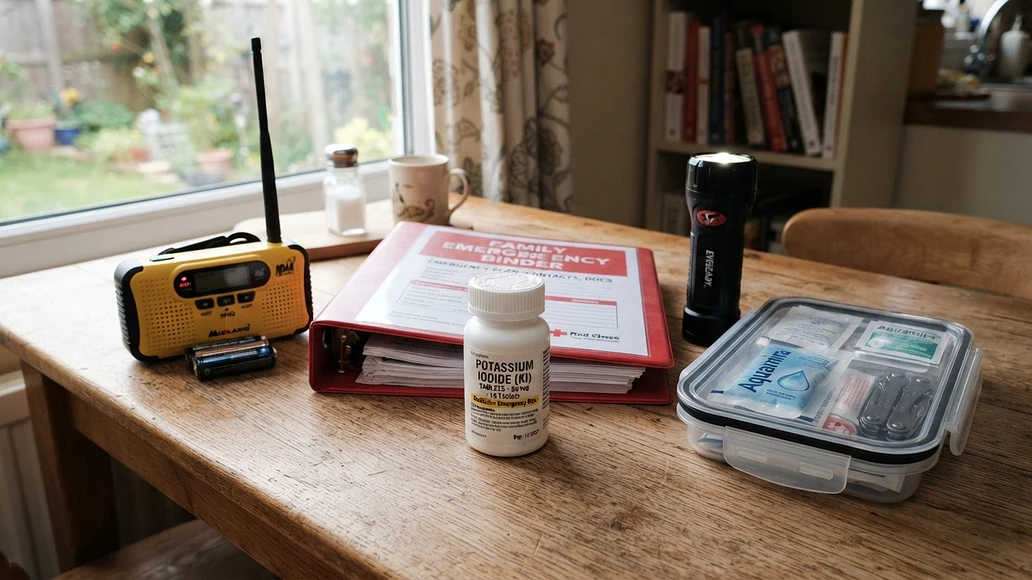
When would iodine pills actually be used in the US?
KI is most relevant in events where radioactive iodine may be released into the environment. That can include a serious nuclear power plant accident, some nuclear detonation scenarios, or a major radiological incident involving radioactive iodine. Not every radiation event involves radioactive iodine, which is another reason self-dosing is a bad idea.
In the United States, emergency managers and public health officials decide whether KI is recommended based on the type of incident, projected thyroid dose, wind and plume modeling, and the expected risk to different age groups. Their instructions may differ by location and by age. Children, infants, pregnant people, and breastfeeding people are often prioritized because younger thyroids are more vulnerable.
For many households, the practical reason to keep KI is simple. If officials do recommend it, stores may sell out quickly, roads may be congested, and distribution points may not be convenient. Having a small, clearly labeled supply at home can remove one layer of chaos.
Why KI makes sense in a balanced home stockpile
A balanced stockpile is built around likely disruptions and high-consequence events. KI fits the second category. You may never need it, but if you do need it, you will need it quickly and in the correct dose.
That said, KI should not crowd out more broadly useful supplies. A household is usually better served by first covering water, food, medications, sanitation, lighting, communications, and shelter-in-place basics. KI belongs in that larger system, not at the center of it.
| Preparedness item | How often it may be useful | Role in a radiological emergency | Priority level |
|---|---|---|---|
| Water storage | High | Supports sheltering and reduces risky trips outside | Very high |
| Battery or hand-crank radio | High | Receives official instructions, including KI guidance | Very high |
| Plastic sheeting and tape if locally recommended | Moderate | Can support shelter-in-place measures | High |
| Potassium iodide | Low frequency, high consequence | Protects the thyroid from radioactive iodine only | Targeted but worthwhile |
| N95 or similar masks if advised | Moderate | May help reduce inhalation of particles in some situations | Situational |
How much potassium iodide should my family keep on hand?
The practical answer is to keep enough for each household member to receive the correct age-appropriate dose for several days if officials continue the recommendation. Exact local guidance can vary, but a small household supply that covers multiple daily doses per person is reasonable preparedness.
Do not guess based on adult tablets alone if you have children or infants. Check the product label for tablet strength, scoring, and whether a liquid form is available. Some families find it easier to keep both adult tablets and a child-friendly option.
| Age or situation | Common emergency KI dose | General note | Planning reminder |
|---|---|---|---|
| Birth to 1 month | 16 mg | Neonates need very careful dosing and follow-up | Ask your pediatrician how to prepare for infant dosing |
| Over 1 month to 3 years | 32 mg | Small children need reduced doses | Do not improvise without label directions |
| Over 3 years to 12 years | 65 mg | School-age children often need half an adult dose | Check tablet splitting instructions |
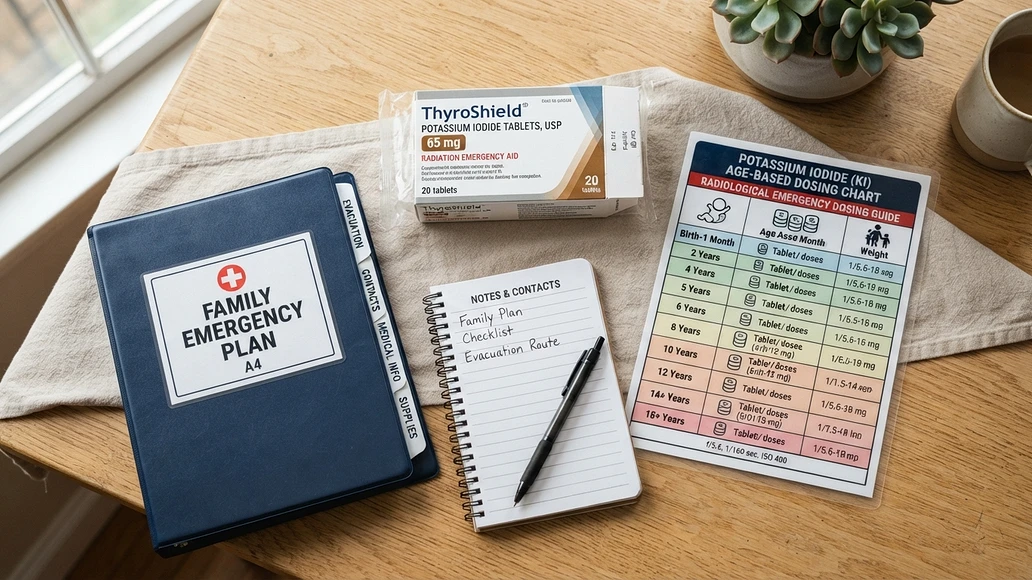
| Adolescents 12 to 18 years | 65 mg if under 150 pounds, 130 mg if 150 pounds or more | Weight matters in this group | Write each teen's dose in your emergency binder |
| Adults up to 40 years | 130 mg | Standard adult emergency dose | Keep enough for several days if directed |
| Pregnant or breastfeeding adults | 130 mg | Often prioritized for protection, but medical follow-up matters | Use only when directed by officials |
| Adults over 40 years | Usually only recommended at higher projected exposure levels | Lower thyroid cancer risk, higher side effect concern | Do not assume you should take it automatically |
Because product strengths vary, the safest approach is to buy an FDA-labeled KI product, read the package insert, and keep a printed dosing sheet with your emergency documents.
Household planning examples
| Household example | People included | Practical KI planning approach | Special considerations |
|---|---|---|---|
| Single adult household | One adult under 40 | Keep several adult doses in original packaging | Review contraindications if you have thyroid disease |
| Couple with two young children | Two adults, one child age 8, one toddler age 2 | Keep adult tablets plus child-appropriate dosing instructions or product form | Children need lower doses and careful measurement |
| Multigenerational home | Adults, teen, grandparent over 40, infant | Plan by person, not by bottle, and write each dose clearly | Older adults and infants need extra caution |
Who should take iodine pills, and who should avoid them?
In a real emergency, the people most likely to benefit are infants, children, adolescents, pregnant people, breastfeeding people, and adults up to about age 40, depending on official exposure estimates. Younger people have a higher long-term thyroid cancer risk from radioactive iodine exposure, which is why they are emphasized in public guidance.
Some people should be especially cautious or seek medical advice in advance. That includes anyone with hyperthyroidism, Graves' disease, thyroid nodules, autoimmune thyroid disease, dermatitis herpetiformis, hypocomplementemic vasculitis, or a known iodine sensitivity. People often say they are “allergic to iodine,” but what that means medically can vary, so it is worth clarifying with a clinician before an emergency happens.
Pregnant and breastfeeding people may be advised to take KI during a qualifying event, but repeated dosing and follow-up should be handled carefully because both parent and baby can be affected. Neonates are particularly sensitive to thyroid disruption and need close attention.
| Group | Potential benefit | Main caution | Best preparation step |
|---|---|---|---|
| Infants and children | High | Need precise lower doses | Get pediatric guidance before an emergency |
| Pregnant people | High | Maternal and fetal thyroid monitoring may matter | Discuss KI with your OB or clinician |
| Breastfeeding people | High | Infant exposure and thyroid follow-up may matter | Ask how your baby would be monitored |
| Adults 18 to 40 | Moderate to high | Standard side effect and interaction concerns | Review label and medical history |
| Adults over 40 | Often lower unless exposure is high | Higher chance of side effects relative to benefit | Follow official instructions closely |
| People with thyroid disease or iodine sensitivity | Variable | Higher risk of complications | Talk to your doctor before buying or using KI |
When is the right time to take iodine pills in an emergency?
Timing is everything. KI works best when taken shortly before exposure to radioactive iodine or as soon as possible after official instruction. Its benefit drops sharply if taken too late. It is not something to start taking days or weeks in advance because of anxiety about headlines.
One dose generally protects the thyroid for about 24 hours. If officials say the risk continues, they may advise additional daily doses. Do not continue taking KI longer than instructed. Repeated unnecessary dosing increases the chance of side effects and thyroid problems.
The safest rule is simple: take KI only when public officials tell your area to take it, and follow the product label and emergency instructions exactly.
How to store iodine pills so they are ready when you need them
Store KI in its original packaging, in a cool, dry place, away from moisture, heat, and direct sunlight. Keep it out of reach of children. Do not toss loose tablets into an unlabeled jar or mix them into a general pill organizer where emergency instructions could be lost.
Check expiration dates during your regular preparedness review. If your household includes children, update your written dose plan as they grow. A dose that was correct two years ago may no longer be right.
Practical stockpile checklist
| Item | Why keep it with KI | Storage note |
|---|---|---|
| Original KI package and insert | Contains official directions and strength information | Keep sealed and readable |
| Printed household dosing sheet | Reduces confusion under stress | Update when children age or weights change |
| Emergency contact list | Helps you reach doctors, poison control, and local contacts | Store in the same binder |
| Battery radio | Receives official timing and shelter instructions | Check batteries regularly |
| Water and shelf-stable food | Supports shelter-in-place | Rotate on schedule |
Iodine pills are not a shield, what else your nuclear plan needs
Even if you have KI on hand, your first line of protection in many radiological emergencies is still to get inside, stay inside, and stay tuned to official information. Depending on the event, authorities may tell you to shelter in place, evacuate, avoid certain foods or water sources, or decontaminate by removing outer clothing and showering.
That means your plan should include more than medicine. Think in systems. How will you receive alerts if power is out? Which room is best for sheltering? Do you have enough water to avoid unnecessary trips outside? Can every adult in the home explain the KI plan without guessing?
| Plan element | Why it matters | How KI fits in |
|---|---|---|
| Shelter-in-place plan | Reduces exposure during plume passage | KI may be an added measure if officials direct it |
| Evacuation plan | Helps you leave quickly if ordered | Bring KI in original packaging |
| Communication plan | Prevents missed instructions | Needed to know when and whether to take KI |
| Food and water plan | Supports staying indoors safely | KI does not replace safe food and water practices |
| Decontamination supplies | Helps remove fallout particles | KI does not remove contamination from skin or clothing |

Safety basics, side effects, interactions, and when to call a doctor
Most people tolerate short-term KI reasonably well, but side effects are possible. These can include stomach upset, nausea, rash, swollen glands, metallic taste, or thyroid dysfunction. Repeated dosing raises the chance of problems, especially in people with thyroid disease.
Seek urgent medical help if someone develops shortness of breath, swelling of the face or throat, chest pain, severe rash, or signs of a serious allergic reaction. If a person with known hyperthyroidism becomes agitated, feverish, or develops a very rapid heart rate after KI, that also needs prompt medical attention. Any unusual symptoms in infants or pregnant people deserve a low threshold for professional advice.
This article is educational only. KI decisions in a real event should follow public health instructions, product labeling, and your clinician's advice if you have pregnancy, chronic illness, or thyroid concerns.
Common myths and mistakes about iodine pills
| Myth or mistake | Reality | Safer takeaway |
|---|---|---|
| KI protects against all radiation | It protects only the thyroid from radioactive iodine | Use KI as one limited tool |
| I should start taking KI now because world events are tense | Unnecessary use adds risk without proven benefit | Store it, do not self-dose |
| Iodized salt can replace KI | Salt does not contain enough iodine for emergency thyroid blocking | Buy an actual KI product |
| More KI means more protection | Overdosing can cause harm | Follow age-based instructions exactly |
| If I have KI, I do not need to shelter or evacuate | KI does not replace official protective actions | Always follow emergency management guidance |
How to talk to your doctor and local officials about KI
If you are considering adding KI to your stockpile, ask your doctor whether your medical history changes the risk. Bring up thyroid disease, pregnancy, breastfeeding, medications, and any past reaction to iodine-containing products. If you have children, ask how to handle dosing, tablet splitting, or liquid options before you are under stress.
It is also worth checking whether you live near a nuclear power plant emergency planning zone and whether your local health department has KI distribution information. Some communities have pre-distribution programs or specific guidance on where to get updates during an incident.
Recent context, why this topic keeps coming back
Interest in KI tends to surge whenever global tensions rise or people see headlines about nuclear facilities. Official guidance has stayed remarkably consistent. KI remains an emergency-only medicine, age-specific dosing still matters, and authorities still stress that it should be taken only when instructed. The renewed attention is understandable, but the fundamentals have not changed.
FAQ
Do iodine pills protect me from all radiation or just certain kinds?
They protect only the thyroid from radioactive iodine. They do not protect the whole body from all radiation or all radioactive materials.
Should I start taking iodine pills because of world events even if officials have not told me to?
No. KI should be stored for readiness, not taken preemptively because of fear or headlines. Unnecessary use can cause side effects and does not provide ongoing general protection.
Can children and infants safely take iodine pills, and how is their dose different?
They may benefit the most in a qualifying emergency, but they need lower age-appropriate doses and careful follow-up. Infants, especially newborns, need extra caution because thyroid disruption is a bigger concern.
Is iodized table salt a good backup if I do not have potassium iodide tablets?
No. It is not an appropriate substitute. The iodine content is too low, and trying to use salt this way would be unsafe.
How long does one dose of potassium iodide protect my thyroid in an emergency?
Generally about 24 hours. If exposure risk continues, officials may advise another dose. Do not continue dosing longer than instructed.