Wild Lettuce and Other So-Called Natural Opioids, What They Are and the Real Safety Questions
People searching for a plant that acts like morphine usually mean wild lettuce, not opium poppy. Here is what wild lettuce is, what research actually suggests, how it differs from poppy and kratom, and when pain needs medical care instead of self-treatment.

When people search for a “natural painkiller plant” that resembles morphine, they are usually talking about wild lettuce, sometimes called opium lettuce. That nickname can be misleading. Wild lettuce is not opium poppy, it does not contain morphine in meaningful amounts, and it should not be treated as a proven substitute for medical pain care. The comparison mostly comes from its milky sap, traditional folk use, and limited lab research on compounds that may have sedating or pain-modulating effects.
This matters because pain can signal anything from a minor strain to appendicitis, a fracture, a kidney stone, nerve compression, or a heart problem. A plant product may dull symptoms without addressing the cause. If you are considering any sedating botanical, especially for severe or persistent pain, use caution and know when self-treatment is the wrong move.
What “resembling morphine” actually means
The phrase can mean several different things, and they are not interchangeable. A plant may resemble morphine in appearance, in traditional reputation, or in having some opioid-like or sedating effects. Those are very different claims.
| Type of resemblance | What it means | Why readers should be careful |
|---|---|---|
| Visual resemblance | A plant produces milky latex that looks somewhat like poppy sap | Appearance does not prove the same chemistry or the same effect |
| Traditional use | People historically used the plant for discomfort, sleep, or calming | Traditional use is not the same as strong clinical evidence |
| Pharmacologic similarity | Some compounds may affect pain perception or sedation | This does not mean the plant contains morphine or works like prescription opioids |
| Marketing language | Online sellers or articles call something “natural morphine” | This can overstate benefits and understate risks, variability, and interactions |
For wild lettuce, the comparison is mostly about the milky latex and old folk terminology, not about true opiate content.
What plant is usually meant, wild lettuce
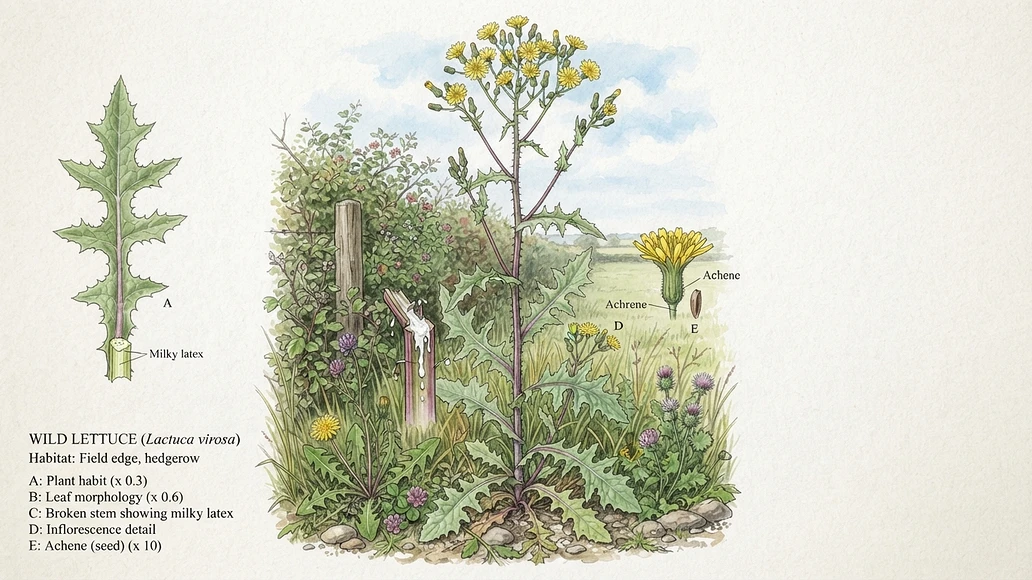
Wild lettuce generally refers to species in the Lactuca group, especially Lactuca virosa and related wild lettuces. The dried milky latex is often called lactucarium. Historically, lactucarium was discussed as a calming or sedating substance, which is why it picked up comparisons to opium. But that does not make it chemically equivalent to opium.
Researchers have looked at compounds such as lactucin and lactucopicrin, which may help explain some sedative or analgesic activity seen in preclinical work. The key limitation is that evidence in humans remains sparse and inconsistent. That means there is not a reliable, standardized, evidence-based way to say wild lettuce will safely relieve pain in a predictable dose.
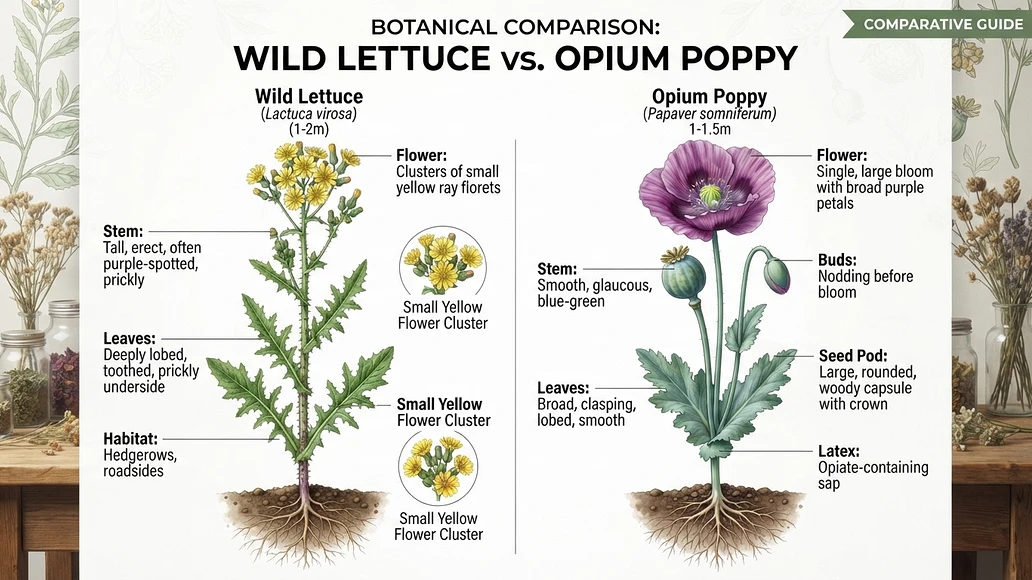
Wild lettuce vs opium poppy
Wild lettuce and opium poppy are different plants with very different chemistry and risk profiles. Confusing them can lead to bad decisions.
| Plant | Main identity | Key compounds | Does it contain morphine? | Main concern |
|---|---|---|---|---|
| Wild lettuce | Lactuca species, often Lactuca virosa | Lactucin, lactucopicrin, other sesquiterpene lactones | No meaningful morphine content | Weak evidence, variable potency, sedation, misidentification |
| Opium poppy | Papaver somniferum | Opium alkaloids including morphine and codeine | Yes | Legal issues, overdose risk, dependence, toxicity |
| Kratom | Mitragyna speciosa | Mitragynine, 7-hydroxymitragynine | No morphine, but opioid-like effects can occur | Dependence, contamination, liver injury, seizures, overdose risk, especially concentrated products |
So if a source says wild lettuce is “like morphine,” the safest interpretation is that it has a folk reputation for pain relief and sedation, not that it is a backyard source of opiates.
Why milky latex is not the same as morphine
One reason people get confused is that both wild lettuce and opium poppy can produce a milky sap or latex when cut. That visual similarity has encouraged dramatic claims for a long time. But plant latex is just a plant fluid, not proof of opioid chemistry.
Opium poppy latex contains well-known opium alkaloids. Wild lettuce latex does not. In wild lettuce, the compounds of interest are different, and the evidence for pain relief is much weaker. Homemade collection of sap also creates a false sense of precision. The amount and composition can vary by species, growing conditions, plant age, and handling.
What the evidence says about pain relief
The evidence base for wild lettuce is limited. There is traditional use and some preclinical support, but there is not strong human evidence showing it is a dependable pain treatment. That is a major difference from how many online articles frame it.
| Claim | Evidence level | Practical takeaway |
|---|---|---|
| Wild lettuce contains morphine or codeine | Weak to false | Do not assume wild lettuce is a source of opiates |
| Wild lettuce may have mild analgesic or sedative effects | Limited, mostly preclinical and traditional use | Possible effects are not the same as proven, standardized treatment |
| Opium poppy is the source of morphine-related alkaloids | Well supported | This is a different plant with different legal and medical implications |
| Kratom can have opioid-like effects | Well supported for risk, mixed for benefit | Not FDA-approved, and safety concerns are significant |
| Homemade extracts provide reliable dosing | Unsupported | Potency is unpredictable and can increase side effect risk |
In plain language, wild lettuce may be interesting from a historical or botanical standpoint, but it is not a well-proven home pain medicine.
How wild lettuce is identified, and why caution matters
Wild lettuce is often described as a tall, weedy plant with a central stem, lobed leaves, yellow flowers somewhat resembling small dandelion-type blooms, and milky sap when cut. Some species can have leaves that clasp the stem and may show a line of prickles along the underside of the leaf midrib.
That said, plant identification from internet photos alone is risky. Similar-looking weeds can grow in the same places, and a mistaken ID can expose you to an ineffective or unsafe plant. If you are not already skilled at plant identification, this is not a good area for guesswork.
Common lookalike risks
| Issue | Why it matters | Safer approach |
|---|---|---|
| Confusing wild lettuce with another roadside weed | You may collect the wrong plant entirely | Use a regional field guide and confirm multiple traits, not one photo |
| Assuming milky sap means medicinal value | Many plants produce latex, and some are irritating or unsafe | Do not use sap alone as an ID feature |
| Harvesting from roadsides or sprayed areas | Plants may carry herbicides, heavy metals, or other contaminants | Avoid contaminated locations |
| Confusing wild lettuce with opium poppy | They are different plants with very different legal and toxicology issues | Learn the full plant structure before making any claim about identity |
Forms people use, tea, tincture, latex, and extract
Wild lettuce is commonly discussed in the form of tea, tincture, dried herb, latex, or concentrated extract. The problem is not just whether a form exists. The problem is that none of these homemade or over-the-counter forms gives the average reader a dependable, standardized dose.
Tea strength can vary. Tinctures vary by manufacturer and extraction method. Latex and homemade extracts are especially unpredictable. Concentrating plant material can also concentrate unwanted effects. For a YMYL topic like pain, it is important not to confuse “natural” with “controlled” or “tested.”
Why homemade dosing is unreliable
Homemade extraction is often presented online as if it turns a wild plant into a consistent remedy. In reality, potency can swing widely. Species differences, harvest timing, storage, solvent choice, evaporation, and contamination all affect the final product.
That creates several risks. First, a weak preparation may do nothing, which can delay proper care. Second, a stronger-than-expected preparation may cause excessive sedation, dizziness, nausea, or impaired judgment. Third, people may combine it with alcohol, sleep aids, cannabis, opioids, or anti-anxiety medicines, which can increase danger.
Side effects and interaction risks
Even if a plant product seems mild, side effects still matter. Sedating botanicals can impair driving, tool use, ladder work, childcare, and decision-making. They can also interact with medications in ways that are hard to predict.
| Risk area | What to watch for | Why it matters |
|---|---|---|
| Sedation | Drowsiness, slowed reaction time, confusion | Raises accident risk and may worsen with other sedatives |
| Allergic or irritant reactions | Rash, mouth irritation, stomach upset | Plant sensitivity varies from person to person |
| Drug interactions | Alcohol, benzodiazepines, opioids, sleep medicines, some antidepressants, seizure medicines | Combined effects can be stronger and less predictable |
| Contamination | Pesticides, heavy metals, adulterants in supplements | Online and imported products may not be standardized |
| Delayed care | Pain temporarily dulled while the cause worsens | Serious conditions can be missed |
Who should avoid wild lettuce and similar sedating botanicals
| Group | Why extra caution or avoidance is advised |
|---|---|
| Pregnant or breastfeeding people | Safety data are inadequate, and sedating compounds may pose avoidable risk |
| Children and teens | Unpredictable dosing and limited safety evidence |
| Older adults | Higher sensitivity to sedation, falls, confusion, and medication interactions |
| People with liver disease | Herbal products may add metabolic stress or interact with medicines |
| People with seizure history | Some botanicals and contaminants may lower seizure threshold or interact with treatment |
| People with substance use disorder history | Using sedating or opioid-like products can complicate recovery and risk patterns |
| Anyone taking CNS depressants | Alcohol, opioids, benzodiazepines, sleep medicines, and similar drugs can amplify sedation |
Wild lettuce vs kratom vs opium poppy, the practical difference
These plants often get lumped together online, but they should not be treated as interchangeable. Wild lettuce is mostly a folk remedy with limited evidence. Opium poppy is the true source of morphine-related alkaloids. Kratom has opioid-like activity and a much more serious modern safety discussion, especially around concentrated 7-hydroxymitragynine products.
| Feature | Wild lettuce | Opium poppy | Kratom |
|---|---|---|---|
| Typical reason people seek it out | Folk pain relief, calming, sleep support | Association with true opiates | Energy at low doses, opioid-like effects at higher doses, self-treatment attempts |
| Evidence for reliable pain treatment | Limited | Opioid chemistry is established, but this is not a safe DIY route | Mixed for benefit, stronger evidence for risk concerns |
| Main safety concern | Misidentification, sedation, delayed care, variable potency | Overdose, dependence, legal issues | Dependence, contamination, liver injury, seizures, overdose risk, especially concentrated products |
| Best bottom-line message | Do not overstate it as a morphine substitute | Not appropriate for backyard self-medication | Not benign, and concentrated products raise major red flags |

Legal and regulatory context in the U.S.
Claims that a plant is “morphine-like” can blur the line between folklore, supplement marketing, and medical claims. In the United States, a product sold as a supplement is not the same as an FDA-approved pain medicine. That means quality, purity, dose consistency, and proven effectiveness may be uncertain.
Kratom deserves special mention here. Federal agencies and major medical centers have repeatedly warned that kratom products are not FDA-approved and may carry risks including dependence, contamination, liver toxicity, seizures, and overdose. Concentrated 7-OH products are an even bigger concern than plain leaf because potency can be much higher.
Wild lettuce does not carry the same modern regulatory spotlight as kratom, but that should not be mistaken for proof of safety or effectiveness.
When a plant remedy is not the right choice
Self-treatment is a poor fit when pain is severe, unexplained, worsening, or paired with other warning signs. A sedating herb can make you feel less urgency while the underlying problem keeps progressing.
| Situation | Why self-treatment is risky | Better next step |
|---|---|---|
| Severe pain after a fall, blow, or lifting injury | Could involve fracture, internal injury, or serious strain | Get medical evaluation |
| Chest pain, shortness of breath, or pain spreading to arm or jaw | Could be cardiac or pulmonary emergency | Seek urgent or emergency care |
| Abdominal pain with fever, vomiting, black stool, or blood | Could be infection, bleeding, ulcer, gallbladder issue, or appendicitis | Seek prompt medical care |
| Back pain with weakness, numbness, or bladder or bowel changes | Could signal nerve compression or other urgent problem | Get urgent evaluation |
| Pain lasting more than a few days without improvement | Persistent pain needs a diagnosis, not repeated masking | Schedule professional assessment |
What to try instead for short-term pain relief
For mild, short-term pain, the safer first steps are usually the boring ones. Rest the area when appropriate, use ice or heat depending on the situation, hydrate, avoid overexertion, and track symptoms. If you normally tolerate them and a clinician has not told you to avoid them, standard over-the-counter options may be more predictable than an unstandardized herb. If you have ulcers, kidney disease, liver disease, blood thinner use, or other medical issues, ask a clinician or pharmacist before using common pain medicines.
For chronic pain, recurring headaches, nerve pain, pelvic pain, or pain that keeps disrupting sleep or function, the better path is evaluation. The right answer may involve physical therapy, dental care, imaging, medication review, sleep improvement, or treatment of the underlying condition.
How to interpret online claims about “natural morphine”
Use a simple filter. Ask whether the claim is about appearance, tradition, chemistry, or proven clinical effect. Ask whether the source separates wild lettuce from opium poppy. Ask whether it mentions interactions, contamination, and who should avoid use. If an article jumps straight from “this plant has milky sap” to “best natural painkiller,” it is leaving out the most important part of the story.
The most accurate summary is this: wild lettuce is the plant most often meant by the phrase, but it is not morphine, not opium poppy, and not a proven substitute for medical pain treatment.
References
- FDA, Kratom public health information
- Yale Medicine, Kratom overview and safety concerns
- University of Utah Health, Kratom and 7-OH safety discussion
- Encyclopaedia Britannica, Kratom background
- PubMed, Current research framing on kratom analgesia and safety caveats
- ScienceDaily, Preclinical reporting on plant-derived pain research
- Chulalongkorn University, Background on kratom research and traditional use