The Purple Oxidizer in Your Kit, Smart Uses, Serious Risks, and Better Backups
Potassium permanganate has a reputation as a do-everything prepper chemical, but it is not a casual item. Learn where it can help in emergencies, where it can hurt, and how it compares with safer modern options for water, skin care, and fire starting.

Potassium permanganate, often sold as dark purple crystals, has long been treated like a magic item in preparedness circles. The appeal is easy to understand. A tiny amount can color water, oxidize organic material, dry some skin conditions, and even help start a fire under controlled conditions. But the same chemistry that makes it useful also makes it risky. It is a strong oxidizer, it can burn skin and eyes, and it is absolutely not something to improvise with casually.
This article is not medical advice. Any health-related use should follow professional instructions. If potassium permanganate is swallowed, gets in the eyes, or causes a painful skin reaction, contact poison control or seek urgent medical care right away.
What potassium permanganate is, and why it gets so much attention
Potassium permanganate, abbreviated KMnO4, is an oxidizing chemical. In plain language, it reacts aggressively with many organic substances. That is why it has been used in water treatment, dermatology soaks, laboratory work, and some industrial processes. It is also why it can stain gear, damage tissue, and ignite certain materials when mixed improperly.
Its survival reputation comes from versatility. One container can potentially serve several roles, but only if the user understands dilution, contact time, contamination limits, and storage hazards. For most households, it is better viewed as a niche specialty item than a universal must-have.
Is it really essential for preparedness?
For most people, no. It is useful, but not indispensable. Modern water filters, unscented household bleach, purpose-made wound care supplies, and reliable fire tools are usually easier and safer to use. Potassium permanganate earns a place only if you want a compact oxidizer for specific backup tasks and you are willing to label it clearly, store it correctly, and practice safe handling before an emergency.
| Preparedness question | Where potassium permanganate helps | Where it falls short | Better default option for most homes |
|---|---|---|---|
| Emergency water treatment | Can reduce microbial risk in a true emergency when used very carefully | Does not remove chemicals, metals, or sediment, and home dosing is imprecise | Certified water filter plus backup disinfection method |
| Topical skin support | Very dilute external soaks may help certain weeping skin conditions | Wrong concentration can irritate or burn skin, not for deep wounds | Sterile saline, standard first aid supplies, clinician guidance |
| Fire starting | Can ignite with glycerin under controlled conditions | Hazardous oxidizer, easy to misuse, not beginner friendly | Ferro rod, stormproof matches, lighter |
| Compact multi-use storage | Small amount stores for a long time if kept dry | Needs strict labeling and separation from incompatible materials | Separate purpose-built supplies |
Emergency water use, what it can do and what it cannot
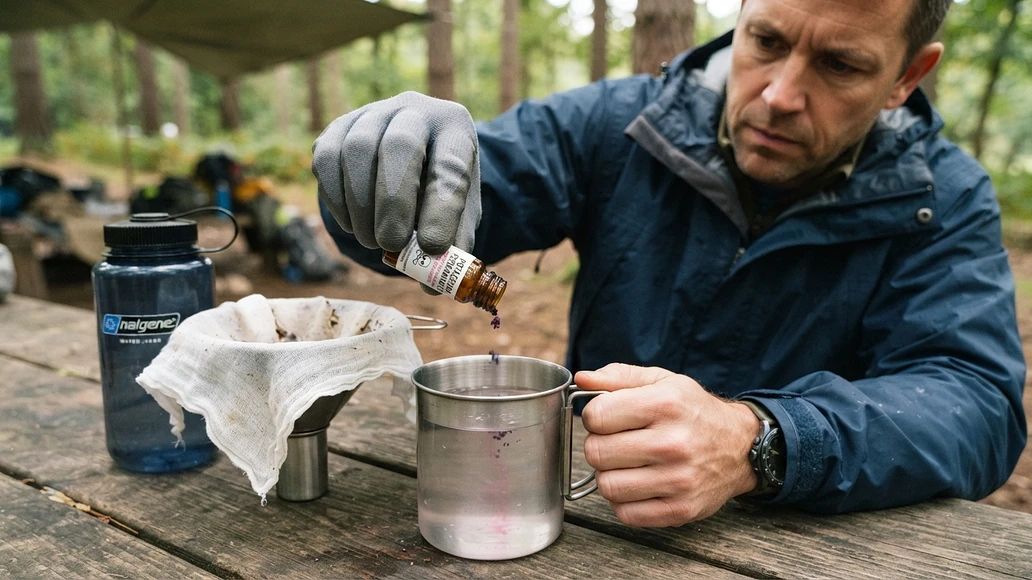
Potassium permanganate is sometimes described as a field water purifier. That oversells it. In emergency use, it may reduce microbial load when diluted to a very light pink solution and allowed enough contact time. It is not equivalent to regulated drinking water treatment, and it does not make dirty water universally safe.
It does not remove pesticides, fuel, heavy metals, salt, or many other chemical contaminants. It also works poorly if the water is muddy or full of organic debris, because the chemical is consumed by that material before it can do much useful disinfection.
A cautious emergency-only approach
- Pre-filter cloudy water through clean cloth, coffee filter paper, or another sediment barrier.
- Use only a tiny amount of potassium permanganate. The target is light pink, not purple and not dark pink.
- Let the water stand for at least 30 minutes. If the water is very cold, questionable, or heavily contaminated, a longer contact time is more prudent.
- If the water becomes dark pink or purple, do not drink it. That suggests over-concentration.
- If you have a safer method available, use that instead.
Because crystal size, purity, and water quality vary, exact field dosing by eye is unreliable. That is the biggest reason this method should be treated as a last-ditch option, not a daily routine.
| Water scenario | Can potassium permanganate help? | Main limitation | Best practice |
|---|---|---|---|
| Clear stream water with biological concern | Sometimes, as emergency disinfection support | Dosing by color is imprecise | Filter first, use regulated disinfection if available |
| Muddy pond water | Limited | Organic matter consumes the oxidizer | Settle, filter, then use a more reliable treatment |
| Water with chemical spill risk | No meaningful protection | Does not remove many hazardous chemicals | Find another source or use advanced filtration designed for chemicals |
| Daily household drinking water | Not recommended | Outdated and hard to control safely at home | Use standard potable water treatment methods |
Topical skin uses, where evidence is strongest
The best-supported home-related use is not drinking water or fire tricks. It is very dilute external skin care under professional-style guidance. Dermatology sources commonly use potassium permanganate soaks or compresses as a drying and antiseptic aid for certain weeping rashes, irritated skin, and some minor superficial infections.
The key phrase is very dilute. The solution should be pale pink. Dark pink or purple is too strong for skin contact. Stronger mixtures can cause irritation, chemical burns, and painful staining.
Even in this area, there are limits. It is not for deep puncture wounds, serious burns, large open wounds, or unexplained skin problems. It should not replace proper wound cleaning, bandaging, or medical evaluation when infection is possible.
| Use or claim | Evidence strength | Typical visual target | Important caution |
|---|---|---|---|
| Soaks for weeping eczema or irritated superficial skin | Well supported | Pale pink | External use only, stop if burning or worsening occurs |
| General skin disinfecting support | Well supported | Pale pink | Not for deep wounds or large raw areas without guidance |
| Foot soaks for athlete's foot or soggy skin between toes | General guidance to well supported | Pale pink | Helpful as a drying aid, not a cure-all |
| Routine wound treatment for major injuries | Weak or inappropriate | Not advised | Use standard first aid and seek medical care |
Practical limits for home users
If you keep potassium permanganate for skin use, the safest approach is to store pre-written dilution instructions from a reputable medical source and never guess from memory. If you cannot measure accurately, skip it. A mislabeled jar or a rushed mix in low light is how people get hurt.
Fire starting with potassium permanganate
This is the most dramatic use, and the one most likely to encourage unsafe experimentation. Potassium permanganate can react with glycerin in a delayed but vigorous exothermic reaction that may produce flame. It can also intensify combustion when mixed with other fuels. The chemistry is real. The danger is real too.
For preparedness, this should be considered an advanced, emergency-only technique. It is not a substitute for carrying dependable ignition tools. If you choose to learn it, do so in a controlled outdoor setting, with eye protection, gloves, a nonflammable base, and extinguishing means nearby. Never test it indoors, in dry grass, near spilled fuel, or around children.
Do not mix potassium permanganate with random household chemicals to see what happens. Oxidizers can react unpredictably with organics, reducing agents, and contaminated containers.

| Fire tool | Reliability | Skill needed | Injury risk | Best use case |
|---|---|---|---|---|
| Potassium permanganate plus glycerin | Moderate under controlled conditions | High | High | Backup chemistry demonstration or true emergency improvisation |
| Ferro rod | High | Moderate | Low to moderate | General survival fire kit |
| Stormproof matches | High | Low | Low | Fast ignition in poor weather |
| Butane lighter | High | Low | Low | Everyday carry and home kits |
Other survival uses, some practical, some overstated
Potassium permanganate is also mentioned for foot care, odor control, seed treatment, and other odd jobs. Some of these have a basis in real practice. Others are more chemistry folklore than mainstream preparedness advice.
| Use | Evidence quality | Realistic value | Notes |
|---|---|---|---|
| Foot soaks for fungal-prone or macerated skin | General guidance to well supported | Moderate | Can help dry skin and reduce surface microbial load when very dilute |
| Seed treatment | General guidance only | Niche | Requires accurate dosing, too much can damage seeds |
| Odor reduction | Mixed | Low to moderate | Oxidation may help some odors, but safer products are easier to use |
| Fruit handling or ripening-related uses | Mixed | Low | Not a mainstream household preparedness use |
| Internal poisoning treatment | Highly specialized and inappropriate for lay use | None for home users | Do not attempt self-treatment |
How dangerous is potassium permanganate?
More dangerous than many prepper articles admit. The crystals and concentrated solutions are corrosive and toxic. They can injure the mouth, throat, stomach, skin, and eyes. Dust can irritate the respiratory tract. Long-term manganese exposure in occupational settings has been associated with serious health effects.
Published safety data commonly note that even relatively small amounts can be dangerous if swallowed, especially for children. Human fatal dose estimates around 10 grams have been reported in safety literature, and animal toxicity data also confirm meaningful oral toxicity. You do not need a large jar for it to become a serious poisoning hazard.
Red flags that require urgent action
| Exposure type | Immediate concern | What to do right away |
|---|---|---|
| Swallowed crystals or solution | Burns to mouth, throat, stomach, vomiting, shock risk | Rinse mouth, give a small amount of water or milk if the person is awake and able to swallow, call poison control and seek emergency care immediately |
| Eye splash | Severe irritation or eye damage | Flush with clean water for at least 15 minutes and get urgent medical help |
| Skin pain, blistering, or dark staining after use | Chemical irritation or burn | Stop use, rinse thoroughly, seek medical advice |
| Dust inhalation | Respiratory irritation | Move to fresh air and seek care if symptoms persist or worsen |
Storage and handling at home
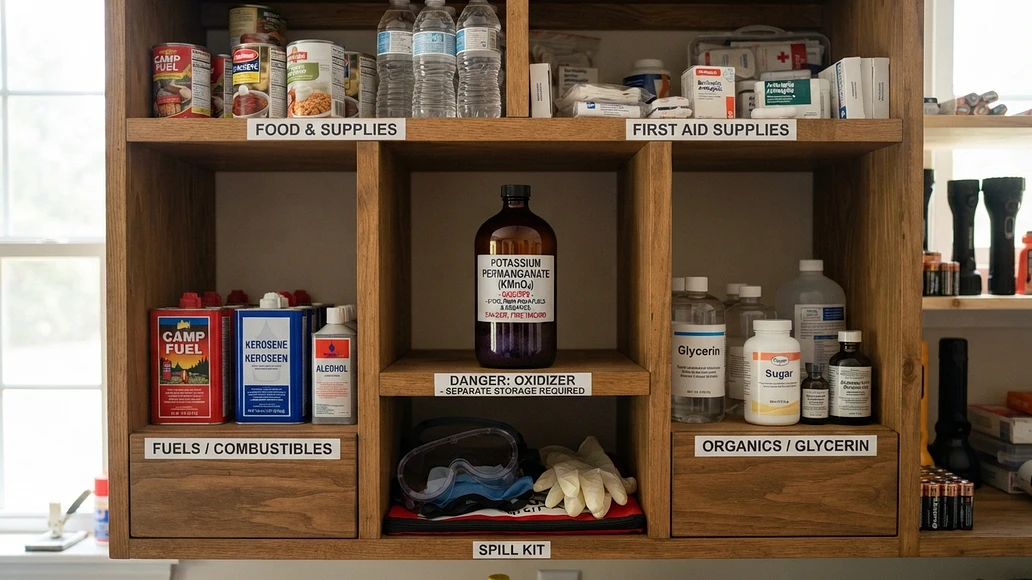
If you store potassium permanganate, treat it like a hazardous oxidizer, not like a harmless pantry item. Keep it dry, tightly sealed, clearly labeled, and physically separated from fuels, glycerin, sugar, solvents, oils, and other reactive materials. Do not store it in an unmarked baggie or a reused food container.
| Storage factor | Recommended practice | Why it matters |
|---|---|---|
| Container | Original container or compatible sealed chemical container | Prevents moisture entry and accidental mix-ups |
| Labeling | Large hazard label plus external-use warning | Reduces poisoning and misuse risk |
| Location | Cool, dry shelf away from heat and sunlight | Protects stability and reduces accidental reaction risk |
| Separation | Store away from fuels, organics, glycerin, sugar, and cleaners | Prevents fire and incompatible reactions |
| Child and pet safety | Locked storage | Small amounts can still be dangerous |
| Handling | Use gloves, avoid dust, protect eyes | Prevents burns, stains, and inhalation exposure |
What type should you buy?
If you decide to keep some, buy from a reputable supplier that identifies the grade and provides safety documentation. Water-treatment, laboratory, aquarium, technical, and medical-adjacent products are not all marketed for the same end use. For preparedness, documentation matters more than marketing language.
Look for a clear product identity, hazard labeling, and an accessible safety data sheet. Avoid mystery packets, relabeled bulk crystals, or products sold with exaggerated claims and no handling information.
Who should avoid using it at home?
Some people should simply skip potassium permanganate entirely. That includes households with small children, anyone likely to confuse chemicals, people with poor vision or shaky hands who cannot measure carefully, and those with chronic skin disease, diabetes-related foot problems, vascular disease, or significant respiratory sensitivity. Pregnant or breastfeeding individuals should not improvise home use without clinician guidance.
If your preparedness style favors simple, low-error systems, this chemical may not fit your kit.
Potassium permanganate compared with common alternatives
The strongest argument against calling potassium permanganate indispensable is that modern alternatives usually outperform it for the same jobs with less risk.
| Item | Main role | Ease of use | Shelf life | Risk profile | Best choice for most people? |
|---|---|---|---|---|---|
| Potassium permanganate | Niche oxidizer, emergency backup uses | Low | Long if kept dry | High if misused | No |
| Unscented household bleach | Emergency water disinfection and sanitation | Moderate | Limited, degrades over time | Moderate | Yes, with correct dosing guidance |
| Iodine products | Some water disinfection applications | Moderate | Good | Moderate, not for everyone | Sometimes |
| Alcohol-based antiseptic | Hand hygiene and surface use | High | Good if sealed | Moderate, flammable | Yes |
| Certified water filter | Water treatment | High | Long with maintenance | Low | Yes |
| Ferro rod or stormproof matches | Fire starting | High | Long | Low to moderate | Yes |
A responsible carry checklist
If you still want potassium permanganate in a kit, keep the system simple and written down.
| Checklist item | What to include | Purpose |
|---|---|---|
| Primary container | Sealed, labeled original or compatible container | Safe storage |
| Secondary containment | Leak-resistant bag or box | Protects surrounding gear |
| Instruction card | External-use warning, emergency contacts, dilution notes from a reputable source | Reduces memory-based mistakes |
| PPE | Nitrile gloves and eye protection | Safer handling |
| Separation plan | Keep away from fire kit fuels and food items | Prevents accidental reaction and poisoning |
| Decision rule | Use only when safer standard tools are unavailable | Keeps it a backup, not a first choice |
Common myths that cause trouble
One myth is that if a little works, more works better. With potassium permanganate, more often means more irritation, more staining, and more danger. Another myth is that any pink color is fine for skin or water. In reality, the target for skin-related use is a very pale solution, and darker shades are a warning sign. A third myth is that it can replace proper medical care or modern water treatment. It cannot.
Another bad habit is storing it next to glycerin or sugar because they are part of the same fire kit trick. That is exactly the kind of convenience that can create an accidental reaction if containers leak or break.
When to skip it and use something else
Skip potassium permanganate when you need routine drinking water treatment, child-safe storage, simple first aid, or beginner-friendly fire making. In those cases, a certified filter, bleach dosing instructions, standard wound supplies, and conventional ignition tools are better choices.
Its best role is as a specialized backup for trained, careful adults who understand that versatility does not equal safety.
FAQ
Can you drink water treated with potassium permanganate every day?
No. It is best thought of as an emergency-only option when safer methods are unavailable. It is not a preferred daily drinking-water treatment method for home use.
How much is too much in a skin soak or foot bath?
If the solution is more than pale pink, it is too strong for casual home use. Dark pink or purple should not touch skin. If you do not have reliable instructions and a way to measure, do not guess.
Is potassium permanganate safe around children and pets?
Not as a casual household item. It should be locked up, clearly labeled, and kept out of reach. Even small amounts can cause serious injury if swallowed or splashed.
What should I do if someone swallows it?
Rinse the mouth, give a small amount of water or milk if the person is awake and can swallow, then call poison control and seek emergency care immediately. Do not wait for symptoms to get worse.
Can I mix it with other household chemicals to make a stronger disinfectant?
No. Do not mix potassium permanganate with random cleaners, fuels, glycerin, sugar, solvents, or other chemicals unless you fully understand the reaction and are using it in a controlled, intentional setting. Accidental fires and corrosive exposures are real risks.