Your Microwave and RF Shielding, What It Really Does and Where It Falls Short
A microwave oven uses Faraday cage principles, but that does not make it a dependable shield for every signal or a safe substitute for EMP protection. Here is the practical, science-based answer for home users and preparedness-minded readers.

People often hear that a microwave oven is basically a Faraday cage. That idea is partly true, but it needs context. A microwave is built as a metal enclosure that helps keep microwave energy inside the cooking cavity. In that limited sense, it uses Faraday cage principles. But that does not mean it is a universal shield for every radio signal, and it definitely does not mean it is a proven, standards-based solution for EMP or solar storm protection.
If your goal is to understand the physics, the short answer is yes, a microwave oven behaves like a Faraday-style enclosure for the frequency it was designed to contain. If your goal is preparedness, the short answer is no, you should not trust a kitchen microwave as your only protection for critical electronics. The details matter, especially frequency, seams, door condition, and the difference between blocking ordinary wireless signals and surviving a high-energy electromagnetic event.
What a Faraday cage actually is
A Faraday cage is a conductive enclosure that reduces the electric fields and radio frequency energy reaching the space inside it. In plain language, it is a metal barrier that can redirect or absorb electromagnetic energy instead of letting that energy pass through to the contents.
For a shield to work well, several things matter. The enclosure should be continuous, conductive, and have as few gaps as possible. Openings should be small relative to the wavelength of the signal you are trying to block. Seams, latches, hinges, power cords, and damaged spots can all reduce performance. Grounding can matter in some applications, but a shield does not always need grounding to provide useful attenuation. What matters most is good conductive continuity and a design matched to the frequencies involved.
This is why the phrase Faraday cage can be misleading in casual conversation. Many metal containers offer some shielding. Far fewer offer predictable, broad-spectrum protection across a wide range of frequencies and field strengths.
How a microwave oven contains radiation
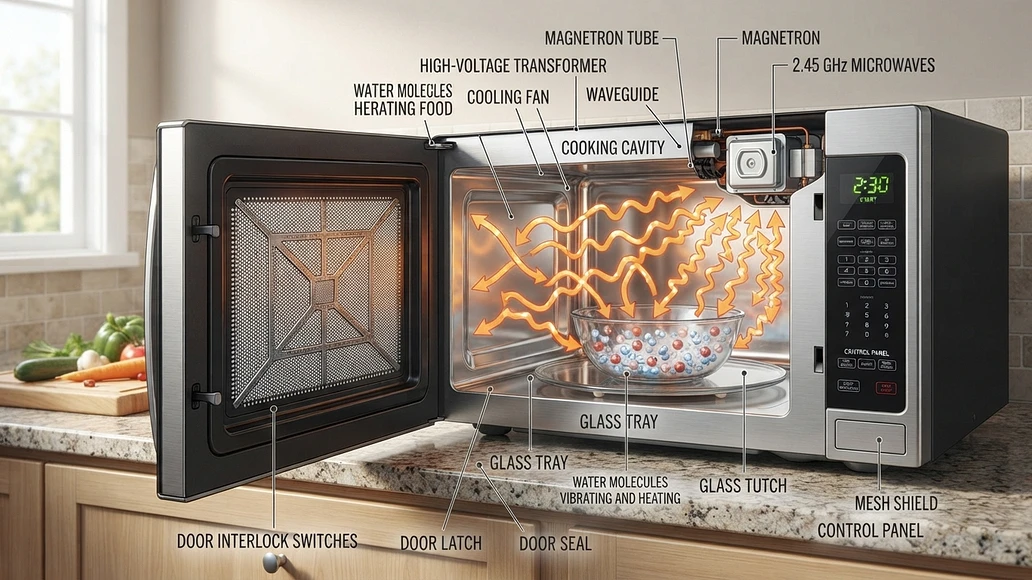
A household microwave oven generates radio frequency energy at about 2.45 GHz. That energy comes from the magnetron and is directed into the metal cooking cavity. The cavity walls reflect the microwaves so they stay inside and heat water-rich food.
The oven body is metal, and the door includes a metal mesh behind the glass. That mesh is the part most people notice. It lets visible light through so you can see your food, but the holes are much smaller than the wavelength of the microwave energy inside the oven. Because of that size relationship, the mesh helps keep the cooking energy contained while still allowing visibility.
Microwave ovens also rely on door geometry, seals, latches, and choke structures around the door opening to limit leakage. A properly functioning unit leaks very little energy, and regulators set strict limits for allowable leakage. In normal use, modern ovens are considered safe when the door closes properly and the appliance is not damaged.
So, is a microwave oven technically a Faraday cage?
The most accurate answer is this: a microwave oven is a Faraday-like enclosure designed for a specific job, which is containing microwave energy around 2.45 GHz during cooking.
That means calling it a Faraday cage is reasonable in a broad, everyday sense. It does not mean it performs like a laboratory shielded enclosure or a purpose-built protective container for every electromagnetic threat. It is engineered around one appliance function, not around broad-spectrum shielding performance.
For readers who want a simple verdict, this table gives the practical distinction.
| Option | Main purpose | Designed frequency focus | Construction strengths | Main weak points | EMP suitability | Best real-world use |
|---|---|---|---|---|---|---|
| Household microwave oven | Contain cooking energy | Primarily around 2.45 GHz | Metal cavity, door mesh, engineered door system | Seams, door wear, power cord, not tested as EMP storage | Unreliable | Cooking, limited short-term signal blocking tests |
| Purpose-built Faraday bag | Protect electronics from RF exposure | Broad consumer RF ranges, varies by product | Designed for shielding, portable, insulated storage options | Quality varies, wear can reduce performance | Potentially useful if tested and reputable | Phones, key fobs, small electronics |
| Purpose-built metal Faraday container | Shield stored electronics | Broader range when properly built | Continuous metal enclosure, insulated contents, fewer openings | Bad seals or interior contact can ruin performance | Better choice than a microwave | Preparedness storage for backup devices |
Why the door screen keeps microwaves in but lets light out
This is one of the easiest parts to understand. Visible light has a much shorter wavelength than microwave energy. The holes in the door screen are tiny compared with the microwave wavelength, so the screen acts like a barrier to the cooking energy. But those same holes are large enough for visible light to pass through, which is why you can watch the food spin.
That does not mean every mesh blocks every signal. Shielding depends on the size of the openings compared with the wavelength you are trying to stop. It also depends on the quality of the metal, the continuity around the edges, and the rest of the enclosure. This is why a microwave door can be effective for its intended frequency while still being a poor choice for unknown or broadband threats.
Microwave shielding is not the same as EMP or solar storm protection
This is where many preparedness articles oversimplify the issue. A microwave oven is designed to contain a narrow operating band used for cooking. An EMP is a fast, intense electromagnetic pulse with broad frequency content. A geomagnetic storm from solar activity is a different phenomenon again, often more relevant to long conductors and grid infrastructure than to a small unplugged gadget in a box.
Those differences matter. A microwave oven has seams, a door interface, and a power cord path. It was not designed, certified, or sold as a hardened protective enclosure for high-intensity electromagnetic events. Even if one unit happens to reduce some signals in informal tests, that does not prove it will protect sensitive electronics during a real EMP event.
Preparedness-minded readers should treat a microwave as a maybe for casual signal blocking, not as a dependable root-cause solution for electromagnetic threats. If the device matters, use a purpose-built Faraday bag or a properly constructed metal container with insulated contents.
Can a microwave block phone, Wi-Fi, or car key signals?
Sometimes yes, sometimes partly, and sometimes not at all. Many people have tested this by placing a phone inside a microwave, closing the door, and then calling it from another phone. In some cases the call does not go through. In others, the phone still rings or receives notifications. The same variability shows up with Wi-Fi, Bluetooth, and keyless entry fobs.
That inconsistency should tell you something important. Signal blocking in a microwave is not standardized performance. It depends on the oven design, condition, the frequency being used, the strength of the outside signal, and how the device itself communicates.
There is also a safety line that should not be crossed. It is generally safe to place a powered-off or idle phone in a microwave as long as the microwave is not turned on. But you should never run the microwave with electronics or random metal objects inside unless the manufacturer specifically says it is acceptable. Doing so can cause arcing, damage the oven, damage the device, or create a fire risk.
| Use case | Will a microwave always work? | Practical reliability | Main concern | Better option |
|---|---|---|---|---|
| Blocking a cell phone signal | No | Mixed | Performance varies by oven and network band | Faraday phone pouch |
| Blocking Wi-Fi or Bluetooth | No | Mixed | May reduce but not fully eliminate signals | Tested Faraday bag |
| Blocking a car key fob | Often possible | Moderate for short-term storage | Not convenient, not purpose-built | Key fob Faraday pouch |
| Protecting emergency electronics from EMP | No proven guarantee | Poor choice | Not designed for broadband pulse protection | Purpose-built Faraday container |
How safe microwave ovens are in everyday use
For normal household use, the evidence is reassuring. Properly functioning microwave ovens leak very little energy, and regulatory limits are strict. Consumer and occupational safety guidance consistently says microwaves are safe when used as directed and kept in good condition.
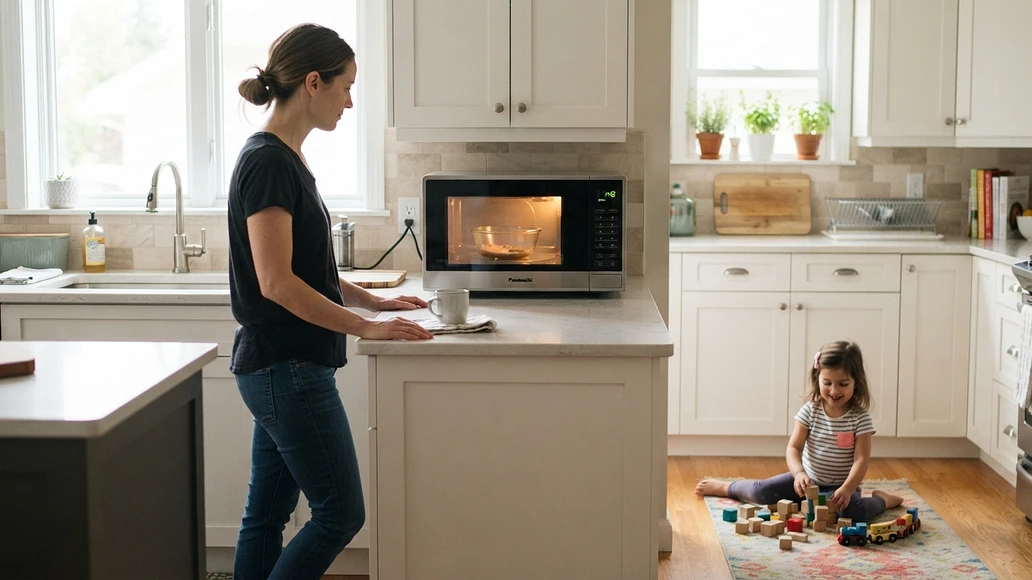
Distance also helps. Radio frequency exposure drops quickly as you move away from the appliance. You do not need to fear a working microwave, but there is no reason to press your body against the door while it runs. Standing a few feet away is a simple, sensible habit, especially in a busy kitchen with children around.
Microwaves use non-ionizing radiation. That means they do not have the kind of energy associated with ionizing radiation such as X-rays. They do not make food radioactive, and normal microwave use is not considered a cause of cancer by mainstream health authorities.
| Situation | Exposure expectation | What safety guidance says | Practical advice |
|---|---|---|---|
| Using a modern microwave in good condition | Very low leakage | Considered safe when used as directed | Use normally, keep door and seals clean |
| Standing very close to the door while running | Still usually below limits, but closer than needed | Avoid unnecessary close contact | Step back while it operates |
| Standing several feet away | Lower still | Distance further reduces exposure | Good habit for adults and children |
| Using a damaged or poorly closing microwave | Unknown, potentially increased leakage | Stop using until repaired or replaced | Do not ignore bent doors or bad latches |
Common myths, sorted from fact
| Myth | Fact |
|---|---|
| A microwave makes food radioactive | No. Microwave ovens use non-ionizing radiation that heats food but does not change atomic nuclei or make food radioactive. |
| If a metal box blocks one signal, it is EMP-proof | No. Blocking a phone or key fob signal does not prove broad-spectrum, high-intensity pulse protection. |
| All microwave ovens are perfect Faraday cages | No. They are engineered to contain cooking energy, not to serve as universal shielding enclosures. |
| Microwave ovens cause cancer in normal use | Mainstream health guidance says properly functioning microwaves are safe when used as directed. |
| Grounding is the only thing that makes a Faraday cage work | No. Good conductive continuity and proper enclosure design are often more important than grounding for many shielding applications. |
Better preparedness options than using your microwave
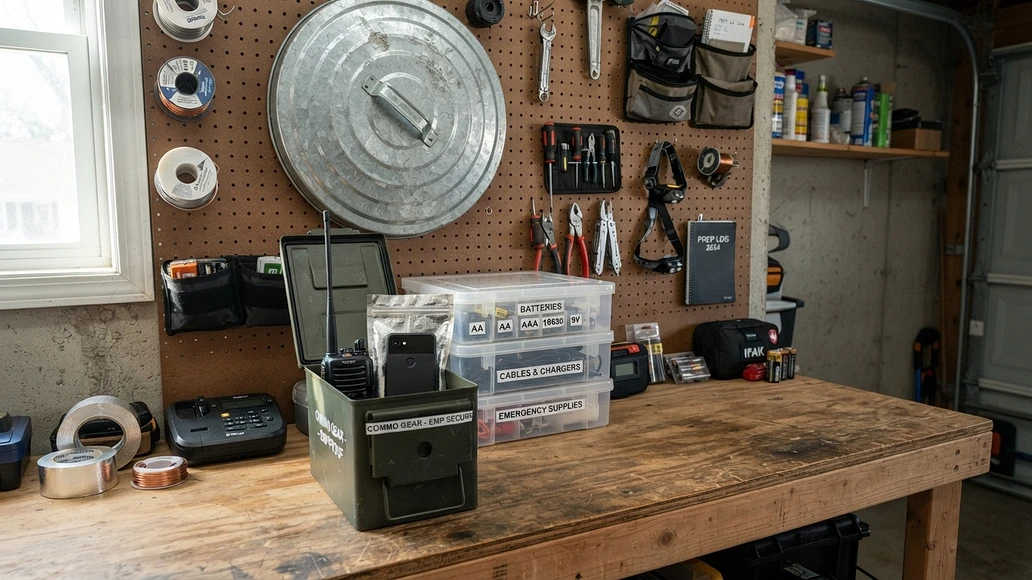
If your real goal is protecting backup electronics, there are better choices than repurposing a kitchen appliance. A purpose-built Faraday bag is the easiest option for small devices. For larger or lower-cost storage, many people build metal container systems using galvanized trash cans, ammo cans, or similar conductive boxes. The key is not just the metal shell. The contents must be insulated from the metal, and the lid or closure must maintain good conductive contact.
A common mistake is assuming any metal container works automatically. Paint, rubber gaskets, poor lid contact, interior metal-to-device contact, and large gaps can all reduce protection. A well-built container is usually a better preparedness tool than a microwave because it is actually dedicated to storage and can be set up with insulation and maintenance in mind.
| Option | Cost level | Ease of setup | Preparedness value | Main caution | Best for |
|---|---|---|---|---|---|
| Faraday bag | Low to moderate | Easy | Good for small electronics | Buy from a reputable maker and inspect for wear | Phones, radios, key fobs, SSDs |
| Galvanized trash can with insulated contents | Moderate | Moderate | Good for larger storage | Need proper lid contact and interior insulation | Backup radios, chargers, solar controllers |
| Ammo can modified for shielding | Low to moderate | Moderate | Useful for compact kits | Gasket and paint can interfere with conductivity | Small emergency electronics |
| Microwave oven | Already owned | Easy to try, poor to trust | Limited and uncertain | Not designed for EMP storage, not portable, not standardized | Short-term ad hoc signal reduction only |
How to tell if your microwave is still shielding properly
Start with the basics. Look at the door, hinges, latch, and seal area. If the door is bent, does not close squarely, or the latch feels loose, stop using the oven until it is repaired or replaced. Also stop using it if you see sparks, smell burning, or notice unusual noises.
Keep the seal area clean. Food residue can interfere with proper closure over time. Do not slam the door. Repeated impact can affect alignment.
Home signal tests are not a reliable substitute for professional leakage testing. A phone call test only tells you whether one signal got through under one set of conditions. It does not measure microwave leakage at the cooking frequency. If you have a real safety concern, have the unit checked by a qualified appliance technician or replace it.
Microwave safety basics that matter more than RF myths
Most microwave injuries are not about radiation leakage. They are about burns, superheated liquids, steam, and uneven heating. Use microwave-safe containers, avoid sealed containers unless vented as directed, and be careful with foods that heat unevenly. Stir and rest food when appropriate.
Children should not crowd the appliance while it is running, mostly because of hot containers and spills. In a family kitchen, the practical safety priorities are supervision, burn prevention, and replacing damaged appliances promptly.
When using a microwave as a makeshift RF shield is reasonable
There are a few limited situations where using a microwave as a temporary signal-reducing enclosure can make sense. For example, if you want to quickly isolate a spare key fob from wireless relay attacks, or if you are doing a simple classroom demonstration about RF shielding, a microwave can be a convenient example of a conductive enclosure.
Even then, the limits stay the same. Do not turn the microwave on. Do not treat the result as proof of EMP readiness. Do not use it for long-term storage of mission-critical devices. And do not assume one successful phone test means every signal is blocked.
Preparing for grid threats without risky shortcuts
Balanced preparedness works better than gadget myths. If you are concerned about grid disruptions, focus first on practical resilience. Keep backup lighting, stored water, shelf-stable food, battery banks, radios, and printed contact information. If you want to protect a few critical electronics, use a tested Faraday bag or a carefully built metal storage container with insulated contents.
That approach addresses the root problem more directly than improvising with a microwave. It also avoids turning a cooking appliance into a false sense of security.
FAQ
Can I store my emergency electronics in a microwave to protect them from EMP?
You can physically place them there, but it is not a dependable protection plan. A microwave oven was not designed or certified for EMP storage. For critical gear, use a purpose-built Faraday bag or a properly constructed metal container with insulated contents.
Is it safe to put my phone in a microwave if I do not turn it on?
Yes, placing a phone in an unplugged or idle microwave is generally safe if the oven is not operated. The danger comes from turning the microwave on with electronics or metal objects inside. Never do that unless the manufacturer specifically allows it.
How can I tell if my microwave is leaking radiation?
Check for obvious problems first, including a bent door, damaged latch, worn hinges, or a dirty seal area. If the door does not close properly, stop using it. Informal phone tests are not reliable leakage tests. If you are concerned, have the oven professionally evaluated or replace it.
Do microwaves make food or containers radioactive?
No. Microwave ovens use non-ionizing radiation, which heats food but does not make it radioactive. The bigger concern is whether the container is microwave-safe and whether the food heats evenly.
Are there simple ways to build a better Faraday cage at home than using a microwave?
Yes. A metal trash can with a conductive lid, or a modified ammo can, can be better choices if built correctly. The contents must be insulated from the metal, and the closure must maintain good conductive contact. A reputable Faraday bag is often the simplest option for small devices.
References
- Are Microwave Ovens Dangerous? - Good Housekeeping
- Fours à micro-ondes et leurs dangers - CCHST
- Microwaves and Faraday Cages: Understanding the Science Behind Electromagnetic Shielding
- How does a Faraday cage work?
- Microwave Oven EMF: Safe Distance and Radiation Levels
- What's in Your Faraday Cage? Electronics to Protect!