Using Medical Manuka Honey on Wounds, What It Can Help and When to Skip Home Care
Medical-grade Manuka honey can support healing in some wounds, especially certain minor burns and selected chronic wounds, but it is not a substitute for proper cleaning, dressings, or medical care. Here is how it works, how to apply it safely, and when to get help instead.

Manuka honey has a real place in wound care, but the useful version is not the jar in your pantry. For wounds, the key distinction is medical-grade, sterile honey, usually sold in dressings, gels, or tubes made for clinical use. Research suggests it may help some wounds heal faster, especially certain partial-thickness burns, and it may also reduce odor, moisture buildup, and surface bacteria in selected chronic wounds. Still, it works best as adjunctive care, not as a replacement for cleaning, debridement, pressure relief, compression, or antibiotics when those are needed.
This guide is general information only. If a wound is deep, heavily bleeding, infected, on the foot of a person with diabetes, near the eye, or getting worse instead of better, skip home treatment and get medical care.
What Manuka honey is, and why it is different from regular honey
Manuka honey comes from nectar gathered from the Manuka shrub, native to New Zealand and parts of Australia. It is often discussed because it contains compounds associated with antimicrobial activity, including methylglyoxal, often shortened to MGO. Compared with ordinary table honey, Manuka products are marketed with activity ratings such as UMF or MGO.
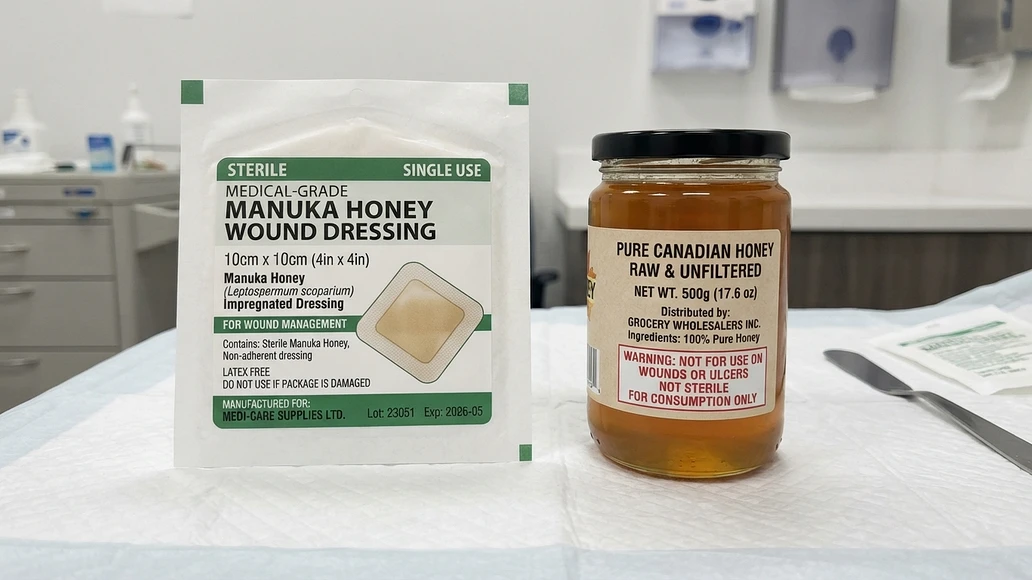
That said, a label showing UMF or MGO does not automatically make a product appropriate for wound care. Grocery-store honey, raw honey, and even premium Manuka honey sold as food are not the same as a sterile wound product. For skin wounds, the safer choice is a product specifically labeled for medical use.
What “medical-grade honey” means for wound care
Medical-grade honey is processed and packaged for use on wounds. The important differences are sterility, quality control, and intended use. Sterile wound products are designed to lower contamination risk and to work with dressings. This matters because open skin is vulnerable, and introducing nonsterile material can create problems instead of solving them.
| Product type | Sterile | Intended use | Best use case | Main caution |
|---|---|---|---|---|
| Medical-grade Manuka honey dressing or gel | Yes | Topical wound care | Selected minor wounds and clinician-directed chronic wound care | Still not suitable for every wound type |
| Food-grade Manuka honey | No | Eating | Dietary use only | Not recommended as a substitute for sterile wound products |
| Regular honey from the grocery store | No | Eating | Food use only | Variable composition, not sterile, not a wound dressing |
| Standard non-adherent dressing without honey | Usually sterile | Routine wound coverage | Many simple wounds after proper cleaning | May need other treatments depending on wound type |
How Manuka honey may help wounds heal
Medical honey is thought to help in several ways. It supports a moist wound environment, which can help tissue repair. Its high sugar content creates osmotic action that can draw fluid from the wound surface. It also has a naturally low pH and antimicrobial properties that may make the wound environment less favorable for some microbes. Some patients also report less odor and less discomfort as the wound bed improves.
These benefits do not mean honey replaces basic wound care. A dirty wound still needs cleaning. Dead tissue may still need debridement. A venous leg ulcer may still need compression. A diabetic foot ulcer may still need offloading and close medical supervision.
Which wounds may benefit most
The strongest consumer-facing evidence is for some partial-thickness burns, where honey dressings have been associated with shorter healing time compared with some conventional dressings. Evidence for chronic wounds is more mixed. Some venous leg ulcers and other hard-to-heal wounds may benefit, but results are not uniform, and those wounds often need a clinician-led plan.
| Wound type | Evidence outlook | Possible role for medical honey | Home use appropriate? |
|---|---|---|---|
| Small partial-thickness burn | Best supported | May shorten healing time in selected cases | Sometimes, if truly minor and not infected |
| Minor scrape or shallow abrasion | Reasonable but less studied than burns | May help maintain a moist healing environment | Yes, if clean and superficial |
| Simple small cut | Limited but plausible | May be used under a dressing after cleaning | Yes, if edges are not gaping and bleeding is controlled |
| Venous leg ulcer | Moderate, mixed | May help as part of a broader wound plan | Usually needs clinician guidance |
| Pressure injury | Mixed | Possible adjunct in selected cases | Usually no, needs assessment and pressure relief |
| Diabetic foot ulcer | Mixed, caution advised | Possible benefit in some settings | No, clinician-led care is safest |
| Surgical wound | Case-specific | Sometimes used in professional care | Only if your clinician approves |
Which wounds should not be treated at home with honey
Some wounds need standard medical care first, and honey should not delay that care. Avoid self-treating with honey if the wound is deep, punctured, contaminated with debris, caused by an animal bite, or has uncontrolled bleeding. Large burns, facial burns, burns over joints, and any suspected third-degree burn need prompt medical evaluation.
Home use is also a poor choice for wounds with spreading redness, warmth, pus, foul odor, fever, worsening pain, or delayed healing. People with diabetes, poor circulation, neuropathy, immune suppression, cancer treatment, or chronic leg and foot wounds should be especially cautious.
Burns, cuts, scrapes, and chronic wounds, what the evidence really suggests
Minor burns
This is where honey has the clearest support. In some partial-thickness burns, medical-grade honey dressings have been linked with faster healing than certain conventional dressings. That does not apply to severe burns, chemical burns, electrical burns, or large burned areas.
Small cuts and abrasions
For a clean, shallow wound, medical honey may be a reasonable option under a sterile dressing. It may help keep the wound moist and protected. The wound still needs gentle rinsing first, and the dressing still needs to be changed on schedule.
Chronic wounds
For venous ulcers, pressure injuries, and diabetic foot ulcers, the evidence is mixed and the stakes are higher. These wounds often fail to heal because of poor circulation, pressure, swelling, infection risk, or repeated trauma. Honey may help some of them, but it is not enough by itself. Professional wound care is usually the safer path.
How to apply Manuka honey safely
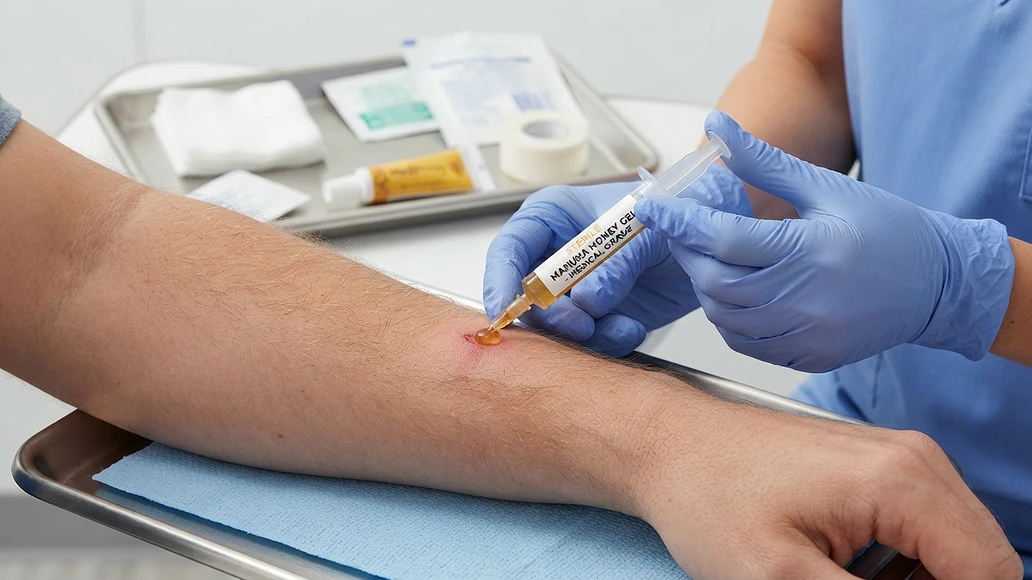
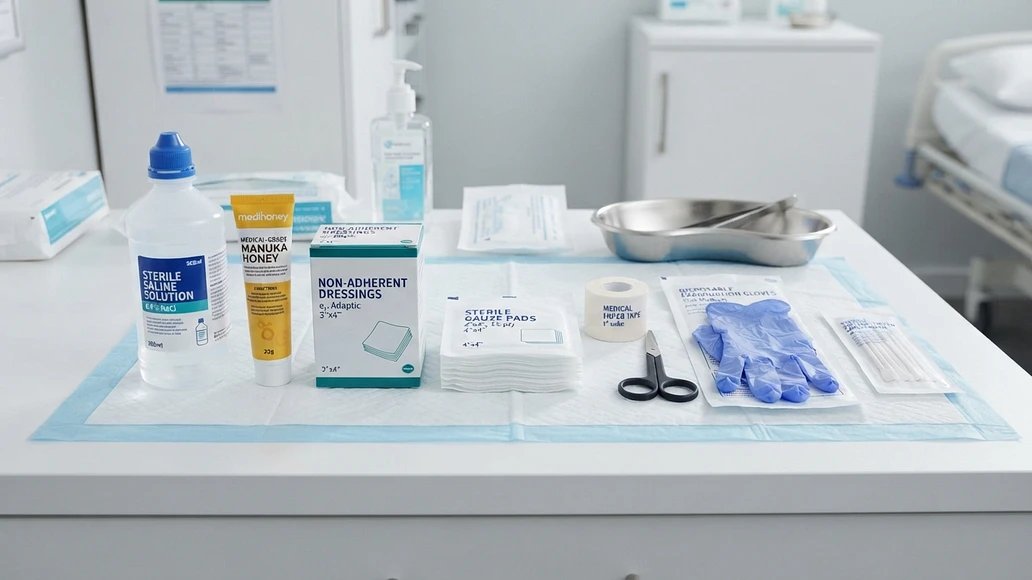
If you are treating a minor wound at home, use a sterile medical-grade honey product and follow the package instructions. A simple process looks like this:
- Wash your hands well, or use clean gloves.
- Rinse the wound gently with clean water or sterile saline.
- Pat the surrounding skin dry. Do not scrub the wound bed.
- Apply a thin layer of medical-grade honey, or place a honey-impregnated dressing over the wound.
- Cover it with a sterile non-adherent secondary dressing.
- Secure the dressing so it stays clean and in place.
- Check the wound daily for increased redness, swelling, drainage, odor, or pain.
Do not pack deep wounds yourself unless a clinician has shown you how. Do not use honey in or near the eye. Do not apply it to large burns or heavily contaminated injuries.
| Wound drainage level | Suggested dressing approach | Typical change frequency | What to watch for |
|---|---|---|---|
| Dry to light drainage | Thin layer of medical honey with non-adherent cover | Every 24 to 48 hours, or as directed by product instructions | Sticking, dryness, rising pain |
| Moderate drainage | Honey dressing plus absorbent secondary dressing | Usually daily | Leakage, skin maceration, odor |
| Heavy drainage | Absorbent dressing system, often clinician-guided | Daily or more often if saturated | Rapid soak-through, worsening tissue, infection signs |
How often to change the dressing
There is no single schedule that fits every wound. Change frequency depends on how much fluid the wound produces, whether the dressing stays in place, and what the product instructions say. A lightly draining scrape may do well with changes every day or two. A wetter wound may need daily changes, sometimes more often if the outer dressing becomes saturated.
If the dressing leaks, smells worse, sticks painfully, or the surrounding skin turns white and soggy, the setup needs adjustment. Those are signs the wound environment is not being managed well.
What normal healing looks like, and what is not normal
A minor wound that is healing normally should gradually look cleaner, less inflamed, and less tender over several days. Drainage should not steadily increase. The wound edges should not spread apart, and the surrounding redness should not expand.
Some people notice a brief stinging sensation when honey is first applied. Mild temporary discomfort can happen. What is not normal is escalating pain, spreading redness, pus, fever, bad odor, or tissue that looks gray, black, or increasingly damaged.
Common mistakes to avoid
The biggest mistake is using food honey instead of a sterile wound product. Another common error is putting honey on a wound that actually needs stitches, debridement, antibiotics, burn care, or vascular assessment. People also run into trouble when they leave a saturated dressing on too long or ignore signs of infection because they assume a natural product is automatically safe.
UMF and MGO ratings are useful for describing honey characteristics, but they do not replace sterile packaging, medical labeling, and proper wound selection.
How to choose a product, and what UMF and MGO do and do not mean
When shopping for wound care, look first for wording such as medical-grade, sterile, and packaging intended for topical wound use. Dressings, gels, and impregnated pads are common formats. If the product is sold mainly as a food, that is a sign to keep looking.
| Label term | What it means | What it does not mean |
|---|---|---|
| UMF | A grading system associated with certain Manuka honey characteristics | Not proof the product is sterile or cleared for wound care |
| MGO | Indicates methylglyoxal content | Not a guarantee of safety for open wounds |
| Medical-grade | Prepared for clinical or topical wound use | Not a promise that it is right for every wound |
| Sterile | Processed to reduce contamination risk | Not a substitute for proper cleaning and dressing technique |
How Manuka honey fits with standard wound care
Think of medical honey as one tool, not the whole toolbox. Standard wound care still matters. That may include saline cleansing, removal of dead tissue by a professional, a non-adherent contact layer, absorbent secondary dressings, compression for venous ulcers, and offloading for diabetic foot ulcers. If infection is present, antibiotics or other medical treatment may be necessary.
In other words, honey may support healing conditions, but it does not fix the underlying reason a wound is failing to close.
When to stop home care and seek medical help
| Red flag | Why it matters | What to do |
|---|---|---|
| Heavy bleeding or gaping wound | May need closure or urgent treatment | Seek prompt medical care |
| Deep puncture, bite, or embedded debris | High infection and tissue injury risk | Get professional evaluation |
| Large burn or suspected third-degree burn | Can be serious even if pain seems limited | Do not self-treat, get urgent care |
| Spreading redness, warmth, pus, foul odor, fever | Possible infection | Stop self-care and seek medical help |
| Diabetes, poor circulation, neuropathy, foot wound | Higher complication risk | Use clinician-led care |
| Immunocompromise or cancer treatment | Healing may be impaired | Get medical guidance early |
| Wound near the eye or on sensitive mucosa | Special tissue requires careful treatment | Do not use home honey products |
| No improvement, or worsening after a short period | May need a different diagnosis or treatment plan | Arrange medical assessment |
| Rash, swelling, or allergic symptoms after use | Possible bee-product or honey reaction | Stop use and seek care if symptoms are significant |
Bottom line
Medical-grade Manuka honey can be a practical addition to a home wound kit for selected minor wounds, especially small superficial burns and clean abrasions. Its best-supported benefits are helping maintain a moist healing environment and, in some wound types, shortening healing time. But it is not a cure-all, and it is not interchangeable with food honey.
If you want to use it safely, choose a sterile medical-grade product, apply it only to appropriate minor wounds, change dressings based on drainage, and stop home care quickly if the wound looks infected, deeper than expected, or slow to improve.
References
- Clinical and Postoperative Applications of Manuka Honey
- Honey in Wound Healing, An Updated Review
- Manuka Honey, Medicinal Uses, Benefits, and Side Effects
- Manuka Honey as a Natural Remedy for Diabetic Foot Ulcers
- Medicinal Honeys from Oceania, Updated Review
- Understanding Medical Grade Honey, How Doctors Use Manuka