The Best Fallout Shelter You Can Reach Fast, Realistic Safe Places Near Home
If a nuclear emergency ever happens, your safest option is usually not a distant cave or abandoned mine. This guide explains how to identify the nearest practical fallout shelter near home, improve your house or apartment for better shielding, and avoid dangerous myths about travel, tunnels, and improvised bunkers.

When people search for a natural nuclear shelter near home, they often picture caves, mines, or secret bunkers hidden in the hills. In a real emergency, that picture can be dangerously misleading. For most households, the best fallout shelter is the closest dense structure you can reach in minutes, not a remote underground site that takes a long drive or a risky hike.
This article focuses on practical sheltering for people who want a realistic plan. It covers what nearby places actually reduce fallout exposure, how shielding works in plain language, how to improve your own home, and why abandoned mines and caves are poor primary choices. This is general preparedness information only, not individualized medical, legal, or engineering advice. In any real event, follow instructions from local emergency management, public health authorities, and official alerts.
What counts as a nearby fallout shelter
A useful fallout shelter does not have to be a purpose-built bunker. In preparedness terms, a good near-home shelter is any place that puts dense material and distance between you and radioactive fallout particles outside. That usually means below-grade spaces, interior rooms in large buildings, or heavily shielded areas with thick concrete, brick, or earth around them.
Good examples include a basement, an underground parking level, a subway station where available, a central room in a large concrete building, or the most interior part of a multi-story structure. These are not magical places. They simply reduce radiation dose better than being outdoors, near windows, or in light-framed structures.
What does not count as a strong option is a flimsy shed, a vehicle, a tent, or an exposed overhang. Those may get you out of the weather, but they do very little against fallout radiation.
Blast, heat, and fallout are different problems
One reason bad advice spreads so easily is that people lump all nuclear effects together. Shelter helps most with fallout, not with a direct hit nearby. If you are very close to ground zero, no ordinary home shelter guarantees survival. Distance from the detonation matters more than any online checklist.
| Hazard | What it is | What helps most | Limits of shelter |
|---|---|---|---|
| Blast pressure | Shock wave that can collapse structures and throw debris | Being far from the detonation, getting below grade, staying away from windows | Improvised shelter is not reliable near the blast zone |
| Thermal pulse | Intense heat and light that can cause burns and fires | Immediate cover, being indoors, avoiding windows and line of sight | Interior shelter helps only if the structure remains intact |
| Fallout radiation | Radioactive dust and particles that settle after the explosion | Dense shielding, underground spaces, interior rooms, staying inside | This is where practical sheltering gives the biggest benefit |
The key takeaway is simple. If you are outside the immediate blast zone, the main life-saving action is to get into the nearest good shelter quickly and stay there through the highest fallout period.
Why speed matters more than finding a perfect bunker
After a detonation, fallout can begin arriving within roughly 10 to 15 minutes in some situations. That is not enough time to drive across town, search for a locked shelter, or head for a cave you found on a map months ago. The safest move is usually the nearest solid building with the best available shielding.
That is why your planning radius should be short. Think in terms of what you can reach on foot or by a very short route from home, work, school, or your usual errands. A decent basement two minutes away beats a theoretically better shelter twenty minutes away.
How shielding works in plain language
Fallout radiation is dangerous because gamma radiation can pass through air and many light materials. To reduce exposure, you want more mass between you and the fallout. Earth, concrete, brick, water, books, and packed supplies all help because they add density and thickness.
Preparedness guidance often mentions about 3 feet of packed earth or a comparable amount of dense material as a strong benchmark for major protection. That does not mean you need exactly that amount everywhere to get benefit. Even smaller improvements can meaningfully reduce dose, especially overhead and on the sides facing the outdoors.
| Material | Relative shielding value | How it helps in a home shelter | Practical notes |
|---|---|---|---|
| Packed earth | Very strong | Excellent overhead and side shielding if already below grade or bermed | Best when part of a proper structure, not loose piles against weak walls |
| Concrete | Very strong | Basement walls, parking garages, utility cores, stairwells | Dense reinforced concrete is far better than thin slabs |
| Brick or block | Strong | Better than light wood framing for exterior walls | Still improved by moving inward from exterior surfaces |
| Water | Moderate to strong | Stored jugs can add shielding around a shelter corner | Useful because it doubles as emergency water storage |
| Books, paper, supplies | Moderate | Can build up mass around a protected nook | Best as supplemental shielding, especially around seated or sleeping areas |
| Wood and drywall | Weak | Offers limited help by itself | Do not rely on a standard interior wall as meaningful shielding |
Shielding and contamination control are not the same thing. Thick materials reduce external radiation. Plastic sheeting, closed windows, and masks help reduce radioactive dust getting inside or into your lungs. Both matter, but they solve different parts of the problem.
The closest practical shelter options most people already have
If you had to choose quickly, these are the types of places worth identifying in advance around your home and workplace.
| Shelter option | Shielding strength | Travel risk | Main advantages | Main drawbacks | Best use |
|---|---|---|---|---|---|
| Home basement | High | Low | Fast access, familiar, easy to stock | May need extra overhead shielding and dust control | Best primary plan for many houses |
| Interior room in a house without basement | Low to moderate | Low | Immediate access, no travel needed | Less shielding from roof and exterior walls | Fallback if no below-grade space exists |
| Middle floors of a large apartment or office building | Moderate to high | Low to moderate | Distance from roof fallout and ground fallout can help | Glass-heavy buildings need careful room selection | Good urban option if interior core is available |
| Underground parking garage | High | Moderate | Concrete and below-grade protection | Vehicle fumes, access control, and crowding can be issues | Good nearby public option |
| Subway station | High | Moderate | Deep underground, substantial shielding | Not available in most areas, may close or become congested | Strong option where officially accessible |
| School, hospital, mall interior core | Moderate to high | Moderate | Large dense structures, interior corridors and service areas | Public access may vary, windows can be extensive | Useful backup plan |
| Storm shelter or root cellar | Moderate to high | Low | Below grade and already built | Ventilation, water intrusion, and overhead mass may be limited | Good if structurally sound and dry |
| Cave or abandoned mine | Potentially high | High | Earth overhead can shield well | Collapse, flooding, bad air, trespassing, rescue difficulty | Not recommended as a primary plan |
How to improve your own home for fallout protection
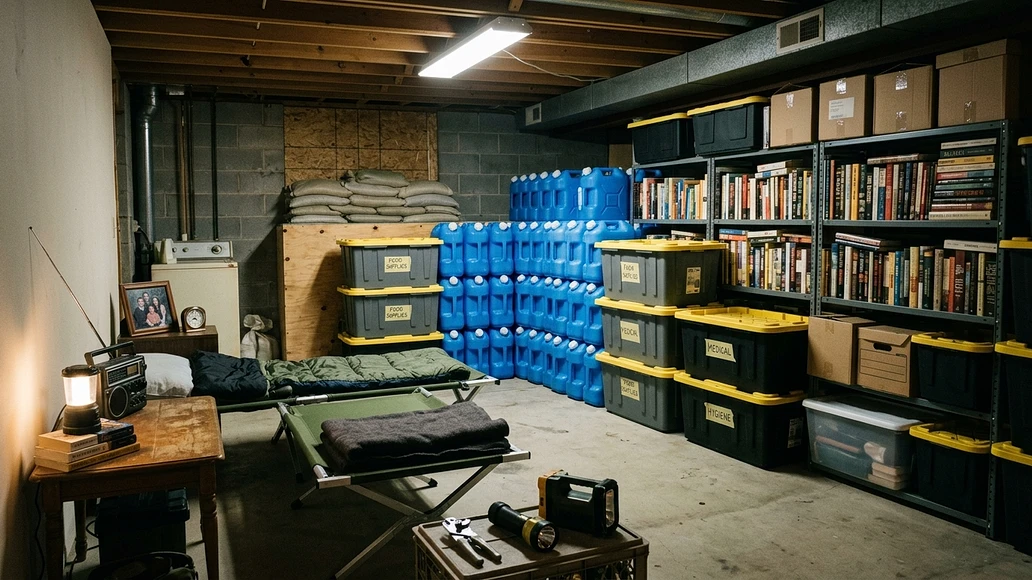
If your house has a basement, start there. The best spot is usually the corner or area with the most earth outside the walls and the most mass overhead. A central area under a heavy part of the house can be better than a finished basement room next to large windows.
If you do not have a basement, choose the most interior room possible, preferably with no windows and the fewest exterior walls. A bathroom, closet, hallway, or storage room near the center of the home may be your best option. Then improve it by adding mass around the occupied area.
Practical home upgrades that help
Water containers are one of the easiest upgrades because they serve two purposes. Cases of bottled water, filled jugs, or stackable containers can be placed along the outer side of your shelter area. Dense books, canned food, bins of supplies, and sandbags can also add shielding. Focus first on the sides facing outdoors and on overhead protection if you are below a light-framed roof.
Furniture can help too. A sturdy table with heavy items stacked around and over it, without creating collapse hazards, can form a more protected nook inside a basement. The goal is not to build a coffin-like enclosure. The goal is to increase mass while preserving safe airflow and a quick exit.
For contamination control, close windows and doors, shut off systems that pull in outside air if official guidance recommends it, and use plastic sheeting and duct tape to reduce dust infiltration around obvious gaps. This does not block gamma radiation, but it can reduce radioactive particles entering the space.
What not to do indoors
Do not run a generator, charcoal grill, camp stove, propane heater, or any other fuel-burning device inside an enclosed shelter unless it is specifically designed, vented, and approved for that use. Carbon monoxide can kill quickly and silently. Also avoid open flames in crowded improvised shelters with plastic sheeting and stored supplies.
How to map shelter options within a 10 to 15 minute radius
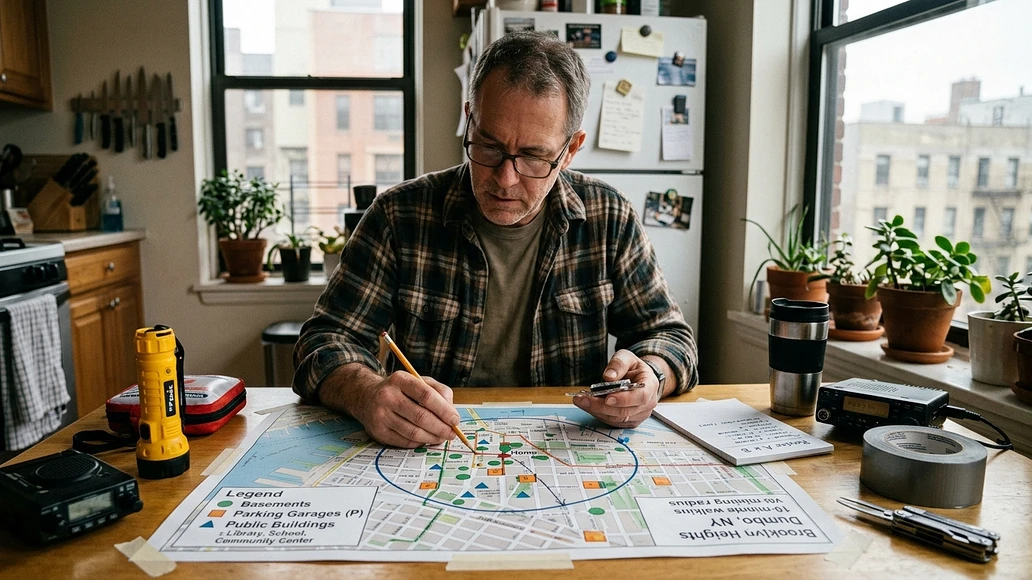
A good plan is local, simple, and repeatable. Instead of hunting for exotic bunkers, map the best places you can reach fast from the places you actually spend time.
- Mark your home, workplace, school, and common errand locations.
- Draw a realistic 10 to 15 minute walking radius around each one.
- Identify basements, underground parking, subway access, concrete stairwells, and large brick or concrete buildings.
- Note which sites are likely open during the hours you would need them.
- Choose a primary, secondary, and tertiary option for each location.
- Walk the route in advance and time it.
- Store a small shelter kit at home, in your vehicle if appropriate, and at work if allowed.
Also check with local emergency management offices to see whether any public shelter guidance exists in your area. Many Cold War shelter signs no longer mean the site is stocked, open, or maintained. Treat online shelter maps as conversation starters, not guarantees.
Are caves, culverts, and mines realistic options
Natural terrain can sound appealing because earth is an excellent shield. But most informal underground spaces come with serious hazards that are often worse than the benefit they promise.
Abandoned mines can collapse, flood, contain toxic gases, or have unstable entrances. Caves may have poor footing, wildlife, hidden shafts, and no maintained ventilation. Culverts can flood suddenly and may channel contaminated runoff. Many of these places are also on private or restricted land, which adds legal and access problems in an emergency.
| Terrain option | Possible benefit | Major hazard | Recommended role |
|---|---|---|---|
| Natural cave | Earth overhead may reduce fallout dose | Collapse, bad air, flooding, difficult rescue | Last resort only, not a primary plan |
| Abandoned mine | Potentially deep shielding | Trespassing, toxic atmosphere, unstable supports | Not recommended |
| Road culvert or drainage tunnel | Some overhead mass | Flash flooding, contamination runoff, poor air quality | Very poor option except immediate life threat outdoors |
| Hillside cut or bermed area | Some terrain shielding if paired with a solid structure | Exposure, weather, limited overhead protection | Supplemental terrain advantage, not stand-alone shelter |
If you are planning ahead, put your effort into improving a legal, dry, structurally sound shelter near where you live. That is far more realistic than betting your life on a remote hole in the ground.
Public buildings and workplaces, where to go inside
In a large building, the safest place is usually not the lobby. Move away from windows, glass atriums, and exterior walls. Look for the central core, basement, service corridors, interior stairwells, or lower levels surrounded by concrete and multiple layers of structure.
In a multi-story building without a basement, middle floors can sometimes be better than the top or ground floor because they place more material between you and fallout on the roof and on the ground outside. The exact best spot depends on the building design. What matters most is dense material, interior location, and minimal exposure to outside surfaces.
How long should you stay sheltered
The first day matters most. Fallout radiation drops significantly with time, especially in the first 24 to 72 hours. That is why official guidance commonly emphasizes immediate sheltering and staying inside for at least 24 hours, and preferably longer if conditions are severe or officials have not cleared the area.
| Time after fallout begins | Typical risk pattern | Recommended behavior | Key caution |
|---|---|---|---|
| 0 to 24 hours | Highest danger period | Stay in the best shelter available, do not travel unless directed by authorities | Avoid all unnecessary outdoor exposure |
| 24 to 72 hours | Risk declines but may still be serious | Remain sheltered, monitor official updates, limit movement inside and outside | Do not assume the danger is over just because time has passed |
| 3 to 7 days | Further decline in many scenarios | Continue sheltering as directed, brief essential trips only if necessary | Contaminated dust and surfaces may still pose hazards |
| 1 to 2 weeks | May be needed in heavier fallout scenarios | Follow official instructions on relocation, decontamination, and water safety | Duration depends on local conditions, not a fixed rule |
If you must go outside after the initial shelter period, keep it brief, cover skin, avoid stirring dust, and remove outer clothing when you return to reduce contamination indoors. Shower with soap and water if available. Bag contaminated outerwear away from living areas.
Essential supplies for short-notice sheltering
A nearby shelter is much more useful if it already has basic supplies. Focus on simple, durable items that support 72 hours at minimum, with the ability to stretch longer if needed.
| Item | Minimum planning target | Why it matters | Storage note |
|---|---|---|---|
| Water | At least 1 gallon per person per day | Hydration and basic sanitation | Sealed containers are safer than open water sources |
| Shelf-stable food | 3 days minimum, more if possible | Supports sheltering without cooking | Choose foods that need little water and no refrigeration |
| Battery or hand-crank radio | 1 per household | Official updates and instructions | Store spare batteries in original packaging |
| Lighting | At least 2 light sources | Safe movement and stress reduction | Prefer LED lanterns over candles |
| N95 or similar masks | Several per person | Helps reduce inhalation of radioactive dust | Useful for cleanup and brief outdoor trips |
| Plastic sheeting and duct tape | One basic roll and enough sheeting for key gaps | Dust control, privacy, simple containment | Do not confuse this with radiation shielding |
| Medications | At least several days extra if possible | Critical for chronic conditions | Rotate before expiration and keep a written list |
| Sanitation supplies | Trash bags, wipes, toilet paper, gloves | Hygiene during extended sheltering | Plan for waste if plumbing fails |
| First aid kit | 1 stocked kit | Minor injuries and routine care | Include pain relief and personal medical items |
For water, sealed bottled water and stored indoor water are generally safer than open surface water after fallout. If you ever need to disinfect water with unscented household bleach, use established emergency water treatment guidance carefully and follow official instructions. In a real event, local public health advice should guide water use.
Special considerations for children, pregnancy, disability, and chronic illness
Children and fetuses are generally more sensitive to radiation, so they should get priority for the best available shielding and the least time outside. People with asthma or other lung conditions may need extra attention to dust control. Anyone who depends on refrigerated medication, oxygen, mobility devices, or regular treatments should plan now for backup power, spare supplies, and a written care summary.
If someone in your household has a serious medical condition, talk with their clinician ahead of time about emergency medication storage and interruption planning. In a real incident, medical and public health guidance should take priority over generic internet advice.
What the evidence supports, and what is more speculative
| Preparedness action | Evidence level | What it does best | Bottom line |
|---|---|---|---|
| Go to the nearest dense building or below-grade space | Well supported | Reduces external radiation dose quickly | Best immediate action for most people outside the blast zone |
| Move to interior rooms away from windows and exterior walls | Well supported | Cuts exposure and contamination | Simple and effective if no basement is available |
| Add mass with water, books, supplies, and sandbags | Well supported conceptually | Improves shielding | Most useful in basements and interior shelter corners |
| Seal gaps and use masks for dust control | Well supported for contamination control | Reduces inhalation and indoor dust entry | Helpful, but not a substitute for shielding |
| Shelter at least 24 hours, preferably 48 to 72 hours | Well supported | Avoids the peak fallout period | Stay longer if officials advise it |
| Use caves or mines as your main plan | Mixed to weak as a recommendation | May provide shielding if sound | Too risky and unreliable for primary planning |
| Build a DIY blast-proof bunker without professional input | Mixed and often unrealistic | May help with fallout only | Construction, ventilation, and legal issues require expert help |
| Use grills, generators, or fuel heaters in enclosed shelter | Harmful | None | Do not do this because of carbon monoxide and fire risk |
Common myths that can get people hurt
One dangerous myth is that the best shelter is always the deepest or most dramatic one. In reality, the best shelter is the best one you can reach fast and safely. Another myth is that any underground space is automatically safe. Many are not. Structural integrity, ventilation, flooding risk, legal access, and rescue access all matter.
A third myth is that sealing a room with plastic somehow makes it radiation proof. It does not. Plastic helps with dust control, not gamma shielding. Finally, many people underestimate how deadly carbon monoxide can be in enclosed spaces. Never bring combustion devices into a sealed shelter unless they are professionally designed and vented for that purpose.
If you want a more permanent shelter at home
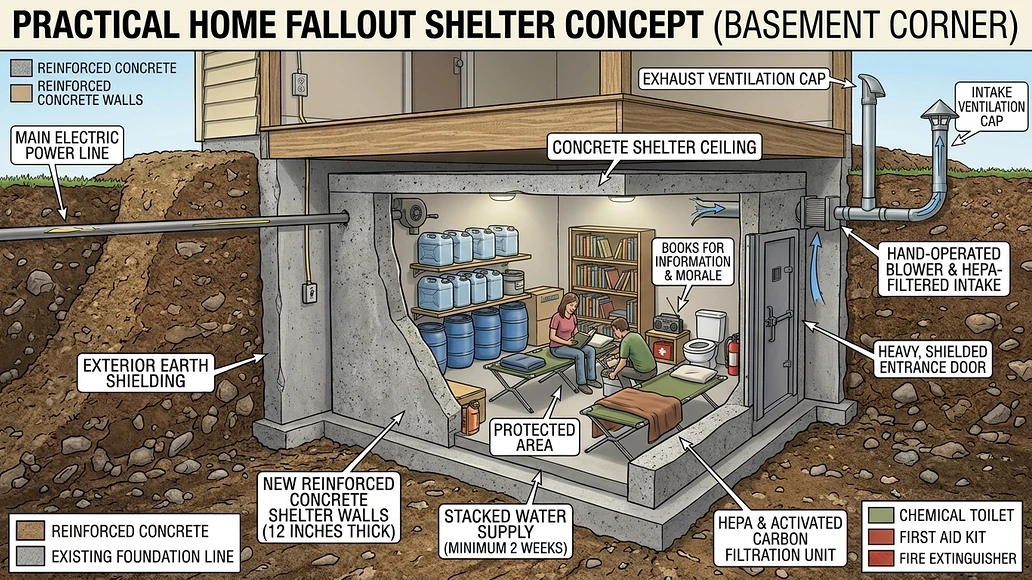
Some households may decide to upgrade a basement room, root cellar, or below-grade safe room for better fallout protection. That can be reasonable, but it should be approached like a real construction project, not a weekend improvisation. Structural loads, moisture control, ventilation, emergency egress, electrical safety, and sanitation all matter.
Before digging or modifying any underground structure, contact local building authorities, call 811 to locate buried utilities, and consider a structural engineer or qualified contractor. A poorly built underground space can fail from water pressure, collapse, or bad air long before radiation becomes the biggest problem.
Why this topic is back in the news
Interest in fallout shelters rises whenever geopolitical tensions increase. That has led to viral shelter maps and stories about old Cold War bunkers. Those tools can be interesting, but many listed shelters are inactive, privately owned, inaccessible, or not stocked for public use. The more dependable lesson from recent public guidance is still the same. Plan to shelter in place or in the nearest strong building, not to chase a distant bunker.
Quick decision guide when seconds count
| Question | If yes | If no |
|---|---|---|
| Is there a basement or below-grade space in the building you are in? | Go there, then move to the most interior protected area | Go to the most interior room or core of the building |
| Is there a larger concrete or brick building closer than your current location? | Use it only if it can be reached immediately and safely | Stay put and improve shielding where you are |
| Are you considering driving to a distant shelter, cave, or mine? | Do not make that your default plan after a detonation | Good, focus on nearest practical shelter |
| Can you add mass around your shelter area? | Use water, books, supplies, and furniture safely | Prioritize interior location and time sheltered |
| Do you have official instructions from authorities? | Follow them even if they differ from your preplanned option | Monitor radio and alerts while staying sheltered |
FAQ
How far is it safe to travel to reach a better nuclear shelter after an explosion?
Usually not far. The practical rule is to get into the nearest good shelter within minutes, not to travel across town. Fallout may begin arriving quickly, and being caught outside or in traffic can be worse than using a slightly less ideal shelter nearby.
If my home has no basement, what is the best room to use as a fallout shelter?
Choose the most interior room with the fewest windows and exterior walls, such as a bathroom, closet, hallway, or storage room near the center of the house. Then add shielding with water containers, books, supplies, and heavy furniture placed safely around the occupied area.
Do old Cold War fallout shelters near me still work, and how can I find out?
Some may still exist, but many are no longer stocked, maintained, or open to the public. Contact your local emergency management office or building owner for current status. Do not assume an old sign means the site is usable in an emergency.
Is it safer to shelter in a subway station or in a large office building?
If the subway station is accessible, structurally sound, and officially open, it often offers stronger shielding because it is underground. If not, a large office building can still be a good option if you move to the basement or interior core away from windows and exterior walls.
Can I use my existing storm shelter or root cellar as a nuclear fallout shelter?
Often yes, at least as a starting point, if it is dry, structurally sound, and has safe ventilation. You may still need better overhead shielding, more supplies, and a plan for sanitation and air quality. Have any major modifications reviewed by qualified professionals.
References
| Source | Link | Why it is useful |
|---|---|---|
| Ready.gov, Nuclear Explosion | https://www.ready.gov/nuclear-explosion | Official U.S. guidance on immediate sheltering, staying inside, and avoiding travel |
| CDC, Nuclear Explosion, What to Do | https://www.cdc.gov/radiation-emergencies/preparedness-response/nuclear-explosion.html | Public health guidance on fallout, contamination control, and protective actions |
| Where to Go If Nuclear War Breaks Out, Shelter First | https://scienceinsights.org/where-to-go-if-nuclear-war-breaks-out-shelter-first/ | Useful summary of why nearest shelter matters more than distant travel |
| Radiation Shielding, Best Materials and Protection Factors for Home Shelters | https://www.nuclearready.com/guides/radiation-shielding-materials/ | Helpful practical overview of shielding materials and home improvements |
| Fallout Shelters Near You | https://trueprepper.com/fallout-shelters/ | Preparedness-oriented discussion of existing shelter types and home options |
| Fallout shelter overview | https://en.wikipedia.org/wiki/Fallout_shelter | Background reading on shelter concepts and historical civil defense design |