Microwave Shielding Explained, What Your Kitchen Oven Can and Cannot Block
A microwave oven uses Faraday cage principles to contain 2.45 GHz energy, but that does not make it a reliable shield for EMP or long-term electronics protection. Here is the practical, safety-first answer.

Many people have heard that a microwave oven is basically a Faraday cage. That idea is partly true, but it needs context. A microwave oven is designed to keep a very specific kind of electromagnetic energy inside the cooking cavity, mainly the 2.45 GHz radio frequency produced by its magnetron. That does not automatically mean it is a dependable shield for every signal, every threat, or every preparedness scenario.
The practical answer is this. A working microwave oven uses Faraday cage principles, but it is not a purpose-built, standards-tested Faraday enclosure for broadband threats like EMP. It may block some phone, Wi-Fi, or key fob signals in a pinch, but it should not be your only plan for protecting important electronics.
This guide covers the science, the safety limits, the myths, and the better options for home preparedness.
What a Faraday cage actually is
A Faraday cage is a conductive enclosure that reduces the electric fields and radio frequency energy reaching whatever is inside it. In simple terms, the metal shell redirects or absorbs electromagnetic energy so less of it passes through to the interior.
For a cage to work well, several details matter:
- The conductive shell needs good continuity, with minimal gaps or weak seams.
- Openings must be small relative to the wavelength of the signal you want to block.
- Doors, hinges, latches, and cable penetrations are common weak points.
- Grounding can help in some applications, but a shield does not always need grounding to block ordinary RF. For surge and high-energy protection, system design matters much more than the casual phrase Faraday cage suggests.
That is why there is a difference between a metal box, a Faraday-like enclosure, and a true protective enclosure built for a known threat model.
How a microwave oven uses Faraday cage principles
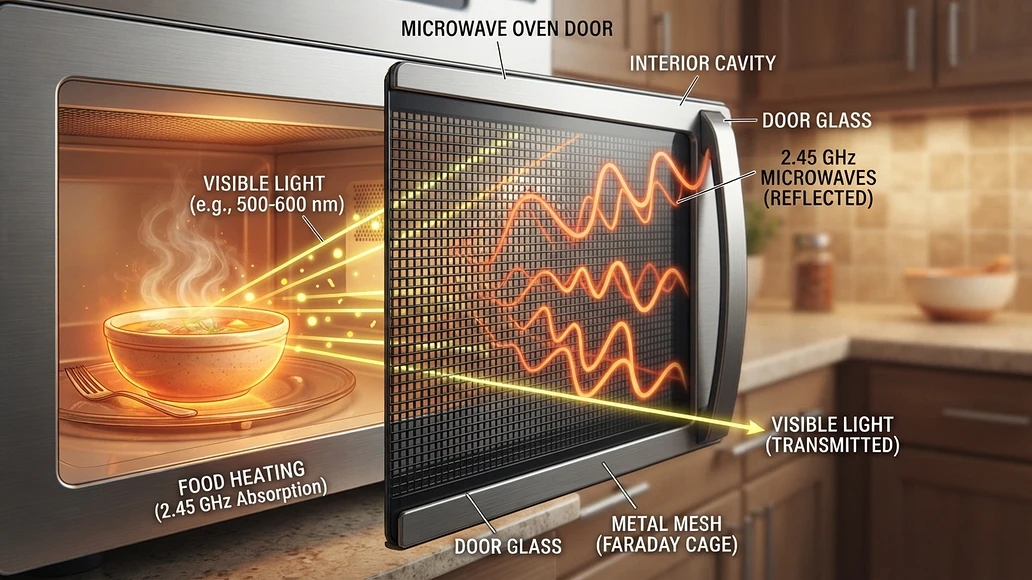
A microwave oven heats food by generating radio frequency energy at about 2.45 GHz. Inside the oven, a magnetron produces that energy, and the metal cooking cavity reflects it around the chamber so it can interact with water-rich food.
The oven body is metal, the door includes a conductive screen, and the door perimeter is engineered to limit leakage. Those features are not decorative. They are the reason the oven can operate safely in a kitchen without flooding the room with cooking-frequency microwave energy.
In that sense, yes, a microwave oven behaves like a Faraday enclosure for the frequency it was designed to contain.
Why the door has a metal mesh
The holes in the door screen are much smaller than the wavelength of 2.45 GHz microwaves, which is roughly 12.2 centimeters, or about 4.8 inches. Visible light has a far shorter wavelength, so light passes through the openings and lets you see inside, while the microwave energy is strongly attenuated.
This is the key nuance many articles skip. Shielding is frequency-specific. A mesh that works very well at one frequency may be much less impressive at another.
So, is a microwave oven technically a Faraday cage?
The most accurate answer is yes, in a limited and practical sense. A microwave oven is a conductive enclosure designed to confine microwave radiation in its normal operating band. That is why many people casually call it a Faraday cage.
But if you mean a broad-spectrum protective enclosure for sensitive electronics, the answer becomes no, not reliably. A kitchen microwave was not designed, validated, or sold as an EMP shelter, a secure RF isolation chamber, or a lab-grade shielded box.
| Option | Main purpose | Best at blocking | Weak points | Good choice for EMP preparedness? | Best everyday use |
|---|---|---|---|---|---|
| Microwave oven | Contain cooking-frequency microwave energy | Mainly around 2.45 GHz | Door seams, latch area, power cord, wear and damage | No, not as a primary solution | Short-term signal blocking tests, normal cooking |
| Purpose-built Faraday bag | Portable RF shielding for devices | Usually broad consumer RF ranges, varies by product | Poor closure, punctures, cheap materials | Better than a microwave, if quality is verified | Phones, key fobs, tablets, small radios |
| DIY metal can or box with insulated contents | Preparedness storage | Depends on construction quality | Lid contact, seams, interior contact with metal | Often reasonable if built carefully | Backup electronics storage |
| Professional shielded enclosure | Controlled RF isolation | Known tested ranges | Cost, complexity | Best technical option | Testing, critical equipment protection |
Why that does not make it dependable EMP or CME protection
EMP and CME discussions often get lumped together, but they are not the same thing. A high-altitude EMP involves a fast, intense electromagnetic pulse with broad frequency content. A coronal mass ejection mainly threatens long conductors and grid infrastructure through geomagnetic effects, not by acting like a kitchen microwave signal.
A microwave oven has several limitations for those scenarios:
- It is tuned for containing its own operating frequency, not a broadband pulse.
- The door seam is a necessary opening and a likely weak point.
- The power cord creates a path that a severe event could exploit.
- Consumer ovens are not tested or certified as EMP protective containers.
- Age, dents, corrosion, and worn latches can reduce shielding performance.
That is why preparedness experts who take shielding seriously usually recommend purpose-built Faraday bags or carefully constructed metal containers with insulated contents, not a spare microwave in the garage.
Can a microwave block phone, Wi-Fi, Bluetooth, or car key signals?
Sometimes yes, sometimes partly, and sometimes not at all. In informal home tests, many microwaves will block or greatly weaken cell, Wi-Fi, Bluetooth, and keyless entry signals when the device is placed inside and the door is shut. But results vary by oven design, signal strength, carrier frequency, and the condition of the door seal.
That means a microwave can be a makeshift RF blocker for short-term experiments or privacy checks, but it is not a standardized security tool.
Important safety limit. If you place a phone or key fob inside a microwave for a signal-blocking check, the oven must remain off. Never run the microwave with electronics inside unless the manufacturer specifically allows that use, which consumer microwave manuals generally do not. Running an empty or improperly loaded oven can damage the appliance, cause arcing, or create a fire risk.
| Use case | Will a microwave sometimes help? | Reliability | Main risk | Better option |
|---|---|---|---|---|
| Blocking a phone signal for a quick test | Often yes | Mixed | Forgetting and turning the oven on later | Faraday bag |
| Blocking Wi-Fi or Bluetooth briefly | Often yes | Mixed | Variable shielding, false confidence | Purpose-built RF pouch |
| Blocking a car key fob signal | Sometimes yes | Mixed | Inconsistent performance | Faraday key pouch |
| Protecting emergency radios from EMP | Not dependable | Poor | Loss of critical gear in a real event | Tested Faraday storage setup |
How safe microwave ovens are in normal daily use
For everyday cooking, properly functioning microwave ovens are considered safe when used as directed. Regulators limit allowable leakage, and real-world exposure from a working unit is typically well below those limits. Microwave radiation is non-ionizing, which means it does not have the energy to damage DNA the way ionizing radiation can.
Microwaves do not make food radioactive. They heat by exciting water molecules and other polar molecules, not by changing atomic nuclei.
Distance also matters. Electromagnetic exposure drops quickly as you move away from the source. You do not need to fear a working microwave, but it is still sensible not to lean against the door while it runs.
| Scenario | Typical concern level | What the evidence says | Practical guidance |
|---|---|---|---|
| Standing right against the door | Higher than necessary exposure position | Still expected to be below regulatory leakage limits if the oven is working properly | Avoid pressing against the oven while it runs |
| Standing about 2 feet away | Low | Exposure falls with distance | Normal kitchen use is reasonable |
| Standing 3 or more feet away | Very low | Distance further reduces already low exposure | A simple comfort choice for adults and children |
| Using a damaged microwave | Potentially unsafe | Door seal and latch damage can increase leakage and create other hazards | Stop using it and repair or replace it |
Common myths that confuse this topic
| Myth | Reality |
|---|---|
| If a microwave blocks signals, it will protect against any electromagnetic event | False. Blocking some everyday RF does not prove protection against broadband, high-energy events like EMP. |
| Any metal box is automatically a Faraday cage | False. Seams, openings, insulation, and frequency range all matter. |
| Microwaves make food radioactive | False. Microwave ovens use non-ionizing radiation and do not make food or containers radioactive. |
| Microwave ovens cause cancer in normal use | Current evidence does not support that claim when the appliance is functioning properly and used as directed. |
| If the oven still heats food, the shielding must be perfect | Not necessarily. Heating performance and shielding integrity are related but not identical. A damaged door area can be a problem even if the oven still cooks. |
Better preparedness options than using a microwave
If your goal is emergency protection for radios, backup drives, solar charge controllers, or spare vehicle electronics, use a solution designed for storage, not cooking.
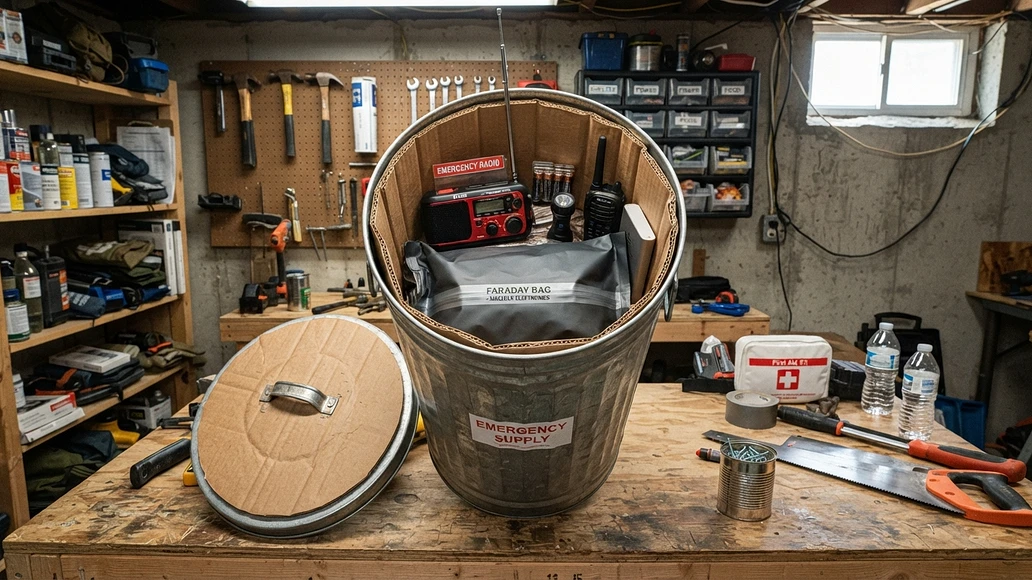
Good alternatives include metal trash cans with tight-fitting lids, ammo cans modified with proper insulation and conductive continuity, and quality Faraday bags from reputable makers. The key is that the device inside should not touch the conductive shell directly. Use cardboard, foam, or another dry insulating layer.
| Option | Cost range | Capacity | Setup difficulty | Main advantage | Main caution |
|---|---|---|---|---|---|
| Faraday bag | Low to moderate | Small to medium devices | Easy | Portable and convenient | Quality varies widely |
| Metal trash can with insulated liner | Moderate | Large | Moderate | Good for home storage of multiple items | Lid fit and interior insulation matter |
| Modified ammo can | Low to moderate | Small to medium | Moderate | Durable and compact | Painted seams and gasket details can affect conductivity |
| Microwave oven | Already owned | Medium | Easy to misuse | Convenient metal enclosure | Not designed or verified for EMP protection |
How to check whether your microwave is still shielding properly
Homeowners can do a basic condition check, but not a definitive leakage certification. Start with a visual inspection:
- Look for dents around the door frame.
- Check that the door closes squarely and latches firmly.
- Inspect the screen, hinges, and seal area for damage, grime, or corrosion.
- Stop using the oven if it sparks, smells hot, or has a loose or misaligned door.
Some people use a phone-call test or Wi-Fi test, but that only gives a rough clue about signal blocking. It does not measure microwave leakage at the cooking frequency, and it does not prove the oven is safe or unsafe.
If you suspect a problem, the right move is professional evaluation or replacement. Do not take the appliance apart yourself. Microwave ovens contain high-voltage components that can remain dangerous even when unplugged.
When using a microwave as a makeshift RF shield is reasonable
There are a few limited situations where using an unplugged microwave as a temporary signal blocker can make sense:
- A quick classroom or home demonstration of RF shielding principles.
- A short-term check to see whether a phone or key fob loses connectivity inside.
- A temporary privacy measure when no Faraday pouch is available.
Even then, treat it as a convenience, not a guarantee. Do not use it for long-term storage of mission-critical electronics, and do not rely on it as your only defense against grid or electromagnetic threats.
Microwave safety basics that matter more than the Faraday cage debate
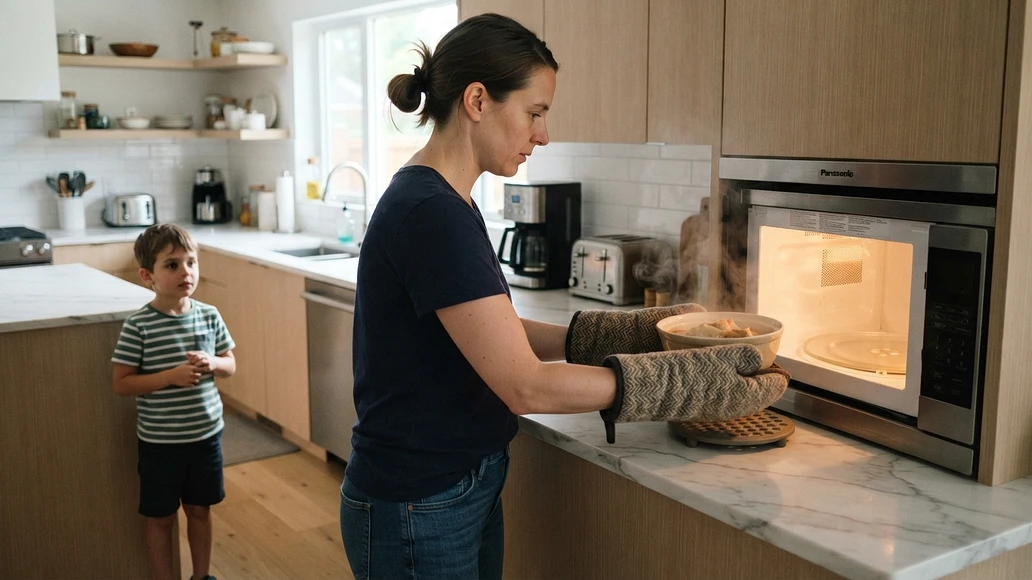
For most households, the bigger risks from microwave ovens are ordinary kitchen hazards, not radiation injury. Burns from superheated liquids, steam, and unevenly heated food are more common concerns.
Use microwave-safe containers, avoid damaged plastic, follow standing-time instructions, and stir foods that heat unevenly. Keep children from opening hot containers without help. If the oven door does not close properly, stop using it.
Preparing for grid threats without risky shortcuts
Balanced preparedness works better than fear-based improvisation. If you are concerned about EMP, solar storms, or communication outages, focus first on practical resilience:
- Keep backup lighting, batteries, and chargers.
- Store copies of key documents offline.
- Maintain a battery radio or emergency communications plan.
- Use purpose-built shielding products for truly important spare electronics.
- Test your storage method before trusting it.
A microwave oven can illustrate the concept of electromagnetic shielding, but it is not a substitute for a real preparedness plan.
FAQ
Can I store my emergency electronics in a microwave to protect them from EMP?
You can physically place them there, but it is not a dependable protection strategy. A microwave oven was not designed or validated for EMP storage. Use a purpose-built Faraday bag or a carefully constructed insulated metal container instead.
Is it safe to put my phone in a microwave if I do not turn it on?
For a brief signal-blocking test, an unplugged or unused microwave can act as a metal enclosure. The key safety rule is simple. Never run the microwave with the phone inside. Also remember the practical risk of forgetting the phone is in there and later starting the oven.
How can I tell if my microwave is leaking radiation?
You can inspect the door, hinges, latch, and mesh for visible damage, but homemade tests are limited. A phone still getting signal inside does not necessarily mean dangerous leakage, and a blocked signal does not prove the oven is perfect. If the door is damaged or misaligned, stop using the oven and have it checked or replaced.
Do microwaves make food or containers radioactive?
No. Microwave ovens use non-ionizing radiation. They heat food, but they do not make food, plates, or mugs radioactive.
Are there simple ways to build a better Faraday cage at home than using a microwave?
Yes. A metal trash can with a tight lid and a dry insulating liner is a common home option. Modified ammo cans and quality Faraday bags are also popular. The details matter, especially conductive continuity and keeping the electronics insulated from the metal shell.
References
- Are Microwave Ovens Dangerous? - Good Housekeeping
- Fours à micro-ondes et leurs dangers - CCHST
- Microwave Oven EMF: Safe Distance and Radiation Levels
- How does a Faraday cage work? - from 1836 to 2025
- Microwaves and Faraday Cages: Understanding the Science Behind Electromagnetic Shielding
- What's in Your Faraday Cage? Electronics to Protect!