Faraday Shielding and Modern Phones, What Really Stops 5G
5G is not one single signal, and not every metal box is a true shield. Learn when a Faraday cage blocks modern wireless signals, why seams and mesh size matter, and how to test bags, boxes, and DIY setups realistically.

If you want the short answer, a properly built Faraday cage can block 5G. The catch is that 5G is not one single frequency, and many homemade cages, cheap pouches, and ordinary metal containers are not built well enough to stop all modern wireless signals consistently.
In practice, the real question is not whether 5G can magically penetrate a true Faraday cage. It is whether your specific cage, bag, box, or room has enough shielding effectiveness to reduce the signal below the level needed for communication. That depends on the metal, the mesh opening size, the seams, the closure, and the frequencies involved.
This guide explains the physics in plain English, compares low-band, mid-band, and mmWave 5G, shows common failure points, and gives practical ways to test shielding for preparedness, privacy, and device isolation. It also keeps health claims in bounds. Faraday products are mainly tools for signal control and security, not proven medical devices.
Bottom line first
An ideal Faraday cage blocks 5G. A real-world cage may only attenuate it. Good shielding often stops calls, texts, Wi-Fi, Bluetooth, GPS, and cellular data. Poor shielding may still let a phone connect intermittently, especially if the device is near a strong tower, router, or small cell.
| Claim or topic | Evidence status | What it means in plain language |
|---|---|---|
| A properly designed Faraday cage can block 5G signals | Well supported | Enclosures with strong attenuation can reduce sub-6 GHz and mmWave signals enough to stop practical communication. |
| Mesh size must be small relative to wavelength | Well supported | Openings that are too large act like leaks, especially as frequency rises. |
| Higher 5G frequencies are easier to weaken but more sensitive to tiny gaps | Well supported | mmWave does not travel through materials well, but tiny seams can still become weak points. |
| A simple phone-call test proves a cage is fully effective | Weak | A phone test can show obvious failure, but it cannot certify broad-band shielding performance. |
| Faraday cages are proven health necessities for everyday 5G exposure | Weak or unsupported | Use shielding for privacy, security, and signal isolation. For health concerns, rely on mainstream medical guidance. |
What a Faraday cage actually does
A Faraday cage is a conductive enclosure that reduces electric fields and radio-frequency energy inside the enclosure. It works mainly through reflection and absorption of electromagnetic energy at the conductive surface. For wireless signals, the practical goal is attenuation, usually measured in decibels, or dB.
More dB means more signal reduction. A small amount of attenuation may weaken reception. A large amount can make a phone appear fully offline.
That is why a random metal box is not automatically a good Faraday cage. If the lid does not make continuous conductive contact, if the seams are loose, or if there are cable openings, the box may leak badly.
Blocking versus attenuating
This distinction matters. Most consumer products do not create a perfect zero-signal environment. They reduce signals enough that the device cannot maintain a usable link. For preparedness and privacy, that is often sufficient. For forensic work, lab testing, or security-critical isolation, you need measured shielding effectiveness across the frequencies you care about.
Why 5G is harder to talk about than older cellular signals
People often say “5G” as if it were one thing. It is not. In the United States, 5G can ride on low-band frequencies, mid-band frequencies, and much higher mmWave frequencies. Each behaves differently around walls, metal, mesh, and gaps.
| 5G band type | Typical frequency range | Approximate wavelength | Real-world behavior | Shielding concern |
|---|---|---|---|---|
| Low-band 5G | About 600 MHz to 1 GHz | Roughly 50 cm to 30 cm | Travels farther, penetrates buildings better | Needs continuous conductive coverage, larger wavelengths mean broad leaks still matter |
| Mid-band 5G | About 2.5 GHz to 4 GHz | Roughly 12 cm to 7.5 cm | Common balance of speed and coverage | Mesh and seam quality become more important |
| mmWave 5G | About 24 GHz to 40 GHz | Roughly 12.5 mm to 7.5 mm | Fast but short range, blocked easily by walls and bodies | Tiny gaps, poor closures, and sloppy seams can become major leak points |
As wavelength gets shorter, smaller openings matter more. That is why a bag that blocks ordinary cellular service may still perform poorly at Wi-Fi or higher-frequency 5G if the closure is weak or the fabric is inconsistent.
Can 5G get through a Faraday cage?
In theory, a well-designed Faraday cage prevents 5G communication. In the real world, 5G gets through when the cage is not truly continuous, when openings are too large, when the closure leaks, or when the shielding material does not perform well at the frequencies being used.
So the honest answer is this: 5G does not penetrate a proper Faraday cage in any useful sense, but it can leak through an imperfect one.
What counts as “proper” shielding
For modern phones, proper shielding usually means a conductive enclosure with continuous contact around all sides, minimal openings, no unfiltered cable penetrations, and enough attenuation across cellular, Wi-Fi, Bluetooth, and GPS bands. Better products publish test ranges and attenuation curves rather than vague claims like “blocks RFID.”
What causes a Faraday cage to leak
Most failures come from construction details, not from the metal itself.
| Failure point | Typical symptom | Likely cause | Practical fix |
|---|---|---|---|
| Lid or door gap | Phone still receives calls or texts | Incomplete conductive contact around the opening | Use overlapping conductive surfaces, conductive gasket material, or a better-fitting enclosure |
| Large mesh openings | Spotty blocking, worse at higher frequencies | Openings too large for the wavelengths involved | Use finer mesh or a solid conductive layer |
| Weak bag closure | Works sometimes, fails near strong signals | Single fold, worn fabric, poor seam design | Choose a double-roll or tested closure and re-test regularly |
| Device touching metal walls | Inconsistent results | Coupling effects or accidental contact with seams | Place the device inside a nonconductive inner sleeve or padding |
| Cables entering the enclosure | Unexpected connectivity or interference | Wires act as antennas | Avoid penetrations or use proper filtered feedthroughs |
| Corrosion, wear, or coating | Performance degrades over time | Conductive path is interrupted | Inspect, clean, and replace worn materials |
Mesh size and material choice for 5G shielding
A common rule of thumb is that openings should be much smaller than the wavelength you want to block. Many guides cite keeping hole size below about half the wavelength as a basic threshold, but in practice, smaller is better because seams and manufacturing tolerances add their own losses.
For low-band 5G, a relatively coarse conductive enclosure may still work if the seams are excellent. For mid-band and especially mmWave, fine mesh, solid metal, or specialized conductive fabrics usually perform better.
Material matters, but design matters more
Copper, aluminum, steel, and conductive textiles can all work. The biggest difference in consumer use is often not the metal type but the quality of the enclosure design. A thin but continuous conductive layer with a strong closure can outperform a thicker metal container with a sloppy lid.
| Shielding method | Typical performance range | Portability | Main strengths | Main limitations | Best use case |
|---|---|---|---|---|---|
| Solid metal box | Can be very strong if seams are tight | Low | Durable, simple, good for storage | Lid contact is often the weak point | Home device isolation |
| Fine metal mesh cage | Good if openings are small and seams are bonded | Low to medium | Ventilation, visibility | Gap control becomes critical at higher frequencies | DIY projects and room shielding |
| Faraday bag or pouch | Ranges from poor to excellent depending on fabric and closure | High | Portable, convenient, useful for phones and key fobs | Wear and seam failure are common issues | Travel, privacy, emergency kits |
| Shielding paint | Can provide strong attenuation when properly installed | None | Useful for rooms and permanent projects | Installation quality and electrical safety matter | Home shielding projects |
| Conductive canopy or fabric enclosure | Moderate to strong depending on fabric and grounding approach | Medium | Large-area coverage | Not ideal for precise device isolation, health claims should be cautious | Specialized room or bed-area shielding |
Do Faraday bags really block 5G?
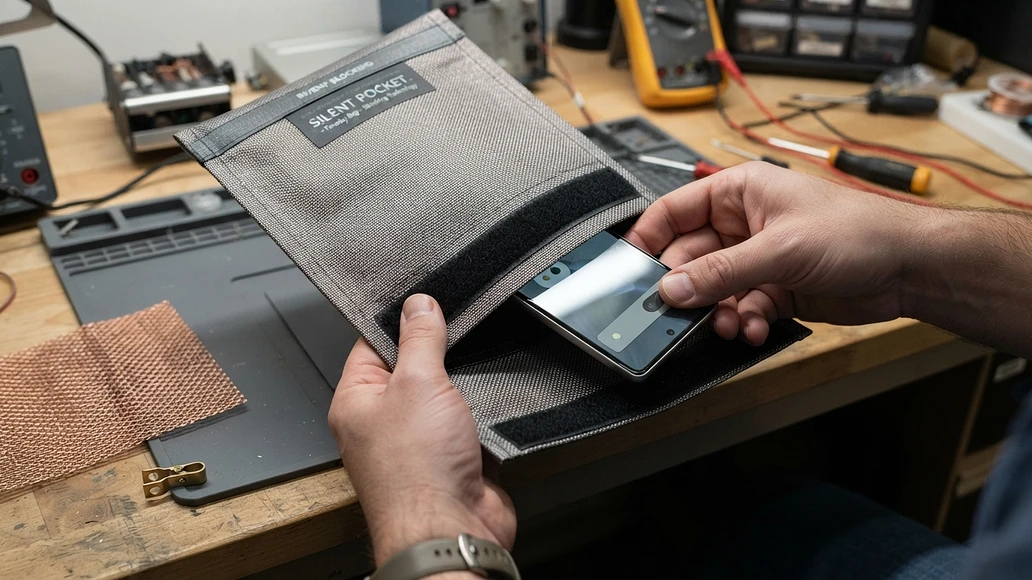
Many do, some do not, and the difference is usually in the test data and closure design. A good Faraday bag for modern devices should specify the frequency range tested, not just say “RFID blocking.” RFID protection alone says very little about cellular, Wi-Fi, Bluetooth, GPS, or 5G performance.
Look for products that mention attenuation in dB across a broad range, ideally extending through sub-6 GHz and, if relevant to your use case, into the 24 to 40 GHz range. Independent testing is better than marketing language.
For key fobs, a smaller pouch may be enough. For smartphones, tablets, and radios, closure quality matters much more because there is more surface area and more opportunity for leaks.
What a good pouch usually has
- A conductive inner layer designed for RF shielding, not just anti-static storage.
- A closure that creates overlapping conductive contact, often a fold-over or double-roll design.
- Published attenuation data across the bands you care about.
- Enough interior space that the device does not press hard against the seams.
- Durable stitching and materials that can survive repeated use.
Everyday examples that act like partial Faraday cages
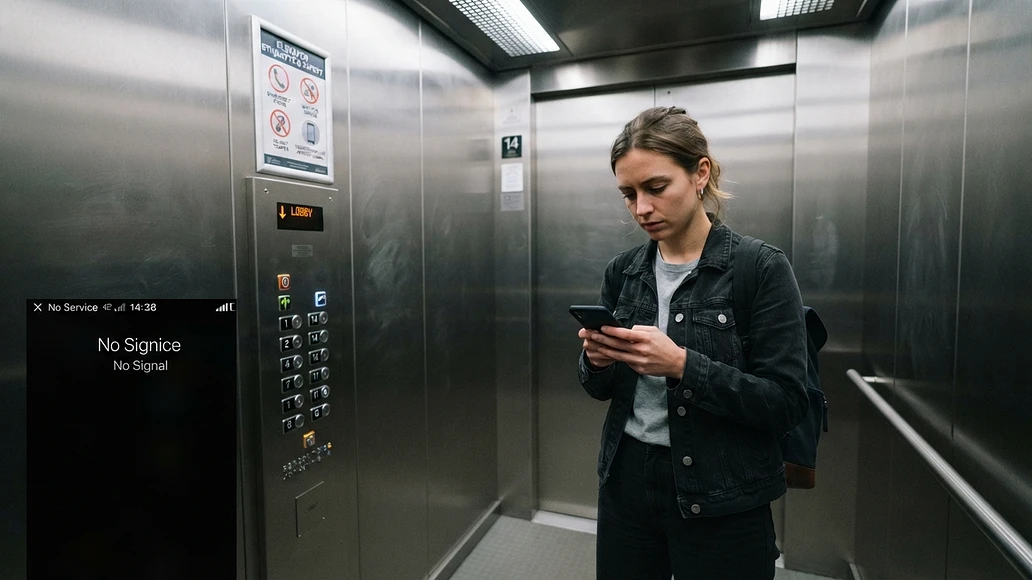
Elevators, metal utility rooms, shipping containers, and some steel-framed buildings often weaken phone signals dramatically. That does not mean they are perfect Faraday cages, but they show the same principle. Metal structures reflect and absorb RF energy, and openings determine how much gets through.
This is also why indoor 5G coverage can be uneven. Higher-frequency signals, especially mmWave, struggle with walls, coated glass, and metal framing. Network designers work around that with indoor systems, repeaters, and dense small-cell placement.
How to test whether your cage blocks modern signals
A home test can reveal obvious failures, but it cannot replace lab measurements. Still, it is useful if you test more than one radio and avoid false confidence.
| Test method | What it checks | Difficulty | Main limitation | Best use |
|---|---|---|---|---|
| Phone call or text test | Basic cellular connectivity | Easy | May miss intermittent leaks or delayed delivery | Quick pass or fail screening |
| Wi-Fi test at 2.4 and 5 GHz | Common local wireless bands | Easy | Depends on router strength and distance | Checking higher-frequency leakage |
| Bluetooth test | Short-range radio leakage | Easy | Very short range can hide weak leaks | Testing pouches and small boxes |
| Find My or locator feature | Whether the device can still report location or presence | Medium | Uses multiple radios and delayed network behavior | Privacy-focused testing |
| GPS map test | Satellite signal reception | Medium | GPS behavior can lag and may need time to update | Checking broad signal isolation |
| RF meter or spectrum analyzer | Measured attenuation across frequencies | Advanced | Requires equipment and know-how | Serious verification |
A practical home test routine
- Turn off Wi-Fi calling so your phone does not route around the test.
- Place the phone in the cage or bag and seal it exactly as intended.
- Call it and send a text. Wait long enough to rule out delayed ringing.
- Test Wi-Fi at both 2.4 GHz and 5 GHz with the router nearby.
- Test Bluetooth with a paired accessory.
- Check whether location or device-finder features still update.
- Repeat the test in a stronger signal area, because weak-signal areas can create false confidence.
If the device still connects sometimes, treat the shield as partial, not reliable.
When you need more than a home test
If you need confidence for evidence handling, sensitive security work, or repeatable technical results, consumer testing is not enough. Professional verification uses shielding effectiveness measurements in dB across defined frequencies. Standards such as ASTM D4935 and IEEE 299 are often referenced for this kind of work.
Professional RF shield boxes used for mobile testing may be rated across wide ranges, including modern 5G bands. That is the level to look toward if failure is not acceptable.
Common DIY mistakes
DIY shielding can work, but several mistakes show up again and again.
- Assuming any metal container is good enough.
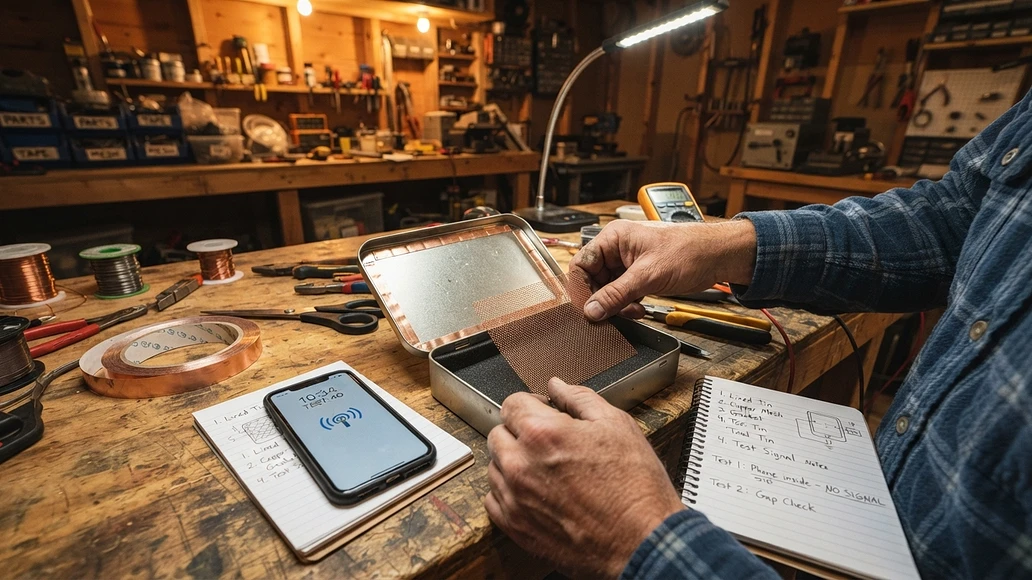
- Using foil or mesh without continuous electrical contact at overlaps.
- Ignoring the lid, zipper, hinge, or door seam.
- Letting the device touch the conductive shell directly.
- Running charging cables or antenna-like wires into the enclosure.
- Skipping re-testing after wear, dents, rust, or modifications.
- Assuming grounding is required for RF blocking in every case.
Grounding can matter in some installations for safety or specific shielding goals, but a small Faraday bag or enclosed box does not need grounding just to block ordinary phone signals.
Preparedness and privacy uses that make practical sense
Faraday products are most useful when you want to control whether a device can send or receive signals.
| Use case | Why shielding helps | What to watch out for |
|---|---|---|
| Car key fob storage | Can reduce relay-attack risk by blocking wireless communication | Retest pouches regularly because wear is common |
| Phone isolation during travel | Prevents routine network contact when the phone is stored | You will also lose emergency reachability while it is sealed |
| Emergency privacy planning | Can limit tracking, remote commands, or network registration | Only works while the device remains fully enclosed |
| Spare electronics storage | Useful for organizing isolated devices and accessories | Do not assume it provides surge or EMP protection unless specifically designed and tested for that purpose |
| Home signal control experiments | Helps verify how shielding affects wireless devices | Permanent projects may involve electrical and code issues |
What Faraday shielding can and cannot promise for health
This is where caution matters. Some readers look into Faraday cages because of worries about EMF or 5G exposure. Shielding can reduce radio-frequency exposure inside the shielded space, but that does not make a consumer cage or canopy a proven medical solution.
No mainstream public-health body recommends DIY Faraday cages as necessary routine health protection for pregnancy, chronic illness, or general wellness. If you have headaches, sleep problems, anxiety, or other symptoms you think may be related to EMF, it is wise to talk with a licensed healthcare professional instead of relying on shielding alone.
If shielding gives you peace of mind, use it as a supplementary comfort measure, not as a substitute for medical care, prenatal care, or treatment plans.
Maintenance and re-testing
Shielding performance can degrade over time. Conductive fabrics wear out. Closures loosen. Metal corrodes. Adhesive conductive tapes lift at the edges. New phones may also use different bands than your old test device.
Re-test after heavy use, after travel, after any repair, and whenever you switch to a new device or network environment. As 5G deployments evolve, updated product test data matters more than old marketing claims.
FAQ
Does a microwave oven work as a Faraday cage for 5G phones?
Sometimes it may block a phone signal, but it is not a reliable substitute for a tested Faraday enclosure. Microwave ovens are designed around a specific cooking frequency and safety standard, not broad-band device isolation. Do not modify or misuse one, and never run it with a phone inside.
Do Faraday cages need to be grounded to block 5G signals?
No, not in the simple sense most people mean. A closed conductive enclosure can block RF without grounding. Grounding may be relevant for electrical safety, static control, lightning protection, or specialized installations, but it is not automatically required for a phone pouch or small box.
Can 5G still track my phone if it is in a Faraday bag?
If the bag is effective and fully sealed, the phone should not be able to communicate with the cellular network while inside. The risk is not “5G penetrating” the shield so much as the bag leaking because of poor construction, wear, or an incomplete closure.
How much attenuation is enough to stop 5G communication?
There is no single magic number because signal strength varies by location, device, and band. In general, higher attenuation is better, and products with published broad-band test data are preferable. For critical uses, look for independently tested shielding rather than relying on pass or fail phone tests.
Final takeaway
A true Faraday cage can stop 5G, but many consumer and DIY setups fall short because of gaps, weak closures, oversized mesh, or lack of testing. If your goal is preparedness, privacy, or key-fob protection, focus on measured attenuation, seam quality, and realistic testing across multiple radios. If your goal is health protection, keep expectations modest and use mainstream medical advice as your primary guide.
References
- Metal Enclosure Improvement
- Cage de Faraday : guide complet pour comprendre, fabriquer ...
- RF Attenuation Charts Explained: What Faraday Bag Ratings ...
- How To Choose The Best Faraday Bag: A Complete Buying Guide
- Faraday Pouches: How Signal-Blocking Bags Work and When...
- Faraday Cage Buying Guide: How to Choose Effective RF ...
- What Is a Faraday Bag? · The Definitive 2026 Guide | REVIS-1 Learn
- What is a Faraday Cage? Complete Guide - Shield Your Body
- Do Faraday Pouches Really Work? A UK Expert's Guide
- 5G Signals Disappear in Elevators Due to Physics