Faraday Cages and Modern Wireless, What Actually Stops 5G
5G is not one signal, and not every metal box is a real shield. Learn when a Faraday cage blocks modern cellular bands, why seams and mesh size matter, and how to test bags, boxes, and DIY setups without false confidence.

A short answer first. A properly built Faraday cage can block 5G well enough to stop normal communication. A poorly built one can leak badly, even if it looks like a solid metal container. The difference usually comes down to frequency, gap size, seams, closures, and how well the enclosure maintains continuous conductivity all the way around the device.
That matters because 5G is not one single signal. It includes low-band cellular frequencies, mid-band frequencies used by many carriers, and in some areas very high frequency millimeter wave, often called mmWave. A cage or pouch that blocks one band may perform differently on another, especially if it has weak seams, oversized mesh, or a closure that does not make full contact.
For preparedness, privacy, and device security, the practical goal is not mystical “perfect blocking.” It is enough attenuation to prevent the device from sending or receiving useful signals. In many cases, that means stopping calls, texts, Wi-Fi, Bluetooth, GPS assistance, and location updates. For security-critical use, you should look for published test data, not just marketing claims.
What a Faraday cage really does
A Faraday cage is a conductive enclosure that reduces electric fields and radio-frequency energy inside the enclosure. In simple terms, incoming radio waves are reflected, absorbed, and redirected by the conductive shell. If the shell is continuous enough, the signal inside drops dramatically.
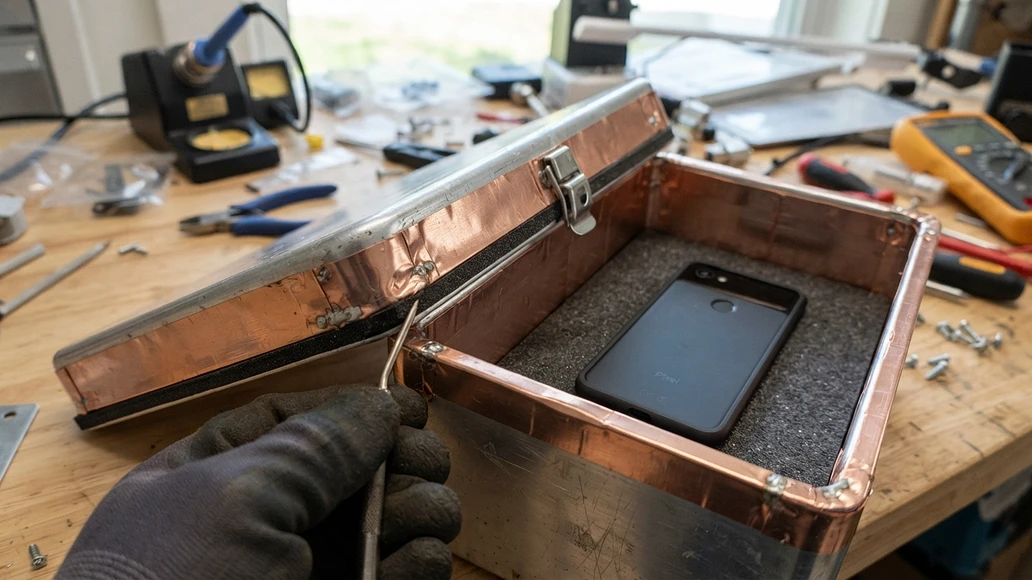
That does not mean every metal object is automatically a good Faraday cage. A cookie tin with a loose lid may attenuate signals. A purpose-built RF shield box with conductive gaskets can suppress them much more effectively. Conductive fabric pouches can work too, but only if the fabric, stitching, and closure are designed for the frequencies you care about.
The key idea is shielding effectiveness, usually measured in decibels, or dB. Higher dB attenuation means less signal gets through. In practical terms, enough attenuation can make a phone appear offline, stop a key fob relay attack, or isolate a device from nearby networks.
Why 5G is harder to discuss than older cellular signals
People often ask whether “5G” penetrates a Faraday cage as if 5G were one frequency. It is not. Different 5G bands behave differently in buildings, bags, and enclosures.
| 5G band type | Typical frequency range | Approximate wavelength | Real-world behavior | Shielding takeaway |
|---|---|---|---|---|
| Low-band 5G | Roughly 600 MHz to 1 GHz | About 50 cm to 30 cm | Travels farther, penetrates buildings better than higher bands | Needs a continuous enclosure, larger wavelengths make broad leaks more relevant |
| Mid-band 5G | Roughly 2.5 GHz to 4 GHz | About 12 cm to 7.5 cm | Common balance of speed and coverage | Seams, zipper quality, and mesh size become more important |
| mmWave 5G | Roughly 24 GHz to 40 GHz | About 12.5 mm to 7.5 mm | Very fast, poor penetration through walls and obstacles | Usually easier to block with solid conductive material, but tiny gaps can leak badly |
This is why a bag that blocks ordinary phone calls may still be weaker than expected at Wi-Fi 5 GHz, Wi-Fi 6E, or higher frequency applications. Shorter wavelengths make small openings and imperfect closures matter more.
So, can 5G get through a Faraday cage?
In theory, a well-designed Faraday cage should block 5G. In real life, 5G gets through only when the cage is not truly acting like a complete shield. That usually means one of the following is happening.
| Condition | What happens to 5G | Why |
|---|---|---|
| Continuous metal enclosure with tight conductive seams | Usually blocked well enough to stop communication | High attenuation across relevant bands |
| Mesh enclosure with holes small enough for the target frequencies | Often blocked effectively | Openings remain too small to pass useful RF energy |
| Loose lid, poor zipper, bad seam contact | Signal may leak in or out | Gaps act like slots or unintended antennas |
| Unshielded cable entering the enclosure | Signal path may bypass the cage | Cables can carry RF energy through the barrier |
| Thin consumer pouch with no published test data | May block some bands but not all | Unknown attenuation, weak closure design, or frequency limits |
So the honest answer is yes, 5G can appear to penetrate a Faraday cage, but that usually means the cage is leaking or only attenuating the signal instead of fully suppressing it for the conditions you are testing.
Mesh size, seams, and materials matter more than most people think
A common rule of thumb is that openings should be much smaller than the wavelength of the signal you want to block. You will often see a simplified guideline that hole size should be less than half the wavelength, but in practice smaller is better, especially when you want a margin of safety and when seams or closures are imperfect.
For example, a mesh that seems fine for lower cellular bands may become less forgiving at higher frequencies. With mmWave, even tiny gaps can matter. That is one reason professional RF shield boxes use carefully engineered seams, conductive gaskets, and tested closures instead of ordinary hinges and latches.
Material choice also matters, but less than people assume. Copper, aluminum, steel, and conductive fabrics can all work if the enclosure is continuous and well assembled. A great material with bad seams performs poorly. A decent material with excellent seam contact often performs much better.
How much attenuation is enough?
For everyday preparedness, you usually do not need to eliminate every trace of RF energy. You need enough attenuation to stop useful communication. That threshold depends on how strong the outside signal is, how sensitive the device is, and which radios are active.
| Approximate attenuation | What it often means in practice | Best fit use |
|---|---|---|
| 20 to 40 dB | Noticeable reduction, may stop weak signals but not strong nearby sources | Basic reduction, limited privacy, some canopy or paint applications |
| 40 to 60 dB | Often enough to disrupt normal consumer connectivity | Better DIY cages, some quality bags and pouches |
| 60 to 85 dB or more | Strong suppression across many common wireless uses | Good Faraday bags, shield boxes, serious privacy and test setups |
| Above 85 dB | Professional-grade territory, depending on frequency and test method | Lab, forensic, or telecom testing environments |
Those numbers are not guarantees. A phone near a strong tower or router may still behave differently than one in a weak signal area. That is why published attenuation curves across frequency are more useful than a simple “blocks 5G” label.
Faraday bags and pouches, do they really block 5G?
Many do, at least across common cellular bands. Some do not, or they work only partially. The biggest difference is whether the product was designed and tested as a true RF shield or merely marketed as RFID blocking.
RFID blocking is not the same as broad-spectrum shielding. A pouch that protects a credit card at very short range may not isolate a smartphone from cellular, Wi-Fi, Bluetooth, and GPS-related signals. For modern devices, look for products that publish a frequency range and attenuation data, ideally extending through sub-6 GHz and, if relevant to your use, into higher bands.
| Feature | What to look for | Why it matters for 5G |
|---|---|---|
| Published frequency coverage | Coverage that includes cellular, Wi-Fi, Bluetooth, GPS, and ideally up to tens of GHz | Shows the maker considered more than RFID |
| Attenuation data | dB results across multiple frequencies | Lets you compare real shielding performance |
| Closure design | Fold-over conductive seal or tested double-roll closure | Closures are common leak points |
| Layer construction | Multiple conductive layers with durable outer fabric | Improves consistency and wear resistance |
| Independent testing | Lab or standards-based test information | Reduces reliance on marketing claims |
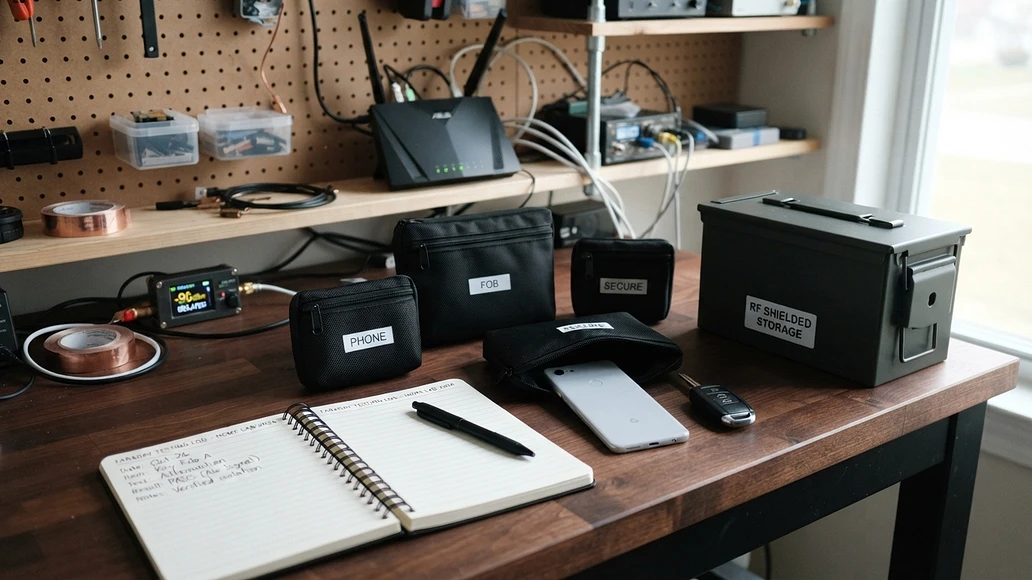
If your goal is key fob protection, a smaller pouch may be enough. If your goal is isolating a smartphone from tracking, remote wipe, or network contact, use a pouch specifically tested for phones and re-test it regularly.
Why elevators and metal buildings create dead zones
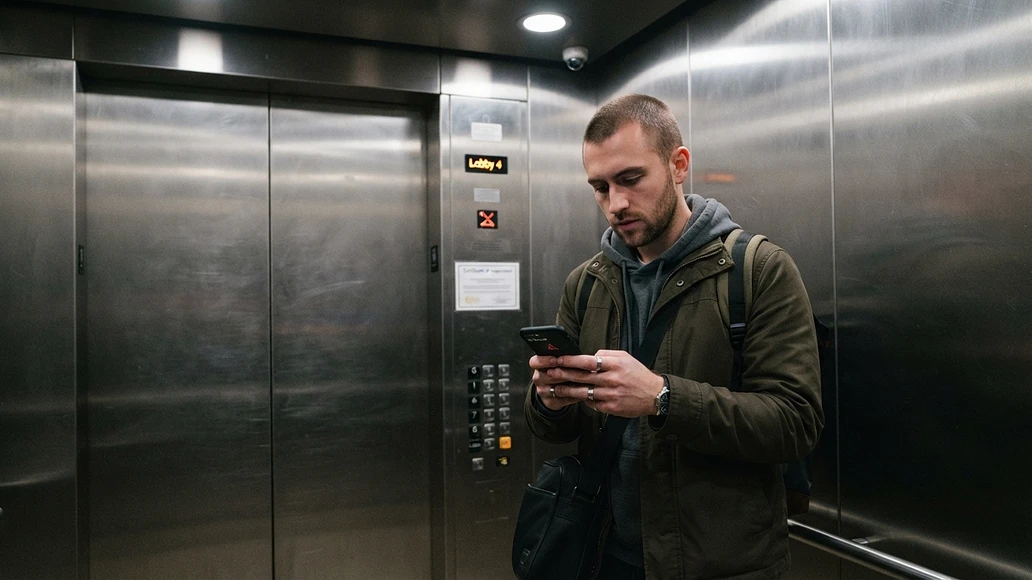
Everyday life offers good examples of partial Faraday shielding. Elevators often weaken phone signals because the metal enclosure reflects and attenuates radio waves. Steel-framed buildings, metal roofs, and foil-backed insulation can also reduce coverage. This is especially noticeable with higher-frequency 5G, which already struggles more with walls and obstacles.
That does not mean every elevator is a perfect Faraday cage. Doors, windows, and cable paths create leaks. But it does show the basic principle. Conductive enclosures and structures can dramatically reduce wireless performance, especially as frequencies rise.
How to test whether your cage or bag actually works
A single phone call test is better than nothing, but it is not enough for strong confidence. A device can fail to ring and still leak enough signal for intermittent data, location updates, or other radios. Test more than one function.
Basic home test sequence
Place the phone in the cage or bag and fully close it as intended.
Try a phone call and text message from another device. Wait long enough for network retries.
Test Wi-Fi with both 2.4 GHz and 5 GHz if available. Stay near the router to make the test harder.
Test Bluetooth with a nearby paired device.
Check whether location or device-finder features update after enclosure.
Repeat the test in a strong signal area, because weak-signal testing can create false confidence.
| Test method | What it checks | Strengths | Limitations |
|---|---|---|---|
| Phone call or text | Cellular connectivity | Easy and familiar | Pass or fail only, not frequency-specific |
| Wi-Fi test | 2.4 GHz and 5 GHz radios | Good for finding weak closures | Depends on router power and distance |
| Bluetooth test | Short-range radio leakage | Useful for nearby leak detection | Short range can hide marginal failures |
| Device locator check | Practical isolation from network updates | Relevant to privacy use | May update with delay, not instant proof |
| RF meter or lab test | Measured attenuation across bands | Best confidence level | More expensive and technical |
If a bag passes one day and fails another, suspect wear, contamination on the closure, or a small change in how the device sits inside. Reproducibility matters.
Common DIY mistakes that let signals leak through
| Failure point | Typical symptom | Likely cause | Practical fix |
|---|---|---|---|
| Loose lid | Phone still receives calls intermittently | No continuous conductive contact around the edge | Add conductive gasket or conductive tape overlap, improve clamping pressure |
| Oversized mesh holes | Higher-frequency signals still get through | Openings too large for target frequencies | Use finer mesh or a solid conductive layer |
| Ordinary zipper or weak flap | Bag blocks some signals but not all | Closure is the leak path | Use a tested roll-top or double-seal design |
| Device touching conductive wall | Inconsistent results | Coupling effects or accidental contact with seams | Place device on insulating foam or cardboard inside |
| Cable entering enclosure | Unexpected connectivity or interference | Cable acts like an antenna path | Remove cable or use proper filtered feedthroughs |
| Corrosion, paint, or dirt on contact surfaces | Performance degrades over time | Electrical contact is reduced | Clean contacts, remove insulating coatings where needed, re-test |
One more myth to clear up. Grounding is not always required to block RF in a small cage or bag. Grounding can matter in some applications for safety, static control, or specialized shielding goals, but a small enclosure can still block radio signals without being grounded if it is built correctly. Do not improvise grounding to household electrical systems unless you understand the risks and local code requirements.
Comparing the main shielding options
| Shielding method | Typical performance range | Portability | Main strengths | Main drawbacks | Best use case |
|---|---|---|---|---|---|
| Metal box with improved seams | Moderate to high, depends heavily on lid contact | Low | Affordable, durable, good for storage | Easy to get wrong at seams and hinges | Home device storage, backup electronics |
| Fine mesh cage | Moderate to high if mesh and seams are well designed | Low to medium | Can be built at larger sizes | Mesh size and joints are critical | Room or equipment shielding projects |
| Faraday bag or pouch | Moderate to high, quality varies widely | High | Portable, convenient, good for phones and key fobs | Wear and closure failure over time | Travel, privacy, emergency kits |
| Shielding paint | Moderate to high when properly applied | None | Useful for room-scale reduction | Installation complexity, electrical safety concerns | Permanent home projects with professional help |
| Conductive canopy or fabric enclosure | Low to moderate, sometimes higher with premium materials | Medium | Flexible, non-permanent | Not ideal for security-critical isolation | Temporary room shielding, experimental setups |
Preparedness and privacy uses that make practical sense
Faraday protection has legitimate non-medical uses. It can help prevent key fob relay theft, isolate spare electronics, and reduce the chance that a phone communicates when you need it offline. It can also be useful in training, troubleshooting, and controlled device storage.
Still, it is not a complete security plan. A phone in a bag cannot help you communicate. A key fob in a pouch is only protected when it is actually inside. A shielded backup device still needs power, updates, and a broader emergency plan.
Health claims, anxiety, and sensible limits
Some people look into Faraday cages because they are worried about EMF or 5G exposure. It is reasonable to want accurate information and practical control over your environment. But shielding products should be framed mainly as tools for signal control, privacy, and interference reduction, not as guaranteed medical protection.
No DIY cage should replace medical care, prenatal care, or treatment for chronic symptoms. If you are dealing with headaches, sleep issues, anxiety, or other health concerns that you believe are related to EMF exposure, speak with a licensed healthcare professional and use mainstream public health guidance as your baseline.
Also keep electrical safety in mind. Permanent shielding projects, especially conductive paints, grounded rooms, or modifications near household wiring, can create shock or fire hazards if done incorrectly. For permanent installations, consult a qualified electrician or RF professional.
Maintenance and re-testing
Shielding performance is not permanent. Bags crease. Conductive layers wear. Closures collect dirt. Metal contacts corrode. New devices may use different bands than the ones you originally tested.
A good routine is to re-test after heavy use, after any repair or modification, and periodically if the item protects something important. If you are buying new gear, favor products with updated test data and frequency coverage that matches current devices.
Bottom line
5G does not magically defeat a real Faraday cage. If signals are getting through, the usual explanation is not that 5G is unstoppable. It is that the enclosure is leaking, the closure is weak, the mesh is too coarse, the test is incomplete, or the product was never designed for broad RF shielding in the first place.
If you want dependable results, think in terms of bands, seams, and attenuation, not just “metal equals shield.” For casual preparedness, a well-made Faraday pouch or carefully improved metal container may be enough. For serious privacy, forensic, or technical work, look for published dB test data and professional-grade construction.
Frequently asked questions
Does a microwave oven work as a Faraday cage for a 5G phone?
Sometimes it attenuates signals strongly, but it is not a reliable or recommended substitute for a purpose-built shield. Door seals vary, leakage standards are designed around appliance safety, and using an unplugged microwave as a storage cage can still give inconsistent results. Do not run tests that involve operating the microwave with electronics inside.
Does a Faraday cage need to be grounded to block 5G?
No, not necessarily for a small enclosure or bag. Good RF shielding depends mainly on conductive continuity and minimizing gaps. Grounding may matter in specialized setups, for static control, or for safety in permanent installations, but it is not the magic ingredient that makes a pouch block cellular signals.
Can 5G still track my phone if it is inside a Faraday bag?
If the bag is working properly, the phone should not be able to maintain useful wireless communication with the network. In practice, that means no normal cellular, Wi-Fi, or Bluetooth contact. But you should verify this with testing, because a worn or poorly designed bag may leak enough signal for intermittent updates.
What attenuation level is a good target if I want to stop 5G communication?
For many consumer situations, 60 dB or more across the relevant bands is a strong target. In weaker signal environments, less may still work. In stronger signal environments or security-critical applications, you may want higher measured attenuation and more rigorous testing across all radios you care about.
References
- Metal Enclosure Improvement
- Cage de Faraday : guide complet pour comprendre, fabriquer ...
- How To Choose The Best Faraday Bag: A Complete Buying Guide
- RF Attenuation Charts Explained: What Faraday Bag Ratings ...
- Faraday Pouches: How Signal-Blocking Bags Work and When...
- Faraday Cage Buying Guide: How to Choose Effective RF ...
- What Is a Faraday Bag? · The Definitive 2026 Guide | REVIS-1 Learn
- What is a Faraday Cage? Complete Guide - Shield Your Body
- Do Faraday Pouches Really Work? A UK Expert's Guide
- 5G Signals Disappear in Elevators Due to Physics