Drone Distance Explained for Homeowners, Pilots, and Preparedness
Learn how far different drones can really travel, what limits them in practice, what US rules matter, and how range affects privacy, safety, and useful preparedness tasks.

Drone range sounds simple until you ask a basic follow-up question: range according to whom? A manufacturer may advertise a long transmission distance, but that does not mean a pilot can safely, legally, or realistically fly that far in everyday conditions. For homeowners, range matters because it shapes privacy concerns and neighborhood safety. For drone owners, it matters because pushing distance too far raises the risk of signal loss, low-battery incidents, crashes, and legal trouble.
This article gives a practical US-focused view of how far drones really fly, what limits them, and why that matters. It is general information only, not legal advice. If you are dealing with harassment, stalking, property damage, or a repeated drone problem near your home, contact local law enforcement and consult a qualified attorney for situation-specific guidance.
What “range” means in the real world
People often use the word range as if it means one thing, but drone distance has several different meanings.
| Range term | What it means | Why it matters |
|---|---|---|
| Control link range | The maximum distance the radio connection between pilot and drone can reach under ideal conditions | This is often the big number shown on spec sheets |
| Battery-limited distance | How far the drone can actually travel before it must return safely | This is usually the practical limit for most flights |
| Mission radius | How far from the pilot the drone can go and still come back with a safety margin | This is the number responsible pilots should plan around |
| Legal operating range | How far the drone may be flown under applicable rules | In the US, this is often limited by visual line of sight requirements |
That distinction matters because a drone might be technically capable of transmitting video for many miles, while the pilot can only legally and safely operate it much closer.
Why spec sheet numbers can be misleading
Advertised range figures are usually measured in ideal conditions, with minimal interference, favorable weather, a fully charged battery, and a clean radio environment. Real neighborhoods are not ideal test ranges. Trees, houses, power lines, Wi-Fi congestion, cell towers, wind, and temperature all reduce performance.
In practice, many pilots see a much shorter usable distance than the headline number on the box. A drone with an impressive transmission spec may still need to turn back early because of battery drain, headwinds, or the simple fact that the pilot can no longer maintain reliable visual awareness.
How far different drones usually fly
Not all drones belong in the same conversation. A toy quadcopter in a backyard, a camera drone used for real estate photos, a fixed-wing mapping aircraft, and a military drone have completely different capabilities.
| Drone type | Typical real-world range | Typical flight time | Common use case |
|---|---|---|---|
| Toy or beginner drone | 20 to 100 meters | 5 to 15 minutes | Backyard practice, basic learning |
| Entry-level hobby drone | Several hundred meters to about 1 mile | 15 to 25 minutes | Recreation, casual video |
| Consumer camera drone | 1 to 5 miles in realistic conditions | 25 to 45 minutes | Photography, inspection, mapping |
| Prosumer drone | 2 to 5 or more miles in favorable conditions | 30 to 45 minutes | Professional imaging, surveying |
| Commercial or industrial drone | 10 to 15 or more miles, depending on system | 40 minutes to several hours | Inspection, agriculture, public safety |
| Fixed-wing specialized drone | Tens to hundreds of miles | Several hours | Large-area mapping, delivery, long-endurance missions |
| Military drone | Hundreds to 1,000 plus miles | Many hours | Defense and surveillance missions |
The important takeaway is that most neighborhood encounters involve small civilian drones, not military-grade aircraft. That does not mean concerns are never valid, but it does mean capability should be judged by the type of drone actually present.
Toy and beginner drones
These are usually short-range machines. They are often limited by weak radios, small batteries, and basic stabilization. Most are intended for yards, parks, or indoor practice. If you see one nearby, it is usually operating close to its pilot.
Consumer and prosumer camera drones
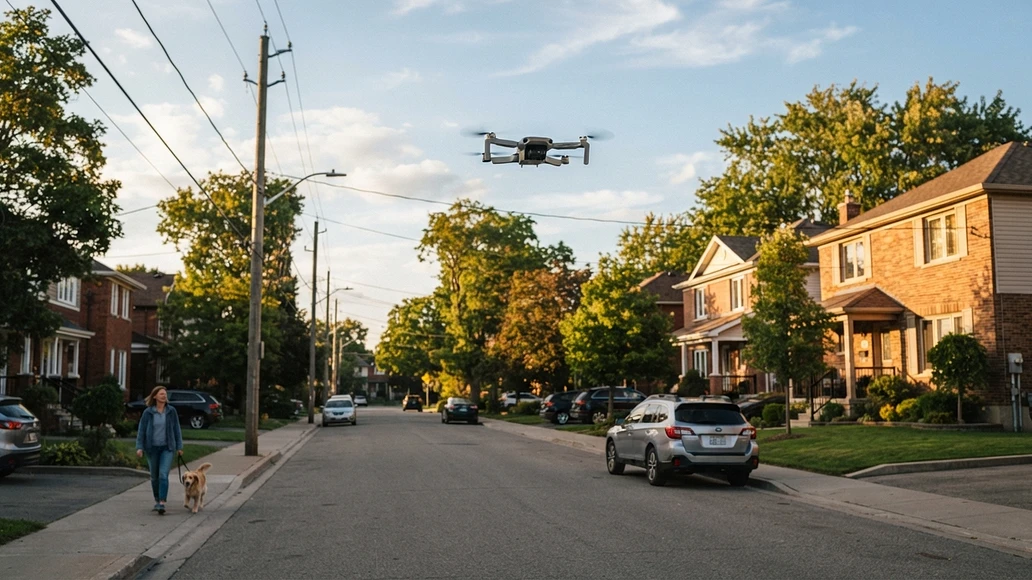
This is the category most homeowners notice. These drones can have strong transmission systems and good cameras, but their practical range is still shaped by battery life, return-to-home needs, and legal line-of-sight limits. In open rural conditions, a capable consumer drone may travel several miles. In a dense suburb or city, usable distance can drop sharply.
Commercial, industrial, and fixed-wing drones
These aircraft may cover much larger areas, especially in agriculture, infrastructure inspection, emergency response, and delivery trials. Fixed-wing designs are especially efficient because they glide forward rather than constantly fighting gravity like a quadcopter. That makes them better suited for long routes and broad-area mapping.
FPV and long-range hobby builds
Some hobbyists build specialized long-range FPV drones that can travel impressive distances. These are not typical off-the-shelf neighborhood camera drones. They also demand more planning, more skill, and more attention to legal compliance. A technically capable build does not automatically make a long flight lawful or safe.
How far drones are legally allowed to fly in the US
For most civilian operators in the United States, the biggest limit is not the radio. It is the rule that the drone must generally remain within visual line of sight, often shortened to VLOS. That means the person operating the drone, or a visual observer working with them, must be able to see the aircraft well enough to know its location, attitude, direction, and whether it poses a hazard.
In plain language, if the drone is so far away that it becomes a tiny speck or disappears behind obstacles, the pilot may be outside normal legal bounds unless operating under a specific authorization.
| Scenario | Technical potential distance | Typical legal limit | Notes |
|---|---|---|---|
| Recreational flying | Often miles for capable consumer drones | Limited by visual line of sight | Altitude and airspace rules also apply |
| Part 107 commercial flying | Often miles for capable systems | Usually visual line of sight unless specifically authorized otherwise | Used for business, inspection, media, and similar work |
| BVLOS operation under waiver or approval | Can extend well beyond normal sight distance | Allowed only under specific regulatory oversight | Common in advanced industrial or delivery contexts |
| Delivery drone operations | Designed for longer routes and service areas | Managed under evolving approvals and operating frameworks | Not the same as ordinary hobby flights |
Many explainers describe ordinary visual contact for small drones as roughly a few hundred meters, often around 400 to 800 meters depending on aircraft size, lighting, contrast, and eyesight. That is not a universal hard number, but it is a useful reality check. A drone may be able to transmit from much farther away than a human can responsibly monitor it.
Altitude and overflight basics
US drone operations also involve altitude limits and airspace restrictions. A common rule of thumb for small drones is to stay at or below 400 feet above ground level unless a specific exception applies. Overflight of private property is legally complex. A drone passing overhead is not automatically committing a crime, but low hovering, peering into windows, repeated targeted observation, or unsafe operation can cross into privacy, nuisance, or harassment issues under state or local law.
What really limits distance
Even expensive drones are constrained by physics. Three factors dominate most flights: battery endurance, radio link quality, and the environment.
Battery life is usually the real ceiling
Small multirotor drones burn energy quickly. Hovering, climbing, fighting wind, carrying accessories, and using aggressive flight modes all increase power draw. A pilot who flies outward too aggressively may not have enough reserve to return safely.
Responsible operators do not plan flights around the moment the battery reaches zero. They leave margin for headwinds, detours, landing complications, and degraded battery performance in cold weather. In practical terms, that means the safe mission radius is often much shorter than the total theoretical distance a drone could cover if it flew one way until empty.
Signal strength changes with location
Radio performance is better in open areas than in cluttered neighborhoods. Buildings block and reflect signals. Trees absorb them. Wi-Fi-heavy suburbs and urban areas create more interference than open farmland or shoreline environments. That is why the same drone may perform very differently in two locations.
Wind, temperature, and payload matter
A tailwind on the way out can become a problem on the way back. Cold temperatures reduce battery efficiency. Added payload, such as a heavier camera setup or accessories, cuts endurance. Even elevation changes can affect power use and return planning.
| Limiting factor | How it reduces range | What a careful pilot does |
|---|---|---|
| Battery age or low capacity | Shorter flight time and weaker reserve | Uses healthy batteries and conservative return thresholds |
| Headwind | Increases power draw on return | Plans outbound leg into the wind when possible |
| Urban interference | Weakens control and video link | Keeps flights shorter and maintains clear sight lines |
| Cold weather | Reduces battery performance | Warms batteries and shortens mission expectations |
| Heavy payload | Cuts endurance and maneuver margin | Reduces distance and avoids pushing battery limits |
| Terrain and obstacles | Blocks signal and visual contact | Chooses launch points with better visibility |
Can a drone watch you from miles away?
This is where fear often outruns reality. A small hobby drone does not need to be miles away to capture usable footage. In fact, if someone wanted a clear look at a person, yard, or window area, the drone would usually need to be relatively close compared with its maximum transmission range.
That does not make privacy concerns imaginary. It means the concern is usually about proximity and behavior, not about a tiny drone secretly filming from some extreme distance. If a drone is close enough to produce detailed footage, it is often close enough to be heard, seen, or noticed.
| Claim | Reality check | What matters most |
|---|---|---|
| A hobby drone can quietly monitor a home from miles away | Possible in a broad technical sense for transmission, but detailed observation usually requires the drone to be much closer | Camera angle, altitude, proximity, and line of sight |
| A single small quadcopter can follow someone all day | Usually unrealistic because of battery limits and the need to land, swap batteries, or reposition | Endurance and operator logistics |
| Every drone over a neighborhood is spying | Most are used for recreation, photos, roof checks, or transit between points | Flight pattern and context |
| Military drone capabilities reflect what civilians can do | Not comparable to ordinary consumer aircraft | Drone type and operating environment |
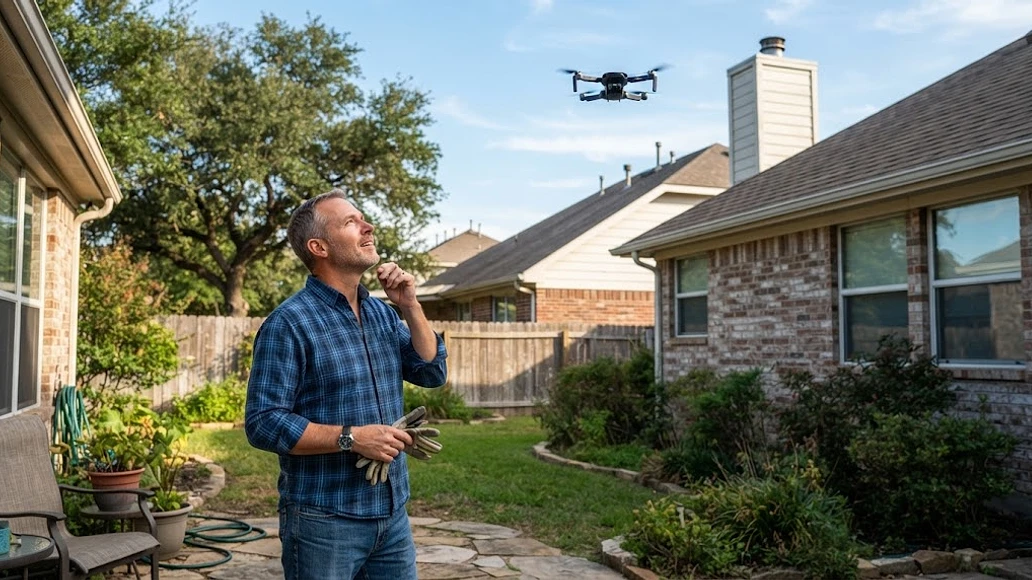
A better question is not, “Can drones theoretically see far?” It is, “What behavior suggests a real problem?” Repeated low hovering near windows, circling one property, flying at odd hours, or obviously tracking a person are more meaningful warning signs than a brief pass overhead.
Why range matters for household privacy and safety
Longer-range drones expand what an operator can do from a distance, but for most households the practical issue is not maximum miles. It is whether a drone can reach your area easily, linger long enough to gather footage, and return without trouble.
Range matters in several ways:
- A pilot can launch from farther away, making it harder to identify who is flying.
- A capable drone can inspect multiple properties or a large neighborhood in one flight.
- Longer endurance allows more hovering, more route flexibility, and more time to search for a landing spot if something goes wrong.
- Greater distance can increase crash risk if the operator loses situational awareness or pushes battery limits.
At the same time, most harmless flights have recognizable patterns. A drone that passes over at moderate altitude on a sunny weekend may simply be filming scenery or returning home. A drone that repeatedly stops outside second-story windows is a different matter.
| Flight pattern | Likely explanation | Recommended homeowner response |
|---|---|---|
| Brief transit across the neighborhood | Routine recreational or photography flight | Observe, no action unless unsafe |
| High pass over several homes | Scenic video, mapping, or route transit | Monitor only if repeated or unusually low |
| Repeated low hovering over one yard | Potential nuisance or targeted observation | Document time, video, direction of travel |
| Drone near windows or following people | Possible privacy invasion or harassment | Document and contact local authorities |
| Erratic flight close to structures or roads | Unsafe operation or inexperienced pilot | Prioritize safety, document, report if needed |
What to do if a drone near your home worries you
If you believe a drone is being used unsafely or intrusively, focus on lawful documentation and reporting. Do not try to knock it down, jam it, or interfere with it physically. That can create injury risk and may violate federal or state law.
- Move people, pets, and vehicles away from any immediate hazard if the drone appears unstable or dangerously low.
- Record the date, time, location, altitude estimate, and flight pattern.
- Take photos or video if you can do so safely from your property.
- Note whether the drone is hovering, circling, approaching windows, or repeatedly returning.
- Look for the launch point only from a safe and lawful position. Do not trespass or confront aggressively.
- If the conduct suggests stalking, voyeurism, harassment, or reckless flying, contact local law enforcement.
- If appropriate, report unsafe drone activity through FAA channels as available.
Persistent low flights targeting a specific home, obvious recording into private spaces, or any crash causing damage or injury deserves prompt attention. Those are the situations where concern is most justified.
Preparedness uses for drones that make range valuable
Drone range is not only about risk. It also has real preparedness value when used responsibly. A modest camera drone can help a household or small community assess conditions without sending a person into a dangerous area.
| Preparedness task | How range helps | Practical benefit |
|---|---|---|
| Roof and property inspection | Lets the pilot check structures without climbing immediately | Reduces fall risk after storms |
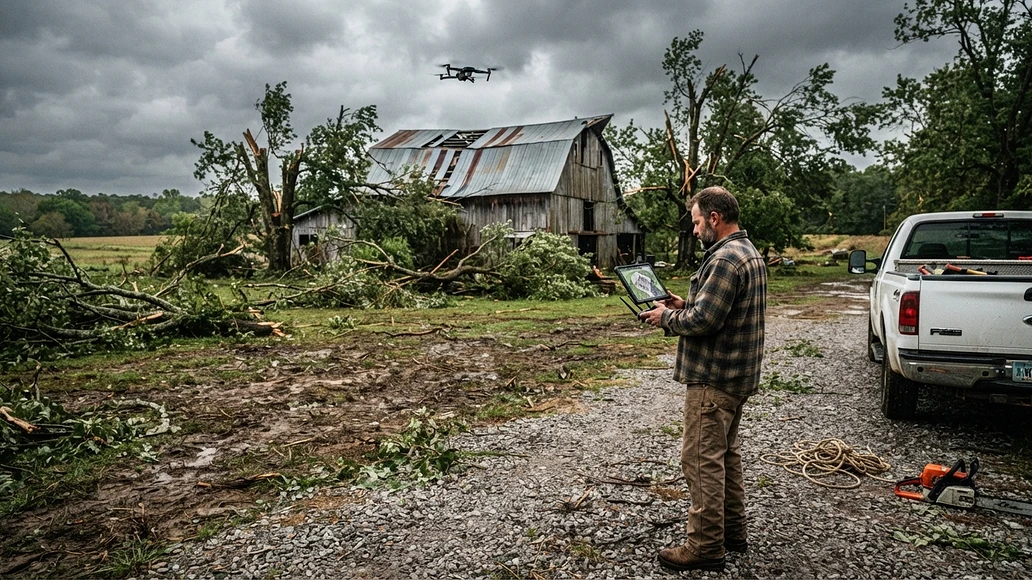
| Storm damage assessment | Covers driveways, fences, outbuildings, and tree lines quickly | Speeds insurance documentation and cleanup planning |
| Wildfire smoke or flood observation | Allows a safe look beyond immediate obstacles | Improves situational awareness before travel |
| Search for livestock or missing pets | Expands visible area in one flight | Saves time and foot travel |
| Community mapping after a disaster | Helps identify blocked roads and damaged infrastructure | Supports local response decisions |
For these uses, longer range increases coverage area, but only if the operator still respects battery margins, airspace rules, and visual awareness. A drone is a useful tool, not a substitute for judgment.
Responsible drone ownership starts with conservative planning
Good drone operation is less about squeezing out the maximum possible distance and more about finishing every flight safely. A few habits make a major difference.
| Good practice | Why it matters | Result |
|---|---|---|
| Plan a conservative mission radius | Prevents overcommitting battery and signal margin | Safer return and fewer emergencies |
| Launch into the wind when practical | Preserves return options | Lower risk of struggling home on low battery |
| Keep the drone easy to see | Supports legal compliance and hazard awareness | Better control and safer avoidance |
| Respect homes, yards, and quiet hours | Reduces conflict with neighbors | Better community acceptance |
| Label and register when required | Supports compliance and accountability | Fewer legal problems |
| Set return thresholds before takeoff | Avoids last-minute decisions | More predictable flights |
As a courtesy, many pilots choose wider buffers around neighboring homes than the bare minimum required by law. That is smart. It reduces noise complaints, avoids misunderstandings, and lowers the chance that a normal flight will be perceived as intrusive.
Delivery drones and future long-range operations
One reason drone range matters more today than it did a few years ago is that commercial and public-service operations are expanding. Delivery trials, infrastructure inspection, utility work, and emergency response all benefit from aircraft that can cover more ground with fewer launches.
Recent industry trends suggest that transmission systems are improving quickly, while battery endurance remains the more stubborn bottleneck. In other words, many drones can communicate farther than they can prudently travel and return. That is one reason battery planning and regulatory oversight still matter so much.
No specific dated consumer rule change is required to understand the current picture. The broader trend is ongoing: more interest in beyond-visual-line-of-sight operations, more delivery experimentation, and continued efforts to balance utility with safety and privacy.
FAQ
Is it legal for someone to fly a drone over my backyard?
Not automatically illegal, but not automatically acceptable either. Simple overflight can be lawful depending on altitude, airspace, and operating rules. Low hovering, peering into windows, repeated targeted observation, or unsafe flying may violate privacy, nuisance, harassment, or other laws. Because this area is fact-specific, treat this article as general information, not legal advice.
How far can a drone fly before it loses signal or battery?
It depends on the drone type, battery health, weather, interference, and terrain. Toy drones may only manage tens of meters. Consumer camera drones can often travel 1 to 5 miles in realistic conditions, though advertised transmission specs may be much longer. In many flights, battery reserve becomes the limiting factor before the radio link does.
Can small hobby drones really record clear video from far away?
They can capture broad scenery from a distance, but detailed footage of a person or private area usually requires the drone to be much closer than its maximum transmission range. If a drone is gathering detailed footage, it is often close enough to be noticed visually or audibly.
What should I do if a drone keeps hovering outside my window?
Document the behavior with time-stamped photos or video if you can do so safely. Note the location, duration, and whether it returns repeatedly. Contact local law enforcement if the conduct appears intrusive, harassing, or voyeuristic. Do not try to shoot, jam, or physically interfere with the drone.
How far should I keep my own drone from neighbors’ homes to be respectful and safe?
There is no one-size-fits-all distance, but farther is generally better when practical. Avoid low hovering over private yards, windows, and gathering spaces. Keep flights brief, visible, and purposeful. Respect quiet hours and choose routes that minimize nuisance. Conservative separation is often the best policy even when a flight might technically be legal.