When to Toss First Aid Ointment, and When Storage Matters More
Topical antibiotic ointment does have an expiration date, but the bigger question is whether an opened or poorly stored tube is still safe for a real wound. Here is how to judge shelf life, storage, spoilage, disposal, and when to get medical care instead of self-treating.

Antibiotic ointment is a common first-aid staple for minor cuts and scrapes, but it is still a medicine. That means the date on the tube matters, how you store it matters, and the condition of the product matters. This article is about topical skin antibiotic ointment, not oral antibiotics and not eye ointments. It offers general guidance only and is not a substitute for a pharmacist or clinician, especially for contaminated, infected, deep, or high-risk wounds.
In plain terms, yes, antibiotic ointment expires. The printed expiration date is the manufacturer’s guarantee that the product will meet its labeled quality and potency through that date when stored as directed. A tube that looks normal after that date is not automatically toxic, but it also cannot be assumed to be safe and effective for active wound care. For a low-cost first-aid item, replacement is usually the better choice.
What antibiotic ointment is, and what it is used for
Topical antibiotic ointment is a skin product used on minor superficial cuts, scrapes, and small abrasions. Some products contain a single antibiotic ingredient, while others are triple-antibiotic formulas. The goal is to reduce bacterial growth on small skin injuries as part of basic wound care. It is not meant for deep punctures, animal bites, serious burns, eye use unless specifically labeled for that purpose, or obvious skin infections that need medical evaluation.
Basic wound care still matters most. Gently cleaning the area, stopping bleeding, and covering the wound appropriately are often just as important as the ointment itself.
Does antibiotic ointment expire?
Yes. Like other over-the-counter medicines, antibiotic ointment is sold with an expiration date. FDA guidance is clear that expired medicines should not be used. The practical reason is not that the product suddenly becomes poisonous the day after the printed date. The concern is that the manufacturer no longer guarantees potency, stability, or quality beyond that point.
For an ointment used on broken skin, there is also a contamination question. Once a tube has been opened, the tip may contact fingers, skin, or surfaces over time. That raises the chance that an older tube is less reliable than a fresh one, even if it still looks fine.
What the expiration date really means
An expiration date is best understood as a quality guarantee under specific storage conditions. If the tube was kept tightly closed, at room temperature, away from moisture and heat, it may still appear normal after the date. But appearance alone does not prove the active ingredients are still at full strength or that the product has remained uncontaminated.
This is why there is a difference between three separate questions:
- Is the tube past the printed expiration date?
- Has the tube been opened and handled repeatedly?
- Does the ointment show visible spoilage or package damage?
Any one of those can be a reason to replace it.
Opened vs unopened tubes
An unopened tube that has been stored correctly is generally in better shape than an opened one, because the seal has not been broken and the contents have had less opportunity for contamination. Once opened, the product is exposed to air and handling. Even if the cap is replaced each time, repeated use can affect cleanliness and consistency.
That does not mean every opened tube is unsafe right away. It means opened tubes deserve more scrutiny. If you do not remember when you opened it, if it has lived in a hot car or damp bathroom, or if the cap area is crusted or dirty, replacement is the safer move.
| Situation | What it usually means | Use or replace? |
|---|---|---|
| Unopened, in date, stored in a cool dry place | Best case for labeled potency and cleanliness | Appropriate for minor superficial wounds if the label directions fit the situation |
| Opened, in date, stored well, tube and cap clean | May still be usable for minor first-aid needs | Use with caution for minor wounds only, avoid touching the tip to skin |
| Unopened, past expiration date | Potency and quality no longer guaranteed | Replace rather than rely on it for active wound care |
| Opened, past expiration date | Higher uncertainty because of age plus handling | Discard and replace |
| Any tube stored in heat, humidity, or a car | Stability may be reduced even before expiration | Replace if there is any doubt |
| Any tube with leakage, damage, odor, discoloration, or separation | Possible spoilage or contamination | Discard immediately |
How long antibiotic ointment lasts after opening
There is no universal, authoritative grace period that says an opened tube is good for a set number of months after first use. Product labels differ, and many over-the-counter skin ointments are used until the printed expiration date if stored correctly and if the product remains in good condition. Still, opened products carry more contamination risk than sealed ones.
A practical home rule is simple. If the tube is opened, older, and easy to replace, replace it before you need it. That is especially true for a first-aid kit that may sit untouched for months.
How to store antibiotic ointment safely
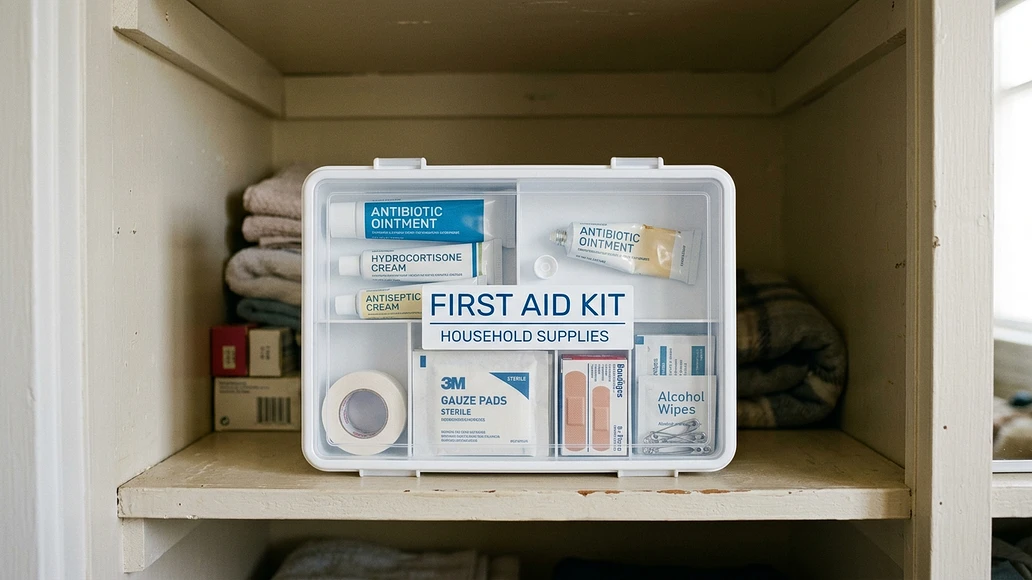
Storage has a direct effect on how well an ointment holds up. Most products should be kept at room temperature in a dry place with the cap tightly closed. Heat and humidity are the main enemies.
Good storage habits include keeping the tube in a bedroom closet, hallway cabinet, or dedicated first-aid box rather than in a bathroom medicine cabinet. Bathrooms often get warm and humid, which is poor for many medicines. Cars are also bad storage spots because temperatures swing widely.
| Storage condition | Effect on ointment | Best action |
|---|---|---|
| Room temperature, dry, cap closed | Supports labeled shelf life | Preferred storage |
| Bathroom cabinet near shower or sink | Humidity can reduce product stability over time | Move to a drier location |
| Car, garage, shed, or attic | Heat and cold swings can damage the product | Do not store there |
| Cap left loose or tube tip dirty | Raises contamination risk | Clean exterior if possible and replace if questionable |
| Leaking or punctured tube | Package integrity is compromised | Discard immediately |
Signs an ointment should be discarded
Throw the tube away if any of the following are true: it is expired, the packaging is damaged, the ointment has separated, the color has changed, it smells unusual, it has leaked, or the cap and tip are visibly dirty and cannot be cleaned well. These are practical warning signs that the product may no longer be dependable.
Do not try to rescue a questionable tube by mixing it, heating it, or cutting it open. If it is doubtful, it is not worth using on broken skin.
Is expired antibiotic ointment dangerous, or just less effective?
For most topical skin ointments, the main concern after expiration is reduced potency and uncertain quality, not sudden toxicity. But that does not make expired ointment a good choice. If the medicine is weaker than expected, it may not do the job you are counting on. If the tube has also been opened and stored poorly, contamination becomes a more realistic concern.
That is why the safest message is not, expired means poison, and not, expired means fine. The safer message is, expired means no longer guaranteed, so replace it when you can and do not rely on it for an active wound.
What if it is only slightly past date?
This is where people often want a simple yes or no. Realistically, a tube that is only slightly expired and has been stored perfectly may still look and behave normally. But there is no universal safe grace period, and there is no home test for potency or contamination. Because antibiotic ointment is relatively inexpensive, the upside of taking the chance is low.
If you are dealing with a real wound and you can replace the tube, replace it. If you are building or refreshing a first-aid kit, swap it out before you need it. Using a fresh tube is the more practical and lower-risk choice.
When not to use antibiotic ointment on a wound
Antibiotic ointment is for minor superficial skin injuries. It is not appropriate for every wound. Do not self-treat with old ointment, or even fresh ointment alone, if the injury is deep, gaping, heavily contaminated, caused by a puncture, caused by an animal or human bite, near the eye, on the face if edges are separated, or associated with a serious burn.
You also should not keep reapplying ointment to a wound that is getting redder, more painful, swollen, warm, or draining pus. Those are warning signs that need medical attention.
| Wound type | Home care or clinician? | Why |
|---|---|---|
| Small clean scrape or shallow minor cut | Usually home care | Often appropriate for cleaning, bandaging, and in-date ointment if needed |
| Deep cut or gaping wound | Clinician | May need closure and better assessment |
| Puncture wound | Clinician | Higher infection risk and deeper tissue involvement |
| Animal or human bite | Clinician | High infection risk, possible need for antibiotics or rabies and tetanus review |
| Dirty wound with debris you cannot remove | Clinician | Needs proper cleaning and evaluation |
| Burn larger than a small minor burn | Clinician | Burn depth and infection risk may be greater than they appear |
| Wound near the eye or on the eyelid | Clinician | Skin ointment is not the same as ophthalmic ointment |
| Wound with spreading redness, pus, fever, or red streaks | Clinician promptly | Possible infection or worsening condition |
Minor cuts vs wounds needing medical care
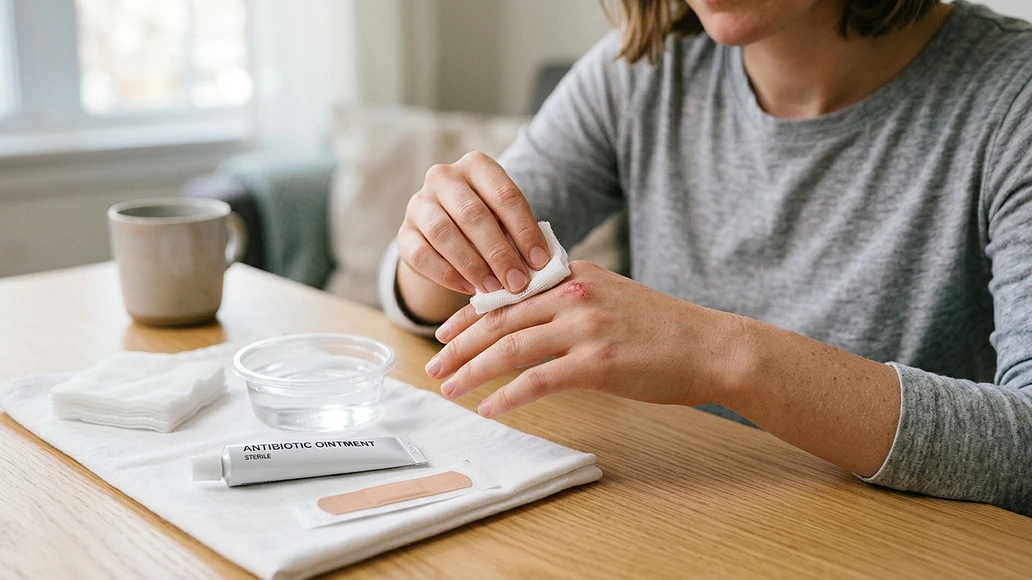
For a minor scrape, basic care usually means washing hands, gently rinsing the wound with clean water, controlling bleeding, applying a small amount of in-date ointment if appropriate, and covering it with a clean dressing. Watch for improvement over the next day or two.
Get medical help sooner if the person has diabetes, poor circulation, immune suppression, chronic skin disease, or is pregnant and the wound is not clearly minor. Healing can be slower and infection risk can be higher in these groups.
How antibiotic ointment compares with petroleum jelly, antiseptics, and oral antibiotics
People often mix up these products. They are not interchangeable. Petroleum jelly is not an antibiotic, but it can help keep a minor wound moist and protected. Antiseptic washes or solutions are used for cleaning, depending on the product and directions, but they are not the same as a leave-on antibiotic ointment. Oral antibiotics are prescription medicines for infections that involve more than a small superficial skin injury and should not be substituted with a topical product.
| Product type | What it is for | What it is not for |
|---|---|---|
| Topical antibiotic ointment | Minor superficial cuts and scrapes when the product is in date and the wound is appropriate for self-care | Deep wounds, bites, punctures, serious burns, eye use unless specifically labeled |
| Petroleum jelly | Moisture barrier and wound protection for minor skin injuries | Not an antibiotic, does not treat an active infection |
| Antiseptic wash or solution | Cleaning skin or wounds according to label directions | Not a substitute for ongoing wound protection by itself |
| Oral antibiotics | Treating certain infections under medical guidance | Not for routine self-treatment of minor cuts and scrapes |
Does antibiotic ointment prevent infection in every minor wound?
Not automatically. Good wound cleaning and proper dressing are still central. An ointment can be part of care for a small superficial wound, but it does not make a dirty, deep, or neglected wound safe. It also does not replace tetanus review when that may be needed.
If a wound is worsening despite basic care, continuing to apply ointment is not enough. That is the point to seek medical advice.
How to dispose of expired ointment
The FDA prefers drug take-back options when available. If there is a local take-back site or event, that is usually the simplest choice. If there is no take-back option and the label does not give different instructions, home trash disposal may be acceptable. In general, do not flush medicines unless the label or FDA guidance specifically says to do so.
| Disposal option | When to use it | Notes |
|---|---|---|
| Drug take-back site | Best option when available | Preferred for expired or unused medicines |
| Mail-back program | When offered by local programs or pharmacies | Useful if no nearby drop-off site exists |
| Household trash disposal | When no take-back option is available and the label does not say otherwise | Follow package instructions and place in the trash securely |
| Flushing | Only if specifically instructed | Not routine for most products |
How often to check first-aid kit medicines
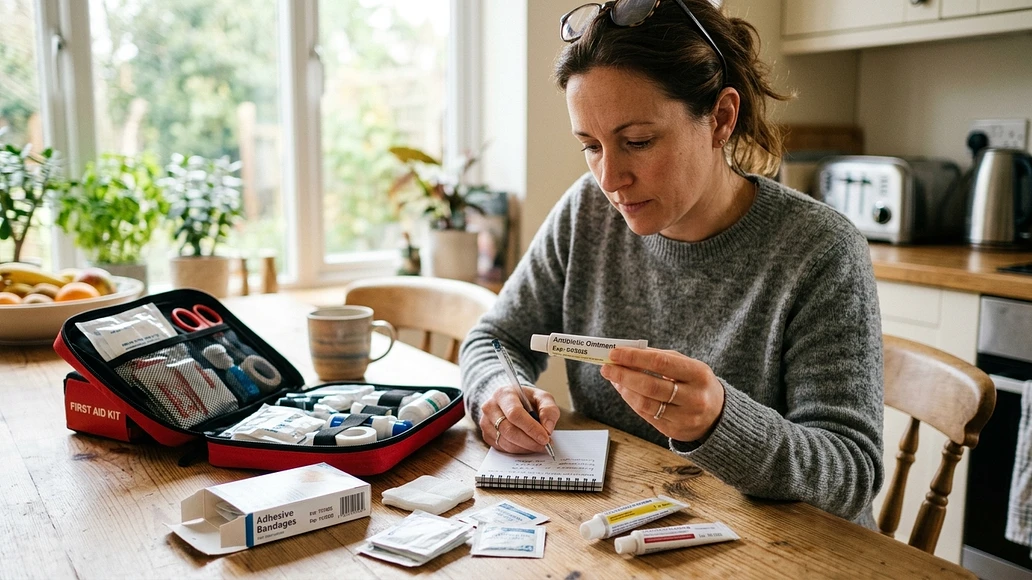
A simple schedule works better than waiting for an emergency. Check your first-aid kit at least twice a year. Many people tie it to daylight saving time changes, the start of hurricane season, or another recurring date they already remember.
During the check, look at expiration dates, packaging condition, and storage location. Replace anything expired, leaking, dried out, or questionable. If the kit lives in a car, garage, or outdoor shed, inspect it even more often because temperature extremes shorten the useful life of many supplies.
Special cautions for children, pregnancy, diabetes, and poor circulation
Children may have more sensitive skin and may be more likely to touch or ingest products accidentally, so store ointments out of reach. Pregnant people should be cautious about any medicine use and ask a clinician or pharmacist when unsure. People with diabetes, poor circulation, or immune suppression should be more careful with wounds in general because small injuries can become serious more quickly.
For these groups, a wound that is not clearly minor, or that is not improving promptly, deserves earlier professional advice.
What to do if a wound gets worse after using ointment
Stop relying on self-treatment alone and get medical advice promptly if you notice spreading redness, warmth, swelling, pus, fever, red streaks, severe pain, or no improvement after basic care. Those signs can point to infection or a wound that needs more than over-the-counter treatment.
If the ointment itself seems to irritate the skin, stop using it and seek advice, especially if there is rash, itching, or worsening inflammation.
Bottom line
Antibiotic ointment does expire, and expired tubes are not worth relying on for active wound care when a fresh replacement is available. The biggest practical issues are lost potency, uncertain quality, and contamination risk, especially with opened or poorly stored tubes. Keep ointment at room temperature in a dry place, avoid bathrooms and cars, discard any tube that is expired or looks abnormal, and use it only for minor superficial wounds that are appropriate for home care.
When the wound is deep, dirty, puncture-related, caused by a bite, near the eye, infected-looking, or simply not improving, skip the guesswork and get medical care.