Signal Jammers in America, What the Law Actually Allows and What to Use Instead
A plain-English guide to U.S. jammer rules, including what counts as jamming, why the FCC bans it, where narrow exceptions exist, and safer legal alternatives for privacy, focus, and device control.

If you are wondering whether a signal jammer is legal in the United States, the practical answer for ordinary consumers is simple, no. Federal law and FCC enforcement make active jamming a prohibited activity in almost every civilian context. That includes devices marketed to block cell service, GPS, Wi-Fi, Bluetooth, or other radio communications.
The part that causes confusion is that people often lump very different products together. A jammer is not the same thing as a signal booster, a Faraday bag, a shielded pouch, or a phone policy for a workplace or classroom. Those differences matter, because one category actively interferes with licensed or authorized communications, while the others may be lawful when used properly.
This guide explains the legal and practical truth in plain English, including what counts as jamming, what the FCC actually regulates, why private property is not a loophole, where narrow government exceptions may exist, and what legal alternatives make more sense for privacy, focus, anti-theft, or parenting concerns.
What is a signal jammer?
A signal jammer is an electronic device that intentionally transmits radio-frequency interference to disrupt communications between other devices. In simple terms, it creates noise on the same frequencies used by legitimate services so phones, GPS receivers, Wi-Fi devices, drones, or radios cannot connect or function normally.
That intentional interference is the key issue. A jammer does not merely block a signal from reaching one device through passive shielding. It actively radiates energy to overpower or confuse authorized communications.
Common jammer categories
| Jammer type | What it targets | Why it raises legal problems |
|---|---|---|
| Cell phone jammer | Cellular voice, text, and data bands | Can disrupt calls, including 911 and other emergency communications |
| GPS jammer | Satellite navigation signals | Can interfere with navigation, fleet tracking, timing, and safety systems |
| Wi-Fi jammer | Wireless local network frequencies | Can disrupt lawful internet access and connected devices |
| Bluetooth jammer | Short-range wireless device links | Can interfere with accessories, sensors, and control systems |
| Drone jammer | Command, control, navigation, or video links | Can affect aircraft-related systems and trigger serious federal concerns |
| Multi-band jammer | Several services at once | Creates broad interference across multiple authorized services |
What counts as jamming versus shielding or blocking?
This is where many online listings become misleading. Some sellers use words like blocker, privacy device, quiet room tool, or anti-tracking gadget to make an active jammer sound harmless. The legal question usually turns on how the device works.
| Device or method | How it works | Typical legal posture | Practical use case |
|---|---|---|---|
| Signal jammer | Actively transmits interference to disrupt communications | Generally prohibited for civilian use, sale, marketing, importation, and distribution in the U.S. | Not a lawful consumer solution |
| Signal booster | Amplifies and rebroadcasts weak signals using approved equipment | Can be lawful when FCC-compliant and carrier-approved where required | Improving weak cell coverage in homes or vehicles |
| Faraday bag or shielded pouch | Passively blocks signals from reaching a device inside the enclosure | Often lawful as a passive shielding product, subject to context and intended use | Travel privacy, anti-theft storage, digital isolation |
| Shielded room or enclosure | Uses materials that reduce signal penetration without transmitting interference | May be lawful depending on installation and purpose | Testing, privacy, or sensitive equipment protection |
| Policy-based control | Uses rules, storage lockers, MDM software, or device settings | Generally lawful when implemented properly | Classrooms, workplaces, meetings, family device limits |
A passive shield does not broadcast interference into the surrounding area. A jammer does. That distinction is one reason a Faraday bag and a cell jammer should never be treated as interchangeable products.

Are signal jammers illegal in the United States?
For ordinary civilian use, yes. Federal authorities have long stated that jamming devices are illegal to use in the United States, and FCC guidance also states that marketing, selling, importing, and distributing them is prohibited. This applies even when a person claims the device is only for private property, a business, a classroom, a theater, or a vehicle.
The safest plain-language summary is this, if a device actively interferes with licensed or authorized radio communications, do not assume you can legally buy it, use it, or test it just because you own the property where you plan to use it.
What laws and agencies regulate jammers?
The main regulator is the Federal Communications Commission, or FCC. The FCC oversees non-federal spectrum use and equipment authorization rules. Federal law, including provisions of the Communications Act, supports the prohibition on harmful interference and unauthorized radio transmissions. The Department of Justice may also become relevant in criminal cases involving interference with radio communications, and federal spectrum management agencies are involved where government systems are concerned.
In practical terms, the FCC is the agency most consumers will hear about. It publishes consumer guidance, enforcement notices, and forfeiture actions. The broad theme is consistent, radio devices must operate within authorized rules, and intentional interference devices do not fit normal lawful consumer pathways.
Why FCC equipment rules matter
Most lawful consumer radio devices are sold under an equipment authorization framework. Jammers are different because their purpose is to interfere, not to communicate lawfully within technical limits. That is why they are not just another gadget with a gray-area setting. Their core function is the problem.
Can you legally use a jammer on private property?
Private property is not a general exception. A homeowner, landlord, school, theater, office, or event venue cannot simply decide to block wireless communications because the building is privately owned. Radio signals do not stop at a property line, and interference can affect neighbors, passersby, emergency responders, and public safety systems.
This is one of the most common myths online. People assume that if they are only trying to stop phones in a conference room or prevent GPS tracking in a car, the law will treat it as a private matter. Federal communications law does not work that way.
| Activity | General U.S. civilian status | Important nuance |
|---|---|---|
| Using a jammer | Clearly prohibited | Private property does not create a consumer exception |
| Selling a jammer | Clearly prohibited | Online offers and advertising can trigger enforcement |
| Importing a jammer | Clearly prohibited | Shipments may be seized or refused |
| Marketing a jammer | Clearly prohibited | Calling it a blocker or privacy tool does not fix the issue |
| Shipping or distributing a jammer | Clearly prohibited | Commercial handling is part of the enforcement picture |
| Mere possession | More nuanced than use | Do not treat possession as safe, risk can depend on context and jurisdictional posture |
Can you legally own or import a signal jammer if you never turn it on?
This is where careful wording matters. Operation and commercialization are the clearest legal red lines. Mere possession can be discussed differently depending on context, but that does not make ownership a good idea or a low-risk gray area. Importation, shipment, advertising, and sale are all major enforcement concerns, and a device sitting in a drawer can still create problems if it was unlawfully imported, marketed, or intended for use.
For a general consumer, the practical answer is simple, do not buy one and do not import one. Even if someone online claims possession alone is harmless, that does not remove the risk of seizure, enforcement attention, or legal trouble connected to how the device was acquired or intended to be used.
What penalties can come with buying, selling, or using a jammer?
Penalties can include FCC forfeitures, seizure of equipment, and other enforcement actions. In more serious cases, criminal exposure may exist, especially where interference affects protected communications or public safety. Exact dollar amounts can change over time and depend on the facts, so it is better to focus on the enforcement reality than on one outdated fine figure copied around the internet.
The practical truth is that federal agencies do not treat jammers like harmless novelty gadgets. They are viewed as interference devices that can disrupt lawful communications and create safety risks.
Enforcement patterns consumers should understand
| Enforcement issue | What it can involve | Why it matters |
|---|---|---|
| FCC forfeiture action | Civil monetary penalties | Can be expensive and public |
| Equipment seizure | Confiscation of unlawful devices | Importers and sellers are especially exposed |
| Import interdiction | Blocked or seized shipments | Buying from overseas sellers is not a safe workaround |
| Advertising enforcement | Action over listings, offers, or promotions | Marketing language itself can create liability |
| Criminal investigation | Possible in serious interference cases | Risk rises if public safety or protected communications are affected |
Why are jammers considered dangerous?
The public safety case is not abstract. Jammers can block emergency calls, interfere with police, fire, EMS, and other responders, disrupt GPS timing and navigation, and affect nearby users who have nothing to do with the person operating the device. Because radio systems are shared, intentional interference can spread beyond the room or vehicle where someone thinks they are keeping the effect contained.
That is why the law does not treat jamming as a simple nuisance-control tool. A person trying to stop phone use in one setting may also prevent someone else from calling for help.
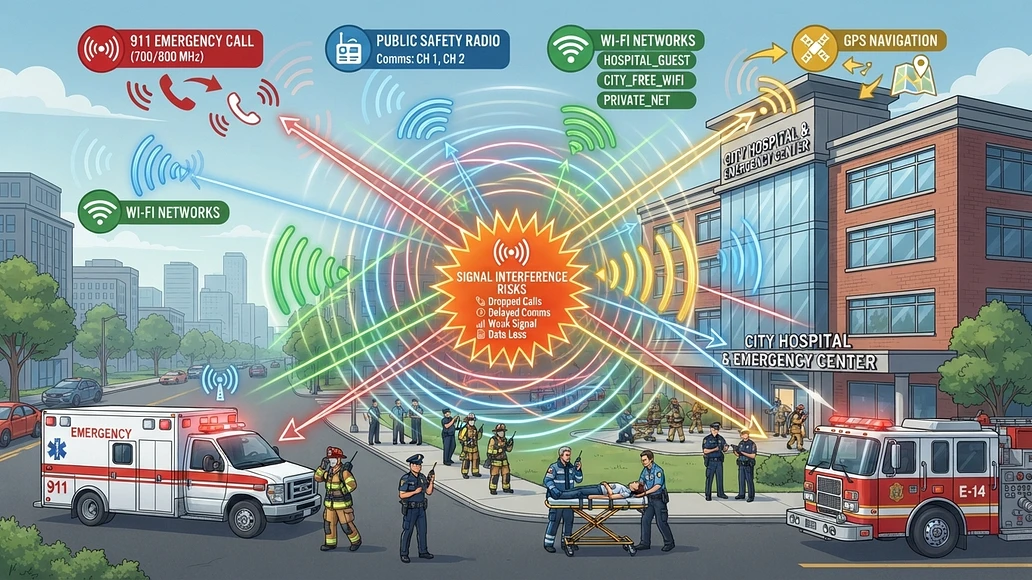
Are cell phone jammers different from GPS, Wi-Fi, or drone jammers?
They differ in target and technical design, but not in the basic legal problem. A jammer aimed at cell service, GPS, Wi-Fi, Bluetooth, or drone links still works by intentionally interfering with authorized radio communications. The exact consequences may vary, but the core issue remains the same.
| Device category | Primary target | Typical real-world harm | General civilian legal outlook |
|---|---|---|---|
| Cell jammer | Mobile network bands | Blocked calls, texts, and emergency access | Prohibited |
| GPS jammer | Navigation satellite signals | Navigation and tracking disruption | Prohibited |
| Wi-Fi jammer | Wireless networking bands | Internet and device connectivity disruption | Prohibited |
| Drone jammer | Control, telemetry, or navigation links | Aviation and federal security concerns | Prohibited for ordinary consumers |
| Multi-function jammer | Several bands at once | Broad collateral interference | Prohibited |
Counter-drone devices deserve extra caution. People sometimes assume that stopping a drone over private property is automatically lawful. It is not safe to make that assumption. Drone-related interference can implicate communications law, aviation concerns, and federal security rules all at once.
Who can use jammers legally, if anyone?
Narrow authorized uses may exist in tightly controlled federal contexts, such as certain defense, intelligence, prison, or specialized testing environments. Those situations are not consumer exceptions. They are authorization-specific, mission-specific, and often governed by separate federal authorities, technical controls, and legal review.
For a private citizen, private business, school, venue, or landlord, the existence of a federal exception somewhere else does not create permission for local use.
| Context | Likely status | Key caution |
|---|---|---|
| Ordinary consumer use at home or in a car | Unauthorized | Not made legal by ownership of the property or vehicle |
| Business, school, theater, or office use | Unauthorized | No general consumer or commercial exception |
| State or local agency use | Not automatically authorized | Must not be assumed lawful without specific federal authority |
| Federal defense or intelligence use | Potentially authorized in narrow settings | Highly controlled and not relevant to consumer purchasing decisions |
| Prison or specialized federal security context | Potentially authorized in narrow settings | Policy discussions do not create a general public exception |
| Research or testing | Potentially restricted and authorization-dependent | Requires expert legal and technical review before any procurement or testing |
What about prisons, law enforcement, and federal agencies?
This area gets attention because prison contraband phones and counter-drone concerns are real policy problems. But recent discussion in those areas does not change the basic rule for the public. Any authorized use in those settings is narrow, controlled, and not a model for civilian use.
Law enforcement, corrections, contractors, schools, and infrastructure operators should not rely on internet summaries when evaluating any interference-related technology. If an organization is considering a product that affects radio communications, it should involve a telecommunications attorney or compliance specialist before procurement, testing, or deployment.
How do jammers differ from signal boosters and shielding products?
This distinction matters because many people searching for a jammer are really trying to solve a different problem. They may want fewer distractions, more travel privacy, less tracking exposure, or better control over devices in a room. Those goals often have lawful solutions that do not involve active interference.
| Need | Illegal or risky approach | Lawful alternative | Why the alternative is better |
|---|---|---|---|
| Reduce phone use in meetings | Cell jammer | Phone lockers, policy enforcement, silent mode rules | Does not interfere with emergency communications |
| Protect a device from remote signals during travel | Portable jammer | Faraday pouch or shielded bag | Passive isolation rather than active interference |
| Improve weak cell reception | Homemade blocker or repeater hack | FCC-compliant signal booster | Designed for lawful signal improvement, not disruption |
| Limit child device access | Whole-house jammer | Parental controls, router schedules, device management tools | Targeted and lawful control |
| Protect business confidentiality | Conference room jammer | Access control, NDAs, secure storage, shielded spaces where appropriate | Avoids unlawful interference and collateral harm |
| Prevent vehicle tracking concerns | GPS jammer | Legal privacy review, device inspection, passive shielding where lawful and appropriate | Avoids interfering with surrounding systems |
What should you use instead of a jammer?
The right alternative depends on the real problem you are trying to solve.
For home use
If your goal is fewer distractions, use router schedules, parental controls, app limits, and household rules. If your goal is privacy for a device, consider a quality Faraday pouch from a reputable seller and verify that it is a passive shielding product, not an active transmitter.
For travel
If you want to isolate a phone, key fob, passport sleeve, or small electronics from wireless signals, passive shielding products may fit the need better than any interference device. Also use airplane mode, power-down procedures, and account security settings.
For workplaces and schools
Use policy-based controls, lockable storage, managed-device software, and physical access rules. If the concern is information leakage, focus on secure meeting practices and lawful technical controls rather than trying to suppress radio signals.
For anti-theft or anti-tracking concerns
Use inspections, access control, account monitoring, and passive shielding where appropriate. If you suspect unlawful tracking or surveillance, get legal advice or help from a qualified investigator rather than trying to jam signals.
Common mistakes people make when buying “privacy” devices online
The biggest mistake is assuming that a product sold openly online must be legal. That is not a safe assumption. Another mistake is confusing words like blocker, suppressor, anti-tracker, anti-spy, or exam tool with a lawful product category.
| Common mistake | Why it is a problem | Safer approach |
|---|---|---|
| Assuming online availability means legality | Illegal products can still appear in marketplaces | Check FCC guidance and buy only clearly lawful products |
| Confusing passive shielding with active jamming | The legal treatment is very different | Verify whether the device transmits any interference |
| Believing private property creates an exception | It does not for consumer jamming | Use policy or passive alternatives instead |
| Trusting vague terms like privacy blocker | Marketing language can hide an illegal jammer | Look for clear technical descriptions and lawful use cases |
| Buying from overseas to avoid scrutiny | Import seizure and enforcement risk remain | Avoid the purchase entirely if it appears to be a jammer |
How to recognize an illegal jammer listing
You do not need technical expertise to spot many red flags. Be cautious if a listing claims it can disable nearby phones, stop GPS tracking, block Wi-Fi in a room, force drones down, or create a no-signal zone. Those are classic jammer claims.
Also be wary of products that avoid the word jammer but promise to cut off communications around other people or devices. If the product description says it transmits to suppress signals, overwhelms frequencies, or creates interference, treat that as a major warning sign.
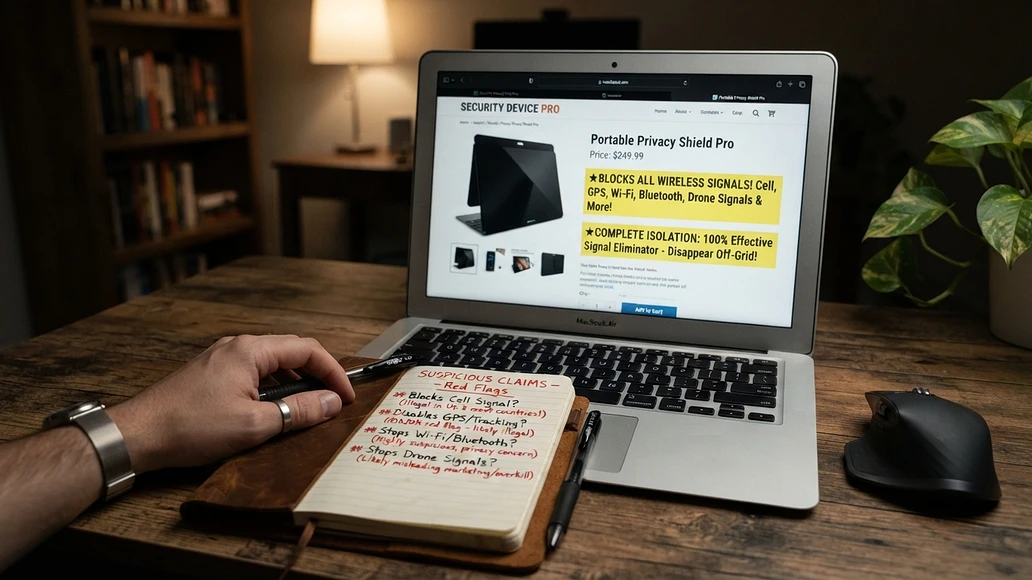
When should you ask a lawyer or compliance expert?
Seek professional advice if you are buying technology for a business, school, venue, prison-related contractor role, public agency, or research setting and the product affects radio communications in any way. The same is true if you are evaluating counter-drone tools, RF testing gear, or imported communications hardware with unclear functions.
For ordinary consumers, the simpler rule is enough, if it actively interferes with wireless signals around you, avoid it. If your need is privacy, focus, anti-theft, or device control, there is almost always a lawful alternative that does not create interference risk.
Bottom line
For U.S. consumers, signal jammers are not a clever loophole product. They are generally prohibited interference devices. The clearest legal red lines are use, sale, marketing, importation, and distribution. Possession can be discussed more carefully in some contexts, but that nuance should not be mistaken for permission.
If your goal is privacy, concentration, child device limits, travel security, or protection from unwanted signals, choose passive shielding, compliant equipment, or policy-based controls instead. Those options are safer, more practical, and far less likely to create legal trouble or public safety harm.
References
- Federal Communications Commission, Jammer Enforcement
- Federal Communications Commission, Jamming Equipment FAQ
- U.S. Department of Homeland Security, Jamming
- eCFR, 47 CFR Part 2
- eCFR, 47 CFR Part 15
- Federal Communications Commission, Fines, Forfeitures, and Penalties
- U.S. Department of Justice, Interference with Radio Signals
- NTIA, Authorized RF Systems and Spectrum Management