Faraday Shielding for Modern Phones, What Stops 5G and What Leaks
5G is not one single signal, and not every metal box blocks it. Learn how Faraday cages, bags, mesh, seams, and testing methods affect real-world shielding for privacy, preparedness, and device security.

If you want the short answer, a properly built Faraday cage can block 5G. The catch is that many DIY boxes, cheap pouches, and loosely sealed containers are not really performing like good RF shields. In practice, 5G gets through when there are gaps, weak closures, oversized mesh openings, worn conductive fabric, or cables that act like antennas.
That matters because 5G is not one frequency. Modern phones may use low-band cellular, mid-band 5G, Wi-Fi at 2.4 or 5 GHz, Bluetooth, GPS, NFC, and sometimes very high frequency 5G bands. A container that stops a phone call in one room may still leak enough signal for tracking, pairing, or intermittent data in another.
This guide explains the physics in plain English, shows what design features matter most, and gives practical ways to test a Faraday cage or bag without overclaiming what consumer gear can do.
What a Faraday cage actually does
A Faraday cage is a conductive enclosure that reduces incoming and outgoing electromagnetic energy. For radio frequency signals, the shielding usually comes from a mix of reflection, absorption, and the fact that the conductive shell creates a continuous barrier around the device.
That last part is where many home projects fail. A metal container is not automatically a high-performing Faraday cage. If the lid does not make good conductive contact, if the seams are interrupted by paint or corrosion, or if the mesh holes are too large for the frequencies involved, the enclosure may only attenuate signals instead of truly stopping communication.
For preparedness and privacy use, attenuation is often enough. If the signal is reduced so much that a phone cannot register on the network, a key fob cannot answer a relay attack, or a tracker cannot update location, the shield is doing useful work. But it is still better to think in terms of signal reduction, not magic invisibility.
Why 5G is harder to discuss than one simple yes or no
People often talk about 5G as if it were a single wave. It is not. In the US, 5G commonly appears in low-band, mid-band, and in some areas mmWave deployments. Those bands behave differently in walls, buildings, and shielded enclosures.
| 5G band type | Typical frequency range | Approximate wavelength | Real-world shielding note | Practical design takeaway |
|---|---|---|---|---|
| Low-band 5G | About 600 MHz to 1 GHz | About 50 cm to 30 cm | Travels farther and penetrates buildings better than higher bands | Good conductive coverage matters, but tiny pinholes are less critical than bad seams |
| Mid-band 5G | About 2.5 GHz to 4 GHz | About 12 cm to 7.5 cm | Common for modern 5G capacity and speed | Mesh size, lid contact, and closure quality become more important |
| mmWave 5G | Roughly 24 GHz to 40 GHz | About 12.5 mm to 7.5 mm | Blocked easily by many materials, but tiny gaps become significant | Very small openings, tight seams, and tested closures are critical |
This is why two statements can both be true. A solid, well-sealed Faraday enclosure can block 5G very effectively. A sloppy enclosure can leak, especially as frequency rises and wavelengths get shorter.
Can 5G penetrate a Faraday cage in theory
In theory, a well-designed conductive enclosure with no meaningful gaps can block 5G signals very well. That includes both sub-6 GHz 5G and higher frequency bands. Professional RF shield boxes and tested enclosures routinely achieve attenuation levels high enough to stop practical communication across a wide range of frequencies.
So the theoretical answer is no, not if the cage is designed and closed correctly.
The practical answer is more nuanced. Real cages are made from actual materials with seams, doors, zippers, corners, wear points, and manufacturing tolerances. Those weak points usually determine performance more than the metal itself.
Why real-world cages leak
Most failures come from construction details, not from some special ability of 5G to pass through metal. Common leak paths include unsealed lids, poor overlap at openings, ordinary zippers, torn conductive fabric, and nonconductive coatings between touching metal parts.
A second issue is false confidence from weak testing. If a phone fails to ring once, that does not prove the enclosure blocks every relevant band. The phone may have switched to Wi-Fi calling earlier, the network may have been weak already, or the device may simply have taken time to update its connection state.
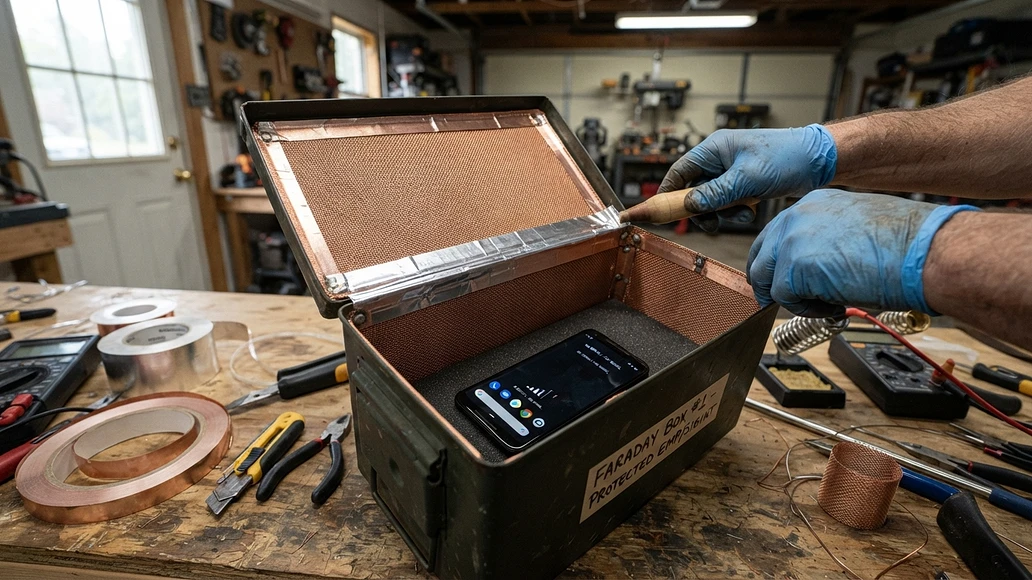
Mesh size, seams, and materials, what matters most
A useful rule of thumb is that openings should be much smaller than the wavelength you want to block. You will often see a half-wavelength rule cited, but in practice smaller is better, especially when you want margin for real-world leaks. At mmWave frequencies, wavelengths are so short that tiny openings and sloppy closures matter a lot.
Material choice matters less than continuity and build quality. Copper, aluminum, steel, and conductive fabrics can all work. The best choice depends on whether you need portability, durability, corrosion resistance, or a permanent installation.
| Shielding element | Why it matters | Typical failure mode | Better approach |
|---|---|---|---|
| Solid metal walls | Provide strong continuous shielding | Paint, rust, or poor lid contact interrupt conductivity | Ensure bare conductive contact at seams and closures |
| Metal mesh | Can work well if openings are small enough | Holes too large for the target frequency | Use finer mesh and overlap joints well |
| Seams and corners | Often the weakest part of the enclosure | Small gaps leak RF | Use conductive tape, gaskets, or overlapping conductive flanges |
| Zippers and closures | Critical in bags and pouches | Ordinary zippers do not maintain a conductive seal | Use fold-over closures or tested RF-shield closures |
| Cables and power leads | Can carry signal through the shield | Wire acts like an antenna path | Keep the enclosure isolated, or use filtered feedthroughs in professional setups |
Do Faraday bags and pouches block 5G
Many good Faraday bags do block common cellular bands, including sub-6 GHz 5G. Some also perform well into higher frequencies. But not all bags are equal, and many products marketed as RFID blockers are not designed to shield a full modern phone across cellular, Wi-Fi, Bluetooth, and GPS bands.
For a bag or pouch, the closure is usually the deciding factor. Conductive fabric can test well in a flat sample, then perform poorly once folded into a pouch with a weak opening. That is why published attenuation curves and finished-product testing are more useful than broad claims on packaging.
Look for products that specify a tested frequency range, mention attenuation in decibels, and describe the closure design clearly. A bag that only says it blocks RFID is not enough if your goal is to isolate a smartphone.
How much attenuation is enough
Shielding effectiveness is usually expressed in decibels, or dB. Higher numbers mean more signal reduction. For everyday preparedness uses, the target is not perfect physics, it is enough attenuation to stop practical communication under realistic signal conditions.
| Approximate attenuation | What it usually means in practice | Best fit use case |
|---|---|---|
| 20 to 40 dB | Noticeable reduction, may stop weak signals but can leak near strong sources | Basic room shielding, some canopy fabrics, limited DIY projects |
| 40 to 60 dB | Often enough to disrupt many consumer wireless functions | Better bags, improved boxes, moderate privacy use |
| 60 to 85 dB or more | Strong isolation, often enough to stop normal phone communication across many bands | Quality Faraday bags, tested enclosures, professional shield boxes |
These numbers are not guarantees. A strong nearby tower, a bag leak at one frequency, or wear at the closure can change results. That is why retesting matters.
Everyday examples that behave like partial Faraday cages
You have probably seen this effect in elevators, parking garages, or steel-heavy buildings. Phones lose service because metal structures and reinforced materials attenuate radio signals. That does not make those spaces perfect Faraday cages, but it does show the same basic principle.
Higher 5G bands are especially vulnerable indoors. They can deliver fast speeds, but they also struggle more with walls, coated glass, metal panels, and dense building materials. So if a building can weaken 5G, a well-built conductive enclosure can certainly block it.
How to test whether your cage or bag really works
A simple phone-call test is a starting point, not a certification. Use several tests because different radios in the same device operate on different bands.
| Test method | What it checks | Main limitation | Best use |
|---|---|---|---|
| Phone call or text | Cellular connectivity | Can be delayed by network timing and device state | Quick first pass |
| Wi-Fi test at 2.4 and 5 GHz | Common local wireless bands | Router distance affects results | Finding leaks that cellular alone may miss |
| Bluetooth pairing test | Short-range radio leakage | Very short range can hide weak leaks | Useful for bags and pouches |
| GPS or location update test | Satellite and location-related signal isolation | Some apps cache location | Checking broader isolation claims |
| Find My or locator network test | Whether the device can still beacon or be found | Network behavior varies by device ecosystem | Privacy-focused verification |
For a more realistic test, place the enclosure near a strong source, such as close to your router for Wi-Fi checks or in an area with strong cell service. Weak-signal environments can make poor shielding look better than it is.
Also test more than once. Rotate the device, reopen and reseal the bag, and repeat after a few days. Intermittent failures often show up only after repeated handling.
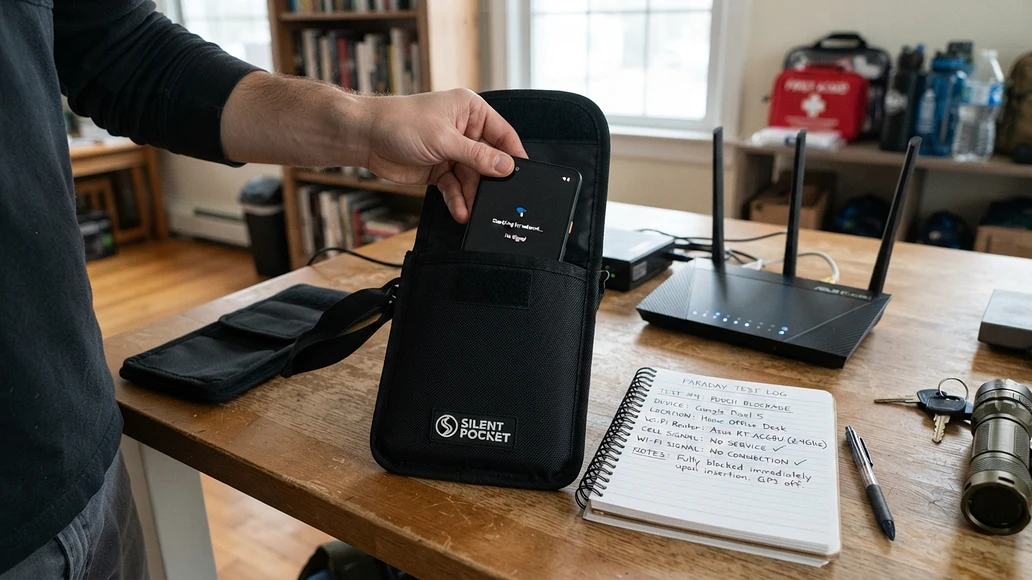
Common DIY mistakes that let 5G slip through
The most common mistake is assuming any metal container is good enough. A cookie tin with a loose lid may reduce signal, but if the lid does not make continuous conductive contact all around, it may leak badly.
Another mistake is letting the device touch the conductive shell directly in a rough DIY build. It is better to place the device inside a nonconductive inner layer, such as cardboard, foam, or cloth, so the shield remains intact and the device is not scratched or shorted by improvised metal edges.
People also overfocus on grounding. For blocking radio signals, grounding is often not required for a small enclosure or pouch. Grounding can matter in some electrical safety or static-control contexts, but it is not the magic ingredient that turns a leaky box into a good RF shield.
Finally, avoid routing charging cables into the enclosure unless you understand filtered feedthrough design. A plain cable can become a path for signal leakage.
Comparing common shielding options
| Shielding method | Portability | Typical performance range | Main strengths | Main weaknesses | Best use case |
|---|---|---|---|---|---|
| Metal box with improved seam contact | Low | Moderate to high, depends on lid quality | Durable, inexpensive, good for storage | Heavy, easy to build poorly | Home storage of small electronics |
| Fine mesh cage | Low to medium | Moderate to high if mesh and seams are correct | Scalable, visible construction | Openings and joints require care | DIY projects and larger enclosures |
| Faraday bag or pouch | High | Moderate to very high, depends on closure and testing | Portable, convenient, ideal for phones and key fobs | Wear over time, quality varies widely | Travel, privacy, emergency kits |
| Shielding paint | None after installation | Moderate to high when properly applied | Useful for rooms and walls | Permanent work, electrical safety concerns | Home shielding projects with professional help |
| Conductive fabric canopy | Medium | Low to moderate, product dependent | Large coverage area, removable | Not ideal for complete device isolation | Specialized room or bed-area applications |
Preparedness and privacy uses that make sense
The strongest practical case for Faraday protection is signal control. That includes storing spare electronics, reducing the chance of key fob relay theft, isolating a phone from networks temporarily, or keeping a backup device offline until needed.
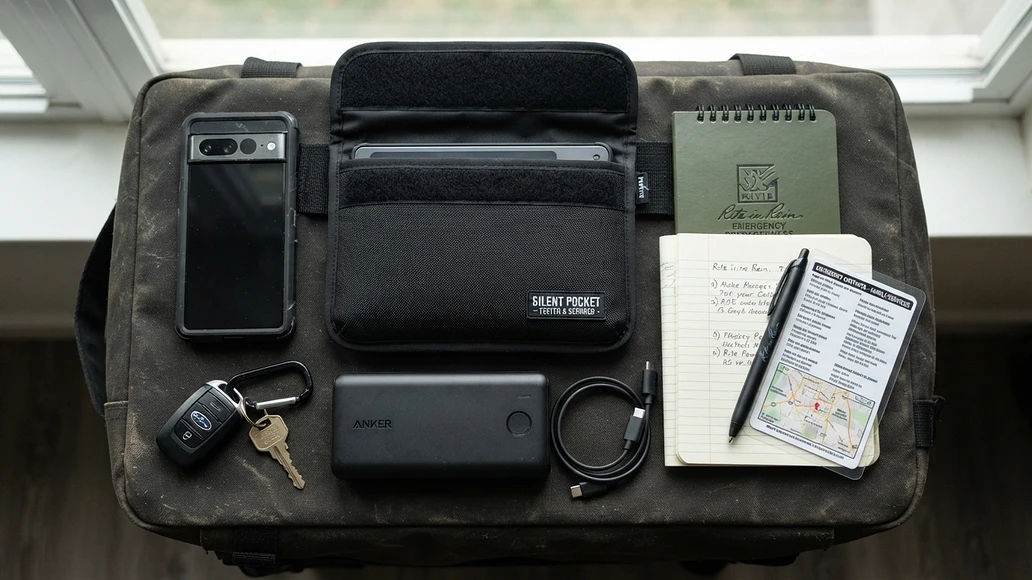
For emergency planning, a Faraday bag is not a substitute for a communications plan. It is one tool. You still need offline maps, printed contacts, backup power, and a clear routine for when devices should be isolated and when they should be available.
If your use case is security-critical, such as evidence handling, forensic isolation, or high-value executive travel, consumer bags may not be enough. That is where professionally tested shield boxes and documented attenuation data become important.
Health claims, what shielding can and cannot promise
Some readers come to this topic because of worries about EMF exposure. It is reasonable to want accurate information and practical control over your devices. But it is important to keep the claims grounded.
Faraday cages and bags are best understood as tools for signal blocking, privacy, and interference control. They are not proven medical devices, and they should not be treated as a substitute for healthcare, prenatal care, or treatment for chronic symptoms. If you have health concerns that you think may be related to wireless exposure, talk with a licensed healthcare professional and review mainstream public-health guidance.
For permanent home shielding projects, especially those involving conductive paints, grounding changes, or work near household wiring, consult a qualified electrician or RF professional. Poor installation can create shock, fire, or code issues.
Maintenance and retesting
Shielding performance can degrade over time. Conductive fabrics crease and wear. Closures lose tension. Metal surfaces corrode. Adhesive conductive tapes lift at the corners. A bag that worked well last year may not perform the same today.
Retest after heavy use, after any repair, and whenever you change devices. New phones may use different bands and antennas, and 5G deployments continue to evolve. Updated product test data matters more than old marketing claims.
What is well supported, and what is not
| Claim or topic | Evidence status | Practical takeaway |
|---|---|---|
| A properly designed Faraday cage can block 5G signals | Well supported | Good enclosures and bags can stop practical communication across relevant bands |
| Mesh size and seam quality are critical | Well supported | Openings and closures usually determine success or failure |
| Higher 5G frequencies are easier to block but more sensitive to tiny gaps | Well supported | mmWave does not like solid barriers, but sloppy construction leaks more easily |
| Most quality Faraday bags block all modern wireless equally well | Mixed | Some do, some do not, verify tested frequency coverage |
| A single phone-call test proves complete shielding | Weak | Use multiple tests and repeat them under strong-signal conditions |
| Faraday shielding is a proven medical necessity for routine wellness | Weak | Keep health claims cautious and seek medical advice for symptoms |
FAQ
Does a microwave oven work as a Faraday cage for a phone?
Sometimes it reduces signal strongly, but it is not a recommended storage solution. Microwave ovens are designed for a specific frequency range and for cooking safety, not as general-purpose RF isolation containers for modern devices. Do not modify or misuse one, and never run it with electronics inside.
Does a Faraday cage need to be grounded to block 5G?
Usually no, not for a small bag or enclosure whose main job is blocking radio signals. Grounding is often misunderstood. Good conductive coverage and tight seams matter more for RF isolation than a ground wire does.
Can a phone still be tracked inside a Faraday bag?
If the bag is working properly, the phone should not be able to communicate normally with cellular, Wi-Fi, Bluetooth, or location networks. But a poor-quality or worn bag may leak enough for intermittent contact. That is why testing and retesting are essential.
What attenuation level should I look for if I want to stop 5G communication?
As a practical target, many users look for products with published performance in the 60 dB to 85 dB range across relevant cellular and Wi-Fi bands. More is generally better, but the frequency range and closure design matter just as much as the headline number.
Bottom line
5G does not have some special ability to defeat a real Faraday cage. If the enclosure is continuous, conductive, and well sealed, it can block 5G very effectively. What usually fails is not the physics, it is the build quality.
If you want dependable results, think beyond the phrase metal box. Match the shield to the frequencies you care about, pay close attention to seams and closures, and test with more than one radio. That approach is far more useful than fear-based claims or one-time phone tricks.
References
- Metal Enclosure Improvement
- Cage de Faraday : guide complet pour comprendre, fabriquer ...
- How To Choose The Best Faraday Bag: A Complete Buying Guide
- RF Attenuation Charts Explained: What Faraday Bag Ratings ...
- Faraday Pouches: How Signal-Blocking Bags Work and When...
- Faraday Cage Buying Guide: How to Choose Effective RF ...
- What Is a Faraday Bag? · The Definitive 2026 Guide | REVIS-1 Learn
- What is a Faraday Cage? Complete Guide - Shield Your Body
- Do Faraday Pouches Really Work? A UK Expert's Guide
- 5G Signals Disappear in Elevators Due to Physics