Faraday Cages and Modern 5G, What Actually Gets Blocked
5G is not one single signal, and a Faraday cage is not just any metal box. Learn when shielding stops modern wireless signals, why seams and mesh size matter, and how to test a cage or pouch realistically.

If you want the short answer, a properly designed Faraday cage can block 5G signals. The catch is that 5G is not a single frequency, and many homemade cages or cheap signal-blocking bags are only partial shields. In real life, 5G usually gets through because of gaps, poor closures, oversized mesh, worn conductive fabric, or cables that act like antennas.
That matters for preparedness, privacy, and device security. A good cage or pouch can isolate a phone, key fob, radio accessory, or backup electronics from wireless communication. A bad one can create false confidence. The practical question is not just whether 5G can penetrate a Faraday cage, but what kind of cage, at what frequency, and with how much leakage.
This guide explains the physics in plain English, compares shielding options, and shows how to test your setup without drifting into hype. For health concerns related to EMF or 5G, use mainstream medical and public health guidance. Faraday products are best understood as tools for signal control, privacy, and interference reduction, not medical treatment.
What a Faraday cage really does
A Faraday cage is a conductive enclosure that reduces electromagnetic energy entering or leaving the space inside it. At radio frequencies, shielding works mainly through reflection and absorption. If the conductive shell is continuous enough, incoming energy is weakened so much that a device inside cannot maintain a usable connection.
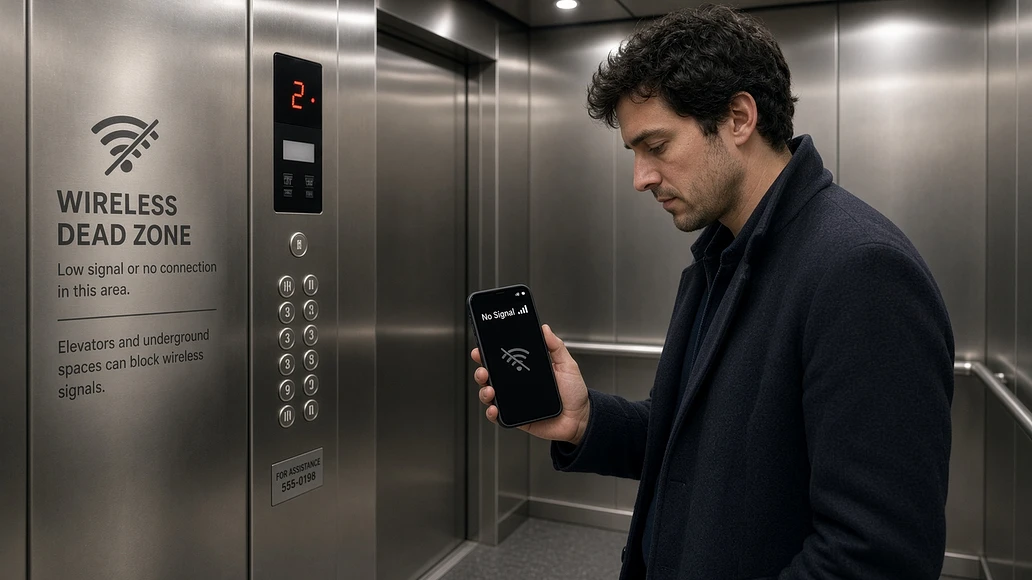
That is why an elevator, metal room, or well-built shield box can make a phone lose service. It is also why a random metal container may fail. A simple metal box is not automatically an effective Faraday cage if the lid does not make good contact, the seams leak, or the contents touch the conductive walls in ways that compromise the setup.
Blocking is not the same as perfect elimination
In everyday use, the goal is usually attenuation, not perfection. If a cage reduces signal strength enough that the phone cannot register on the network, send a location update, or receive a call, it is doing the job for most preparedness and privacy uses. That does not mean every trace of RF energy has vanished.
| Claim or topic | Evidence status | Practical takeaway |
|---|---|---|
| A well-built Faraday cage can block 5G communication | Well supported | Good enclosures and quality pouches can reduce signal enough to stop real-world use |
| Any metal box works the same as a Faraday cage | Weak | Seams, closures, coatings, and openings often determine success or failure |
| A phone-call test alone proves complete shielding | Weak | Use several tests across cellular, Wi-Fi, Bluetooth, and location services |
| Faraday products are proven medical protection from 5G | Mixed to weak | Use them for signal control and privacy, not as a substitute for medical advice |
Why 5G is harder to discuss than people think
One reason this topic gets oversimplified is that 5G spans several frequency ranges. Low-band 5G behaves differently from mid-band, and both differ from millimeter wave, often called mmWave. A cage that blocks one range may perform differently at another, especially if it has small leaks.
| 5G band type | Typical frequency range | Approximate wavelength | What it means for shielding |
|---|---|---|---|
| Low-band | About 600 MHz to 1 GHz | About 50 cm to 30 cm | Longer wavelengths can exploit larger openings, so broad continuity matters |
| Mid-band | About 2.5 GHz to 4 GHz | About 12 cm to 7.5 cm | Common for current 5G, seams and closures become more critical |
| mmWave | About 24 GHz to 40 GHz | About 12.5 mm to 7.5 mm | Easier to weaken with solid metal, but tiny gaps and poor seals can become major leak points |
That last point surprises people. Higher frequencies often penetrate buildings less effectively, which can make them easier to block with solid conductive material. But because the wavelengths are so short, tiny slots, zipper leaks, and seam defects matter more.
Can 5G get through a Faraday cage in theory
In theory, an ideal Faraday cage with continuous conductive coverage and no meaningful openings will block 5G. That includes low-band, mid-band, and mmWave. In practice, consumer products and DIY builds are not ideal. They attenuate signals by a certain number of decibels, and that attenuation varies by frequency.
For many real-world uses, attenuation in the range of 60 dB to 85 dB is strong enough to stop normal communication. Lower attenuation may still be useful, but it can allow intermittent connections in strong signal areas. That is why a pouch that works in one room may fail near a cell tower or router.
Where most cages fail
The weak points are usually not the metal itself. They are the openings and transitions. Common failure points include:
- Lids that do not make continuous conductive contact
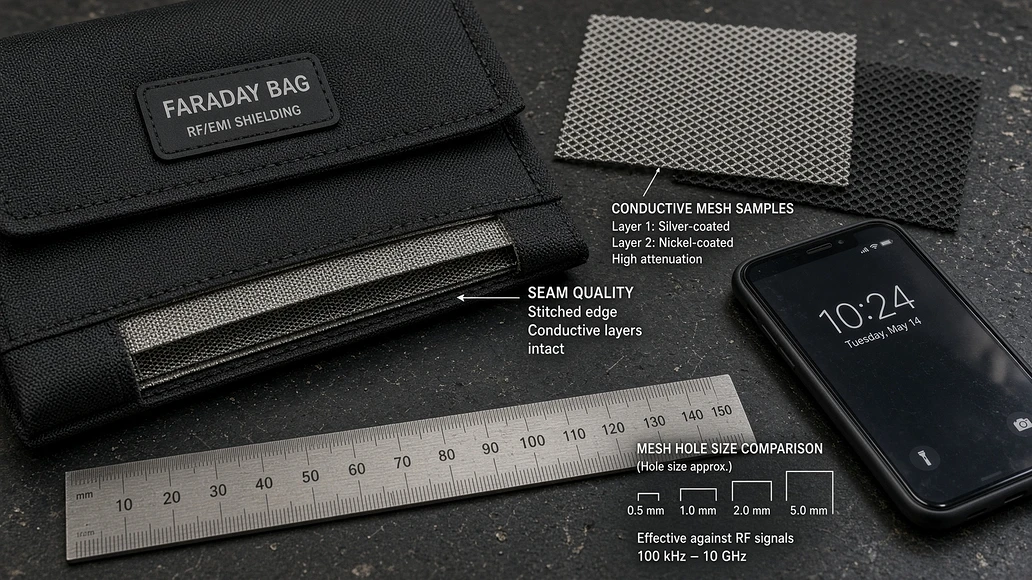
- Mesh openings that are too large for the target frequency
- Single zippers without conductive overlap
- Painted or coated surfaces that interrupt metal-to-metal contact
- Torn conductive fabric or worn pouch linings
- Power cords, charging cables, or antenna leads entering the enclosure
- Devices touching the cage walls directly, especially in improvised builds
If you remember one design lesson, make it this: seams and closures usually matter more than the bulk material.
Mesh size, materials, and shielding performance
A common rule of thumb is that openings should be smaller than half the wavelength of the signal you want to block, and in practice smaller is better. For modern wireless devices, especially when you want broad coverage across cellular, Wi-Fi, Bluetooth, and GPS, tighter mesh or solid conductive layers are safer choices than coarse screen material.
Copper, aluminum, steel, and conductive fabrics can all work. The best choice depends on whether you need portability, durability, corrosion resistance, or a permanent installation. Conductive fabrics and pouches are convenient, but they wear out faster than rigid enclosures. Metal boxes can perform very well, but only if the lid and seams are designed correctly.
| Shielding method | Typical performance range | Strengths | Weaknesses | Best use case |
|---|---|---|---|---|
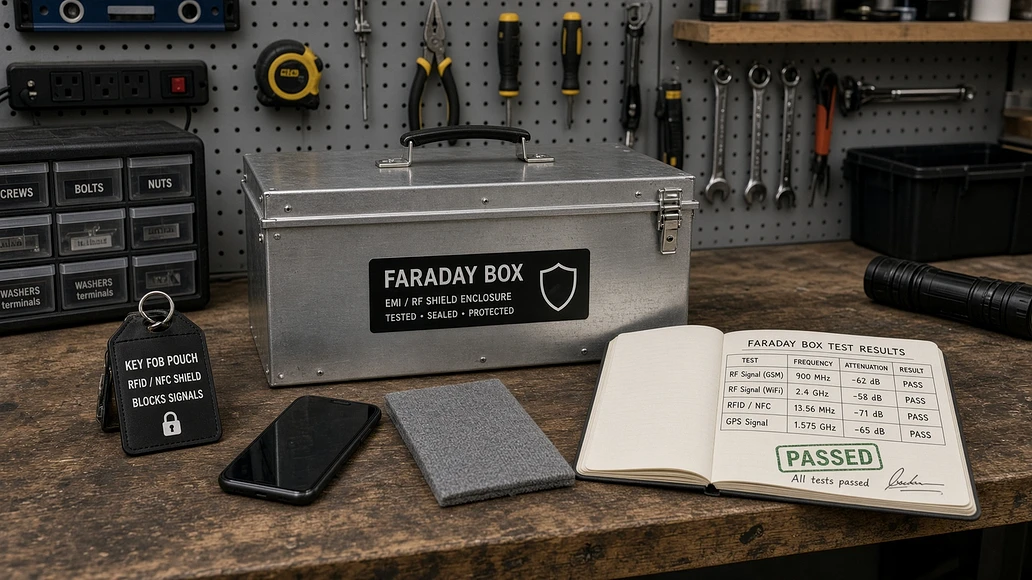
| Rigid metal box with conductive lid contact | Often strong across cellular and Wi-Fi when well built | Durable, repeatable, good for storage | Lid design is critical, less portable | Home preparedness, spare electronics, key storage |
| Fine metal mesh cage | Can work well if openings and seams are controlled | Ventilation, visibility | Design-sensitive, leaks at joins | DIY projects, larger enclosures |
| Faraday bag or pouch | Ranges from poor to excellent depending on fabric and closure | Portable, convenient | Wear, seam failure, inconsistent quality | Phones, key fobs, travel use |
| Conductive paint | Can provide meaningful attenuation when properly installed | Useful for room-scale projects | Installation complexity, electrical safety concerns | Specialized home shielding projects |
| Canopy or shielding fabric enclosure | Often moderate attenuation rather than full isolation | Large coverage area | Not ideal for complete device isolation | Niche room or bed-area applications |
Do Faraday bags block 5G
Some do, some do not. A quality Faraday bag can block or heavily attenuate sub-6 GHz 5G, along with 4G, Wi-Fi, Bluetooth, GPS, and RFID. But many low-cost products are really just RFID blockers. That may be enough for a card, but not for a smartphone using multiple radios across several bands.
When shopping, look for published frequency coverage and attenuation data, not just marketing phrases like signal blocking or military grade. A serious product should specify the tested range and explain the closure design. Overlapping conductive folds are generally more trustworthy than ordinary zippers alone.
What to look for in a 5G-ready pouch
| Feature | Why it matters | What to prefer |
|---|---|---|
| Published frequency range | 5G, Wi-Fi, GPS, and Bluetooth use different bands | Coverage that clearly includes cellular, Wi-Fi, and GPS relevant ranges |
| Attenuation data in dB | Shows measured reduction, not just a yes or no claim | Independent or standards-based test results |
| Closure design | Most leaks happen at the opening | Fold-over conductive closure or tested multi-layer seal |
| Material layers | Multiple conductive layers often improve reliability | Purpose-built shielding fabric, not decorative metallic lining |
| Durability | Wear can reduce shielding over time | Reputable construction, replaceable if used daily |
Everyday places that act like partial Faraday cages
Elevators are a familiar example. Phones often drop calls or struggle to connect inside because the metal enclosure weakens the signal. Steel-framed buildings, utility rooms, and some basements can do the same. These are not perfect cages, but they show how conductive structures can interfere with modern wireless service, especially at higher frequencies.
This also explains why 5G, especially mmWave, has a harder time indoors. The same physics that make fast high-frequency signals useful for dense urban coverage also make them easier to disrupt with walls, metal, coated glass, and structural materials.
How to test whether your cage really blocks modern signals
A single phone-call test is better than nothing, but it is not enough. Phones use multiple radios and may switch between cellular, Wi-Fi, Bluetooth, and cached location features. A better approach is to test several functions and repeat the test in a strong signal environment.
- Charge the device first, then disable any settings that could confuse the test, such as airplane mode.
- Place the phone in the cage or pouch and seal it exactly as intended.
- Try a phone call and text message from another device.
- Test Wi-Fi on both 2.4 GHz and 5 GHz if available.
- Test Bluetooth pairing or device discovery.
- Check whether location-based features, such as Find My or similar services, still update after enough time has passed.
- Repeat near a strong router or in an area with strong cellular coverage to avoid false confidence.
| Test method | What it checks | Useful for | Main limitation |
|---|---|---|---|
| Phone call or text | Basic cellular connectivity | Quick pass or fail check | Does not reveal partial leakage well |
| Wi-Fi test | 2.4 GHz and 5 GHz shielding | Checking common high-frequency leaks | Depends on router strength and distance |
| Bluetooth test | Short-range radio leakage | Spotting seam or closure problems | Short range can make results inconsistent |
| Location service check | Whether the device can still communicate position updates | Privacy and tracking concerns | May involve delays and cached data |
| Lab RF measurement | Attenuation across frequencies | Security-critical or professional use | Requires specialized equipment |
If the device still connects sometimes, do not assume the network is unusually strong and the cage is good enough. For preparedness and privacy, intermittent leakage is still leakage.
When you need more than a home test
If you are isolating evidence, protecting sensitive devices, or trying to verify a product for professional use, look beyond casual testing. Shielding effectiveness is measured in decibels across a frequency range. Standards such as ASTM D4935 and IEEE 299 are commonly referenced when manufacturers or labs characterize shielding materials and enclosures.
Forensic labs and device test facilities often use RF shield boxes built specifically for phones and wireless equipment. Those products are designed to provide repeatable attenuation over known bands, sometimes extending into mmWave ranges. That level of verification is overkill for most households, but it shows why published test data matters.
Common DIY mistakes and practical fixes
| Failure point | Typical symptom | Likely cause | Practical fix |
|---|---|---|---|
| Lid gap | Phone still rings or receives texts | Poor conductive contact around the opening | Add conductive gasket material or redesign the closure |
| Large mesh holes | Wi-Fi or 5G still works nearby | Openings too large for target frequencies | Use finer mesh or a solid conductive layer |
| Ordinary zipper | Bag works inconsistently | Leak path along the closure | Use a fold-over conductive closure or double-layer design |
| Painted contact surfaces | Metal box underperforms | Insulating coating interrupts continuity | Expose conductive contact points safely |
| Worn fabric lining | Bag used to work, now leaks | Material fatigue or abrasion | Replace the pouch and retest regularly |
| Cable entering enclosure | Unexpected connectivity remains | Wire acts as an antenna path | Avoid penetrations unless professionally filtered |
Which option makes sense for preparedness and privacy
For most people, the best choice depends on the item and the mission. A key fob pouch is different from a phone isolation bag, and both are different from a storage box for backup electronics.
| Use case | Best option | Why | Notes |
|---|---|---|---|
| Car key fob storage | Small tested Faraday pouch | Portable and easy to use daily | Retest often because daily wear matters |
| Phone privacy during travel | Quality Faraday bag with published test data | Blocks multiple radios in a compact form | Verify GPS, Wi-Fi, and cellular, not just calls |
| Backup radios or spare electronics at home | Rigid metal container with reliable conductive seal | More durable for long-term storage | Pad contents so devices do not contact the metal directly |
| Room-scale shielding project | Professional design using mesh or conductive paint | Can address larger spaces | Consult qualified electricians or RF professionals for permanent work |
What shielding can and cannot do for health concerns
Some readers come to this topic because they are worried about EMF exposure. It is reasonable to want accurate information and practical control over your environment. Still, Faraday cages and shielding products should not be presented as proven medical protection or a substitute for healthcare.
Mainstream public health guidance does not recommend consumer Faraday cages as necessary routine medical protection from 5G. If you are dealing with headaches, sleep problems, pregnancy concerns, or chronic symptoms that you think may be related to EMF, talk with a licensed healthcare professional. If worry about EMF becomes intense or disruptive, it may also help to discuss that anxiety directly with a qualified clinician.
For permanent home shielding, especially conductive paints or modifications near wiring, treat electrical safety seriously. Poor installation can create shock or fire hazards. Follow local code and consult a qualified electrician when the project involves walls, outlets, grounding, or mains power.
Maintenance matters more than most buyers expect
Shielding performance can degrade with use. Bags crease, conductive coatings wear thin, seams loosen, and corrosion can appear on metal contact surfaces. A pouch that worked last year may not work today, especially if it rides in a pocket, glove box, or backpack every day.
Retest after heavy use, after any repair, and whenever you change devices. New phones may use different bands, stronger antennas, or different network behavior. As 5G deployments evolve, updated test data is more useful than old marketing claims.
Bottom line
5G does not magically penetrate a true Faraday cage. What usually happens is that the enclosure is not a true high-performance cage. A well-designed shield can block 5G, but a sloppy lid, weak zipper, oversized mesh, or worn fabric can let signals leak through.
If your goal is preparedness, privacy, or key-fob security, focus on tested products, careful design, and repeatable verification. Think in terms of attenuation and failure points, not myths. The best Faraday setup is the one you have actually tested against the signals your device uses.
FAQ
Does a microwave oven work as a Faraday cage for 5G phones?
Sometimes it can attenuate signals, but it is not a reliable or recommended substitute for a purpose-built Faraday cage or bag. Door seals vary, leakage performance is not designed for this use, and you should never run the microwave with electronics inside. Use it only as a rough experiment, not as trusted protection.
Does a Faraday cage need to be grounded to block 5G?
No. Grounding is not generally required for blocking radio signals in a small enclosure or pouch. Shielding depends mainly on conductive continuity and minimal openings. Grounding may matter in some specialized electrical or lightning contexts, but it is not the reason a phone pouch blocks cellular service.
Can my phone still be tracked in a Faraday bag?
If the bag is working properly, the phone should not be able to send or receive the radio signals needed for normal tracking, calls, texts, or remote commands. But if the bag leaks, tracking may still occur intermittently. Also remember that location history may already exist from before the phone was isolated.
How much attenuation is enough to stop 5G communication?
There is no single number that guarantees success in every environment, because signal strength and frequency vary. In general, higher attenuation is better, and many serious products aim for roughly 60 dB to 85 dB or more across relevant bands. The key is not the advertised peak number alone, but whether the product maintains strong attenuation across the frequencies you care about.
References
- Metal Enclosure Improvement
- How To Choose The Best Faraday Bag: A Complete Buying Guide
- RF Attenuation Charts Explained: What Faraday Bag Ratings Really Mean
- Cage de Faraday : guide complet pour comprendre, fabriquer, utiliser
- Faraday Pouches: How Signal-Blocking Bags Work and When to Use Them
- Faraday Cage Buying Guide: How to Choose Effective RF
- Do Faraday Pouches Really Work? A UK Expert's Guide
- What is a Faraday Cage? Complete Guide
- What Is a Faraday Bag? The Definitive Guide
- 5G Signals Disappear in Elevators Due to Physics