Can Your Microwave Really Shield Electronics? The Science, Limits, and Safer Alternatives
A microwave oven uses Faraday cage principles, but that does not make it a dependable EMP shelter. Here is what it can block, what it cannot, and how to choose better home preparedness options.

Many people have heard that a microwave oven is basically a Faraday cage. That idea is partly true, but it needs context. A microwave is built to keep a specific kind of radio-frequency energy inside the cooking cavity, not to serve as a universal shield for every electromagnetic threat. If you are wondering whether your kitchen microwave can block signals, reduce exposure, or protect emergency electronics, the short answer is this: it can act like a Faraday cage in a narrow, design-specific way, but it is not a reliable substitute for a purpose-built Faraday container.
This matters for both everyday safety and preparedness. A working microwave should leak only very small amounts of energy under regulatory limits, and normal use does not make food radioactive or cause cancer. At the same time, using a microwave as your only plan for EMP or CME protection is not a sound strategy. The details below explain why.
What a Faraday cage actually is
A Faraday cage is a conductive enclosure that reduces the electric fields and radio-frequency energy reaching whatever is inside it. In simple terms, the metal shell redirects or absorbs incoming electromagnetic energy so less of it gets through to the contents.
That simple definition hides an important detail. Real shielding performance depends on frequency, construction quality, and continuity. A box with gaps, seams, poor contact points, or attached wires may still block some signals while failing badly against others. That is why engineers talk about shielding effectiveness, attenuation, aperture size, and frequency range instead of treating every metal container as equal.
Three design factors matter most:
- How continuous the conductive shell is
- How large any openings are compared with the wavelength being blocked
- Whether cords, seams, hinges, and latches create leakage paths
Grounding can matter in some applications, but a shield does not always need grounding to reduce radio-frequency energy. What matters most for a household discussion is that a true, dependable cage needs good conductive continuity and very limited openings.
How a microwave oven uses Faraday cage principles
A microwave oven heats food with radio-frequency energy generated by a magnetron, usually around 2.45 GHz. The metal cooking cavity reflects that energy around the chamber so it can interact with water-rich food. The oven body, door frame, and door screen are specifically designed to keep most of that energy inside while still letting you see through the window.
So yes, a microwave oven uses Faraday cage principles. The metal shell acts as a shield, and the door includes a conductive mesh with holes small enough to block the oven's microwave wavelength while still passing visible light.
That last point is the key to understanding the whole question. The oven is engineered around a known frequency. It is not a general-purpose broadband shield.
Why the door screen works
At 2.45 GHz, the wavelength is roughly 12.2 centimeters, or about 4.8 inches. The holes in the microwave door mesh are far smaller than that wavelength, so the energy cannot efficiently pass through them. Visible light has a much shorter wavelength, which is why you can still see your food cooking.
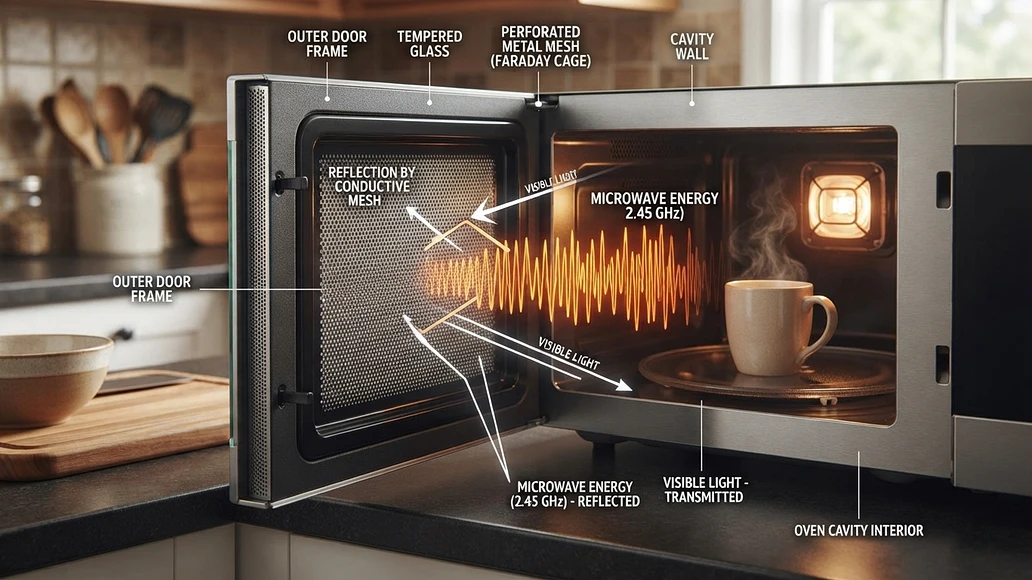
This is a useful example of frequency-specific shielding. A barrier can be effective against one band of energy and much less effective against another.
So, is a microwave oven technically a Faraday cage?
In casual language, yes. In engineering language, only partly.
A microwave oven is a Faraday-like enclosure designed to contain microwave radiation near its operating frequency. That means it behaves like a Faraday cage for the job it was built to do. But if someone means a robust enclosure for broad electromagnetic protection, including unpredictable pulses or a wide range of frequencies, then a household microwave does not meet that standard.
The most accurate answer is this: a microwave oven is a specialized shielded cavity, not a dependable all-purpose Faraday cage.
| Option | Main purpose | Best frequency performance | Weak points | Good choice for EMP storage? | Everyday use case |
|---|---|---|---|---|---|
| Microwave oven | Contain cooking energy | Strongest near 2.45 GHz design range | Door seams, latch area, power cord, wear over time | No, not as a sole solution | Short-term signal blocking in a pinch, if oven stays off |
| Purpose-built Faraday bag | Shield portable electronics | Designed for broad RF reduction, varies by product | Quality varies, damage or poor closure reduces performance | Better than a microwave, especially for small devices | Travel, key fobs, phones, backup electronics |
| Well-built metal can or box with insulated contents | Preparedness storage | Can be effective across a wider range if built correctly | Seams, lid contact, interior insulation, testing needed | Often a better DIY option | Home storage for radios, chargers, spare electronics |
Why microwave shielding is not the same as EMP or solar storm protection
This is where many articles oversimplify the subject. A microwave oven is designed to contain a steady, known frequency generated inside the appliance. An EMP is a fast, intense electromagnetic pulse with broad frequency content. A CME, or coronal mass ejection, is different again. It is mainly a grid and infrastructure problem that can induce currents in long conductors such as power lines.
Those are not the same challenge as keeping 2.45 GHz cooking energy inside a metal box.
A microwave has several limitations for preparedness use:
- The door is a seam, not a welded continuous shell
- The latch and hinge areas are practical leakage points
- The power cord creates a conductive path
- The unit was never tested or certified as EMP protection
- Performance varies by model, age, and condition
That does not mean a microwave blocks nothing. It means you should not confuse partial signal blocking with verified survival of a high-intensity electromagnetic event.
Can a microwave block phone, Wi-Fi, Bluetooth, or key fob signals?
Sometimes, yes. Reliably, not always.
Many people have tested this informally by placing a phone in a microwave, closing the door, and seeing whether calls or messages still get through. Some ovens block cellular, Wi-Fi, Bluetooth, and key fob signals well enough for a quick demonstration. Others leak enough that some signals still pass, especially depending on carrier frequency, phone power, oven design, and local signal strength.
That means a microwave can be a makeshift radio-frequency shield for short-term use, but it is inconsistent. Blocking a phone signal for a few minutes is not proof of serious shielding performance.
There are also safety limits:
- Never turn the microwave on with a phone, radio, batteries, metal objects, or other electronics inside unless the manufacturer explicitly says that use is safe
- Do not use the oven as a routine storage locker for critical gear
- Do not rely on a signal test as proof of EMP readiness
How safe are microwave ovens in normal household use?
For normal cooking, a properly working microwave is considered safe. Regulatory agencies set strict leakage limits, and modern ovens are designed to stay well below levels associated with harm when used as directed. Exposure also drops quickly with distance, which is why standing a few feet away further reduces an already low level.
Microwave ovens use non-ionizing radiation. That means the energy can heat materials, but it does not have the kind of energy needed to change atomic nuclei or make food radioactive. Current evidence also does not support the claim that normal microwave use causes cancer.
| Situation | What exposure means in practice | Relative concern level | Practical guidance |
|---|---|---|---|
| Door closed, oven in good condition | Leakage should remain below regulatory limits | Low | Use normally, keep seals clean, avoid pressing against the door |
| Standing 2 feet away while it runs | Exposure is lower than at the surface because intensity drops with distance | Very low | Reasonable everyday distance in a home kitchen |
| Standing 3 or more feet away | Further reduction from already low leakage | Very low | A comfortable choice for cautious users and children nearby |
| Damaged door, bent frame, bad latch, or sparking | Shielding and safe operation may be compromised | Higher | Stop using the appliance and have it repaired or replaced |
If you are pregnant or simply cautious about EMF exposure, keeping a bit more distance is a personal comfort choice. The larger safety issue in most homes is not radiation, but burns, superheated liquids, and uneven food heating.
Common myths that confuse this topic
| Myth | What is more accurate |
|---|---|
| A microwave is the same thing as a true Faraday cage | It uses the same principle, but it is optimized for a narrow job and is not a verified all-hazard shield |
| If it blocks my phone, it will protect electronics from EMP | Phone blocking is a weak informal test and does not prove broadband pulse protection |
| Microwaved food becomes radioactive | Microwave ovens use non-ionizing radiation and do not make food radioactive |
| Normal microwave use causes cancer | Current evidence and mainstream health guidance do not support that claim when the oven is used properly |
| Any metal box is EMP-proof | Shielding depends on continuity, seams, openings, insulation, and construction quality |
Better preparedness options than using a microwave
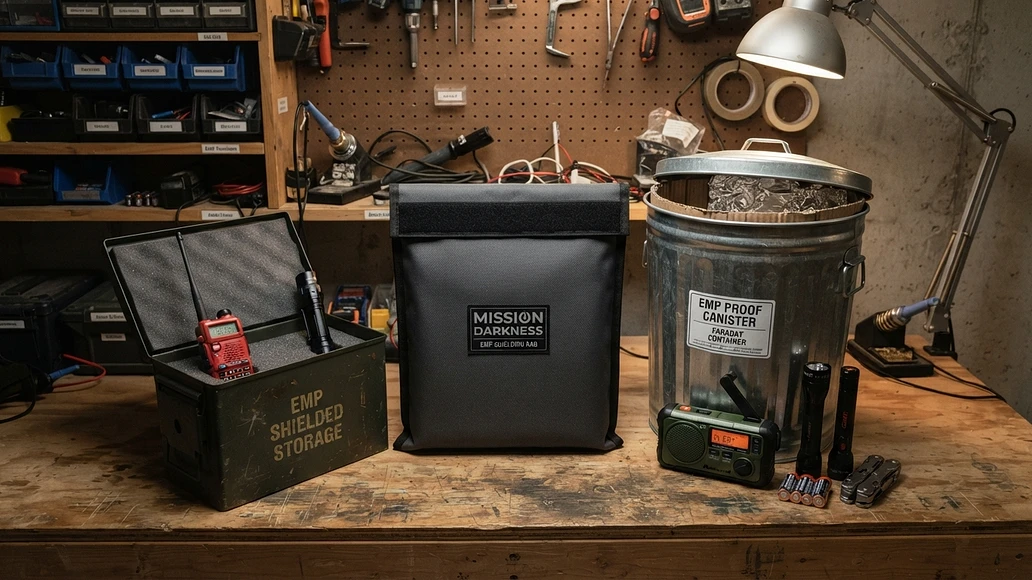
If your goal is to protect backup electronics, there are better choices than repurposing a kitchen appliance. A purpose-built Faraday bag or a carefully assembled metal container with insulated contents is usually more practical, easier to store, and more believable as a preparedness measure.
The basic design rules are simple:
- Use a conductive outer shell with good contact around the closure
- Keep the electronics insulated from touching the metal directly
- Minimize gaps and openings
- Store only dry, powered-off items
- Test your setup for ordinary signal reduction, while remembering that this still does not equal certified EMP testing
| Storage option | Strengths | Main drawbacks | Best use case |
|---|---|---|---|
| Faraday bag | Portable, convenient, made for electronics | Quality varies, closure must seal well | Phones, tablets, key fobs, small radios |
| Galvanized trash can with tight lid and insulation | Large capacity, affordable, common DIY choice | Needs careful interior insulation and lid fit | Home storage for multiple backup devices |
| Ammo can with insulated lining | Durable, compact, easy to organize | Gasket and contact surfaces may need attention for shielding performance | Spare handheld radios, batteries, chargers |
| Foil-wrapped insulated box | Cheap and accessible | Easy to damage, inconsistent results, awkward for long-term use | Temporary experiments or backup layers |
| Microwave oven | Already in the house, may block some signals | Not designed for storage, inconsistent shielding, unsafe if accidentally turned on | Very limited short-term use only |
How to tell whether your microwave is still shielding properly
You do not need to become a technician, but you should inspect the appliance regularly. The most important parts are the door, latch, hinges, and seal area.
What to look for
- Door that does not close flush
- Bent frame or damaged hinges
- Cracked or dirty seal surfaces
- Rust, heavy corrosion, or visible damage around the door opening
- Sparking, burning smell, or unusual noises during use
If you notice those problems, stop using the oven until it is repaired or replaced. Professional leakage testing is more meaningful than homemade experiments. A phone call test or Wi-Fi test can hint at shielding changes, but it does not tell you whether the oven meets safety limits.
When a microwave might be reasonable as a makeshift RF shield
There are a few narrow situations where using a microwave as a temporary shield can make sense, as long as the oven stays unplugged or clearly out of service and is never turned on with the device inside. For example, you might use it briefly to reduce phone or key fob signals during a quick test, a classroom demonstration, or a short privacy experiment.
Even then, it is a convenience move, not a best practice. It is not ideal for long-term storage, mission-critical electronics, or anything you cannot afford to lose.
A simple rule helps here. If the device matters enough that you are asking about EMP protection, it matters enough to store in something better than a microwave.
Microwave safety basics that matter more than the Faraday debate
For most households, the practical risks from a microwave are ordinary kitchen hazards, not exotic radiation scenarios. Safe use comes down to maintenance and common sense.
- Use microwave-safe containers only
- Avoid sealed containers that can burst
- Be careful with superheated liquids
- Stir and rest food to reduce cold spots and overheating
- Keep children from tugging the door or standing against the oven while it runs
- Do not use a damaged unit
These habits do more for household safety than worrying about whether the oven is secretly making food dangerous.
Preparedness without risky shortcuts
Concern about EMP, solar storms, and grid disruption is understandable, but good preparedness starts with realistic priorities. Water, lighting, backup communications, food storage, medications, and a family plan usually matter more than trying to turn every metal object in the house into a shielded vault.
If electronics protection is part of your plan, build it around redundancy. Keep paper copies of key information, have low-tech backups, and store a few essential devices in a better shielded container than a kitchen appliance. That approach is calmer, safer, and more likely to help in a real disruption.
FAQ
Can I store my emergency electronics in a microwave to protect them from EMP?
You can place powered-off electronics in a microwave temporarily, but it should not be your only EMP plan. A microwave is not designed or verified for that purpose, and seams plus the power cord limit confidence. A purpose-built Faraday bag or a well-made insulated metal container is a better option.
Is it safe to put my phone in a microwave if I do not turn it on?
Physically placing a phone in an off microwave for a brief signal-blocking test is generally less risky than operating the oven, but it is still not ideal routine practice. The real danger is accidental activation. If you use a microwave this way, make absolutely sure it stays off and that no one else can start it.
How can I tell if my microwave is leaking radiation?
Start with a visual inspection of the door, hinges, latch, and seal area. If the door is bent, does not close properly, or the oven sparks or smells hot, stop using it. For a meaningful answer, have the appliance checked professionally. Informal phone tests do not measure leakage against safety standards.
Do microwaves make food or containers radioactive?
No. Microwave ovens use non-ionizing radiation, which heats food but does not make it radioactive. The bigger concern is whether the container itself is microwave-safe and whether the food heats evenly.
Are there simple ways to build a better Faraday cage at home than using a microwave?
Yes. Common options include a galvanized metal trash can with a tight lid and nonconductive interior lining, an insulated ammo can, or a quality Faraday bag. The key is conductive continuity on the outside and insulation on the inside so devices do not touch the metal shell.