How Amish Communities Handle Power, And What Off Grid Families Can Learn
Many Amish households do not connect to the public electric grid, but that does not mean they live with zero power. This guide explains how Amish energy rules work, why they vary by community, and which low grid ideas can realistically help a modern home.

The short answer is yes, many Amish people use electricity in some form. The longer answer is that many Amish communities avoid connecting the home to the public electric grid, while still allowing certain local power sources such as batteries, generators, solar panels, compressed air systems, or engine driven equipment. The exact rule depends on the community, the bishop, and the local Ordnung, which is the customary code that shapes daily life.
That distinction matters because the common claim that Amish people use no electricity is too simple to be accurate. In many places, the real boundary is not electricity itself. It is whether a technology encourages dependence, convenience, individualism, or too much connection to the outside world. For modern readers interested in resilience, lower utility bills, or off grid living, that makes Amish energy practice less of a curiosity and more of a case study in selective technology.
This article explains the myth versus reality, the history behind Amish energy rules, the differences between Amish groups, and the practical lessons a non Amish household can borrow without romanticizing the lifestyle.
Myth versus reality, what Amish usually mean by “no electricity”
When people say the Amish do not use electricity, they usually mean Amish homes are often not tied into the public utility grid. That is different from saying they never use electric current, powered tools, or battery devices.
In many settlements, the public grid is seen as more than a wire. It can represent a direct link to a broader consumer culture and a stream of appliances that may reshape family and community life. A battery light, a solar powered fence charger, or a generator in a workshop may be judged differently because it is limited, local, and easier to control.
| Power source | Common Amish stance | Typical uses | Main advantage | Main drawback |
|---|---|---|---|---|
| Public electric grid | Often restricted or rejected in Old Order districts | Would power household appliances, lighting, HVAC, electronics | Reliable and convenient | Can invite unrestricted appliance use and outside dependence |
| Batteries | Often allowed in limited ways | Lights, small tools, flashlights, fence chargers | Portable and controllable | Needs charging, replacement, and management |
| Generators | Often allowed for shops or specific tasks | Power tools, farm equipment, workshop loads | Strong output when needed | Fuel cost, noise, fumes, maintenance |
| Solar panels with battery storage | Increasingly accepted in some communities | Barn lighting, pumps, small household loads, charging systems | Local power without grid tie | Upfront cost, battery replacement, design complexity |
| Compressed air or hydraulic power | Used in some shops and farms | Tools, mechanical equipment | Avoids wiring tools directly to grid power | Specialized setup, efficiency losses |
So the most accurate summary is this. Many Amish reject grid connection, not all electricity.
Why many Amish avoid the public grid
Amish decisions about technology are rooted in religious and social values, not in a belief that every modern invention is evil. Important ideas include humility, community accountability, family cohesion, and separation from the world. A technology is often judged by what it does to relationships, work patterns, and the pace of life.
Grid electricity became controversial because it could easily bring in radios, televisions, unrestricted lighting, and labor saving devices that might reduce interdependence within the family and church district. The concern was not only the wire itself. It was the social change that might follow once the house was fully electrified.
That is why Amish communities often ask questions that modern consumers rarely ask first:
- Will this tool strengthen or weaken family life?
- Will it make us more self sufficient or more dependent?
- Will it encourage pride, speed, and convenience for their own sake?
- Can the community set limits on its use?
Those questions help explain why one device may be accepted while another, seemingly similar one, is not.
How the Ordnung shapes energy rules
The Ordnung is the local code of conduct that governs many parts of Amish life, including dress, transportation, work practices, and technology. It is not identical everywhere. Each district may interpret and apply it somewhat differently, which is why broad statements about “the Amish” can be misleading.
Technology decisions are usually made slowly and communally. A bishop and church leaders weigh whether a new tool fits the values of the district. The question is often less “Can this work?” and more “What will this do to our people over time?”
That process creates visible variation. One district may allow battery lights in the home but not a wired electrical system. Another may permit a phone in a small shed away from the house. Another may allow solar panels for a dairy barn but not for extensive household convenience loads.
A short history of Amish electricity rules
Amish caution toward electricity became more defined in the early 20th century, especially as rural electrification spread. By the 1920s and later decades, many Amish communities had come to see connection to high voltage public power as a line they did not want to cross. Similar concerns shaped their approach to telephones and, later, other communication technologies.
The timing matters. Electricity was not rejected in a vacuum. It arrived during a period when industrialization, mass media, and consumer culture were changing rural America quickly. Amish communities often responded by drawing boundaries that would preserve a slower, more communal way of life.
Over time, however, the picture became more nuanced. As batteries, engines, inverters, and solar systems improved, some communities found ways to use limited local power without accepting full grid dependence. That is one reason modern Amish energy practice can look surprisingly adaptive rather than frozen in time.
Do all Amish groups follow the same rules
No. There is no single Amish rulebook for electricity that applies everywhere. Old Order Amish communities are often the most restrictive about household grid connection, but even among Old Order districts there is variation. New Order Amish groups may be more open to selected technologies. Beachy Amish and related groups are often more permissive still, though they are not always what people picture when they imagine the most conservative Amish lifestyle.
| Group type | Typical home electricity stance | Typical business or farm stance | Notes |
|---|---|---|---|
| Old Order Amish | Usually avoid public grid connection to the home | May allow generators, batteries, solar, or engine powered systems for work | Rules vary by district and bishop |
| New Order Amish | Often somewhat more open to selected technologies | May permit broader use of modern equipment | Still guided by community standards, not individual preference alone |
| Beachy Amish and related groups | Often more permissive with electricity and vehicles | May use modern business systems more freely | Practices can differ significantly from Old Order communities |
Region matters too. A dairy heavy settlement may make different decisions than a furniture making settlement. A district facing economic pressure may permit certain shop technologies that a more agrarian district would limit. That is why any honest answer must include the phrase “it depends on the community.”
What energy sources Amish households use instead
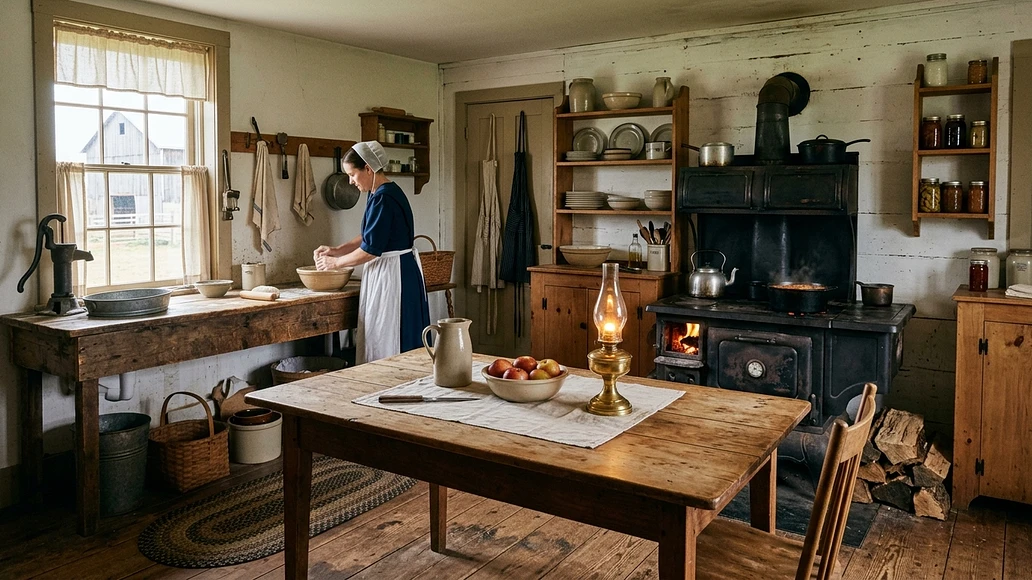
Amish homes and farms often rely on a layered energy system rather than one all purpose utility feed. Heat, light, water, refrigeration, and work power may all come from different sources. That approach can be inconvenient, but it also creates resilience because one failure does not shut down everything at once.
| Household function | Common Amish method | Typical mainstream method | Tradeoff |
|---|---|---|---|
| Space heating | Wood stove, coal stove, propane heater, masonry heater | Central furnace or heat pump | More labor and fuel handling, but less grid dependence |
| Cooking | Wood cookstove, propane or natural gas range | Electric or gas range | Reliable during outages, but may require more ventilation and attention |
| Lighting | Kerosene or propane lamps, battery lights, limited DC lighting | Whole house electric lighting | Lower convenience and brightness, but simple and local |
| Water pumping | Wind, engine, hydraulic ram, solar pump, gravity systems | Electric well pump | Can work off grid, but design is site specific |
| Refrigeration | Propane refrigerator, ice, root cellar, spring house in some cases | Electric refrigerator and freezer | Less capacity and flexibility, but no grid tie required |
| Laundry | Wringer washer, line drying, gas or engine assisted systems | Electric washer and dryer | More time and labor, lower energy demand |
Common fuels and power sources include wood, propane, natural gas, kerosene, gasoline, diesel, batteries, solar panels, and in some cases wind or water powered systems. The exact mix depends on local fuel prices, climate, building style, and community rules.
Inside an Amish home, heat, light, water, and refrigeration
Heat
Wood heat is one of the best known features of Amish homes. A wood stove or masonry heater can provide dependable warmth without the grid, but it requires fuel storage, ash handling, chimney maintenance, and daily labor. Some homes also use propane or natural gas for cooking and supplemental heat.
Light
Lighting may come from oil lamps, propane lamps, battery powered fixtures, or small local electrical systems. These options work, but they are dimmer, more limited, and sometimes less safe than modern wired lighting if used carelessly.
Water
Water systems vary widely. Some homes use gravity fed storage, some use engine or solar powered pumps, and some farms use more complex systems for livestock and dairy operations. Water is one of the hardest parts of true off grid living because it requires reliable pumping, storage, freeze protection, and sanitation planning.
Cold food storage
Propane refrigerators are common in many off grid settings, including some Amish homes. Root cellars, cool basements, and seasonal food preservation also reduce dependence on electric refrigeration. That said, these methods require planning and may not match the convenience or food safety margin of a modern refrigerator and freezer setup.
Do Amish use phones, e bikes, and power tools
Sometimes, yes. The same principle of selective use applies here. A phone may be allowed in a separate booth or workshop rather than inside the home. Battery powered lights and tools may be acceptable where a grid connected house full of electronics is not. E bikes have appeared in some communities because they can extend travel range without fully adopting cars, though they are also controversial in some districts.
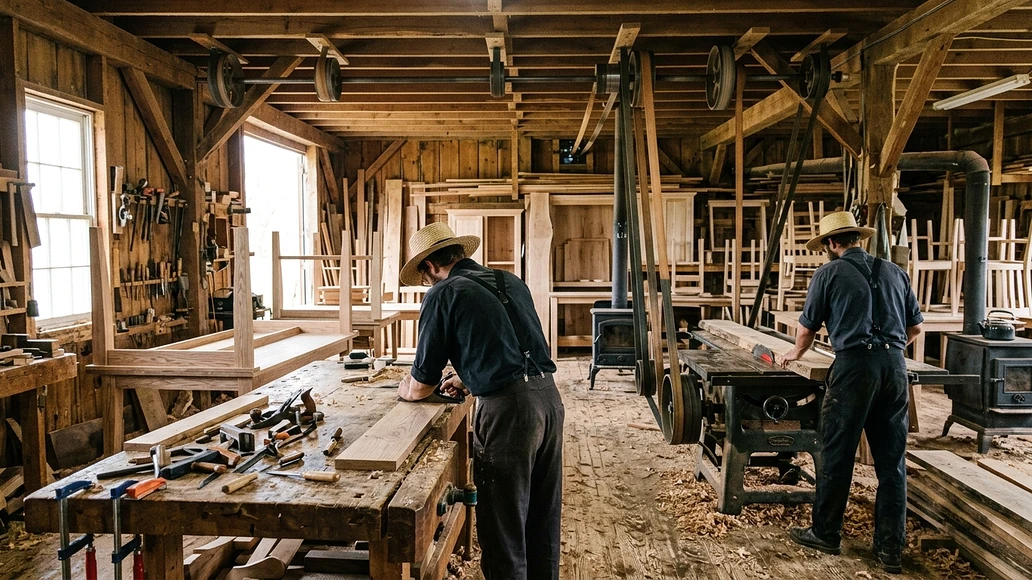
Power tools are especially common in Amish businesses. Furniture shops, machine shops, and farm operations often need practical workarounds to stay economically viable. That may mean pneumatic tools, hydraulic systems, generator power, or solar charged battery tools.
This can look inconsistent from the outside, but from within the community the distinction is often about scale, purpose, and social effect. A tool used for work under clear limits may be treated differently from a convenience device that changes home life.
Amish farms and businesses often have different energy rules than homes
One of the biggest misunderstandings is assuming home rules and business rules are always identical. They often are not. A dairy barn may need cooling, pumping, or lighting systems that a home does not. A workshop may need power tools to remain competitive. In some communities, limited electricity for business use is more acceptable than broad household electrification.
This is another reason the phrase “Amish do not use electricity” misses the real picture. Many Amish communities are not anti tool. They are pro boundary.
What is well supported, and what is overstated
| Claim or theme | Evidence level | Practical takeaway |
|---|---|---|
| Many Amish reject public grid electricity, not all electricity | Well supported | Do not confuse no grid connection with zero power use |
| Ordnung guides technology decisions | Well supported | Community values shape tool choices more than technical capability alone |
| Batteries, generators, compressed air, and solar are used in some Amish settings | Well supported | Local, limited power sources are often more acceptable than utility service |
| Most Amish homes rely heavily on wood and gas fuels | Well supported | Off grid living usually shifts dependence from wires to fuels and labor |
| Amish never pay energy bills | Mixed | They may avoid utility bills, but still pay for propane, fuel, equipment, and maintenance |
| All Amish strictly avoid electrical devices | Weak or incorrect | Rules vary too much for blanket statements |
| Amish systems are secret and automatically better than modern homes | Weak | The useful lesson is selective design, not romantic marketing |
What modern households can learn from Amish energy practice
The most valuable lesson is not to copy Amish life literally. It is to think in systems. Amish households often reduce demand first, then match each need with the simplest workable energy source.
| Design principle | What it means | How a modern household can apply it |
|---|---|---|
| Demand reduction | Use less energy before adding more supply | Air seal the house, improve insulation, choose efficient appliances, reduce standby loads |
| Fuel flexibility | Do not rely on one energy source for everything | Combine grid power with backup heat, solar charging, and alternative cooking options |
| Redundancy | Have more than one way to meet critical needs | Keep backup lighting, water storage, and outage cooking methods |
| Repairability | Favor durable systems that can be maintained locally | Choose simple heaters, serviceable tools, and standard parts where possible |
| Passive design | Let the building do part of the work | Use shading, orientation, insulation, thermal curtains, and ventilation planning |
For many families, the realistic path is partial adoption. A wood stove for emergency heat, a small solar battery system for lights and communications, a clothesline, a pressure canning routine, or a better pantry may deliver most of the resilience benefit without requiring a total lifestyle overhaul.
The tradeoffs are real, and they matter
Amish style energy systems can reduce dependence on the grid, but they are not effortless. They often require more labor, more maintenance, more fuel handling, and more tolerance for inconvenience. Cutting and stacking wood, cleaning chimneys, managing lamps, monitoring batteries, and hauling fuel all take time.
There are also limits for many households. If someone in the home depends on powered medical equipment, refrigerated medication, precise climate control, or mobility devices, a fully low tech setup may be unrealistic or unsafe. Families with infants, frail older adults, or chronic health conditions should be especially cautious about major changes to heating, cooling, and refrigeration systems.
Safety basics before copying any off grid energy idea
This topic is practical, but it has real safety boundaries. Wood stoves, gas appliances, battery banks, and improvised wiring can all become dangerous if installed poorly.
- Have wood stoves, chimney systems, propane appliances, and masonry heaters installed or inspected by qualified professionals.
- Follow local building, fire, and insurance requirements before making structural or heating changes.
- Use carbon monoxide detectors and smoke alarms, even in homes trying to stay low tech.
- Do not improvise indoor combustion appliances or unvented heating setups.
- Use a licensed electrician or qualified solar installer for off grid electrical design, battery storage, and transfer equipment.
- Talk with a healthcare provider before changing home energy systems if anyone depends on medical devices, medication refrigeration, or stable indoor temperatures.
General inspiration is useful. DIY shortcuts around fire, gas, or electrical systems are not.
Solar panels and batteries, a growing Amish compromise
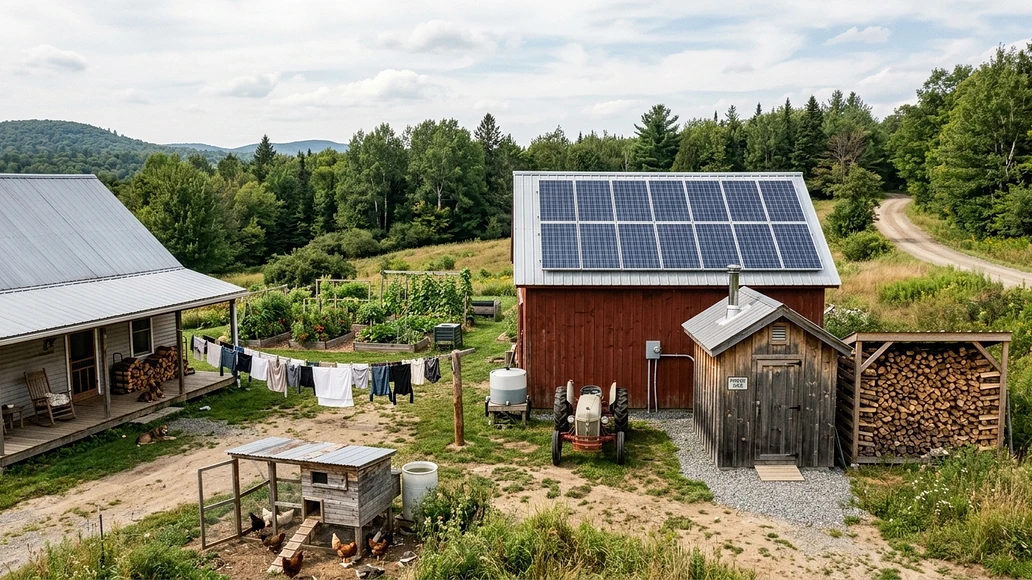
One of the clearest recent trends is the wider use of small scale solar in some Amish communities. Solar can fit Amish values better than a utility connection because the power is generated on site, sized for specific needs, and easier to limit. It may run barn lights, charge batteries, power a pump, or support a workshop function without turning the home into a fully electrified modern house.
For non Amish readers, this is a useful reminder that solar works best when paired with load discipline. A modest system serving a few critical circuits is often more affordable and resilient than trying to duplicate a high consumption suburban lifestyle off grid.
A practical low grid checklist inspired by Amish habits
If you want to borrow the principles without copying the culture, start with a simple sequence.
- List your critical loads, heat, water, refrigeration, lighting, cooking, and communications.
- Reduce demand before buying equipment.
- Decide which needs require electricity and which can be met mechanically, thermally, or manually.
- Add redundancy for the essentials first.
- Choose systems you can maintain safely and legally.
- Test your setup during short planned outages before depending on it.
That approach is less dramatic than a total off grid fantasy, but it is usually more affordable and more durable.
FAQ
Can Amish legally connect to the public electric grid if they want to?
In most places, the issue is not civil law but church discipline and community standards. A household may be legally able to connect, but doing so could conflict with the local Ordnung and bring religious consequences within that district.
Do Amish children grow up completely without electricity or technology?
Usually not completely. Many Amish children grow up around battery lights, farm equipment, generators, propane appliances, and work related technology. What they often grow up without is a fully electrified, entertainment centered home tied to the public grid.
How do Amish keep food cold without a regular refrigerator?
Common methods include propane refrigerators, root cellars, cool basements, ice, and seasonal food preservation. The exact method depends on the household, climate, and local rules.
Do any Amish communities use air conditioning or electric heating?
Some more permissive groups may use limited modern climate equipment, especially in business settings, but many conservative Amish homes avoid standard electric heating and central air. Climate control is one area where practices vary a lot.
Could a non Amish person copy Amish energy rules for their own off grid home?
You can borrow the principles, especially lower demand, layered energy sources, and simpler systems. But a direct copy may not fit your climate, health needs, local code requirements, work demands, or family expectations. For most people, selective adoption is more realistic than full imitation.