Faraday Shielding and Modern Phones, What Actually Stops 5G
5G is not one signal, and a Faraday cage is not just any metal box. Learn when shielding works, why seams and mesh size matter, how Faraday bags perform, and how to test your setup realistically.

If you want the short answer, a properly built Faraday cage can block 5G. The catch is that 5G is not one single signal, and many homemade cages, pouches, and metal containers are only partial shields. In real life, the question is less about whether 5G can magically penetrate a true Faraday cage, and more about whether your seams, lid, mesh, zipper, or cable opening are letting enough radio energy leak through to keep a device connected.
That distinction matters for preparedness, privacy, and security. A phone that cannot place a call might still leak enough signal for Wi-Fi, Bluetooth, GPS-related functions, or intermittent network registration. A key fob pouch that blocks low-frequency RFID may still fail against higher-frequency wireless signals. Good shielding is about attenuation, not wishful thinking.
Bottom line first
An ideal Faraday cage blocks 5G. A practical cage blocks 5G only if it has continuous conductive coverage, tight seams, appropriate mesh or solid metal, and no significant gaps. Higher-frequency 5G, especially mmWave, is often easier to weaken with metal, but it is also more sensitive to tiny leaks around closures and openings.
| Claim or topic | Evidence status | What it means in practice |
|---|---|---|
| A properly designed Faraday cage can block 5G signals | Well supported | Good enclosures and tested bags can reduce signal enough to stop normal communication across sub-6 GHz and even mmWave bands. |
| Mesh size and gap size matter | Well supported | Small holes and tight seams are critical. A tiny leak can dominate performance. |
| Most Faraday bags block every wireless signal equally well | Mixed | Some do very well across wide frequency ranges. Others block phone calls but leak Wi-Fi or higher bands. |
| A quick phone-call test proves a cage is fully effective | Weak | It is a useful first check, but not a certification method. |
| Faraday cages are proven medical protection from 5G | Weak or unsupported | Use shielding for signal control, privacy, and security. For health concerns, rely on licensed medical advice and mainstream public health guidance. |
What a Faraday cage actually does
A Faraday cage is a conductive enclosure that reduces electric fields and radio-frequency energy inside the enclosure. In simple terms, the conductive outer layer reflects and absorbs incoming radio waves, while the enclosure geometry helps keep those fields from reaching the protected device.
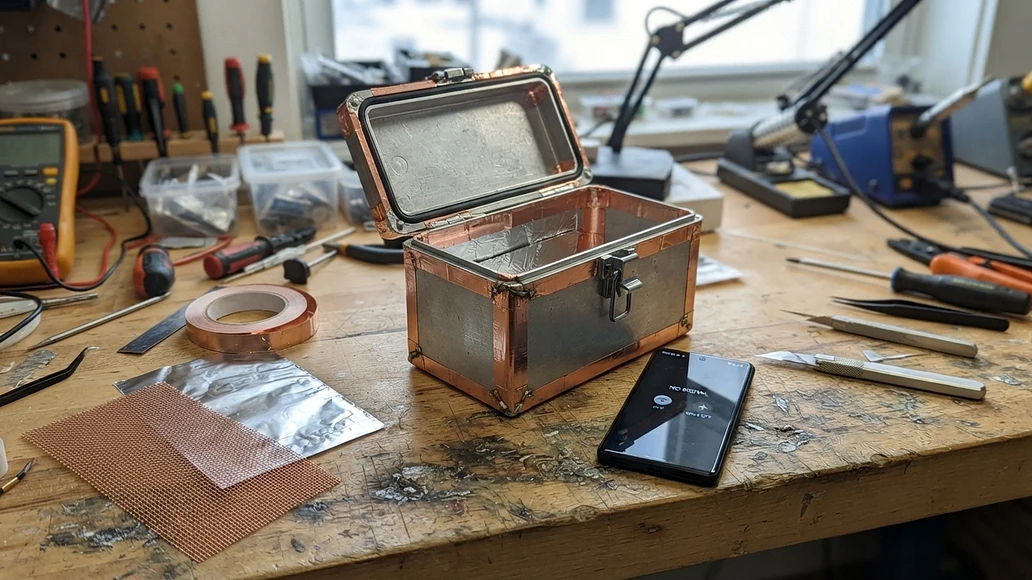
That does not mean every metal object is automatically a high-performance shield. A cookie tin with a loose lid may reduce signal but still leak badly. A metal trash can can work surprisingly well if the lid makes continuous contact all the way around, but poorly if paint, plastic, or uneven contact creates gaps.
For wireless signals, three ideas matter most:
- Conductive coverage, meaning the enclosure surrounds the device with metal or conductive fabric.
- Continuity, meaning seams and closures maintain electrical contact.
- Opening size, meaning holes and gaps stay small relative to the wavelength being blocked.
Why 5G is not one shielding problem
People often talk about 5G as if it were one frequency. It is not. In the US, 5G commonly appears in low-band, mid-band, and mmWave deployments. Each behaves differently around walls, windows, metal, and shielding materials.
| 5G band type | Typical frequency range | Approximate wavelength | Real-world behavior | Shielding takeaway |
|---|---|---|---|---|
| Low-band 5G | About 600 MHz to 1 GHz | About 50 cm to 30 cm | Travels farther and penetrates buildings better | Needs solid coverage and good seam contact. Larger wavelengths can still get through surprisingly large leaks. |
| Mid-band 5G | About 2.5 GHz to 4 GHz | About 12 cm to 7.5 cm | Common balance of speed and coverage | Mesh and seam quality become more important. Many consumer bags are mainly judged here. |
| mmWave 5G | About 24 GHz to 40 GHz | About 12.5 mm to 7.5 mm | High speed, short range, poor building penetration | Metal blocks it readily, but tiny gaps, zipper leaks, and poor closures become critical. |
As frequency rises, wavelength gets shorter. That is why a gap that seems trivial to the eye can become a meaningful leak path at higher frequencies.
Can 5G get through in theory?
In theory, a true Faraday cage with continuous conductive walls and no meaningful openings will block 5G. That includes low-band, mid-band, and mmWave signals. In practice, most failures happen because the enclosure is not truly continuous.
Common reasons a device still connects include:
- A lid that touches only at a few points.
- Paint or coating interrupting metal-to-metal contact.
- Mesh openings that are too large.
- A zipper or flap that does not create a complete conductive seal.
- A charging cable or other wire acting like an antenna path.
- The protected device touching the conductive layer directly in a way that compromises the setup.
So the honest answer is this: 5G does not penetrate a well-designed Faraday cage in any useful sense, but it can leak through a poorly made one.
Mesh size, seams, and attenuation, the details that decide the outcome
A common rule of thumb is that openings should be smaller than half the wavelength of the signal you want to block, and often much smaller for reliable real-world performance. That rule is only a starting point. Seam quality, overlap, material thickness, and closure design can matter more than the base material itself.
Shielding performance is usually described in decibels, or dB, of attenuation. Higher numbers mean less signal gets through.
| Approximate attenuation | What it usually means | Typical use case |
|---|---|---|
| 20 to 40 dB | Noticeable reduction, but not necessarily complete isolation | Basic room shielding, some fabrics, weak-signal reduction |
| 40 to 60 dB | Strong blocking for many everyday signals | Better bags, improved DIY boxes, some paints and meshes |
| 60 to 85+ dB | Serious isolation for practical communications blocking | Quality Faraday bags, tested enclosures, RF shield boxes |
For preparedness and privacy, the goal is usually not laboratory perfection. It is enough attenuation to stop the device from communicating in the environment where you use it. But if you need forensic, legal, or mission-critical isolation, consumer tests are not enough. That is where professional shield boxes and standards-based testing matter.
Why some Faraday bags work and others disappoint
Faraday bags and pouches are convenient because they use conductive fabric layers instead of a rigid metal enclosure. A good one can block cellular, Wi-Fi, Bluetooth, GPS, and key fob signals. A weak one may only block some of those.
The biggest buying mistake is confusing RFID blocking with broad RF shielding. RFID-blocking sleeves are often designed for cards at very short range, not for modern phones operating across multiple cellular and Wi-Fi bands.
| Feature | Better Faraday bag | Weaker Faraday bag |
|---|---|---|
| Published frequency range | Clearly states tested range, often up to 40 GHz | Vague claims like signal blocking or RFID safe |
| Attenuation data | Provides dB figures or test curves | No measured performance listed |
| Closure design | Fold-over, double roll, magnetic or conductive layered closure | Simple zipper or loose flap |
| Construction | Multiple conductive layers, reinforced seams | Thin single layer, weak stitching |
| Use case | Phones, tablets, key fobs, GPS devices | Mostly cards or basic anti-scan use |
If your goal is to stop a smartphone from connecting to 5G, Wi-Fi, Bluetooth, and location services, look for a bag with independent test data, not just marketing language.
Everyday examples that behave like partial Faraday cages
You have probably seen this effect without thinking about it. Elevators, metal utility rooms, and steel-heavy buildings often weaken phone signals. That does not mean they are perfect Faraday cages, but they show the same principle. Conductive structures reflect and absorb radio energy, and small openings determine how much still gets through.
This is also why mmWave 5G struggles indoors. The same short wavelengths that allow high data rates are easily blocked by walls, coated glass, and metal framing. So yes, 5G can be fragile around building materials, but a purpose-built shield still needs good seam control to work reliably.
How to test whether your cage really blocks modern signals
A simple phone-call test is a starting point, not the finish line. Use several tests because different radios operate on different bands and power levels.
| Test method | What it checks | Strengths | Limitations |
|---|---|---|---|
| Phone call or text | Cellular connection | Easy and fast | May miss intermittent leaks or delayed network behavior |
| Wi-Fi 2.4 GHz and 5 GHz | Local wireless radios | Good for checking common household frequencies | Depends on router strength and distance |
| Bluetooth test | Short-range radio leakage | Useful for wearables and accessories | Short range can create false confidence |
| Find My or device locator | Background connectivity | Can reveal subtle leaks missed by a call test | May update with delays |
| GPS or map behavior | Satellite-related reception | Helpful for broader isolation checks | Not all location functions rely only on GPS |
| RF meter or spectrum analyzer | Measured signal reduction | Best way to quantify attenuation | Costs more and requires skill |
A practical home test routine
- Turn off Wi-Fi calling on the phone so a failed cellular test is meaningful.
- Confirm the phone has a strong signal before testing.
- Place the phone in the cage or bag and seal it exactly as intended.
- Try a call and send a text.
- Test Wi-Fi at both 2.4 GHz and 5 GHz if the phone supports both.
- Test Bluetooth by trying to connect to earbuds, a watch, or another nearby device.
- Check whether location or device-finder services still update after several minutes.
- Repeat the test near stronger signal sources, such as close to your router or in an area with strong cellular coverage.
If the setup passes in weak-signal conditions but fails near a strong source, your shielding is marginal.
Common DIY mistakes that let 5G slip through
| Failure point | Typical symptom | Likely cause | Fix |
|---|---|---|---|
| Loose lid | Phone still rings or reconnects intermittently | Poor metal-to-metal contact around the perimeter | Improve contact with conductive gasket, copper tape, or better overlap |
| Painted or coated contact surfaces | Unreliable blocking | Insulating layer interrupts continuity | Expose bare conductive contact points safely |
| Large mesh openings | Higher-frequency leakage | Openings too large for target bands | Use finer mesh or multiple layers with offset openings |
| Single weak zipper or flap | Bag blocks some signals but not all | Closure leak path | Use double-fold closure or a better-tested bag |
| Cable entering the enclosure | Unexpected connectivity or interference | Wire acts as an antenna path | Avoid cables unless using proper filtered feedthroughs |
| Wear, corrosion, or torn fabric | Performance degrades over time | Damaged conductive layer or seam | Retest regularly and replace worn components |
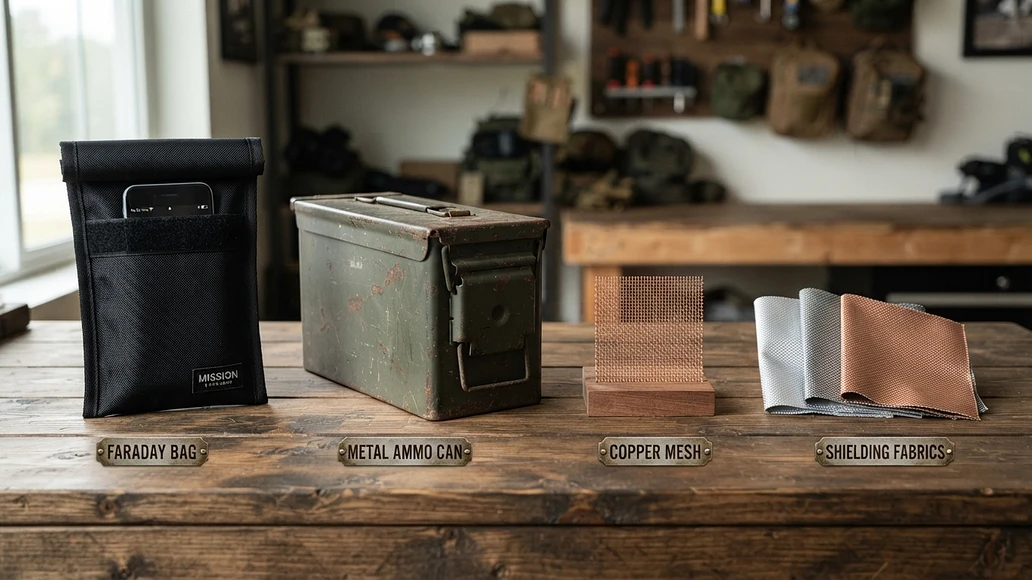
Comparing common shielding options
| Method | Typical performance | Portability | Best use | Main drawback |
|---|---|---|---|---|
| Metal box with tight lid | Can be very good if seams are solid | Low | Home storage for phones, radios, spare electronics | Lid contact is often the weak point |
| Mesh cage | Good if mesh is fine and seams are continuous | Low to medium | Larger enclosures and custom projects | Design errors are easy to make |
| Faraday bag or pouch | Good to excellent depending on quality | High | Travel, key fobs, phones, tablets | Many products are poorly tested |
| Shielding paint | Can reduce RF significantly when properly applied | None | Permanent room treatment | Installation quality and electrical safety matter |
| Conductive fabric canopy | Moderate to strong RF reduction | Medium | Specialized room or bed-area shielding | Not a substitute for medical advice, and sealing details matter |
Preparedness and privacy uses that make sense
Faraday protection has legitimate practical uses. It can help isolate a phone from tracking, network contact, or remote commands. It can protect key fobs from relay attacks. It can reduce interference during testing or storage of certain electronics. For preppers, it can be part of a broader communications and privacy plan.
It is not magic. A bag or cage does not replace backups, offline maps, spare power, written contact lists, or a realistic emergency communications plan. If you isolate your phone, you also lose incoming alerts, calls, and navigation updates. That tradeoff should be intentional.
Health claims, where caution matters
Some readers come to this topic because they are worried about EMF exposure or 5G health effects. It is reasonable to want balanced information. But a Faraday cage or canopy should not be presented as a medically necessary solution, and it should not replace care from a licensed healthcare professional.
Mainstream public health guidance does not recommend consumer Faraday cages as routine medical protection. If shielding helps you feel more in control, treat it as a comfort or privacy measure, not a substitute for prenatal care, treatment plans, or professional evaluation of symptoms such as headaches, sleep problems, or anxiety.
If worry about EMF becomes severe or intrusive, it is wise to discuss that with a qualified healthcare provider. For permanent home shielding that involves wiring, grounding, or conductive paints near electrical systems, consult a qualified electrician or RF professional and follow local codes.
Do Faraday cages need grounding to block 5G?
For blocking radio-frequency signals like 5G, grounding is not usually required for a small enclosure or bag to work. What matters more is conductive continuity and the absence of gaps. Grounding can matter in other contexts, such as static control, lightning protection, or certain permanent installations, but it is not the magic ingredient that turns a leaky box into a proper RF shield.
How often should you re-test?
Re-test after any modification, after heavy use, and periodically if the item is part of your regular kit. Conductive fabrics wear. Seams loosen. Closures crease. Corrosion appears. New phones may also use different band combinations than your old test device.
A good habit is to test every few months, and again before relying on the item for travel, privacy, or emergency storage.
FAQ
Does a microwave oven work as a Faraday cage for 5G phones?
Sometimes partially, but it is not a reliable or recommended test enclosure. Microwave ovens are designed to contain energy around their operating frequency, and door seals vary. Do not run the microwave with a phone inside. If you use an unplugged microwave only as a rough experiment, treat the result as informal and not proof of full-spectrum shielding.
Can 5G still track my phone if it is in a Faraday bag?
If the bag is effective and fully sealed, the phone should not be able to communicate with the cellular network, Wi-Fi, Bluetooth, or related services. But if the bag leaks, tracking or network contact may still occur intermittently. That is why testing matters.
What attenuation level is enough to stop 5G communication?
There is no single number that guarantees success in every environment, because tower strength, device sensitivity, and frequency band all vary. In general, higher attenuation is better, and many serious products aim for roughly 60 dB or more across relevant bands. For critical use, look for published test data across the frequencies you care about.
Is a solid metal box always better than mesh?
Not always, but solid metal often gives you an easier path to good shielding if the lid seals well. Fine mesh can work very well too. The deciding factor is usually not solid versus mesh by itself, but whether the enclosure maintains continuous conductive coverage with minimal leaks.
References
- Metal Enclosure Improvement
- Faraday Cage Buying Guide: How to Choose Effective RF ...
- How To Choose The Best Faraday Bag: A Complete Buying Guide
- RF Attenuation Charts Explained: What Faraday Bag Ratings ...
- Cage de Faraday : guide complet pour comprendre, fabriquer ...
- What Is a Faraday Bag? · The Definitive 2026 Guide | REVIS-1 Learn
- Faraday Pouches: How Signal-Blocking Bags Work and When...
- What is a Faraday Cage? Complete Guide - Shield Your Body