Microwave Shielding Explained, What It Blocks, What It Doesn’t, and Safer Prepper Options
A microwave oven does use Faraday cage principles, but that does not make it a reliable EMP vault. Here is the practical answer, plus safety limits, signal-blocking reality, and better home shielding choices.

A microwave oven is Faraday-like, but that short answer needs an important qualifier. It is engineered to keep 2.45 GHz microwave energy inside the cooking cavity during normal use. That does not automatically mean it is a dependable shield for EMP, solar storm effects, or broad-spectrum radio threats. For everyday kitchen safety, a working microwave is designed to leak only very small amounts of energy, well below regulatory limits. For preparedness, though, it is better to think of a microwave as a specialized appliance, not a purpose-built electronics shelter.
If you want the practical takeaway first, here it is. A microwave can sometimes block signals from a phone, Wi-Fi device, or key fob when it is off, but results vary by model and condition. It should not be your only plan for protecting radios, backup drives, or emergency electronics from a serious electromagnetic event.
What a Faraday cage actually is
A Faraday cage is a conductive enclosure that reduces the electric fields and radio-frequency energy reaching what is inside it. In plain English, the metal shell redirects or absorbs incoming electromagnetic energy so less of it gets through to the contents.
Whether a cage works well depends on several details, not just whether it is made of metal. The most important factors are continuity, seams, openings, and the frequencies involved. A box with gaps, poor contact at the lid, or attached wires can perform very differently from a sealed enclosure designed for shielding.
| Faraday cage requirement | Why it matters | What weakens performance |
|---|---|---|
| Continuous conductive shell | Creates the main barrier that redirects electromagnetic energy | Cracks, rust, loose joints, thin contact points |
| Small openings relative to wavelength | Prevents energy from slipping through holes and slots | Large vents, wide seams, damaged mesh |
| Good electrical contact at seams | Keeps the enclosure acting like one connected shield | Paint, dirt, bent lids, worn latches |
| Isolation of contents from metal walls | Helps protect devices from induced currents and contact transfer | Electronics touching bare metal directly |
| Minimal conductive paths in or out | Reduces the chance that wires carry energy inside | Power cords, antennas, charging cables |
How a microwave oven contains radiation
A household microwave oven uses a magnetron to generate radio-frequency energy at about 2.45 GHz. That energy bounces around inside the metal cooking cavity and heats food by exciting water molecules and other polar molecules.
The oven body is metal, and the door includes a metal mesh behind the glass. That mesh is the part most people notice first. The holes are small enough relative to the wavelength of 2.45 GHz microwaves that the energy is largely reflected or attenuated, while visible light still passes through so you can see your food.
There are also design features around the door frame and choke areas that help limit leakage. In a properly functioning oven, these parts work together so the appliance can cook food without significant microwave escape.
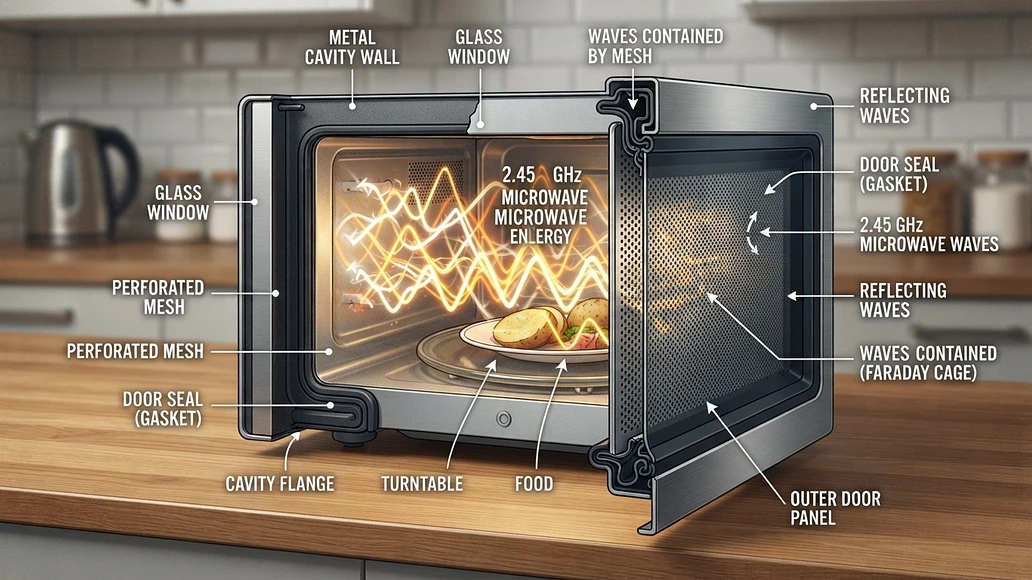
So, is a microwave oven technically a Faraday cage?
Yes, in a limited and practical sense. A microwave oven uses Faraday cage principles to confine the specific radio-frequency energy it generates. That is why many science teachers and engineers casually describe it as a Faraday cage.
No, if you mean a broad, verified, all-purpose shielding enclosure. A true shielding enclosure for sensitive electronics is judged by how well it performs across specific frequencies and conditions. A kitchen microwave is not sold or tested as an EMP-safe storage vault. It has seams, a latch system, a viewing window mesh, and a power cord, all of which matter when you move beyond its intended job.
The best way to phrase it is this. A microwave is a frequency-specific shielding enclosure, not a universal electromagnetic shield.
Why the door mesh works for microwaves but not for every threat
This is where wavelength matters. The wavelength of 2.45 GHz microwave energy is roughly 12.2 centimeters, or about 4.8 inches. The holes in the door mesh are much smaller than that, so the mesh behaves like a barrier to that energy while still allowing visible light, which has a far shorter wavelength, to pass through.
That does not mean the same mesh will perform equally well against every other frequency or pulse shape. Shielding is not a simple yes-or-no property. It changes with frequency, field strength, geometry, and the quality of the enclosure.
| Signal or field type | Typical frequency behavior | How a microwave oven is designed to respond | Practical takeaway |
|---|---|---|---|
| Cooking microwaves | Centered around 2.45 GHz | Specifically engineered to contain this energy | Strong everyday containment when the oven is in good condition |
| Cell phone and Wi-Fi signals | Varies by band and device | May block some or most signals, but not consistently across all models | Useful only as an informal, short-term signal blocker |
| Car key fob signals | Lower-power radio transmissions | Often blocked when the oven is off and closed | Can work in a pinch, but not a guaranteed anti-theft solution |
| EMP or broadband pulse | Wide frequency content and intense transient energy | Not designed or certified for this threat | Do not rely on a microwave as sole protection |
| Geomagnetic storm effects | Mainly affects long conductors and grid infrastructure | Not relevant in the same way as cooking-frequency containment | Grid preparedness matters more than storing gear in a microwave |
Microwave shielding versus EMP and solar storms
Preparedness discussions often blur together EMP, CME, hacking, and ordinary radio blocking. They are not the same problem.
An EMP is a fast, intense electromagnetic pulse with broad frequency content. A coronal mass ejection, or CME, is a solar event that can induce damaging currents in long conductors such as power lines and other infrastructure. A microwave oven was not built to address either threat in a validated way.
Why not? First, the shielding goal is different. The oven is meant to keep its own 2.45 GHz energy inside during operation. Second, the weak points are different. The door seam, latch area, and power cord can all reduce performance as a protective enclosure for outside threats. Third, there is no consumer standard telling you, in plain terms, how many decibels of shielding your specific microwave provides across the frequencies that matter in an EMP scenario.
That is why many preparedness experts treat the microwave idea as an interesting improvised measure, not a robust plan.
Can you use a microwave to block phone, Wi-Fi, or key fob signals?
Sometimes, yes. Many people have found that an unplugged, off microwave can reduce or stop signals from phones, Bluetooth devices, Wi-Fi gadgets, and car key fobs. But the results are inconsistent. One oven may block a signal completely, while another leaks enough for the device to remain reachable.
Several factors affect the outcome. Newer phones may switch among multiple bands. Some ovens have tighter door tolerances than others. Damage, wear, dirt on the seal area, and manufacturing differences all matter.
There is also an important safety rule here. Do not turn the microwave on with electronics, batteries, foil, or random metal objects inside unless the manufacturer specifically allows it. Running a microwave empty or with unsuitable contents can damage the oven, cause arcing, and create a fire risk.
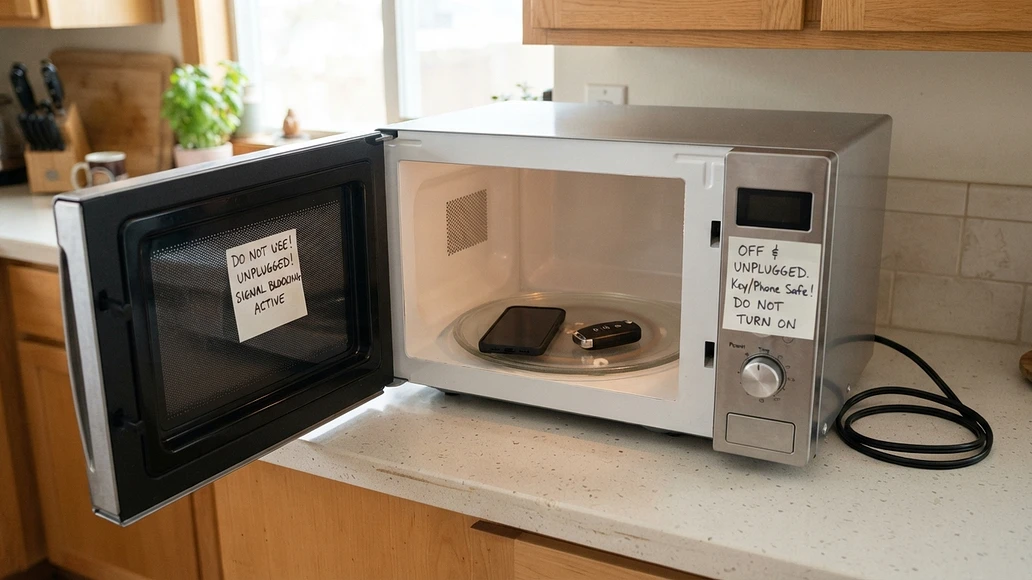
Short-term signal blocking, not long-term protection
If your goal is temporary privacy, a quick classroom demonstration, or testing whether a key fob signal can be blocked, an unplugged microwave may be reasonable as a quick check. If your goal is long-term storage of emergency electronics, anti-theft storage, or serious preparedness, a purpose-built Faraday bag or properly built metal container is the better choice.
How safe microwave ovens are in everyday use
For normal cooking, the evidence is reassuring. Properly functioning microwave ovens leak very little energy, and regulators set strict limits for allowable leakage. Real-world exposure also drops quickly with distance, so standing a few feet away reduces already low exposure even further.
Microwave radiation is non-ionizing. That means it does not have enough energy to break chemical bonds in DNA the way ionizing radiation can. It does not make food radioactive. Mainstream health guidance continues to support microwave use when the appliance is in good condition and used as directed.
| Everyday scenario | Exposure picture | Practical guidance | Risk note |
|---|---|---|---|
| Standing pressed against the door while it runs | Still expected to be below legal leakage limits if the oven is working properly | Avoid leaning on the oven during operation | Unnecessary exposure and poor habit, even though levels are low |
| Standing about 2 feet away | Lower than at the surface because intensity drops with distance | Reasonable everyday use position | Comfortable margin for routine cooking |
| Standing 3 or more feet away | Lower still | Good choice if you are cautious or supervising children | Further reduces already low exposure |
| Using a damaged or poorly closing oven | Leakage risk may increase | Stop using it until repaired or replaced | Door seals and latches matter |
Common myths that confuse this topic
| Myth | Reality |
|---|---|
| A microwave is a perfect Faraday cage for anything electromagnetic | It is designed for containing its own cooking frequency, not as a verified all-threat shield |
| If a phone loses signal in a microwave, the oven is EMP-proof | Blocking a consumer radio signal is not the same as surviving a high-intensity broadband pulse |
| Microwaved food becomes radioactive | Microwave energy is non-ionizing and does not make food or containers radioactive |
| Microwave ovens cause cancer when used normally | Mainstream health guidance supports normal use of properly functioning ovens |
| Any metal box works the same as a purpose-built Faraday container | Seams, insulation, contact quality, and frequency range make a major difference |
Better preparedness options than using your microwave
If you want to protect small electronics, the better route is to use a container designed or adapted for shielding. The key principles are simple. Use a conductive enclosure, make sure the lid or closure has good contact, keep devices insulated from the metal walls, and avoid unnecessary wires entering the container.
| Option | Best use case | Advantages | Limitations |
|---|---|---|---|
| Purpose-built Faraday bag | Phones, radios, drives, spare key fobs | Portable, simple, designed for signal blocking | Quality varies by brand, needs periodic testing |
| Metal trash can with tight lid and insulated contents | Larger home backup electronics | Affordable, roomy, popular DIY choice | Needs careful lid contact and interior insulation |
| Ammo can modified for shielding | Compact storage for radios and batteries | Durable, easy to store | Rubber seals may need modification depending on design goals |
| Foil-wrapped insulated box | Low-cost temporary setup | Cheap and flexible | Easy to build poorly, easy to tear or compromise |
| Kitchen microwave oven | Short-term signal blocking in a pinch | Already in many homes, convenient | Not purpose-built, not validated for EMP, not ideal for storage |
For mission-critical gear, redundancy matters more than clever improvisation. A spare radio in a tested Faraday bag, plus backup batteries and a second communication method, is a stronger plan than trusting one appliance in the kitchen.
How to check whether your microwave is still shielding properly
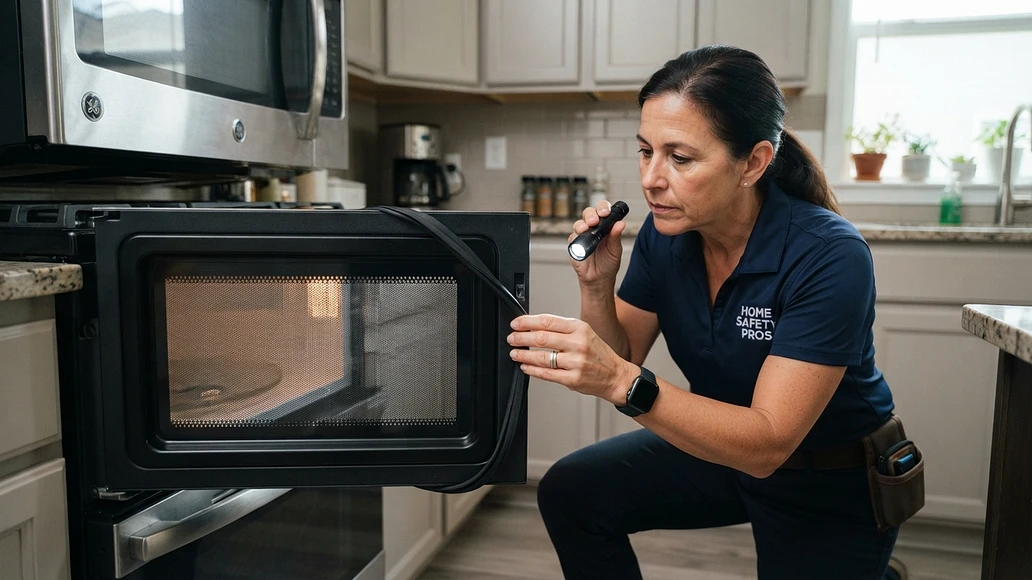
Start with a visual inspection. Look at the door seal area, hinges, latch, and mesh window. If the door is bent, does not close squarely, or the oven has visible damage, stop using it. Dirt and food buildup around the sealing surfaces can also interfere with proper closure, so keep those areas clean according to the manufacturer instructions.
Watch for warning signs such as sparking, a burning smell, unusual noises, or a door that feels loose. Those are appliance safety issues first, not just shielding issues.
Professional leakage testing uses proper instruments and procedures. Homemade phone tests can tell you only whether some signals get through, not whether the oven meets leakage standards. If you suspect a problem, replacement is often the most practical answer for a consumer appliance.
Microwave safety basics for home use
The biggest everyday microwave hazards are usually not radiation. They are burns, superheated liquids, steam, and unsuitable containers. Use microwave-safe containers, follow heating times, stir foods that heat unevenly, and let hot liquids stand before handling. Keep children back from the door while the oven is running and while hot food is being removed.
If you are pregnant or simply cautious about EMF exposure, current evidence does not show harm from normal microwave use. Still, standing a few feet away while it runs is an easy personal comfort measure and reduces exposure further.
When using a microwave as a makeshift RF shield makes sense
There are a few narrow cases where using an unplugged microwave as a temporary shield is reasonable. You might use it to see whether a key fob signal can be blocked, to demonstrate shielding concepts to students, or to create a short-term no-signal spot for a phone during a test.
It does not make sense as your primary plan for EMP storage, long-term electronics protection, or anything safety-critical. It also does not make sense if the oven is damaged, still plugged in where someone could accidentally start it, or being used as a substitute for proper anti-theft or cybersecurity practices.
Preparing for grid threats without risky shortcuts
Balanced preparedness works better than fear-driven gear hacks. If you are concerned about grid outages, solar storms, or communication disruptions, focus first on the basics. Have lighting, water, backup power, printed contacts, battery management, and a communication plan. Then protect a few essential electronics with tested, purpose-built shielding products or a carefully built enclosure.
That approach solves the real problem more directly than relying on a kitchen appliance that was never designed to be your emergency vault.
FAQ
Can I store my emergency electronics in a microwave to protect them from EMP?
You can place them there temporarily, but it is not a dependable EMP strategy. A microwave is not designed or certified for broad-spectrum pulse protection. Use a purpose-built Faraday bag or a properly constructed shielded container instead.
Is it safe to put my phone in a microwave if I do not turn it on?
Generally, placing a phone in an off microwave for a brief signal-blocking test is not the same as operating the oven. The critical rule is to make sure nobody can accidentally start it. Unplugging the microwave first is the safest approach.
How can I tell if my microwave is leaking radiation?
Check for obvious door damage, poor closure, bent hinges, or a worn latch area. Informal signal tests are not reliable leakage tests. If the oven is damaged or you are concerned, stop using it and replace it or have it evaluated professionally.
Do microwaves make food or containers radioactive?
No. Microwave ovens use non-ionizing radiation, which heats food but does not make it radioactive.
Are there simple ways to build a better Faraday cage at home than using a microwave?
Yes. A metal trash can with a tight-fitting lid and insulated contents, a well-made ammo can setup, or a quality Faraday bag are all better choices for preparedness than a microwave oven.